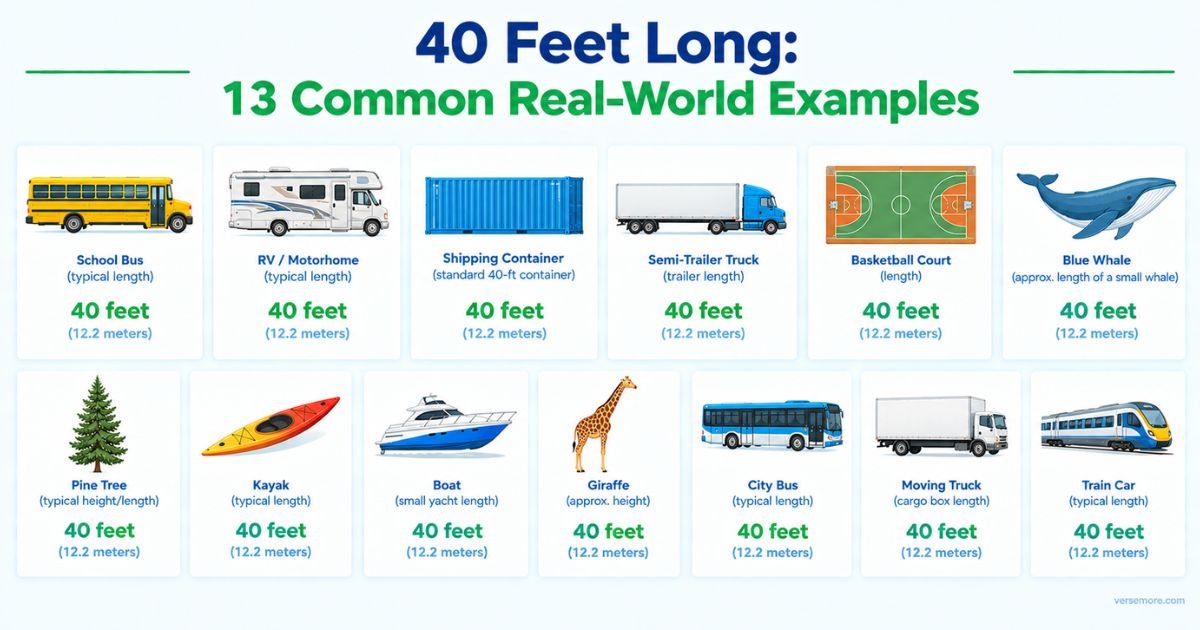
Trying to picture 40 feet long can be surprisingly difficult. Forty feet is long enough to stretch across a sizable room or driveway, yet it is still a familiar dimension in transportation, shipping, recreation, and construction.
The exact measurement is 40 feet = 480 inches = 13⅓ yards = 12.192 meters. The conversion uses the international foot, which is exactly 0.3048 meter.
A number like 12.192 meters is precise, but everyday objects make the scale much easier to imagine. Below, we use real-world examples—including a standard 40-foot shipping container, a 40-foot motorcoach, large RVs, boats, trees, and other familiar references—to make the distance more tangible.
How Long Is 40 Feet?
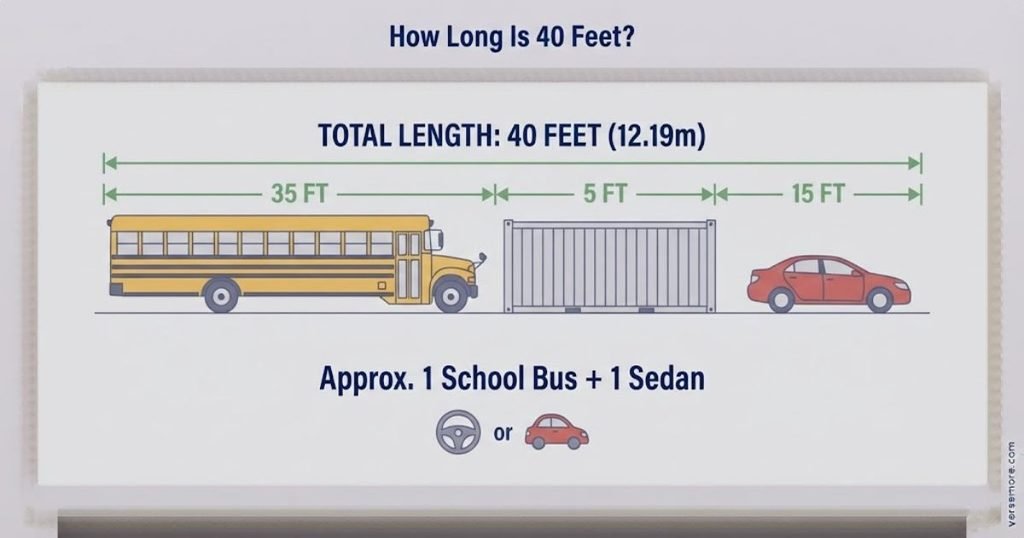
40 feet is exactly 12.192 meters, or about 39 feet 4.8 inches in metric-to-imperial reverse terms. It is also 480 inches and 13⅓ yards.
For everyday comparisons, it helps to think of 40 feet as a horizontal distance rather than just a number. You could walk the length of a 40-foot space in roughly 12–15 normal adult steps, depending on your stride.
| Measurement | Equivalent |
| Feet | 40 ft |
| Inches | 480 in |
| Yards | 13⅓ yd |
| Meters | 12.192 m |
| Centimeters | 1,219.2 cm |
| Kilometers | 0.012192 km |
| Miles | 0.007576 mi |
Conversions use the international foot: 1 ft = 0.3048 m exactly. Values other than 40 feet are rounded where appropriate.
A useful way to visualize 40 feet
Imagine laying a measuring tape across the ground and extending it to the 40-foot mark. You would have covered more than the length of a typical large room and roughly the same scale as several large recreational or commercial vehicles.
One especially useful reference is a standard 40-foot shipping container. Its nominal exterior length is exactly 40 feet, although the usable interior length is shorter because the container walls and end structure take up space.
That distinction matters: when someone says an object is “40 feet long,” they may be describing its overall exterior length, not 40 feet of usable interior space.
40 Feet Long at a Glance
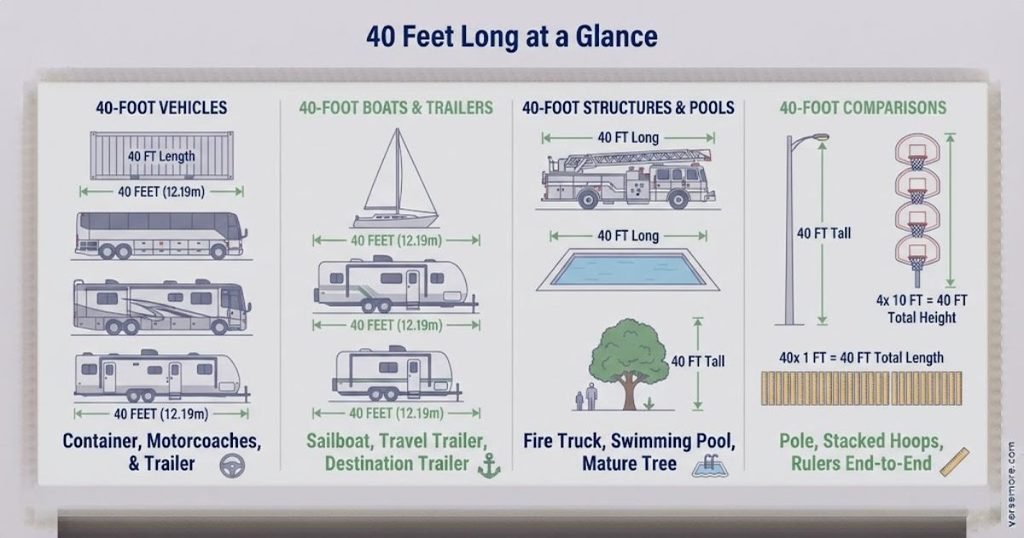
| Example | Approximate length/height | How it compares with 40 ft |
| Standard 40-foot shipping container | 40 ft externally | Exact nominal match |
| Prevost XL-40 motorcoach | 40 ft | Exact manufacturer-listed match |
| Large travel trailer | Around 39–40+ ft | Very close |
| Large mature tree | Around 40 ft | Possible height |
| 40-foot-class sailboat | Around 40 ft | Very close |
| Large RV/motorhome | Around 40 ft | Very close |
| Large residential swimming pool | Around 40 ft | Common custom size |
| Long recreational/ toy-hauler trailer | Around 40 ft | Very close |
| 40-foot-class utility/light pole | Around 40 ft | Height reference |
| Medium-to-large shade tree | 25–40+ ft | 40 ft can represent mature height |
| Large coach bus | Around 40 ft | Common full-size scale |
| 4 basketball hoop heights | 40 ft total | Exact mathematical comparison |
| 40 one-foot rulers end to end | 40 ft | Exact |
1. A Standard 40-Foot Shipping Container
A 40-foot shipping container is probably one of the clearest real-world examples because its nominal length is built directly into its name. A standard dry container has an external length of 40 feet (12.192 meters). Its external width is about 8 feet, while its external height is commonly about 8 feet 6 inches for the standard version. The interior is shorter because of the container’s construction. This makes a shipping container particularly useful for visualizing 40 feet: if you have seen one sitting at a port, warehouse, construction site, or freight yard, you have probably encountered something almost exactly this long. A 40-foot High Cube container is still 40 feet long; the major difference is its greater height.
2. A Prevost XL-40 Motorcoach
A modern Prevost XL-40 motorcoach provides another unusually precise comparison. Prevost’s technical specifications list the XL-40 at an overall length of 40.0 feet (12,192 mm). That means you could stand at the front bumper and imagine a straight line extending 40 feet to the rear of the coach. The comparison is also useful because a 40-foot coach demonstrates how much physical space 40 feet can occupy while remaining a single vehicle.
3. A Large Travel Trailer
Large travel trailers can approach the 40-foot mark, although their exact dimensions vary by model. For example, Forest River’s 2026 Surveyor Camp Series 34CAMP has an exterior length of 38 feet 10 inches, only 14 inches shorter than 40 feet. This is a useful comparison because a trailer of this size occupies a surprisingly long footprint. When parked, its length can extend across much of a driveway or campsite.
4. A Large Sailboat
A 40-foot-class sailboat is another memorable way to picture the measurement. There are numerous production and cruising sailboats around this size. A sailboat can therefore provide a good near-40-foot comparison, rather than an exact universal example. The key point is that a “40-foot sailboat” generally refers to the boat’s length overall or a closely related specification, not the height of its mast.
5. A 40-Foot-Class Destination Trailer
Large destination trailers provide another practical way to understand the scale of 40 feet. These are designed more like temporary or semi-permanent vacation homes than compact towable campers. For example, the 2026 Jayco Jay Flight Bungalow 40RLTS has an overall exterior length of 40 feet 4 inches. Another 2026 Bungalow floorplan, the 40DLFT, reaches 41 feet 6 inches overall. These trailers are therefore close to, but not necessarily exactly, 40 feet.
6. A Large Aerial Fire Truck
Some specialized fire trucks are surprisingly close to 40 feet long. Pierce Manufacturing lists a heavy-duty aerial apparatus in configurations around the 40-foot mark, including one listed at 40 feet 0.5 inches overall. That is only half an inch longer than the target measurement. Do not confuse the vehicle’s length with the aerial ladder’s reach: the ladder can extend far beyond the truck’s physical length.
7. A 40-Foot Swimming Pool
A swimming pool can provide a very intuitive 40-foot distance comparison because 40-foot rectangular pools are a documented design dimension. A 40-foot-long pool gives you a clear end-to-end visualization: stand at one end and look directly toward the opposite end. This comparison is particularly useful for homeowners because a 40-foot pool is long enough to create a substantial swimming area while remaining far shorter than an Olympic-size pool.
8. A Mature Tree About 40 Feet Tall
Forty feet does not have to be a horizontal measurement. A tree can help you visualize the same distance vertically. Tree height varies enormously by species, age, soil, climate, and growing conditions, so there is no single tree that is universally 40 feet tall. However, trees in the 40-foot range are entirely realistic. Picture a tree standing about 40 feet from its base to its uppermost point. Now imagine tipping that tree over horizontally: its length would occupy roughly the same 40-foot span.
9. A 40-Foot Utility or Light Pole
A tall utility or lighting structure can also give you a vertical reference for 40 feet. Poles come in many lengths depending on their purpose and installation requirements, so this is an approximate comparison rather than a universal specification. A pole around 40 feet high would extend roughly four times the height of a 10-foot room, making it a useful mental model for understanding how high 40 feet is.
10. A Full-Size Motorhome
A large Class A motorhome can occupy about 40 feet of road space. Many luxury and diesel-pusher motorhomes are built in the 40-foot class, although their exact overall lengths vary by floorplan and manufacturer. Imagine standing at the front of a large motorhome and walking toward the rear: you would cover approximately the same 40-foot span as the length of a standard 40-foot container.
11. Four Basketball Hoops Stacked in Height
A regulation basketball rim is 10 feet above the playing floor. Four 10-foot rim heights placed one above another would therefore equal exactly 40 feet. This does not mean four basketball hoops are physically stacked together; it is simply a convenient mathematical visualization: 10 ft + 10 ft + 10 ft + 10 ft = 40 ft.
12. Forty One-Foot Rulers End to End
For an exact and uncomplicated comparison, imagine placing 40 one-foot rulers end to end without gaps. Each ruler contributes exactly 1 foot, so 40 × 1 foot = 40 feet. This example provides an exact physical model that can be useful when estimating a space, even though a tape measure would be much faster.
13. A Long Recreational Trailer Around 40 Feet
The recreational-vehicle industry includes fifth wheels, destination trailers, toy haulers, and other large towable units that can approach or exceed 40 feet in overall exterior length. Their exact dimensions depend on the manufacturer and floorplan, so this is best treated as a 40-foot-class comparison. A trailer of this size gives you a useful sense of scale because its entire footprint can extend across a substantial driveway, campground site, or storage area. When checking whether one will fit somewhere, allow for the tow vehicle, turning radius, slide-outs, rear equipment, and clearance.
What Does 40 Feet Look Like in Everyday Space?
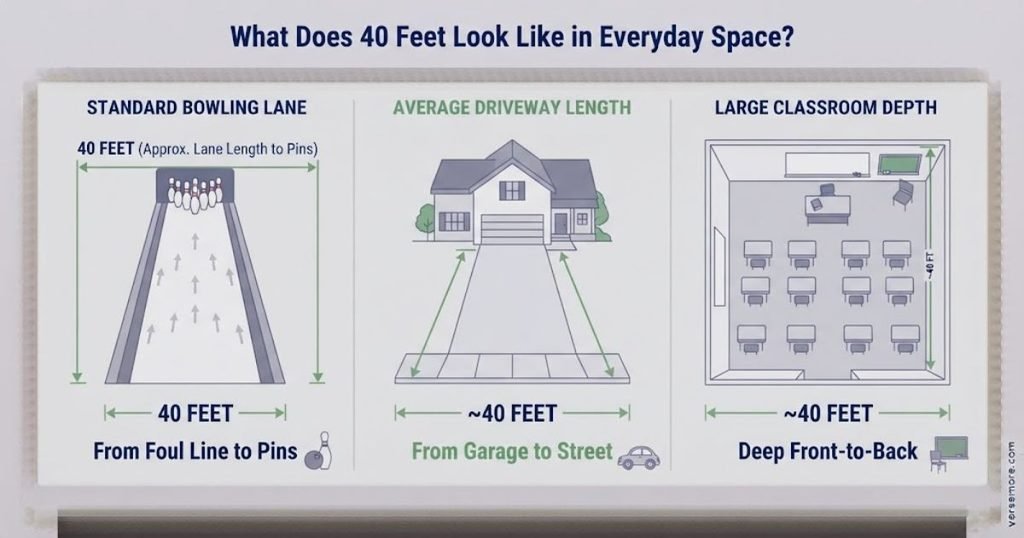
The easiest way to judge 40 feet depends on what you are comparing it with. A horizontal object such as a container or trailer shows the length, while a tree or pole shows the height.
· 40 feet = 480 inches
· 40 feet = 13⅓ yards
· 40 feet = 12.192 meters
· 40 feet = four 10-foot sections
· 40 feet = eight 5-foot sections
· 40 feet = 480 one-inch units
· A 40-foot line is slightly longer than 12 meters
A useful trick is to divide the distance into manageable pieces. Instead of trying to imagine one continuous 40-foot line, picture four 10-foot sections placed end to end. Most people have a much better intuitive sense of 10 feet than 40 feet.
For a physical location, you can also mark 10-foot intervals with a tape measure or measuring wheel. Four such intervals give you the full 40-foot distance without relying on visual estimation.
A Simple 40-Foot Visualization Method
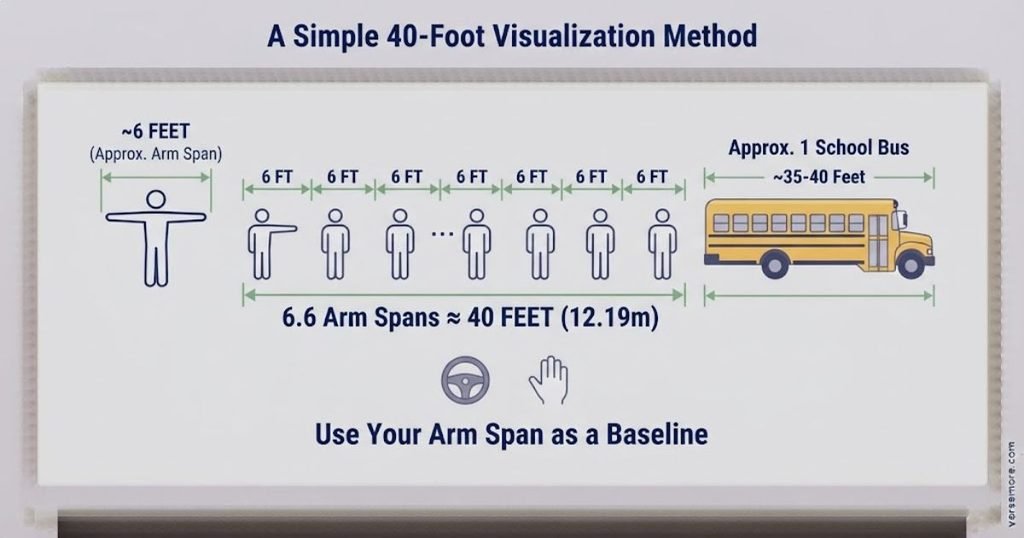
If you need to estimate 40 feet without a measuring tool, breaking the distance into smaller sections is more reliable than trying to judge the entire span at once.
Think of 40 feet as:
· 4 × 10 feet
· 8 × 5 feet
· 2 × 20 feet
For example, if you know approximately how long 10 feet looks in your driveway, imagine that distance four times in a straight line. This will generally give you a better mental estimate than trying to guess the appearance of a 40-foot distance from scratch.
For anything where accuracy matters—construction, vehicle clearance, property measurements, shipping, or installation—use a tape measure, measuring wheel, laser distance meter, or another appropriate measuring instrument rather than relying on visual estimation.
FAQ’s
How many meters is 40 feet?
40 feet is exactly 12.192 meters. For everyday use, it is reasonable to round this to about 12.2 meters.
How many inches are in 40 feet?
There are 480 inches in 40 feet because one foot contains 12 inches and 40 × 12 = 480.
Is 40 feet the same as 12 meters?
No. 40 feet is 12.192 meters, so it is 0.192 meter, or 19.2 centimeters, longer than 12 meters.
What is exactly 40 feet long?
A standard 40-foot shipping container has a nominal exterior length of 40 feet. Certain commercial vehicles are also manufactured at or extremely close to a 40-foot overall length.
How far is 40 feet when walking?
The number of steps depends on your stride length. As a rough visualization, an adult may cover 40 feet in around a dozen to 15 ordinary walking steps, but this should not be used as a precise measurement.
Is a 40-foot container actually 40 feet inside?
No. A standard 40-foot container’s external length is 40 feet, while its interior length is shorter because the walls, doors, and structural components occupy some of that space. Exact interior dimensions vary by container specification.
How long is 40 feet compared with a shipping container?
A standard 40-foot shipping container provides an almost exact comparison because its nominal external length is 40 feet. It is one of the most straightforward real-world objects to use when visualizing the measurement.
How long is 40 feet in yards?
40 feet equals 13⅓ yards because one yard contains three feet. In other words, 13 full yards would be 39 feet, leaving another 1 foot.
How can I measure 40 feet accurately?
The simplest method is to use a measuring tape or measuring wheel and mark the 40-foot point. For longer distances or situations where a straight tape is inconvenient, a laser distance meter or surveying equipment may be more practical.
Conclusion
40 feet long is a substantial distance: exactly 480 inches, 13⅓ yards, or 12.192 meters. The number becomes much easier to picture when it is attached to something physical.
A standard 40-foot shipping container and a 40-foot-class motorcoach provide especially strong references because their overall dimensions can closely match the target. Large trailers, recreational vehicles, pools, boats, specialized fire apparatus, trees, and other structures offer additional ways to understand the scale.
For an exact measurement, however, an everyday comparison should only be a visualization tool. When fitting a vehicle into a space, planning construction, checking clearance, or measuring property, use an actual measuring instrument rather than relying on an object’s advertised or estimated size.
That combination—12.192 meters on paper and a real-world 40-foot reference in your surroundings—is usually the easiest way to understand just how long 40 feet really is.

I am the admin of VerseMore, sharing helpful, informative, and engaging content on various topics to inspire readers, provide value, and make everyday life easier.