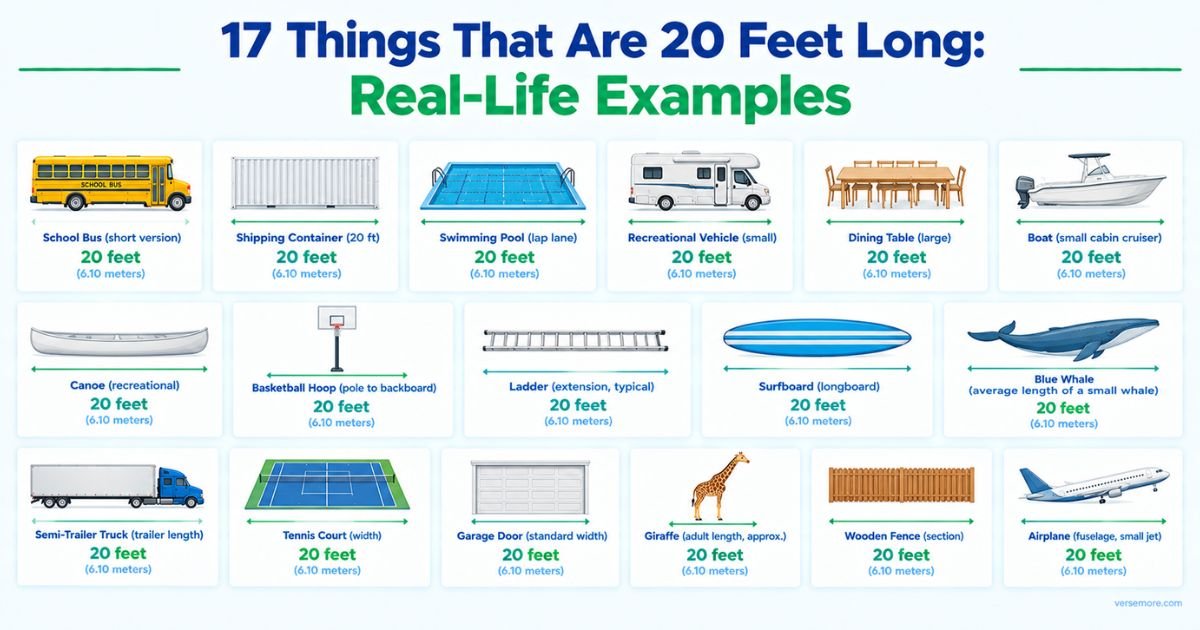
Twenty feet can be difficult to picture when you only see the number on a page. It is long enough to span a substantial part of a room or driveway, yet it is not always easy to estimate by eye. Comparing the distance with familiar objects makes the measurement more practical.
In this guide, you will find 17 everyday objects and spaces that can help you visualize 20 feet. Keep in mind that many examples are approximate: vehicle models, product designs, and building layouts vary. Whenever an exact fit matters, check the specific item’s published dimensions or measure it directly.
How Long Is 20 Feet?
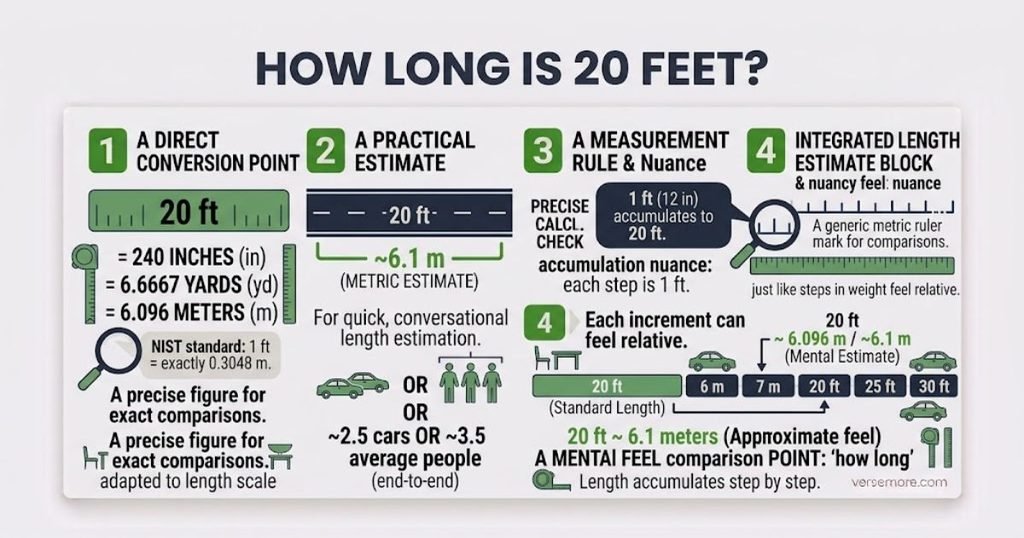
Twenty feet is equal to 240 inches, 6.6667 yards, or 6.096 meters. In everyday conversation, you can think of it as approximately 6.1 meters. The exact conversion is useful when comparing dimensions listed in different measurement systems.
20 Feet in Inches, Yards, and Metric Units
| Unit | Equivalent |
| Feet | 20 ft |
| Inches | 240 in |
| Yards | 6.6667 yd (approximately) |
| Meters | 6.096 m |
| Centimeters | 609.6 cm |
| Millimeters | 6,096 mm |
A Quick Reference Table for 20 Feet
A simple way to remember the conversion is that one foot contains 12 inches, so 20 feet contains 20 × 12 = 240 inches. For metric use, multiply 20 feet by 0.3048 to get 6.096 meters.
17 Common Things That Are 20 Feet Long
1. A Standard 20-Foot Shipping Container
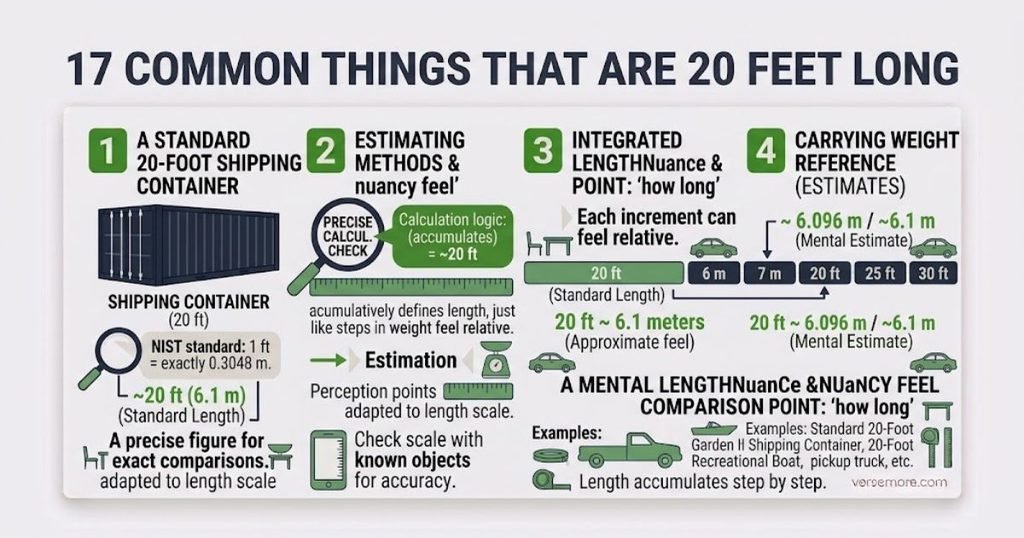
A standard 20-foot shipping container is one of the clearest examples because its name is based on a nominal external length of 20 feet. Its internal usable length is shorter because of the walls and construction. If you are planning storage or delivery access, consult the manufacturer’s external and internal dimensions rather than relying on the label alone.
2. A 20-Foot Garden Hose
A garden hose sold in a 20-foot length provides a direct comparison. When laid out straight, it spans 20 feet, although bends and coils make it occupy less straight-line distance. Check the product label if you need a specific length for a garden, patio, or outdoor project.
3. A 20-Foot Extension Ladder
Some extension ladders are sold in a 20-foot size, making them a useful reference for the length of a long ladder. However, the advertised size, the length of the rails, the ladder’s working height, and the safe reach from the ground are not necessarily the same. Follow the manufacturer’s specifications and safety instructions.
4. A 20-Foot Recreational Boat
A recreational boat with an overall length of about 20 feet can help make the measurement tangible. Boat length may be reported differently depending on whether the measurement includes platforms, outboard equipment, or other extensions. Check the stated overall length when comparing boats or planning storage.
5. A 20-Foot Moving Truck
A moving truck may have a cargo box described as 20 feet long, but the full vehicle is usually longer when the cab and other components are included. This distinction matters when estimating parking space, driveway clearance, or access to a loading area. Use the truck rental company’s overall vehicle dimensions for planning.
6. A Short School Bus
Some smaller school buses may be around 20 feet long, but bus sizes vary widely by model and seating capacity. Many full-size school buses are substantially longer. Treat a short bus as an approximate comparison only after checking the dimensions of the specific model.
7. A Full-Size Pickup Truck
Some pickup trucks approach 20 feet in overall length, depending on the cab style, bed length, and model year. Other pickups are shorter or longer. If you are using a truck to estimate a parking space or garage depth, check its published bumper-to-bumper length.
8. Two Cars Parked End to End
Two compact vehicles that each measure 10 feet would total 20 feet when parked end to end. However, many passenger cars are longer than 10 feet, so two typical cars may exceed this distance. This example is best treated as a simple calculation rather than a universal rule about car lengths.
9. A Large Living Room
A living room that measures 20 feet along one wall gives you a useful indoor comparison. For example, a room measuring 20 by 12 feet has a floor area of 240 square feet. Remember that 20 feet describes one dimension of the room, not its total area or perimeter.
10. A Residential Driveway Section
A 20-foot stretch of driveway can be visualized by marking a straight section from one point to another. Driveway dimensions vary with the property and its intended use, so do not assume every driveway is 20 feet deep or long. Measure the actual space when checking vehicle clearance or planning improvements.
11. A Long Utility or Construction Pipe
A pipe cut to 20 feet provides another straightforward length comparison. Be careful with product descriptions: a pipe’s nominal size often refers to its diameter, not its length. Confirm the cut length and the pipe’s outside diameter separately when planning a project.
12. A Large Recreational Vehicle
Some recreational vehicles are around 20 feet long, while many motorhomes and travel trailers are longer. Length can also be measured differently depending on whether a hitch, bumper, or other extension is included. Check the vehicle’s overall length before planning a parking spot or storage area.
13. A Small Event Stage
An event stage measuring 20 feet along its front edge gives a useful visual reference. A 20-by-12-foot stage, for example, covers 240 square feet. Be sure to distinguish the stage’s length from its depth, and confirm the actual dimensions when arranging equipment or seating.
14. A Backyard Swimming Pool Dimension
One side of a small backyard pool or a designated pool area may measure about 20 feet. Pool sizes vary, and a pool described as 20 feet long may have a different width and depth. Use the manufacturer’s or installer’s dimensions when planning the surrounding deck, fence, or available yard space.
15. A Long Lumber Board or Beam
Lumber and construction beams are sometimes sold or cut in 20-foot lengths. The actual dimensions can differ from nominal lumber sizes, and long pieces may require special handling. For structural projects, use the specifications and guidance provided by a qualified professional rather than choosing a beam based on length alone.
16. A Row of Park Benches
Four benches that are each 5 feet wide would add up to 20 feet when placed side by side with no gaps. Real benches differ in width, and spaces between them increase the total span. This comparison is useful for estimating a seating area, but measure the specific benches for an accurate layout.
17. A Large Animal as a Length Comparison
A large animal can sometimes help people picture a long distance, but this comparison is only reliable when the species and the measured dimension are clearly specified. Body length, total length, height, and wingspan are different measurements. Avoid using an animal as an exact 20-foot reference unless a trustworthy source documents that specific dimension.
How to Visualize 20 Feet Without a Measuring Tape
Estimating 20 Feet by Walking Steps
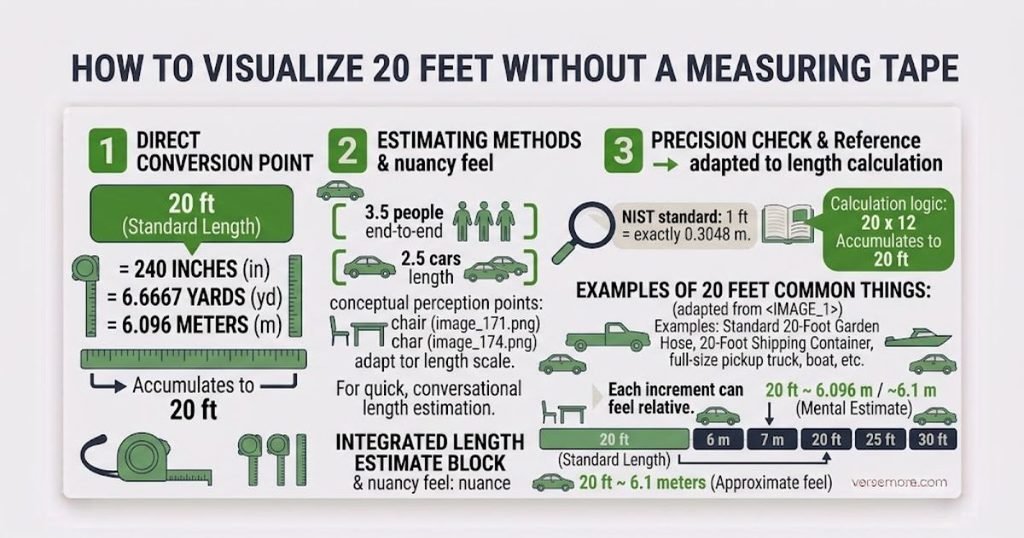
Walking can give you a quick estimate if you have a rough idea of your stride length. If each step covers about 2 feet, 10 steps would cover roughly 20 feet. If each step covers about 2.5 feet, around 8 steps would cover that distance. These are only estimates because stride length varies from person to person and can change with terrain and walking pace.
Using Familiar Objects as Reference Points
Choose an object with a known, verified dimension and compare it with the distance you want to estimate. A measured hose, a marked floor space, or a container with published dimensions can be more useful than an object whose size varies greatly between models. Keep the object aligned with the distance you are comparing.
When You Need an Accurate Measurement
Visual estimates are helpful for understanding scale, but they are not a substitute for measurement when precision matters. Use a tape measure, measuring wheel, or laser distance meter to confirm a length before buying materials, placing equipment, or checking clearance.
Practical Uses for a 20-Foot Measurement
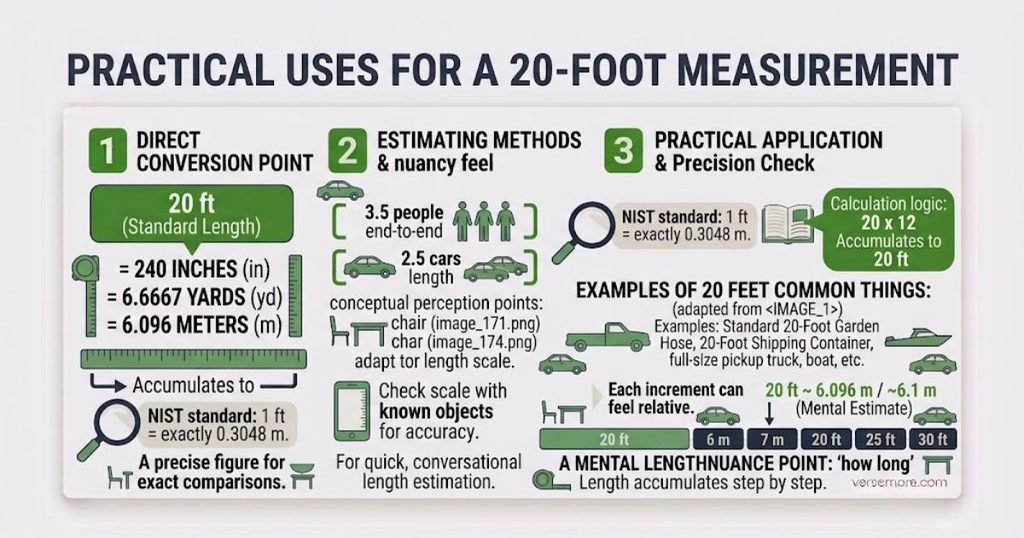
Measuring Driveways and Parking Areas
Knowing what 20 feet looks like can help when making an initial estimate of driveway space, parking layouts, or vehicle access. Vehicle lengths and turning requirements vary, so verify both the available space and the dimensions of the vehicle before relying on a layout.
Planning Storage and Indoor Spaces
A 20-foot reference can help you visualize a storage unit, workshop, room, or long wall. For storage planning, check both the length and width of the space, as well as doors, corners, and other access constraints. A room’s single dimension does not tell you its total floor area.
Understanding Nominal and Actual Dimensions
Product names often use rounded or nominal dimensions. The actual overall length, internal usable length, working height, or cut size may differ. Before making a purchase or planning a fit, read the product specifications and identify exactly which dimension is being reported.
FAQ’s
How long is 20 feet in meters?
20 feet is exactly 6.096 meters. For everyday estimates, you can round it to approximately 6.1 meters.
How many inches are in 20 feet?
There are 240 inches in 20 feet because each foot contains 12 inches. Multiply 20 by 12 to get 240 inches.
What is a good example of something 20 feet long?
A standard 20-foot shipping container is a clear example because its name refers to a nominal external length of 20 feet. A 20-foot hose or a measured section of pipe can also be useful references.
Is a shipping container exactly 20 feet long?
A 20-foot shipping container is designed around a nominal length of 20 feet, but actual external dimensions can vary slightly by design. Its internal usable length is shorter, so check the manufacturer’s specifications when fit matters.
How many steps does it take to walk 20 feet?
If each step covers about 2 feet, approximately 10 steps would cover 20 feet. If your stride is about 2.5 feet, around 8 steps may be enough. These are rough estimates, not precise measurements.
Is a school bus 20 feet long?
Some smaller school buses may be around 20 feet long, but dimensions vary by model. Many full-size school buses are much longer, so check the specific bus model for an accurate comparison.
Can two cars fit within 20 feet?
Two cars fit within a combined length of 20 feet only if their individual lengths add up to 20 feet or less. Many passenger cars are longer than 10 feet, so two typical cars may exceed the distance.
How can I measure 20 feet without a tape measure?
You can estimate 20 feet by walking a known number of steps or comparing the distance with an object of verified length. For accurate fitting, construction, or clearance checks, use a tape measure or laser distance meter.
Conclusion
Twenty feet is equal to 240 inches, 6.67 yards, or 6.096 meters. Although the measurement can be difficult to picture on its own, familiar references such as a nominal 20-foot shipping container, a garden hose, a boat, or a measured room dimension can make it easier to understand.
The key is to check what each measurement represents. An object’s overall length may differ from its usable length, and a product’s advertised size may be nominal rather than exact. When planning a real space or checking whether something will fit, confirm the specific dimensions before making a decision.

I am the admin of VerseMore, sharing helpful, informative, and engaging content on various topics to inspire readers, provide value, and make everyday life easier.