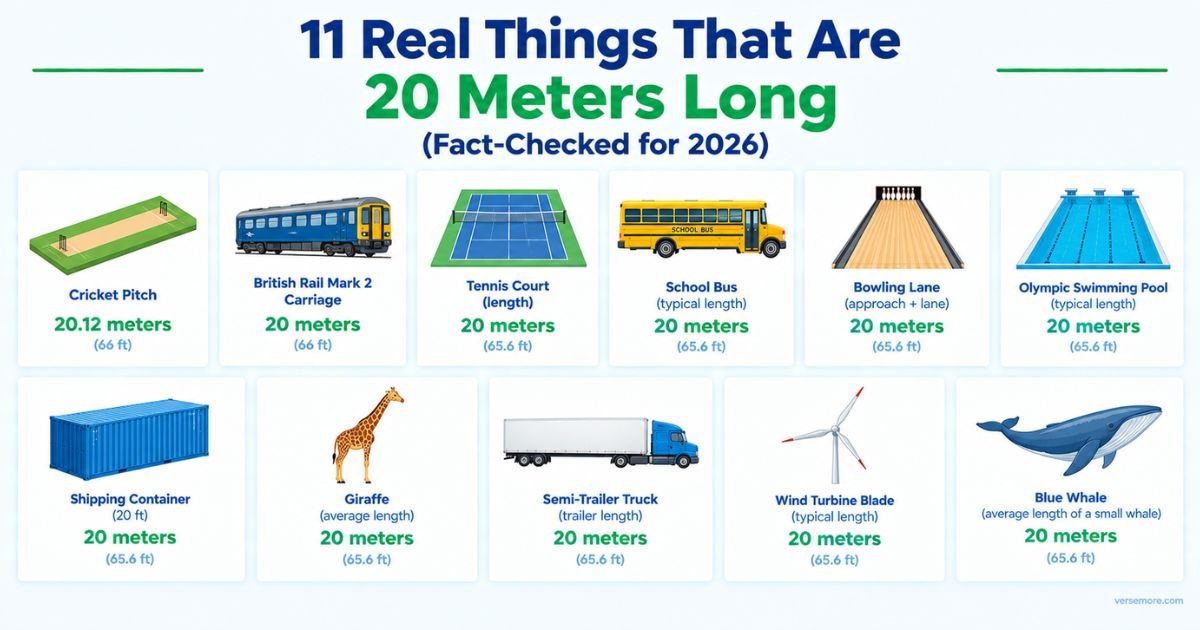
Walk the length of a cricket pitch and you have covered 20 meters. Step inside a British Rail Mark 2 carriage and you are standing in the same length: 66 feet, or 22 yards.
Most pages on things that are 20 meters long lean on the same shaky list. A tennis court, a school bus, a bowling lane “plus the approach”. Several of those fail when you check them against the rulebooks.
This guide keeps only things that land within 10% of 20 meters, shows the exact figures, and sets the near-misses apart.
20 meters is 65.6168 feet (65 ft 7.4 in), 21.8723 yards or 787.4016 inches, and a cricket pitch at 20.12 meters is the closest everyday match.
Key Takeaways
• 20 meters = 65.6168 feet, using the exact definition 1 foot = 0.3048 meter.
• A cricket pitch and a later-build British Rail Mark 2 coach are both 20.1168 m, within 1% of 20 meters.
• 20 meters is not 20 yards. 20 yards is 18.288 m, about 5 ft 7 in short.
• Adults need roughly 24 to 29 steps, or about 14 to 15 seconds of walking, to cover 20 meters.
How Long Is 20 Meters?
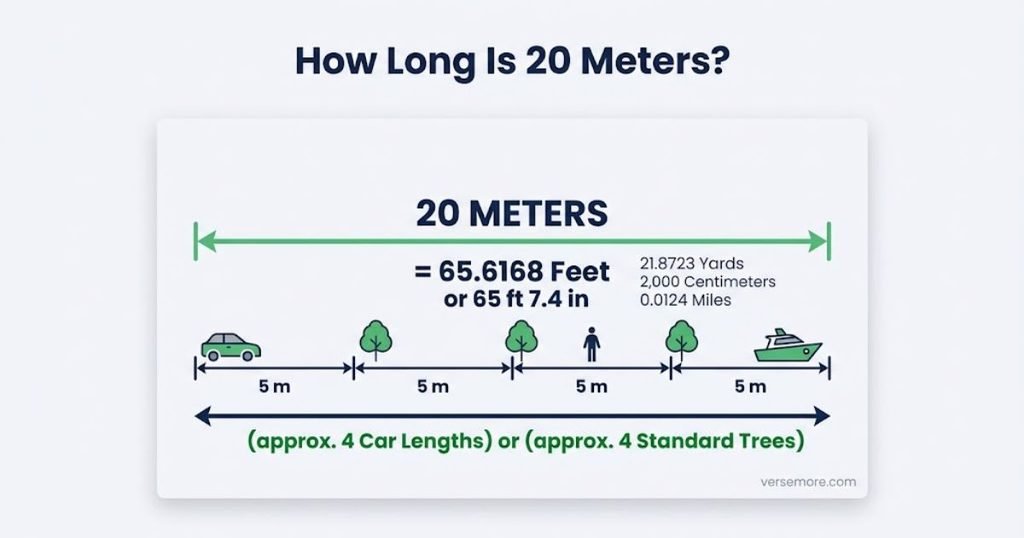
20 meters is 65.6168 feet, or 65 feet 7.4 inches. In the UK and most of Europe the unit is spelled “metres”, but the length is identical.
20 Meters in Feet, Yards, Inches and Miles
| Unit | 20 meters equals | Exact or rounded |
| Feet | 65.6168 ft | Rounded (repeating decimal) |
| Feet and inches | 65 ft 7.4 in | Rounded |
| Yards | 21.8723 yd | Rounded |
| Inches | 787.4016 in | Rounded |
| Centimeters | 2,000 cm | Exact |
| Millimeters | 20,000 mm | Exact |
| Kilometers | 0.02 km | Exact |
| Miles | 0.0124 mi | Rounded |
Exact vs Rounded: Which Figures to Trust
The foot is defined as exactly 0.3048 meter, so every feet figure above comes from one division with a single rounding at the end. NIST lists the international foot as exactly 0.3048 m, and the survey-foot equivalent as only slightly different. The US survey foot was retired from use at the end of 2022. On a 20-meter length the difference between the two feet was under a tenth of a millimeter.
Rounding matters more than the foot. “About 66 feet” sounds harmless, but it overshoots by roughly 4.6 inches. It happens to be the length of a cricket pitch, which is why that comparison works so well.
20 Meters Is Not 20 Yards
A yard is exactly 0.9144 meter, so 20 yards is 18.288 meters. That leaves 20 meters longer by 1.712 m, or about 5 ft 7 in. If you are marking out a drill or a fence run, mixing the two gives you a gap you can see from across the field.
The ±10% Test: What Counts as 20 Meters
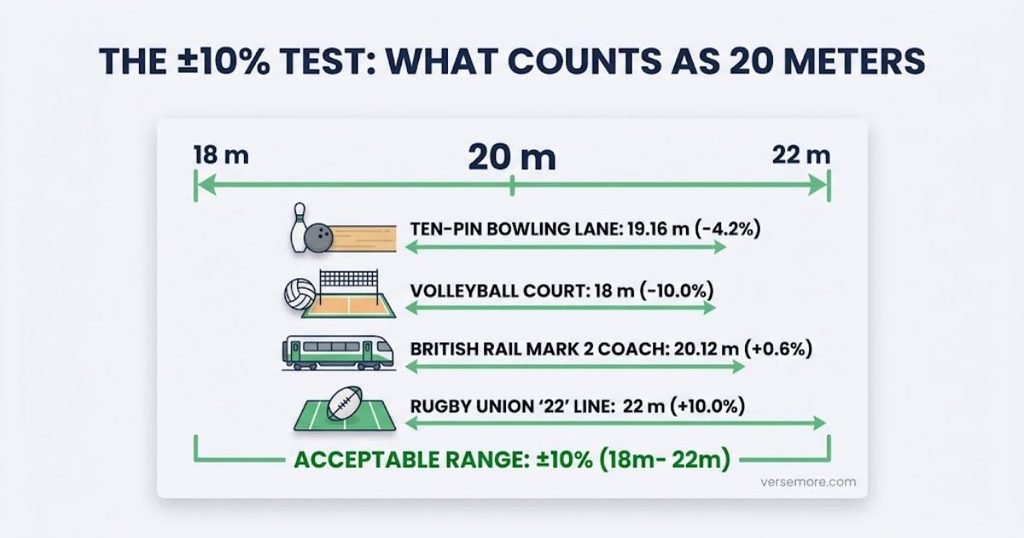
Every list of this kind eventually slides into “close enough”. To stop that, each item here must pass one rule: its typical or defining length falls between 18 and 22 meters, which is within 10% of 20. For items that vary, such as animals, I show the range and say so.
Anything outside that band goes in the near-miss table later, not in the list.
| # | Item | Length | Difference from 20 m |
| 1 | Cricket pitch | 20.1168 m | +0.6% |
| 2 | British Rail Mark 2b–2f coach | 20.1168 m (66 ft) | +0.6% |
| 3 | Ten-pin bowling lane | 19.16 m | −4.2% |
| 4 | Volleyball court | 18 m | −10.0% |
| 5 | Rugby union “22” | 22 m | +10.0% |
| 6 | 20 m shuttle run course | 20 m | 0% |
| 7 | Saab 340 | 19.73 m | −1.4% |
| 8 | Articulated bus | up to 18.75 m | −6.3% |
| 9 | US tractor-trailer | about 21.3 m (70 ft) | +6.7% |
| 10 | Fin whale | about 18–26 m, varies by source | straddles the band |
| 11 | England’s 18 m building line | 18 m | −10.0% |
Lengths are rounded to two decimals except where the source gives an exact figure. Percentages are rounded to one decimal.
Sports Fields and Courts That Measure About 20 Meters
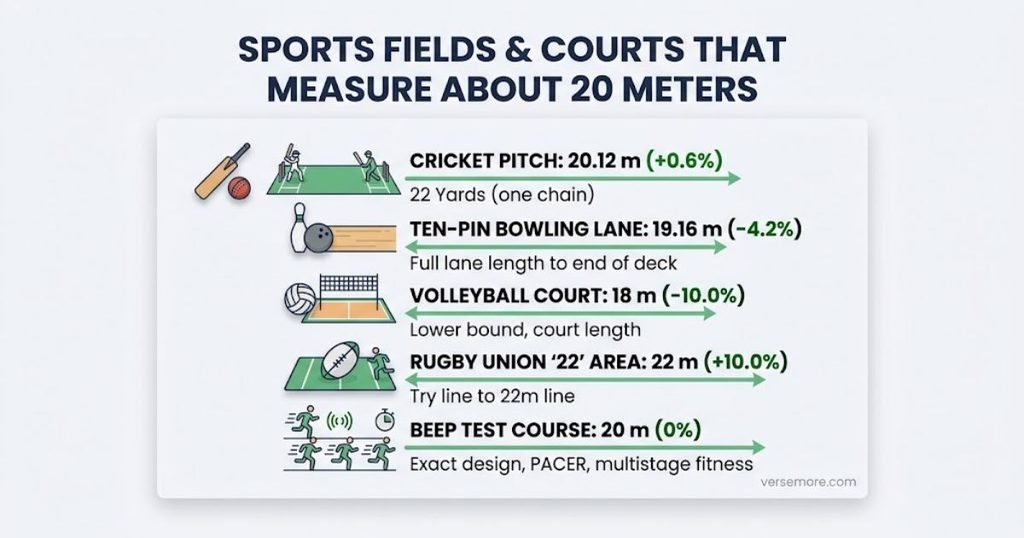
Sports make the best anchors because rulebooks fix the lengths. You can look them up, and they do not change by model year.
Cricket Pitch
The Laws of Cricket set the pitch at 22 yards (20.12 m) long and 10 ft (3.05 m) wide. Twenty-two yards is exactly one surveyor’s chain, and NIST gives the chain as 20.1168 m. That makes the pitch 11.7 centimeters longer than 20 meters, a gap smaller than a mobile phone.
Fans in India, Pakistan, the UK, Australia and the Caribbean already carry this distance in their heads. For everyone else, picture two batters at opposite ends and nothing but grass between them.
Ten-Pin Bowling Lane
The foul line sits 60 ft (18.29 m) from the head pin. The full lane is longer: 62 ft 10 3/16 in, or 19.16 m, to the end of the pin deck. That second figure is the one that lands close to 20 meters.
Competitor pages often say the approach pushes the lane to “about 20 m”. It does the opposite. The approach is a separate area of at least 15 feet behind the foul line, so approach plus lane runs to roughly 23.7 m. For a clean comparison, use the lane alone.
Volleyball Court
An official volleyball court is 18 meters by 9 meters, split by the net into two 9 × 9 m halves. At 18 m it is the shortest item that passes the test, exactly 10% under, so treat it as a lower bound.
It is still useful. Two square halves are easy to picture, and adding about two meters, roughly the height of a tall adult, takes you to 20.
Rugby Union’s 22-Meter Area
In rugby union, “the 22” is the area between the goal line and the 22 m line. So running from the try line to that mark is 22 meters, or about 72 feet. That is 10% over, the top edge of the band.
World Rugby writes its Law 1 in meters, so this is a native metric figure and not a converted one. Cricket’s 20.12 m is the opposite case, a yard measurement expressed in meters.
The 20-Meter Shuttle Run (Beep Test) Course
This one is exactly 20 meters by design. In the multistage fitness test, participants run 20 meters back and forth, keeping time with beeps that get closer together. The UK calls it the bleep test, and US schools know it as the PACER.
The pacing shows how long 20 meters feels. The test starts at 8.5 km/h and speeds up by 0.5 km/h each minute. At 8.5 km/h the first lap gives you just under 8.5 seconds per 20 m. By the end, runners are crossing the same distance in a few seconds.
If you want a way to see 20 meters, you do not need a landmark. Mark two lines 20 m apart and walk it.
Trains, Buses, Trucks and Aircraft Near 20 Meters
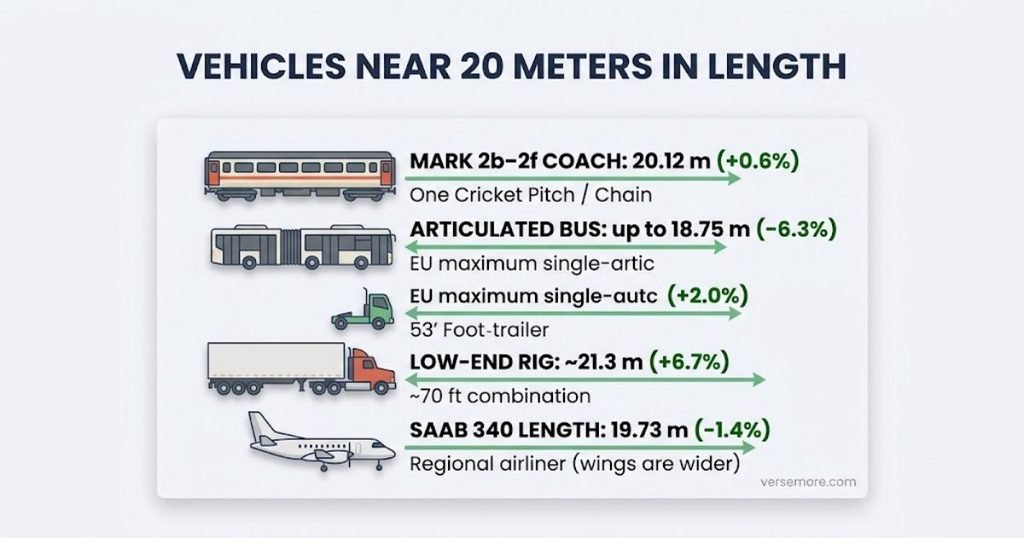
Vehicles are easy to picture, but their lengths change by country and by model year. Each one below is tied to a specification or a legal limit.
British Rail Mark 2 Coach
British Rail coaches grew over time, and the 66-foot ones are the match here. The Mark 1 was 64 ft 6 in (19.66 m), early Mark 2 and 2A coaches were 65 ft 4 in (19.91 m), and the Mark 2b through 2f coaches reached 66 ft 0 in (20.12 m). The Mark 3 stretched on to 75 ft (22.86 m).
So a Mark 2b–2f carriage is exactly one cricket pitch, 22 yards or one chain, on wheels. If you have ridden a heritage railway or an older British intercity train, you have sat inside 20 meters.
Articulated City Bus
The bendy bus has a legal cap. EU rules set the maximum length of an articulated bus at 18.75 m, the same as a road train, while an articulated lorry is limited to 16.5 m. That puts the longest legal single-articulated bus about 6% under 20 meters.
The directive does not cover buses with more than one articulated section, so double-articulated buses can run longer. Rigid two-axle buses are held to 13.5 m and three-axle ones to 15 m, so you would need about one and a half rigid buses to reach 20 meters.
US Tractor-Trailer
A 53-foot trailer is 16.15 m by itself. The tractor in front is what carries the whole rig toward 20 meters and beyond. A typical 53-foot dry-van setup runs about 70 to 80 feet overall, roughly 21.3 to 24.3 meters. A lower-end rig of about 70 ft (21.3 m) is the one that passes the ±10% Test.
Federal rules cap the trailer, not the whole combination, so overall length varies a lot. The longer end of that range is covered in our guide to things that are 80 feet long.
The contrast across the Atlantic is large. A European articulated lorry is capped at 16.5 m, so it is close to 3.5 meters shorter than a typical US rig.
Saab 340 Turboprop
The Saab 340 is a small twin-engine regional airliner. Saab lists its length at 19.73 m and its wingspan at 21.44 m. That is 64 ft 9 in nose to tail.
The wings are wider than the fuselage is long, which is a good reminder that vehicle “length” and “size” are not the same thing. If a plane’s length is what you want, use the Saab. If you want its footprint on the apron, add about 1.7 m.
Animals and Buildings That Reach 20 Meters
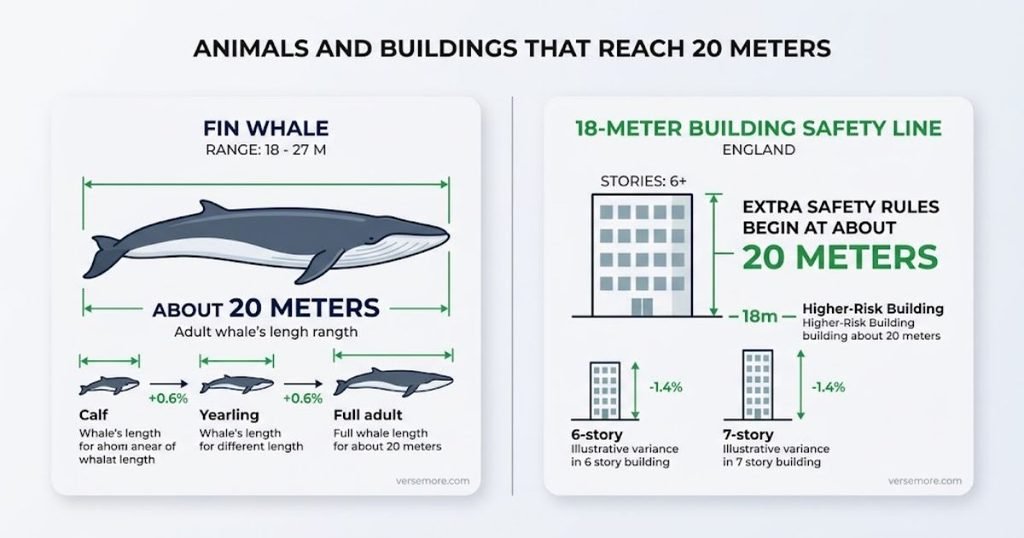
Living and built things make poor rulers because they vary so much. These two earn their place because the variation is documented.
Fin Whale
Sources do not agree on adult fin whale length, so I’m giving the range and not a single number. NOAA material republished by Massachusetts puts adults at 23 to 26 m, while another reference gives 18 to 27 m, and Merriam-Webster says they can exceed 21 m. A 20-meter animal is therefore a plausible mid-sized adult and not a record.
Young whales are much shorter. A stranded fin whale near Anchorage was 14.3 m long and was estimated to be one to three years old. That is a good way to see why “fin whale” is not a fixed ruler: the same species runs from about 14 m to about 26 m.
The 18-Meter Building Line in England
Building height gets a legal 20-meter-ish line in England. The Building Safety Act 2022 defines a higher-risk building as one that is at least 18 metres in height or has at least 7 storeys. At roughly 3 m per floor, a building of about 18 m is six storeys, so the height test and the storey test point at nearly the same block.
The rule covers England, with Wales handled in a separate section of the Act. In practice it means a residential block close to 20 meters is where extra safety rules begin. Two meters taller than the line, at 20 m, would be a six-and-a-half-to-seven-storey building.
Things Often Mistaken for 20 Meters
These are the comparisons that circulate widely and fail the ±10% Test. They are useful to know, but they are not 20 meters.
| Commonly used comparison | Actual length | Difference from 20 m |
| Tennis court, baseline to baseline | 23.77 m (78 ft) | +18.9% |
| Olympic pool, width | 25 m (82 ft) | +25.0% |
| 25-yard pool, length | 22.86 m | +14.3% |
| Bowling lane plus minimum approach | about 23.73 m | +18.6% |
| British Rail Mark 3 coach | 22.86 m (75 ft) | +14.3% |
| 53-ft trailer without the tractor | 16.15 m | −19.2% |
| EU articulated lorry (legal maximum) | 16.5 m | −17.5% |
| Half an NBA court | 14.33 m | −28.4% |
Figures are rounded to two decimals, with differences to one. Several are derived: 25 yards × 0.9144, 53 ft × 0.3048, 19.16 m plus 15 ft (4.57 m) for the approach, and half of 94 ft.
Two pages claim a half-court plus the sideline buffer reaches 20 m. A half-court is 14.33 m, and I could not find a rule that adds buffer space to that.
How Far Is 20 Meters on Foot?
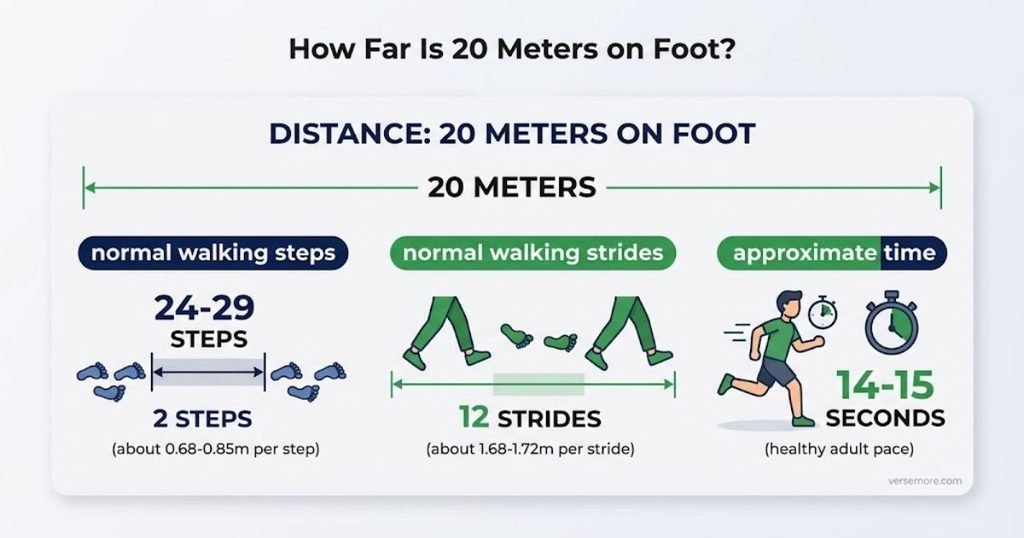
20 meters is about 24 to 29 normal walking steps, or about 12 strides, and it takes roughly 14 to 15 seconds.
Steps vs Strides: Why the Counts Differ
Many pages treat the two words as one, and that is where the errors start. A step is one foot’s movement, and a stride is two steps, one with each foot. A stride is therefore about twice a step.
Typical adult step length is 0.68 to 0.85 m and stride length is 1.68 to 1.72 m. The table turns that into 20-meter counts.
| Measure | Typical adult length | Count for 20 m |
| Short step | 0.68 m | about 29 steps |
| Mid step | 0.75 m | about 27 steps |
| Long step | 0.85 m | about 24 steps |
| Stride (two steps) | 1.68–1.72 m | about 12 strides |
Counts are rounded to the nearest whole number. A page that says “20 strides is about 20 meters” is treating a stride as a meter. It is closer to 1.7 m.
How Long It Takes to Walk 20 Meters
Healthy adults at a self-selected pace walk at about 1.30 to 1.46 m/s, which is 13.7 to 15.4 seconds for 20 meters. Competitor pages often say 20 to 30 seconds. That would be a slow stroll of about 1 m/s or less, not a normal pace. Hills, bags and crowds add time, so treat 14 to 15 seconds as the flat-ground figure.
How to Mark Out 20 Meters Without a Tape Measure
1. Start from a known length. Measure 10 meters once with a tape, or use a distance you can trust, such as the 18 m side of a volleyball court.
2. Walk it at a normal pace. Count your steps from start to finish.
3. Divide to find your step length. Distance divided by steps gives your own number. For example, 18 m in 24 steps is 0.75 m per step.
4. Divide 20 by it. At 0.75 m, 20 m takes about 27 steps.
5. Check once. Walk the marked distance a second time. If the counts differ by more than a step or two, repeat step 2.
20 Meters Compared With Other Common Lengths
| Length | In meters | 20 m is about |
| 15 feet | 4.572 m | 4.4 times as long |
| 30 feet | 9.144 m | 2.2 times as long |
| 40 feet | 12.192 m | 1.6 times as long |
| 80 feet | 24.384 m | 82% as long |
| 300 feet | 91.44 m | 22% as long |
| 1 kilometer | 1,000 m | 2% as long |
Each foot value is exact (feet × 0.3048). Ratios are rounded.
If you have read our guide to 30 feet long, 20 meters is a little more than twice that distance. The article on 40 feet sits about two-thirds of the way up to 20 meters, and 15 feet long is the short end, with 20 meters about 4.4 times that.
Going the other way, 20 meters fits almost five times inside 300 feet, and fifty of them make 1 kilometer.
Which Comparison Works Best Where You Live
| Where you are | Best anchor | Why it works |
| United States | A tractor-trailer rig, or a bowling lane | Both are familiar. A lane is 62.85 ft, about 2 ft 9 in short of 20 m (65.62 ft). |
| United Kingdom | A cricket pitch or a Mark 2 coach | Both are 20.12 m, within 1%. |
| Europe | An articulated bus | The legal cap is 18.75 m, so a long one is just under 20 m. |
| Anywhere | Two lines 20 m apart | The beep test course is exact by definition. |
Pick the one you can see from your own street. A comparison you have walked beside beats one you have only read about.
FAQ’s
How long is 20 meters in feet?
20 meters is 65.6168 feet, which is 65 feet 7.4 inches. The figure comes from the exact definition 1 foot = 0.3048 meter. In yards it is 21.8723.
Is a cricket pitch exactly 20 meters?
Almost. A cricket pitch is 22 yards, which is 20.1168 meters, so it is about 11.7 centimeters longer than 20 meters. That is within 1%, which makes it the closest everyday match.
Is 20 meters the same as 20 yards?
No. 20 yards is 18.288 meters, so 20 meters is longer by about 1.7 meters, or 5 ft 7 in. Going the other way, 20 meters is 21.87 yards.
How many steps is 20 meters?
Most adults need about 24 to 29 steps, since typical step length is 0.68 to 0.85 meters. At 0.75 meters per step it is about 27. In strides, which are two steps each, it is about 12.
How long does it take to walk 20 meters?
At a normal self-selected pace of 1.30 to 1.46 meters per second, it takes about 14 to 15 seconds. Slopes, bags and crowds add time.
How tall is 20 meters in storeys?
At roughly 3 meters per storey, 20 meters is between six and seven storeys. Storey heights vary by building. In England, the higher-risk building rule starts at 18 meters or seven storeys.
What is the best everyday example of 20 meters?
It depends on where you live. In the UK and cricket-playing countries, use a cricket pitch (20.12 m) or a Mark 2b–2f train coach (20.12 m). In the US, a ten-pin bowling lane (19.16 m) or a tractor-trailer rig (about 21.3 m) are the best-known matches.
Is a tennis court 20 meters long?
No. A tennis court is 23.77 meters (78 feet) from baseline to baseline, so it is 3.77 meters longer than 20 meters. It works as a “slightly over” reference, not a 20-meter one.
How can I measure 20 meters without a tape measure?
Work out your own step length first. Walk a known distance, such as the 18 meter length of a volleyball court, and divide by your step count. Then divide 20 by that number. If you take 24 steps for 18 meters, your step is 0.75 meters and 20 meters is about 27 steps.
Conclusion
Things that are 20 meters long are easier to find than most people expect, as long as you hold them to the same standard. A cricket pitch, a Mark 2 train coach, a bowling lane and a Saab 340 all land within a few percent of 20 meters, and every figure above comes from a rulebook, a specification or a legal limit. The comparisons that miss, from the tennis court to the Olympic pool’s width, are better kept as near-misses. Pick the anchor you can walk beside, and 20 meters will stop being an abstract number.

I am the admin of VerseMore, sharing helpful, informative, and engaging content on various topics to inspire readers, provide value, and make everyday life easier.