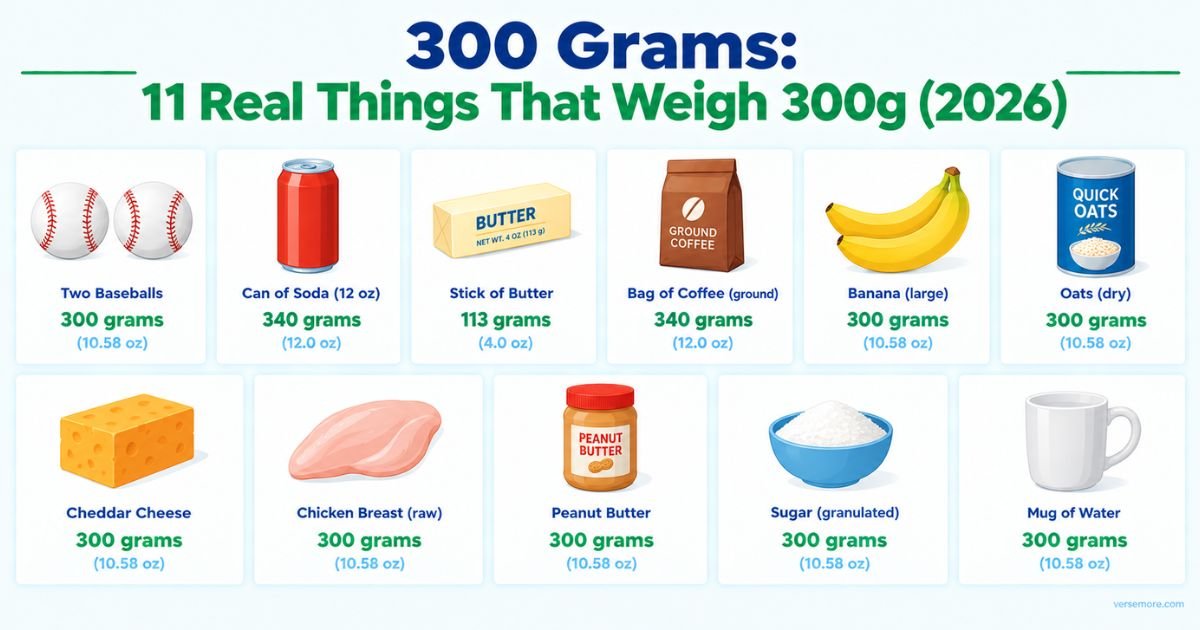
Pick up two baseballs and you’re holding roughly 300 grams. Pick up a full can of soda and you’re holding a good deal more. That gap is why this weight is hard to judge by feel, and why so many lists get it wrong.
300 grams is 0.3 kilograms, or about 10.58 ounces. Below are 11 everyday objects that land at or near it, each checked against an official spec or a published standard instead of copied from other lists.
You’ll also get a grams-to-cups table, a method for estimating 300 grams without a scale, and corrections to a few numbers that keep getting repeated online.
300 grams equals 0.3 kilograms, 10.58 ounces or 0.661 pounds, roughly the weight of two baseballs or an adult tennis racket.
Key Takeaways
• 300 g = 10.5822 oz = 0.6614 lb, a little under two-thirds of a pound (two-thirds of a pound is 302.4 g).
• Two regulation baseballs weigh 283–298 g, and Apple lists the iPad mini (A17 Pro) at 293 g (Wi-Fi) or 297 g (cellular).
• Six large US eggs only reach about 300 g without their shells. In the shell, USDA rules put them at 340 g or more.
• 300 g of all-purpose flour is about 2.5 US cups, not the 1.25 cups several sites claim.
How Much Is 300 Grams in Ounces and Pounds?
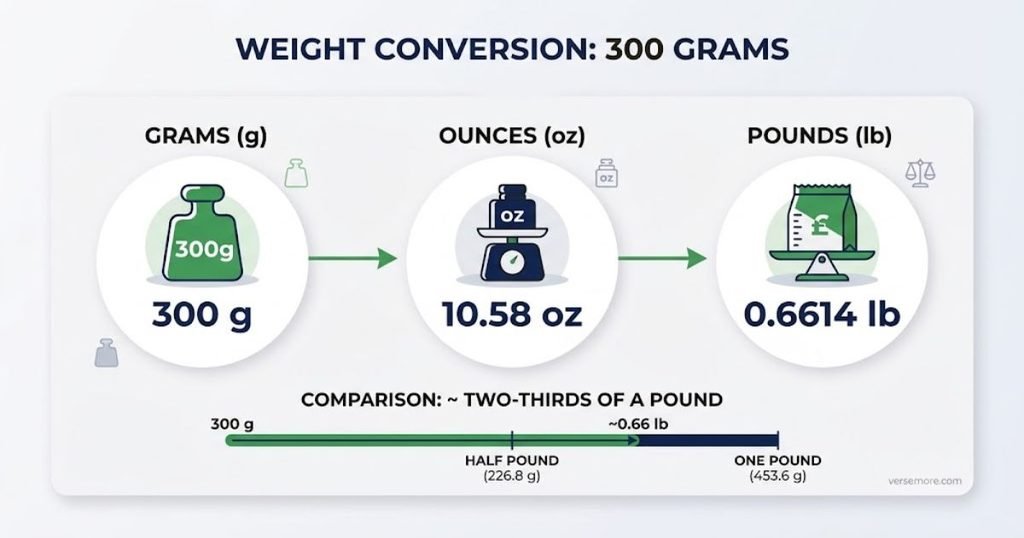
300 grams is 10.58 ounces, or 0.6614 pounds. That makes it about a third more than half a pound (226.8 g) and a hair under two-thirds of a pound.
| Unit | 300 g equals | Exact or rounded |
| Milligrams | 300,000.0000 mg | Exact |
| Kilograms | 0.3000 kg | Exact |
| Ounces (avoirdupois) | 10.5822 oz | Rounded to 4 decimals |
| Pounds (avoirdupois) | 0.6614 lb | Rounded to 4 decimals |
| Troy ounces | 9.6451 oz t | Rounded to 4 decimals |
The ounce figure comes from the legal definition: the international pound is exactly 0.45359237 kg, and one avoirdupois ounce is one-sixteenth of that, or exactly 28.349523125 g. This definition is published in NIST Special Publication 811 (IEC Electropedia reproduces it). I divided 300 by that exact value and rounded once, at the end. Dividing by the casual 28.35 gives the same 10.58 oz.
For quick mental math, remember that 300 g is a hair under two-thirds of a pound. The weight ounce and pound are identical in the US and UK. The fluid ounce is where the two systems differ, which matters for the water example later on.
Troy ounces (about 31.1035 g each) are only used for precious metals. If a recipe or a grocery label says “oz,” it means the avoirdupois ounce.
Sports Gear That Weighs About 300 Grams
Sports equipment is a good calibration tool because weights are often regulated or tightly specified. Two examples fall right at 300 g.
Two Regulation Baseballs
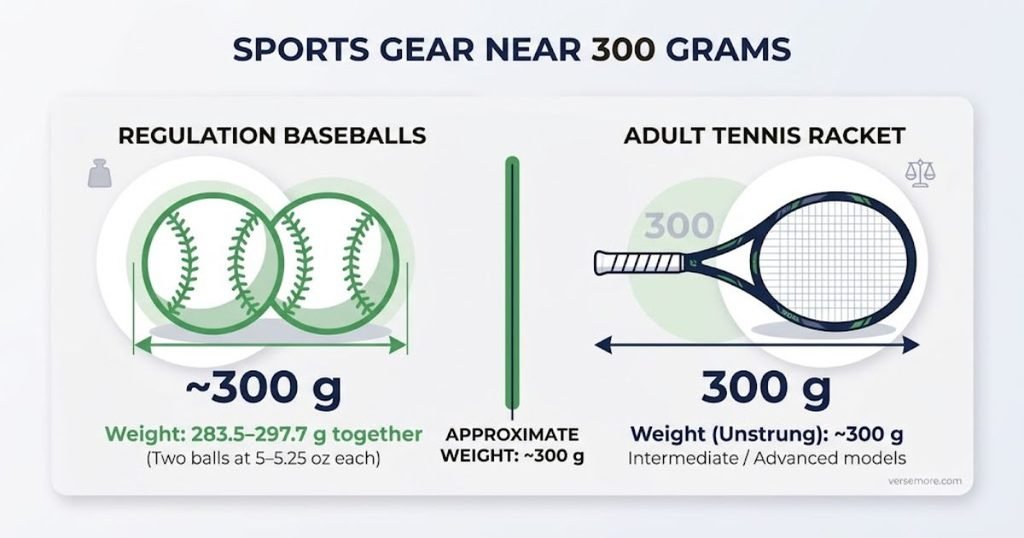
Two regulation baseballs weigh between 283.5 and 297.7 g together. The Official Baseball Rules (Rule 3.01) set a baseball at 5 to 5.25 oz, which is 141.7 to 148.8 g per ball, and the same weight range applies in college, high school and Little League.
That puts a pair of baseballs 2 to 16 g short of 300 g. It’s the one object in this list with a rulebook behind its weight, so it makes a trustworthy reference. Cup two balls in one hand and you’re holding about 300 grams.
An Adult Tennis Racket (Unstrung)
A modern adult tennis racket weighs about 300 g unstrung. Tennis Nerd puts the typical range at 260–280 g for beginners, 285–305 g for intermediate players and 300–320 g for advanced players.
Strings add roughly 15 to 20 g, so a racket you’ve just weighed at home will usually read closer to 320 g. If you weigh one, check whether it’s strung first.
The weight is common enough that the number shows up in product names. A retailer lists Tecnifibre’s T-Fight 300 and Fire 300 at 10.6 oz (300 g) unstrung.
Tech, Paper and Cash That Weigh About 300 Grams
You probably have at least one of these within arm’s reach.
The iPad mini (A17 Pro)
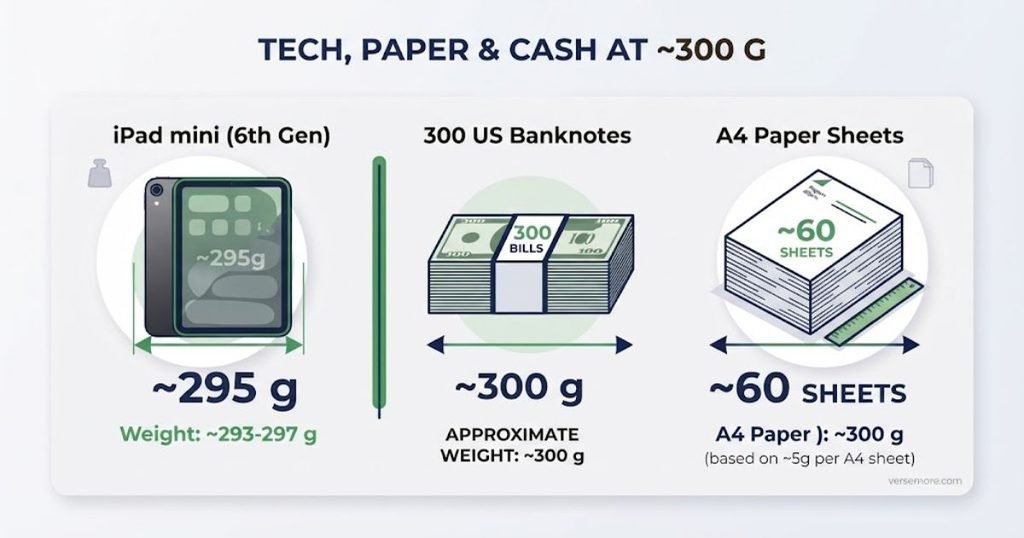
Apple lists the iPad mini (A17 Pro) at 293 g for Wi-Fi models and 297 g for Wi-Fi + Cellular. That’s just 3 to 7 g below 300 g, and it’s the closest official figure in this guide.
Phones are less reliable. An iPhone 15 Pro Max weighs about 221 g by itself, so it only reaches 300 g with a heavy case. Because case weights vary so widely, I’ve left “cased phone” out as a reference.
A Stack of 300 US Banknotes
Three hundred US banknotes weigh about 300 g. The US Currency Education Program says a banknote weighs approximately 1 gram regardless of denomination, which works out to 454 notes per pound.
So 300 one-dollar bills and 300 hundred-dollar bills weigh about the same. The value changes by $29,700, but the weight doesn’t. Worn notes can drift slightly below 1 g, so treat this as an approximation. Other currencies don’t follow the 1 g rule, so don’t carry it over to euros or pounds.
66 Sheets of US Letter Paper (or 60 Sheets of A4)
About 66 sheets of US Letter paper weigh 300 g, and so do about 60 sheets of A4. These are my calculations from sheet area and paper density, not weighed samples.
• US Letter: 215.9 × 279.4 mm is about 0.0603 m². Standard 20 lb bond is roughly 75 gsm, so each sheet is about 4.52 g. 300 ÷ 4.52 is about 66 sheets.
• A4: 210 × 297 mm is about 0.0624 m². At the common European 80 gsm, each sheet is about 4.99 g, so 60 sheets come to about 299 g.
For scale, a 500-sheet ream of Letter is roughly 2.26 kg, so 300 g is only about 13% of it. Real paper varies from brand to brand, so use these counts as estimates.
Kitchen Items That Weigh 300 Grams
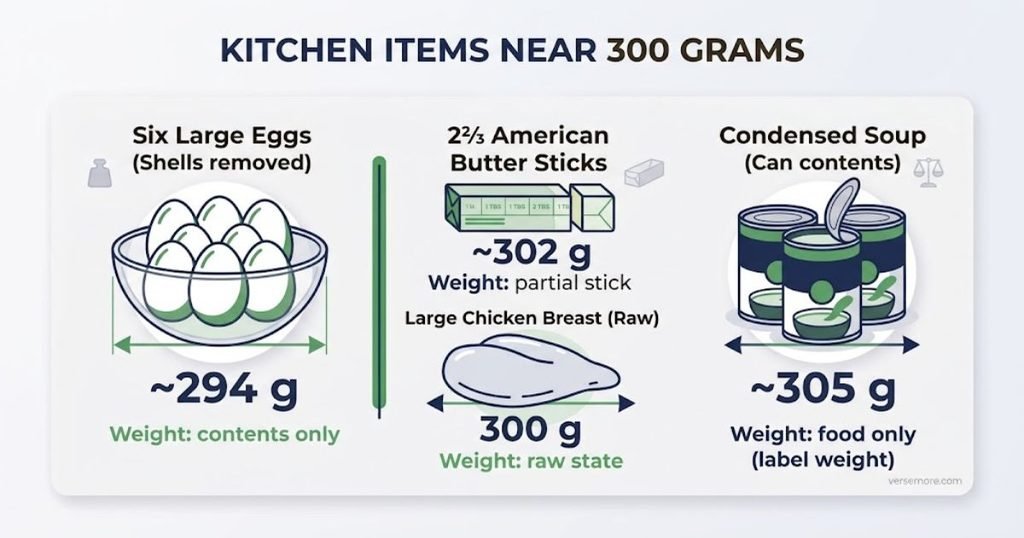
The kitchen is full of 300 g references, but several popular ones are less exact than they look. The figures below are checked against USDA or label data.
Six Large Eggs, Without the Shells
Six large eggs weigh about 300 g only after you crack them. USDA sizing requires a dozen large eggs to weigh at least 24 oz, which is 2 oz (56.7 g) per egg in the shell, so six eggs in the shell come to at least 340 g. A large egg’s contents run closer to 1.73 oz (about 49 g), per the Cook’s Illustrated breakdown of yolk and white, which makes six about 294 g.
USDA sizes are set per dozen, not per egg, so individual eggs vary within a carton. In the UK and EU, a “large” egg is heavier than a US large, so you’ll need fewer of them. If a recipe needs exactly 300 g of beaten egg, weigh it.
2⅔ Sticks of American Butter
2⅔ US butter sticks weigh 302.4 g, which is 2.4 g over 300. One stick is 4 oz (113.4 g), so 300 g is exactly 2.6455 sticks. On the wrapper’s tablespoon markings, that’s 21 tablespoons, or two sticks plus five tablespoons.
Outside the US, butter is commonly sold in 250 g blocks, so 300 g is one block plus a fifth of another. Three full sticks are 340.2 g, which is a different weight entirely (see the near-miss table below).
One Large Chicken Breast (Raw vs Cooked)
300 g is one very large boneless, skinless breast or a smaller pair, and the raw-versus-cooked distinction matters more here than for any other item. Supermarket breasts typically run 6 to 8 oz (170 to 227 g) raw, so two average breasts weigh 340 to 454 g. A pair totaling 300 g would be about 150 g each, which is on the small side.
The USDA’s raw entry lists 22.5 g of protein per 100 g, so 300 g raw has about 68 g of protein. Cooked chicken is more concentrated at about 31 g per 100 g, so 300 g cooked has roughly 93 g. Cooking drives off about a quarter of the weight, so 300 g cooked started as roughly 400 g raw. Always say which one you weighed.
The Contents of a 10.75 oz Soup Can
The food inside a 10.75 oz can of condensed soup weighs 304.8 g (10.75 × 28.349523125), which matches the “10.75 oz (about 305 g)” net weight listed for Campbell’s cans. The label’s net weight is the food only, and the steel can adds to it.
I couldn’t find a single sourced figure for a whole can. Estimates range from about 320 g to 350 g. Campbell’s foodservice listing gives 37.26 lb for a case of 48 cans, which works out to about 352 g per can including carton. Either way, a full can lands 20 to 50 g above 300 g, not on it. If you want the can’s exact dimensions, see our guide to soup can dimensions.
Surprising 300-Gram Things: Water and the Human Heart
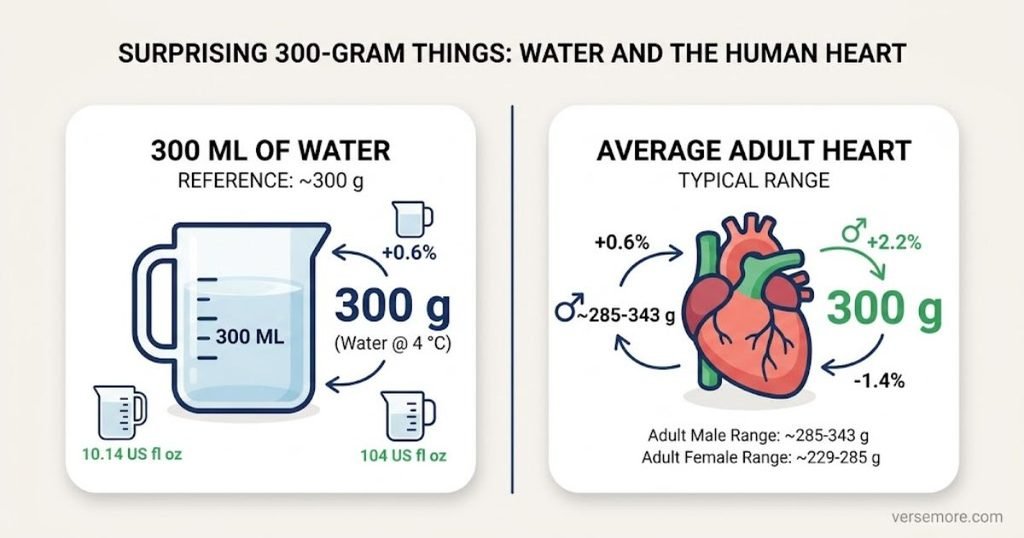
Two last items round out the list of 11 and come from outside the kitchen drawer.
300 mL of Water
300 mL of water weighs about 299.5 g at room temperature (water’s density is 0.9982 g/mL at 20 °C), and 300.0 g at 4 °C. That makes a 300 mL measure the easiest 300 g reference for any water-like liquid.
In US fluid ounces that’s 10.14, and in UK (imperial) fluid ounces it’s 10.56, so the ounces don’t match the 10.58 weight ounces you saw earlier. In cups, it’s 1.27 US cups or 1.20 metric (250 mL) cups. The shortcut only works for water. Milk is slightly denser than water, so 300 mL is a little over 300 g, and cooking oil is lighter, so 300 mL is closer to 275 g.
An Average Adult Heart
A typical adult heart weighs about 300 g. A general reference puts it at 285 to 343 g in adult men and 229 to 285 g in adult women, and roughly the size of a clenched fist. That makes the average heart a fair match for 300 g, sitting inside the male range and at the top of the female one.
Heart weight scales with body size and sex, so treat the figure as a typical range, not a medical reference.
What Does 300 Grams Look Like in Cups and Spoons?
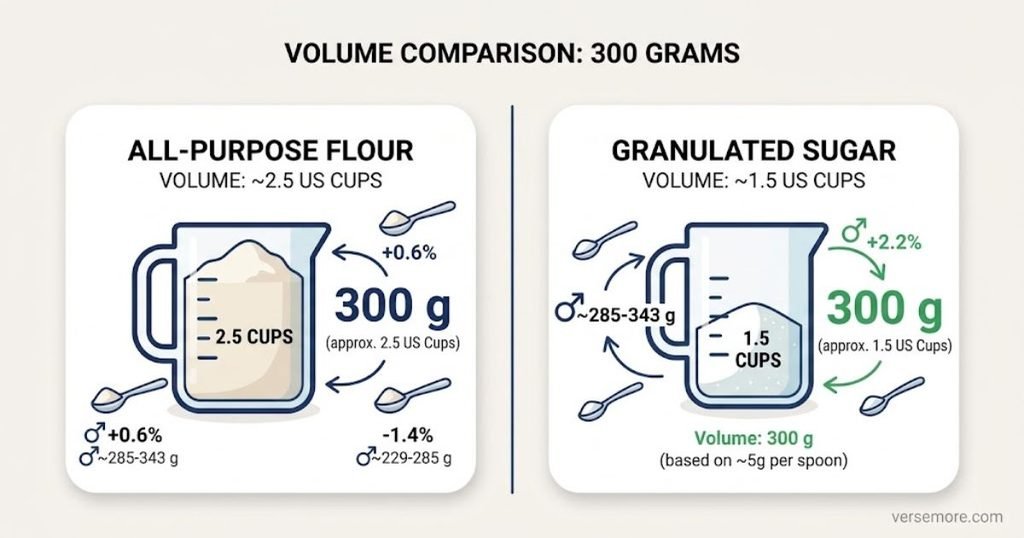
It depends on the ingredient: 300 grams is about 2.5 US cups of all-purpose flour, 1.5 cups of granulated sugar or 1.3 cups of butter. Grams measure mass and cups measure volume, so a denser ingredient fills less of the cup.
Same Weight, Different Volume: 300 g in US cups
| Ingredient | Grams per US cup | 300 g in cups |
| All-purpose flour | 120 | 2.50 |
| Granulated sugar | 200 | 1.50 |
| Brown sugar (packed) | 213 | 1.41 |
| Confectioners’ sugar (unsifted) | 113 | 2.65 |
| Butter | 227 | 1.32 |
| Water | 237 | 1.27 |
Grams per cup are rounded published values: flour, brown sugar and confectioners’ sugar come from the King Arthur ingredient weight chart, and granulated sugar’s 200 g is a commonly used approximation. Cup counts are rounded to two decimals.
Several pages claim 300 g is about 1.25 cups for “dry ingredients” like flour or sugar. That doesn’t hold up. It’s close for water, but flour is far lighter per cup than water, so 300 g takes up twice as much room.
Technique also matters. King Arthur’s 120 g flour figure assumes you spoon flour into the cup and level it. Scooping packs in more, so the same 300 g can look like fewer cups. A US cup is 236.6 mL, but many UK, Australian and European recipes use a 250 mL metric cup, so check which one you have.
How to Estimate 300 Grams Without a Scale
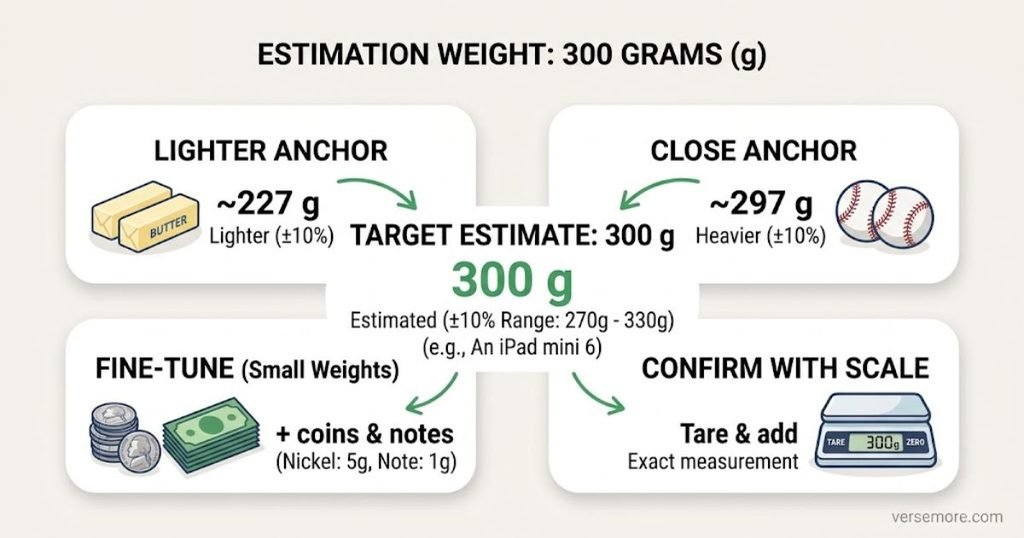
The Anchor-and-Adjust Method gets you to within a rough ballpark using objects you already know the weight of. It’s good for estimating, not for baking.
1. Pick three anchors. Use a light one, a close one and a heavy one: two sticks of US butter (226.8 g, exactly half a pound), an iPad mini or two baseballs (about 290 to 297 g), and a full 12 oz can of soda (about 385 g).
2. Hold the item in one hand and the close anchor in the other. Switch hands, since your dominant hand tends to misjudge.
3. Place it on the ladder. Lighter than the close anchor but heavier than the butter? It’s roughly 230 to 290 g. Heavier than the close anchor but lighter than the soda can? It’s roughly 300 to 380 g.
4. Fine-tune with small known weights. A US banknote is about 1 g and a US nickel is 5 g, so you can add a few coins or notes to the lighter side until they feel even.
5. Confirm with a scale when it matters. Place the empty container on the scale, tare it to zero, then add the ingredient until it reads 300 g.
Things That Almost Weigh 300 Grams (Near Misses)
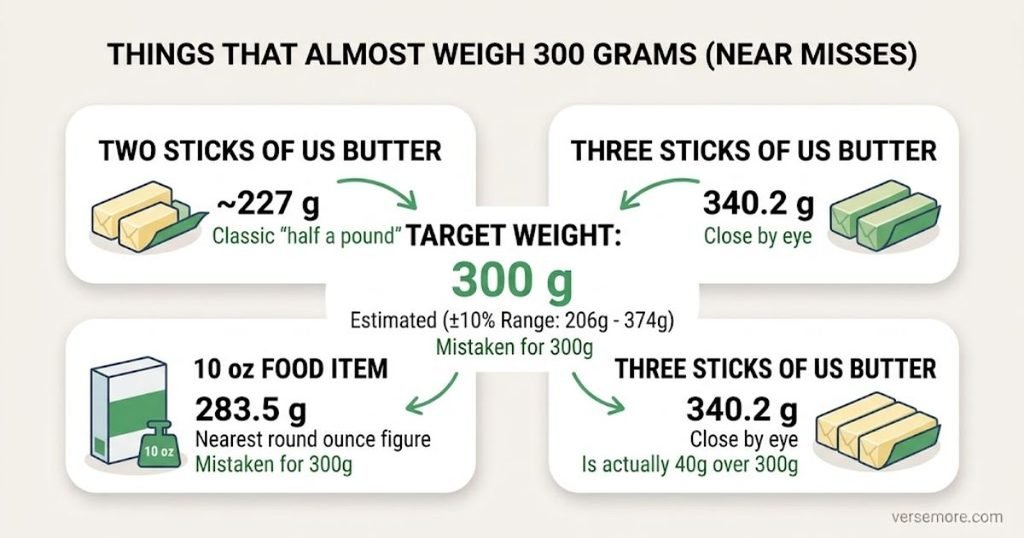
These objects get called “about 300 grams” often enough that they’re worth correcting.
| Object | Weight | Why it gets mistaken for 300 g |
| Two sticks of US butter (8 oz) | 226.8 g exact | The classic “half a pound” |
| 10 oz (any food) | 283.5 g exact | The nearest round ounce figure |
| Campbell’s 10.75 oz can, whole | ≈320–350 g | The label says 305 g, but that’s the food only |
| Three sticks of US butter (12 oz) | 340.2 g exact | Close to 300 g by eye, 40 g over |
| Full 12 oz can of soda | ≈385 g | Often called “slightly under 300 g,” but it’s about 85 g heavier |
“Exact” values are conversions from the 28.349523125 g ounce. “≈” values are estimates and vary by product.
That soda can figure comes from 12 fl oz of liquid (about 355 mL) plus an aluminum shell. If you want the can’s dimensions, see our beer can dimensions guide. For the closest ounce-based neighbor, our article on things that weigh 10 ounces covers the 283.5 g mark.
Where 300 Grams Matters in Real Life
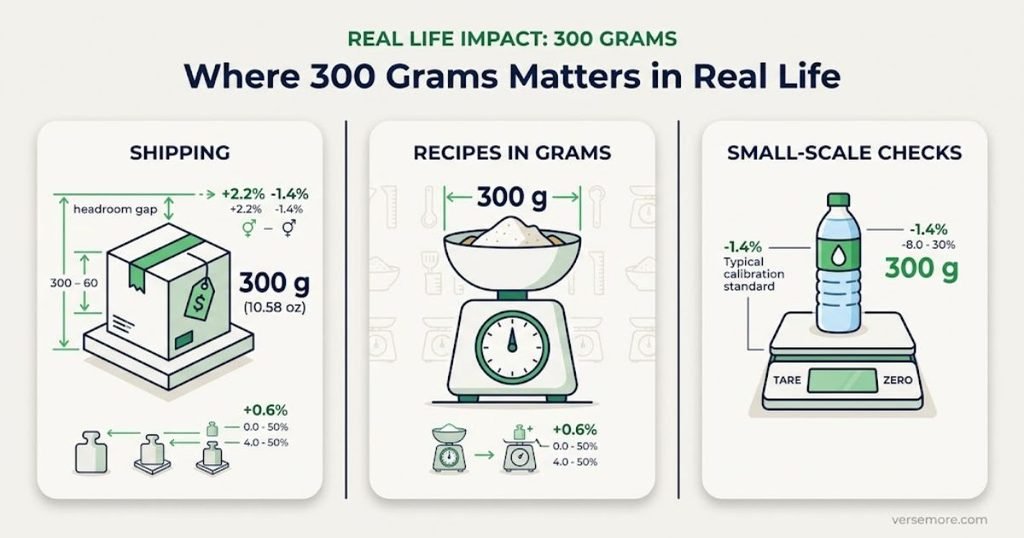
Three everyday situations come up most often.
Shipping. USPS Ground Advantage retail pricing for packages up to a pound uses tiers at 4, 8, 12 and 15.999 ounces, and anything over a tier rounds up to the next one. 300 g is 10.58 oz, so it lands in the 12 oz tier (340.2 g). That leaves only about 40 g of headroom for the box, padding and tape. Go over and you jump to the 15.999 oz tier. Other countries’ carriers use their own weight bands, so check your carrier’s table before assuming the same breakpoints.
Recipes written in grams. Most recipes outside the US assume a kitchen scale. Weigh 300 g directly into the bowl on the scale, and tare between ingredients. It’s more consistent than cups, because the cup table above shows how much a “cup” varies by ingredient and technique.
Small-scale checks. A 300 g reading is within capacity of nearly every kitchen scale, so you can use a known 300 g item, like a full 300 mL bottle of water, to confirm a scale is reading correctly.
FAQ’s
How much is 300 grams in ounces and pounds?
300 grams is 10.58 ounces (10.5822 to four decimals) and 0.6614 pounds. These come from the exact definition of 1 avoirdupois ounce as 28.349523125 g, rounded once at the end. A handy shortcut is that 300 g is just under two-thirds of a pound.
What does 300 grams look like?
Two regulation baseballs (283–298 g), an iPad mini (293–297 g) and 2⅔ sticks of American butter (302 g) all sit very close to 300 grams. A 300 mL measure of water is another easy picture. For lighter or heavier reference points, see our guides to things that weigh 20 grams and things that weigh 10 pounds.
Is 300 grams more than half a pound?
Yes. Half a pound is 226.8 g, so 300 grams is about 73 g (roughly a third) more. It’s also just under two-thirds of a pound, which is 302.4 g.
How much is 300 grams of flour in cups?
About 2.5 US cups of all-purpose flour, if you spoon it into the cup and level it off. That’s based on King Arthur’s figure of 120 g per cup. Scooping packs in more flour, so a scooped cup is heavier and you’ll need fewer of them.
How many tablespoons is 300 grams of butter?
About 21 US tablespoons. That’s 2⅔ US sticks (302.4 g), or two sticks plus five tablespoons. In the UK and Europe, where butter often comes in 250 g blocks, it’s one block plus about a fifth of another.
Is 300 grams of chicken a lot?
300 g of cooked chicken is a large portion. A common reference serving is 3 oz (85 g) cooked, so 300 g is roughly 3.5 of those. It holds about 93 g of protein cooked, or about 68 g if you weighed it raw, per USDA data. Cooking removes about a quarter of the raw weight, so say whether you’re weighing before or after.
How can I measure 300 grams without a scale?
Use the Anchor-and-Adjust Method from earlier. Compare your item against two sticks of butter (226.8 g), an iPad mini or two baseballs (about 290–297 g) and a full soda can (about 385 g). For water or other thin liquids, 300 mL gets you very close.
Does 300 mL of water weigh 300 grams?
Almost exactly. At room temperature (20 °C), 300 mL of water weighs about 299.5 g, and at 4 °C it weighs 300.0 g. The shortcut only works for water. Milk is slightly heavier per mL and cooking oil is lighter.
Conclusion
300 grams is 0.3 kilograms, about 10.58 ounces, and a handful of things you can verify yourself: two baseballs, an iPad mini, 300 US banknotes, 66 sheets of Letter paper, 300 mL of water and the average adult heart. The common mistakes are treating six eggs in the shell, a whole soup can or a few chicken breasts as 300 g when they’re heavier, and using 1.25 cups as the flour or sugar equivalent when it’s closer to 2.5 cups of flour and 1.5 of sugar.
Next time you need to judge 300 grams, hold one of these anchors in one hand and the item in the other, and add a few coins if it’s close. For anything where precision matters, weigh it.

I am the admin of VerseMore, sharing helpful, informative, and engaging content on various topics to inspire readers, provide value, and make everyday life easier.