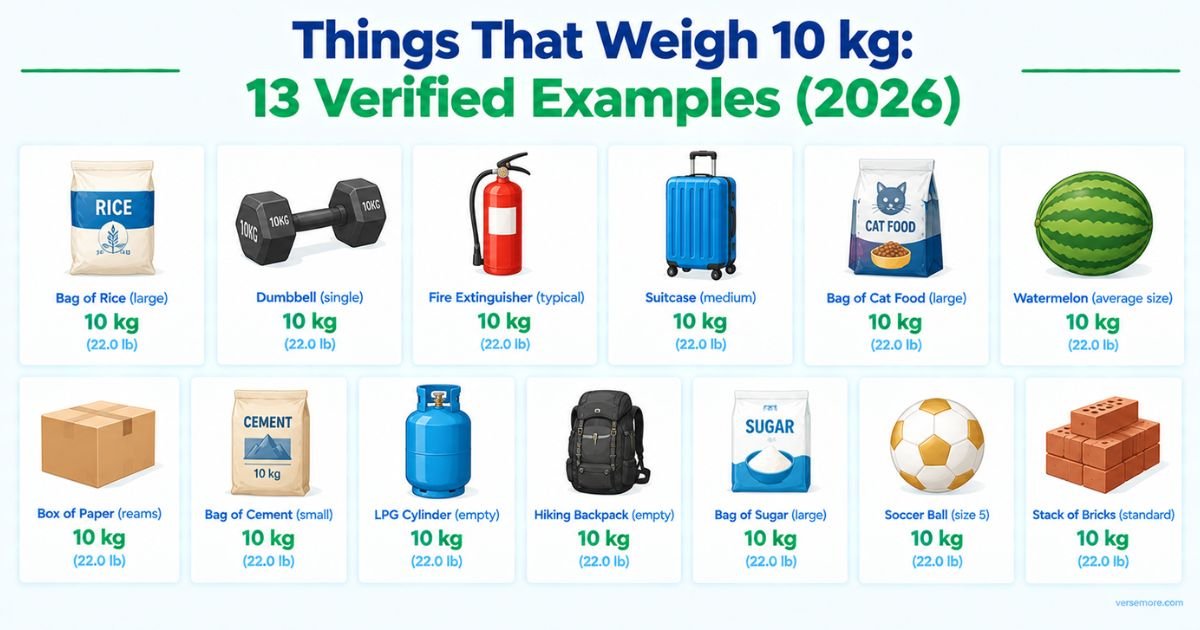
Ten kilograms is a weight you feel in your hands long before you can name it. It is the sack you drag across a kitchen floor, or the water a camper carries in one trip.
This guide covers things that weigh 10 kg. Each one is checked against a manufacturer spec, a published standard or plain arithmetic. Where a popular comparison is off by a kilo or more, you’ll see the corrected figure.
You’ll also get 10 kg in pounds, stone and ounces, and an answer to the question most lists skip: is 10 kg actually heavy?
10 kg is 10,000 grams, or about 22.05 pounds. That is close to 10 litres of water, a green Olympic weight plate, or two 11 lb bowling balls.
Key Takeaways
•        10 kg = 10,000 g = 22.05 lb = 1 st 8.05 lb (pound figures rounded once, from 22.0462 lb).
•        10 litres of water weighs 9.98 kg at 20 °C. It is very close, but not exactly 10.
•        No single ten-pin bowling ball can weigh 10 kg, because the USBC cap is 16 lb (7.26 kg).
•        A 24-pack of 12 oz regular cola is about 9.2 kg before the carton. A 24-pack of 330 ml cans is about 8.5 kg.
•        A 25 lb plate weighs 11.34 kg, so it is not a "10 kg" plate.
How Heavy Is 10 kg? (Pounds, Stone and Ounces)
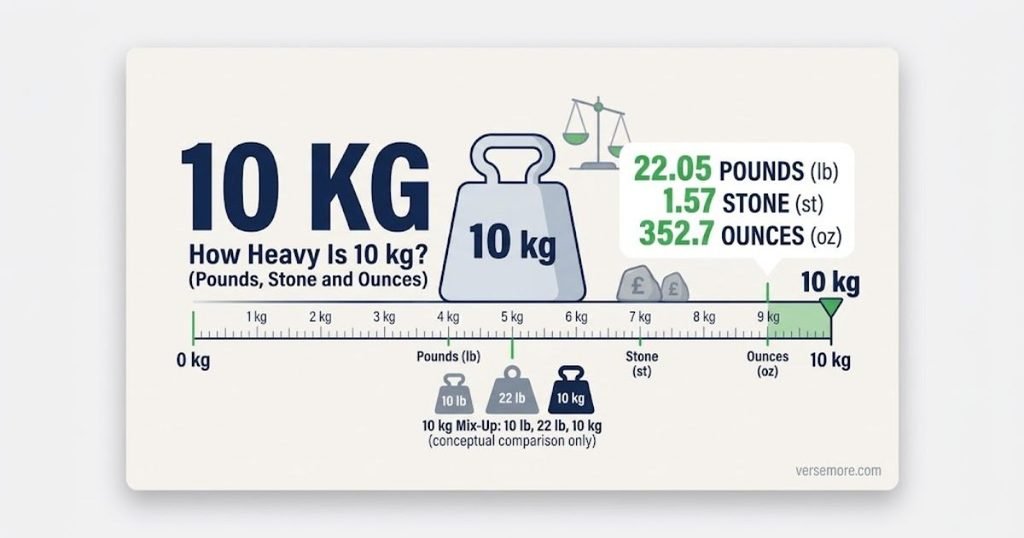
10 kg is exactly 10,000 grams and, rounded to two decimals, 22.05 pounds. In practice it is a load most adults can carry for a short walk but would not want to hold at arm’s length for long.
| Unit | 10 kg equals | Exact or rounded |
| Grams | 10,000 g | Exact |
| Milligrams | 10,000,000 mg | Exact |
| Metric tonnes | 0.01 t | Exact |
| Pounds | 22.05 lb | Rounded to 2 decimals |
| Pounds and ounces | 22 lb 0.74 oz | Rounded to 2 decimals |
| Ounces | 352.74 oz | Rounded to 2 decimals |
| Stone (decimal) | 1.57 st | Rounded to 2 decimals |
| Stone and pounds | 1 st 8.05 lb | Rounded to 2 decimals |
The pound figures use the international avoirdupois pound, defined as exactly 0.45359237 kg (NIST SP 811). Dividing 10 by that factor gives 22.046226… lb, and each row is rounded once, at the end.
For scale, 10 kg is 10,000 grams, or about 33 of the 300-gram objects in our guide to things that weigh 300 grams.
10 kg in Stone and Pounds
10 kg is 1 stone 8.05 lb, or roughly 1 stone 8 lb. A stone is exactly 14 lb, or 6.35029318 kg, and it is still the everyday body-weight unit in the UK and Ireland.
The decimal figure causes most of the errors. The 1.57 st in the table is a fraction of a stone, so the .57 is not 57 pounds. It works out to about 8 lb. That makes a 10 kg weight loss on a bathroom scale a loss of one stone and eight pounds.
10 kg, 22 lb and 10 lb: The Mix-Up
22 lb is 9.98 kg, which is 21 grams short of 10 kg. That is close enough for any bag you pack, and it is the nearest whole-pound figure to 10 kg.
10 lb is a different story, at only 4.54 kg. If a label says “10“, check the unit before you picture the weight. We cover the pound version in things that weigh 10 pounds.
Things That Weigh 10 kg in the Kitchen and Pantry
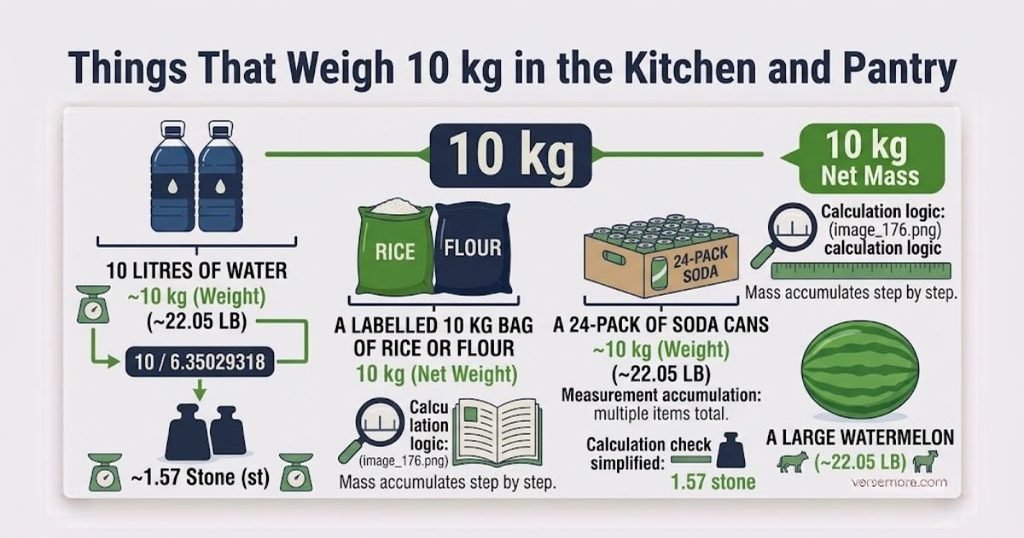
The kitchen gives you the most familiar 10 kg references. It is also where the most rounding happens, so each item below shows how close it really gets.
10 Litres of Water
Ten litres of water weighs 9.98 kg at 20 °C, because water’s density at that temperature is about 0.9982 kg per litre. At 4 °C, its densest point, it is 10 kg almost to the gram. Either way, the water alone is the closest thing to a pure 10 kg you can pour yourself.
The container adds to the total, and a full carrier sloshes as you walk, which shifts the weight with every step. If you own a plastic jerry can, fill it to the 10-litre mark and you have a reference that lives in your garage.
Gallon fans should note that 10 litres is 2.64 US gallons or 2.20 imperial gallons, because the two gallons differ in size.
A Labelled 10 kg Bag of Rice or Flour
A 10 kg sack of rice or flour is the one pantry item whose weight is printed on it. In many metric markets this is a standard retail size, and the figure is the net weight of the contents, so the paper or woven bag adds a little on top.
US bags are sold in pounds, so they rarely land on 10 kg. A 20 lb bag is 9.07 kg, and a 25 lb bag is 11.34 kg. With a common baking-chart value of 120 g per US cup, 10 kg of flour is about 83 cups, though that figure shifts with how you scoop.
A 24-Pack of Soda Cans
A 24-pack of cola is a popular 10 kg comparison, but the arithmetic puts it a little under. A full 12 oz can of regular cola holds 355 ml at about 1.04 g/ml, so roughly 369 g of liquid. Add a can weighing about 15 g, and each one comes to roughly 384 g. Twenty-four of them make about 9.2 kg before the carton.
Diet cola is lighter, at about 8.9 kg for 24. You would need around 26 regular 12 oz cans to reach 10 kg.
The European 330 ml can is lighter still. A manufacturer’s spec sheet for a 330 ml aluminium can lists a nominal empty weight of about 9.6 g. That puts a 24-pack near 8.5 kg, on my own arithmetic with the same cola density. For more on can sizes, see our guide to 12 oz aluminum can dimensions.
A Large Watermelon
A watermelon only reaches 10 kg, or about 22 lb, if it is a big variety. Published figures vary by source, but Charleston Gray is typically given at 20 to 30 lb. Crimson Sweet is quoted anywhere from 12 to 25 lb, depending on who you ask.
Smaller “icebox” types like Sugar Baby usually sit at roughly 6 to 13 lb, which is less than half of 10 kg for the lighter ones. So a melon is a fair 10 kg reference only when it is a large one, and a tape measure won’t tell you that. Check the sticker or the scale.
Things That Weigh 10 kg at the Gym and Bowling Alley
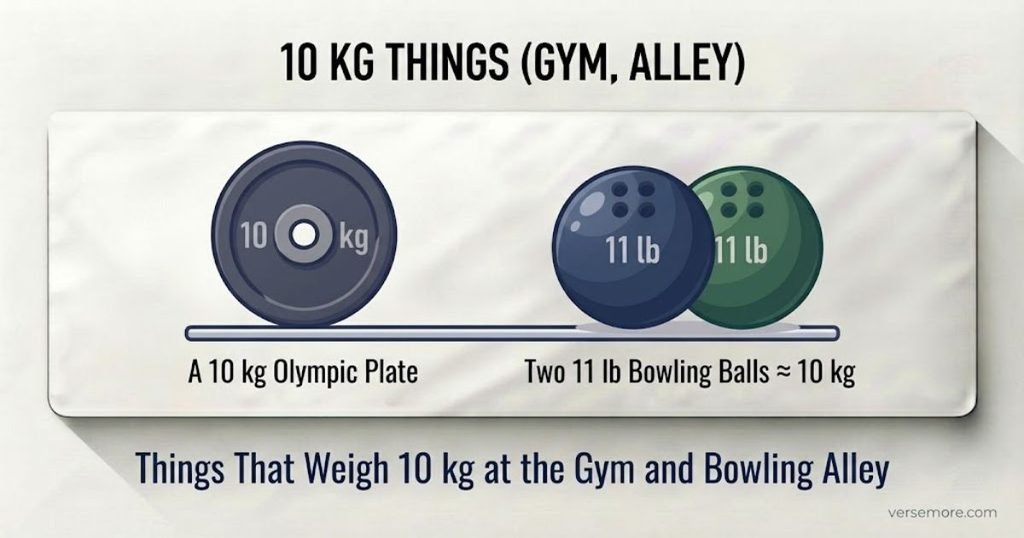
Gym kit is useful because the weight is stamped on the object itself. It is a good way to calibrate your hands, as long as you pick the right unit.
A 10 kg Olympic Weight Plate
A green competition bumper plate is the clearest 10 kg object you can buy. The IWF colour code runs green for 10 kg, yellow for 15, blue for 20 and red for 25. The plates share a 450 mm diameter and a 50.4 mm collar opening.
Makers publish tight tolerances, such as ±15 g on Rogue’s training plates. Thickness differs by brand, at about 30 to 31 mm on competition plates and 1.25 inches on Rogue’s.
Watch the unit on US plates. A 25 lb plate is 11.34 kg, so it is not a “10 kg” plate. Many bumper plates are also sold as pairs, so a listing for “10 kg” may mean 20 kg in the box.
Two 11 lb Bowling Balls
Two 11 lb house balls weigh 4.99 kg each and 9.98 kg together. That is a good hands-on 10 kg reference at any bowling alley, and you can feel the weight split evenly across both arms.
No single ball gets there, though. USBC specifications cap a ten-pin ball at 16 lb (7.26 kg), and house balls typically run from 6 to 16 lb. A claim that “a bowling ball weighs 10 kg” does not survive that check.
Things That Weigh 10 kg Around the House and Garage
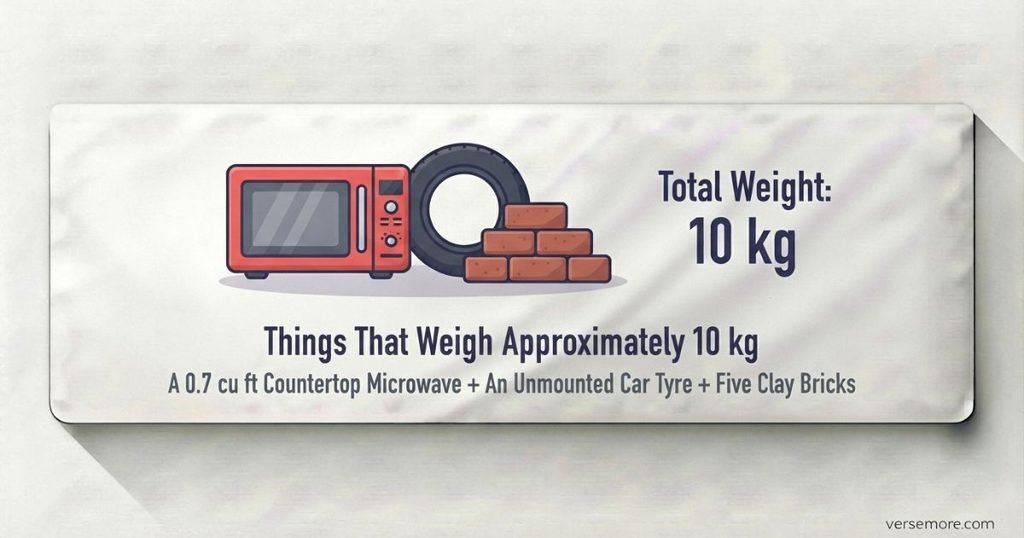
Household objects are the least standardised 10 kg references. Each one below is tied to a listed spec, and the near-misses are marked.
A 0.7 cu ft Countertop Microwave
A compact 0.7 cu ft microwave is the one appliance that reliably lands on 10 kg. The Black+Decker EM720CB7 is listed at 22.5 lb, which is 10.2 kg. Other listings of the same family run from 20.2 lb (9.2 kg) on an eBay listing to 23.6 lb (10.7 kg) at Walmart, so treat it as 10 kg give or take a kilo.
Size matters. The bigger Toshiba EM131A5C-BS, at 1.2 cu ft, is listed at 34.6 lb, or 15.7 kg. “A microwave weighs about 10 kg” is only true for the compact class, so check the capacity before you picture the weight.
An Unmounted Car Tyre
An unmounted passenger tyre (a “tire” in US spelling) reaches 10 kg only in the larger sizes. TyreReviews lists a Michelin Primacy 4 in 205/55 R16 91V at 8.49 kg, which is 18.7 lb. The wider 225/55 R17 97W is listed at 10.14 kg and the 97Y at 10.22 kg, or about 22.4 and 22.5 lb.
So a compact-car tyre falls about 1.5 kg short, while a mid-size 17-inch one matches. The weight excludes the wheel, and it varies by brand and construction even within one size. Check the listing for your own size.
Four to Five Clay Bricks
A standard UK facing brick measures 215 × 102.5 × 65 mm and weighs less than most lists assume. Listings run from about 1.95 kg for a frogged Forterra brick to 2.2 kg and 2.4 kg for Ibstock bricks. Breedon lists its dragface brick at 2.25 kg.
Four bricks therefore weigh 7.8 to 9.6 kg, and 10 kg usually takes four or five. Five bricks come to 9.75 to 12 kg. A frog, the indent in the top face, lightens a brick, and denser or solid types weigh more, so the maker’s figure is the one to trust.
Babies, Toddlers and Dogs at 10 kg
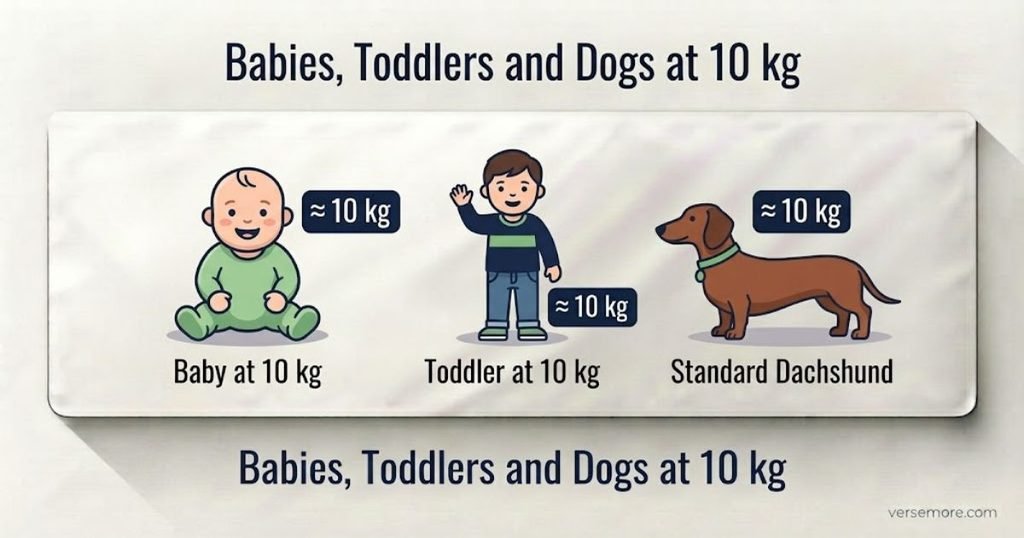
Living references are the easiest to picture, but they vary far more than objects do. These ranges come from published standards, not from a single “typical” animal or child.
A Baby or Toddler at 10 kg
A child reaches 10 kg later than the “one-year-old” line in most lists suggests. WHO’s median weight is 10.0 kg for girls at about 17 months, and for boys 10.1 kg at about 14 months.
At exactly 12 months the medians are 9.6 kg for boys and 8.9 kg for girls. The healthy range is wide: the 3rd to 97th percentiles at 12 months run from 7.8 to 11.8 kg for boys and from 7.1 to 11.3 kg for girls. So a healthy one-year-old can sit well on either side of 10 kg.
These are population figures. Questions about an individual child’s growth belong with a paediatrician or health visitor, not with a chart.
A Standard Dachshund
A standard dachshund is a mid-range 10 kg example. The breed standard puts the standard dachshund at 16 to 32 lb, or 7.3 to 14.5 kg, so 10 kg (22 lb) sits comfortably inside it. A miniature dachshund is capped at 11 lb (5 kg), which makes a 10 kg dog about twice a miniature’s weight.
Because the range is wide, a vet is the right person to say whether a particular dog’s weight suits its frame.
Things That Weigh 10 kg When You Travel
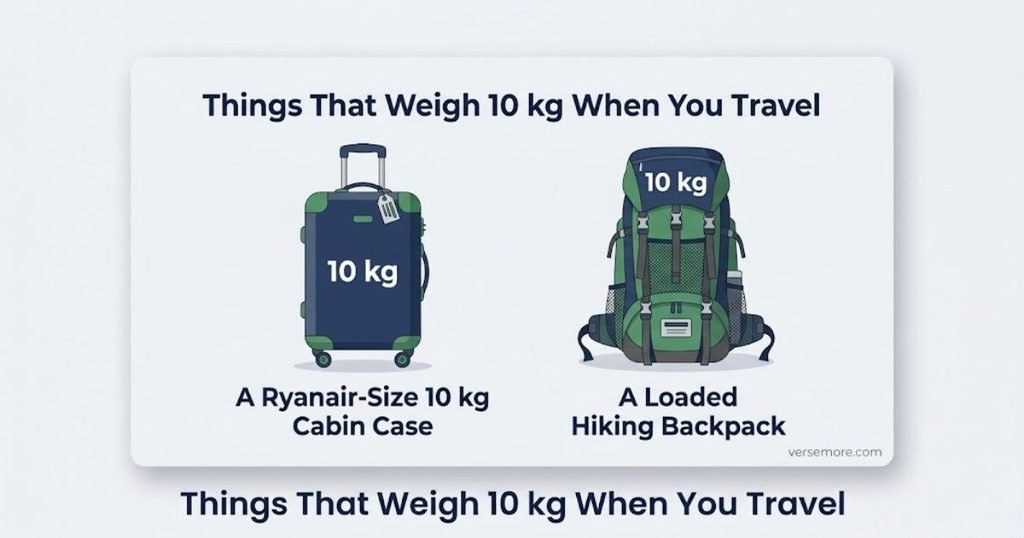
For travellers, 10 kg is a rule at the airport as much as a feeling in the arm.
A Ryanair-Size 10 kg Cabin Case
Ryanair’s help centre describes a free small bag of 40 × 30 × 20 cm that goes under the seat. Its Priority & 2 Cabin Bags option adds a 10 kg bag of 55 × 40 × 20 cm for the overhead locker.
It also sells a 10 kg check-in bag, which goes in the hold, so the same weight can travel either way. The scale weighs the packed case, so the case’s own weight counts against the 10 kg. In pounds, 10 kg is 22.05 lb, so 22 lb on a US scale is just inside it.
Ryanair’s pages don’t state a weight for the free small bag. Secondary guides say only that you must be able to lift it yourself, so check the current policy when you book.
A Loaded Hiking Backpack
A 10 kg pack feels very different depending on who wears it. Walkers on a pilgrimage forum talk about 10 per cent of body weight as a target. That is a community rule of thumb, not a standard.
By my own arithmetic, the share changes quickly with body weight:
| Body weight | A 10 kg pack as % of body weight |
| 50 kg | 20% |
| 60 kg | 16.7% |
| 70 kg | 14.3% |
| 80 kg | 12.5% |
| 100 kg | 10% |
Percentages are rounded to one decimal place and exclude water you drink along the way.
“10 kg” Claims That Don’t Hold Up
Some comparisons appear on many pages and fail a quick check. The error is usually the same: a figure borrowed from a different size, unit or product.
| Claim seen online | What the evidence shows |
| A 1.2 cu ft Toshiba microwave weighs 22.5 lb (10.2 kg) | The Toshiba is listed at 34.6 lb (15.7 kg). The 22.5 lb figure belongs to the smaller 0.7 cu ft Black+Decker. |
| Four bricks make 10 kg | UK facing bricks are listed at about 1.95 to 2.4 kg each, so four weigh 7.8 to 9.6 kg. |
| Four reams of paper make 10 kg (some say a ream has 5,000 sheets) | A ream is 500 sheets. A US letter ream of 20 lb bond weighs about 5 lb, so four reams are about 20 lb (9.07 kg). |
| A 5-gallon bucket of paint weighs 9–11 kg | Latex paint is commonly given at about 10 to 11 lb per US gallon, so five gallons is about 50 to 55 lb (22.7 to 24.9 kg) before the pail. |
| A Maine Coon cat weighs about 10 kg | One breed guide, citing TICA, gives adult males as 8.2 to 10 kg and females as 5.4 to 6.8 kg. A 10 kg cat is at the very top of the male range. |
| A one-year-old baby weighs 10 kg | WHO medians at 12 months are 9.6 kg for boys and 8.9 kg for girls. |
Ream and paint figures are rules of thumb. Check the label for your own product.
Is 10 kg Heavy? How Carrying Changes the Answer
For most healthy adults, 10 kg is a moderate load. It is easy to lift once and tiring to carry for long.
Britain’s HSE publishes lifting guideline figures of 25 kg for men and 16 kg for women. They apply to infrequent lifts of a load held close to the body at about waist height. The HSE says they are screening figures, not safe limits, and they fall in the highest and lowest zones. Workplace guidance reproducing the HSE diagram gives about 10 kg for men and 7 kg for women there.
So “is 10 kg heavy for a woman?” depends on the task. At waist height and close to the body, 10 kg is inside the 16 kg guideline. Held out in front or reached overhead, it is a different job. NIOSH’s lifting equation in the US starts from a ceiling of 23 kg (51 lb) in ideal conditions and reduces it from there.
Position changes how 10 kg feels, which I’ll call the 3-Carry Comparison:
| How you carry 10 kg | Why it feels different |
| On your back (backpack) | The load sits close to your centre of mass and your legs do most of the work. |
| Two-handed, close to the body | The HSE guideline case: the load stays near your trunk. |
| One hand at your side | Grip fatigues first, and the load pulls your shoulder out of line. |
| Held out in front or overhead | The load acts at arm’s length, so your shoulders and back feel more than the number suggests. |
If you are pregnant, recovering from an injury or have a back condition, take advice from a health professional before lifting loads like this.
10 kg Compared With 9 kg, 12 kg and Other Near Misses
Most “10 kg” mistakes come from a neighbouring weight. If you are asking what weighs 9 kg, nine litres of water is the cleanest answer at 8.98 kg, and a 20 lb sack is close behind. A few other weights are easy to mistake for 10 kg:
| Weight | In kg | In pounds | Difference from 10 kg | Everyday anchor |
| 10 lb | 4.54 | 10.00 | −5.46 kg (−54.6%) | Two reams of US letter paper |
| 9 kg | 9.00 | 19.84 | −1.00 kg (−10.0%) | Nine litres of water (8.98 kg at 20 °C) |
| 20 lb | 9.07 | 20.00 | −0.93 kg (−9.3%) | A 20 lb sack of rice or potatoes |
| 22 lb | 9.98 | 22.00 | −0.02 kg (−0.2%) | A cabin bag when your scale reads in pounds |
| 10 kg | 10.00 | 22.05 | n/a | Ten litres of water (9.98 kg) |
| 25 lb | 11.34 | 25.00 | +1.34 kg (+13.4%) | A US 25 lb weight plate |
| 12 kg | 12.00 | 26.46 | +2.00 kg (+20.0%) | Six 2-litre bottles of water |
Pound and kilogram conversions use 1 lb = 0.45359237 kg exactly, rounded once to two decimals. Percentages are rounded to one decimal.
Two rows matter most for shoppers. A 20 lb sack is 0.93 kg lighter than a 10 kg one, and a 25 lb plate is 1.34 kg heavier. If you want the next step up, our guide to things that weigh 12 kg shows how that extra 2 kg changes the examples.
How to Check 10 kg Without a Scale
You can confirm 10 kg at home with ordinary items. Here are four ways, from most to least accurate:
1. Use a hanging luggage scale. Weigh the packed bag directly, but check the scale first against a known weight such as 10 litres of water.
2. Subtract on a bathroom scale. Weigh yourself, weigh yourself again holding the object, and take the difference. Many bathroom scales show coarse steps, so repeat the weighing two or three times and average the results.
3. Build it from water. Ten 1-litre bottles hold about 9.98 kg of water at 20 °C. Counting the bottles themselves, you land slightly over 10 kg.
4. Use a printed weight. A green 10 kg bumper plate or a labelled 10 kg sack of rice or flour is more trustworthy than a guess.
FAQ’s
How many pounds is 10 kg?
10 kg is 22.05 pounds, or 22 lb 0.74 oz. The exact figure is 22.0462 lb, because one pound is defined as exactly 0.45359237 kg, and the result is rounded once at the end.
What is 10 kg in stone and pounds?
10 kg is 1 stone 8.05 lb, or roughly 1 stone 8 lb. The decimal form is 1.57 st, and the .57 is a fraction of a stone, not 57 pounds.
Is 10 kg heavy to carry?
For most healthy adults, 10 kg is a moderate load: easy to lift once and tiring over distance. The HSE’s guideline figures are 25 kg for men and 16 kg for women, for lifts close to the body at waist height. They are screening figures rather than safe limits, and they drop for loads held at arm’s length or overhead.
Is 10 kg heavy for a woman?
It depends on how it is carried. At waist height and close to the body, 10 kg is inside the HSE’s 16 kg guideline figure for women. The same load held out in front, lifted high or carried far is a different task, and the figures fall in those positions.
What household items weigh 10 kg?
A compact 0.7 cu ft microwave is one: the Black+Decker EM720CB7 is listed at 22.5 lb, which is about 10.2 kg. Ten litres of water weighs 9.98 kg, and a larger 17-inch passenger tyre can reach about 10.1 to 10.2 kg. A labelled 10 kg bag of rice or flour is the most exact example.
Can I take 10 kg as hand luggage?
On some airlines, yes, but it varies by carrier and fare. Ryanair’s help centre describes a 10 kg bag of 55 × 40 × 20 cm as part of its paid Priority & 2 Cabin Bags option, alongside a free small bag. Check your own booking, because limits change and the packed bag’s own weight counts.
How many litres of water weigh 10 kg?
About 10.02 litres, because water weighs about 0.998 kg per litre at 20 °C. That is roughly 2.65 US gallons or 2.20 imperial gallons, and the two gallons differ in size.
What age is a baby who weighs 10 kg?
WHO medians put 10 kg at about 14 months for boys and about 17 months for girls. Healthy children vary a lot around those medians, so a question about an individual child belongs with a paediatrician or health visitor.
Is 10 kg the same as 10 lb?
No. 10 lb is 4.54 kg, and 10 kg is 22.05 lb. The two only look alike because both use the digits “10”. We cover the pound version in things that weigh 10 pounds.
Conclusion
The things that weigh 10 kg are less alike than most lists suggest. A compact microwave, ten litres of water, a standard dachshund and a green weight plate all land close to the mark, but only when you check which size, which model and which unit a figure refers to. Items sold in pounds rarely match, and a 20 lb sack falls nearly a kilogram short.
The most reliable references are the ones with a printed weight or a published standard: a plate marked 10 kg, a labelled sack, WHO growth tables, a manufacturer’s listing. Use those to calibrate your hands, then treat any round “about 10 kg” comparison with a little suspicion.

I am the admin of VerseMore, sharing helpful, informative, and engaging content on various topics to inspire readers, provide value, and make everyday life easier.