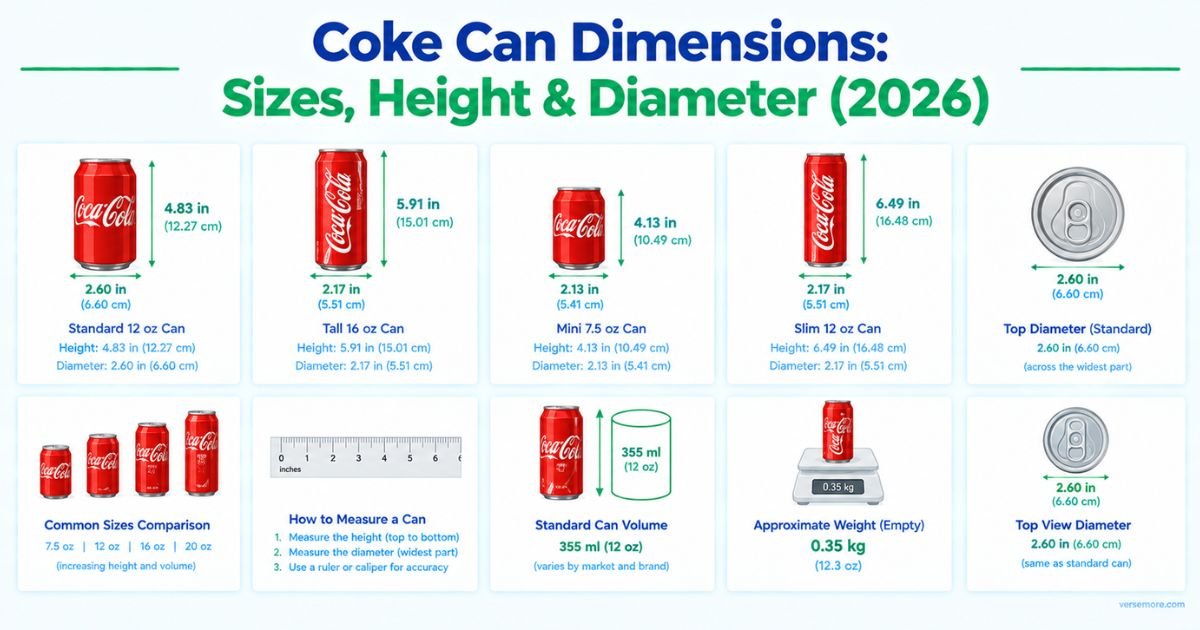
Coke cans come in several sizes and shapes, depending on the market, beverage capacity, and packaging format. If you need a can for a cup holder, refrigerator shelf, product photograph, craft project, or 3D model, knowing its height and diameter is often more useful than knowing its capacity alone. This guide explains common Coke can dimensions in inches, centimeters, and millimeters, compares popular formats, and shows how to measure a can accurately.
Measurements in this guide are representative rather than universal specifications for every Coca-Cola product. Can dimensions can vary by manufacturer, market, and design. If a precise fit matters, measure the specific can or check its manufacturer’s specification.
What Are the Standard Coke Can Dimensions?
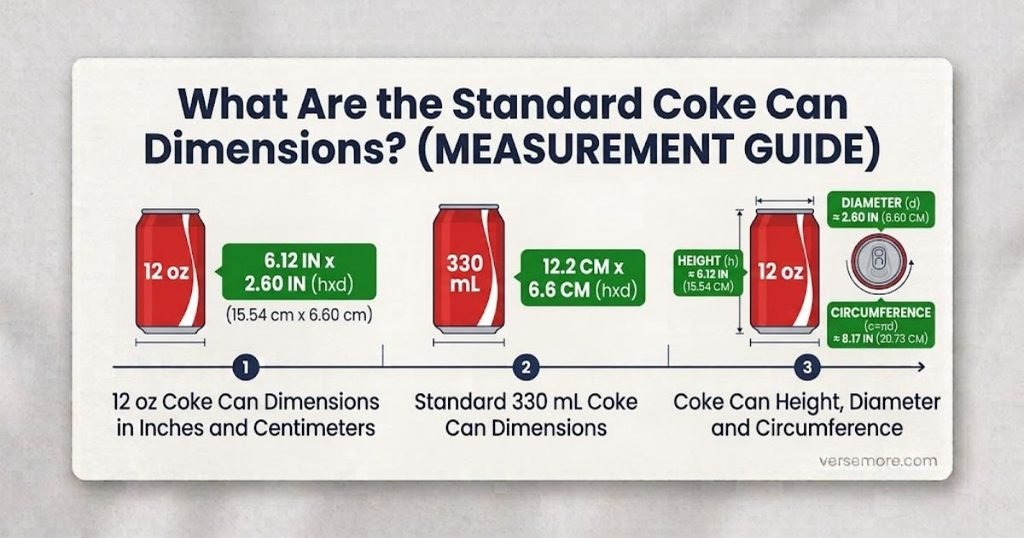
A typical US Coke can holds 12 US fluid ounces, approximately 355 mL. A representative can is about 4.8 inches (12.2 cm) tall, with a body diameter of around 2.6 inches (6.6 cm). These figures are useful for general reference, but they should not be treated as guaranteed dimensions for every can.
12 oz Coke Can Dimensions in Inches and Centimeters
| Measurement | Inches | Centimeters | Millimeters |
| Height (representative) | 4.81 in | 12.22 cm | 122.2 mm |
| Body diameter (approx.) | 2.60 in | 6.60 cm | 66.0 mm |
| Circumference (calculated approx.) | 8.17 in | 20.73 cm | 207.3 mm |
| Capacity | 12 US fl oz | 35.5 cL | 355 mL |
Standard 330 mL Coke Can Dimensions
A published specification for a classic 330 mL beverage can lists a height of 115 mm (11.5 cm or about 4.53 inches) and a diameter of 66 mm (6.6 cm or about 2.60 inches). This is a manufacturer example, not a promise that every 330 mL Coca-Cola can has precisely the same dimensions.
Coke Can Height, Diameter and Circumference
Height is the vertical distance from the bottom to the top of the can. Diameter is the distance across the circular body through its center. Circumference is the distance around the body. For a roughly circular body, circumference can be estimated with C = π × d, where d is diameter and π is approximately 3.1416. A 6.6 cm diameter gives a calculated circumference of about 20.7 cm (8.16 inches).
Coke Can Size Chart: All Common Sizes Compared
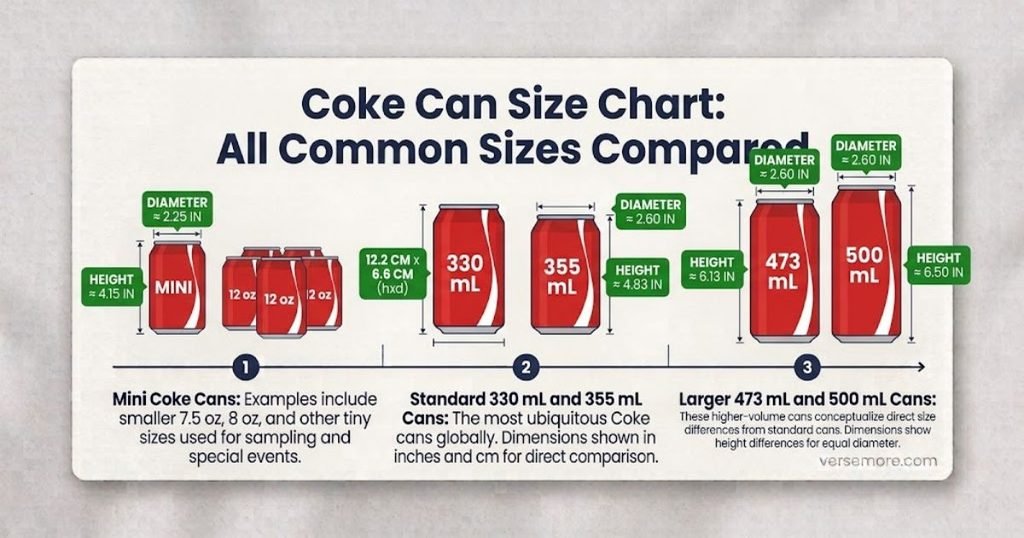
The table below compares common beverage-can capacities. It is a format guide, not a universal dimensional chart: height and diameter depend on the exact can design.
| Can format | Typical capacity | Dimension note |
| Mini can | 7.5 US fl oz (about 222 mL) | Dimensions vary by product and market. |
| Standard US can | 12 US fl oz (about 355 mL) | A common reference format. |
| Metric standard can | 330 mL | A common format in many markets. |
| Larger can | 16 US fl oz (about 473 mL) | Often taller than a standard can, but design varies. |
| Large metric can | 500 mL | Height and profile depend on the manufacturer. |
| Slim can | Often around 250 mL | Typically narrower; exact dimensions vary. |
| Sleek can | Varies; some formats are 330–355 mL | Usually taller and narrower than a standard can. |
Mini Coke Cans
Mini cans are smaller-capacity formats, with examples around 7.5 US fluid ounces. Their height and diameter are not identical across all products, so check the label or measure the can if dimensions are important.
Standard 330 mL and 355 mL Cans
The 330 mL and 355 mL formats are common but are not interchangeable in capacity. Their outer dimensions may be similar in some designs, yet differences in height, rim, or base can affect storage and fit.
Larger 473 mL and 500 mL Cans
Larger cans can require additional shelf height or holder depth. Do not estimate fit from capacity alone; compare the actual height and widest body diameter.
Slim and Sleek Coke Can Dimensions
Slim cans generally have a narrower body, while sleek cans typically have a taller, narrower appearance than a standard can. These are general profile descriptions, not fixed standards. Dimensions depend on the can specification.
Coke Can Dimensions in Inches, CM and MM
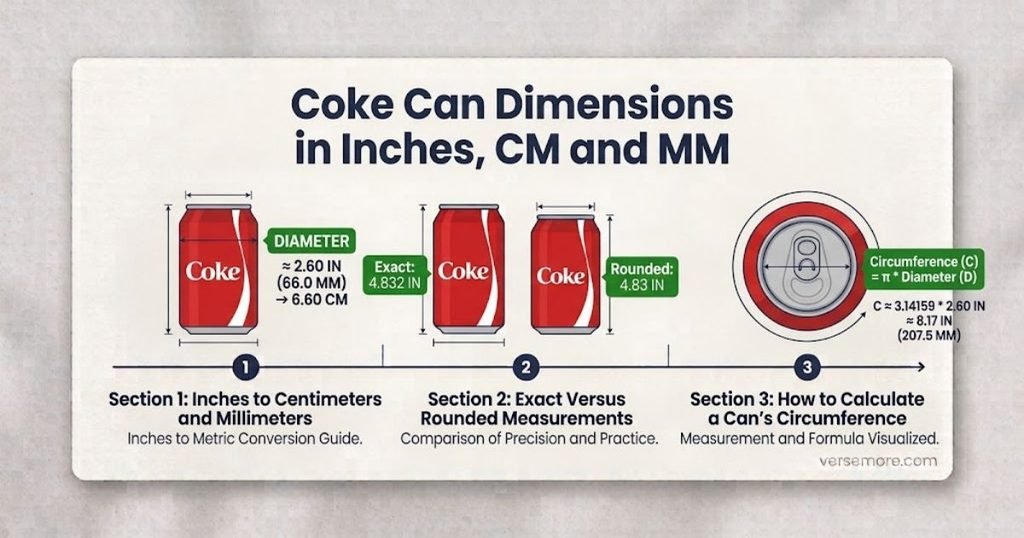
Coke cans are often measured in inches in the United States and in millimeters or centimeters in many other countries. Converting between units makes it easier to compare sizes, plan storage, create product mockups, and build models.
Inches to Centimeters and Millimeters
The exact conversion is 1 inch = 2.54 centimeters = 25.4 millimeters.
| Measurement | Inches | Centimeters | Millimeters |
| Typical 12 oz can height | 4.81 in | 12.22 cm | 122.2 mm |
| Typical body diameter | 2.60 in | 6.60 cm | 66.0 mm |
| Typical circumference | 8.17 in | 20.73 cm | 207.3 mm |
| Example 330 mL can height | 4.53 in | 11.5 cm | 115 mm |
| Example 330 mL can diameter | 2.60 in | 6.6 cm | 66 mm |
These are representative measurements, not guaranteed specifications for every Coca-Cola can. The example 330 mL measurements match a published beverage-can manufacturer specification.
Exact Versus Rounded Measurements
Rounded measurements work for general comparisons but may not be precise enough for close-fitting projects. For example, “about 12 cm tall” is useful as a quick reference, while a measurement in millimeters is more precise. For a custom fit, measure the actual can and include any features that extend beyond its main body.
How to Calculate a Can’s Circumference
Circumference = π × diameter. For a body diameter of 6.6 cm: 3.1416 × 6.6 ≈ 20.73 cm.
The result is a calculated estimate. A direct measurement may differ slightly because of the can’s shape and the measurement technique.
Standard vs. Slim vs. Sleek Coke Cans
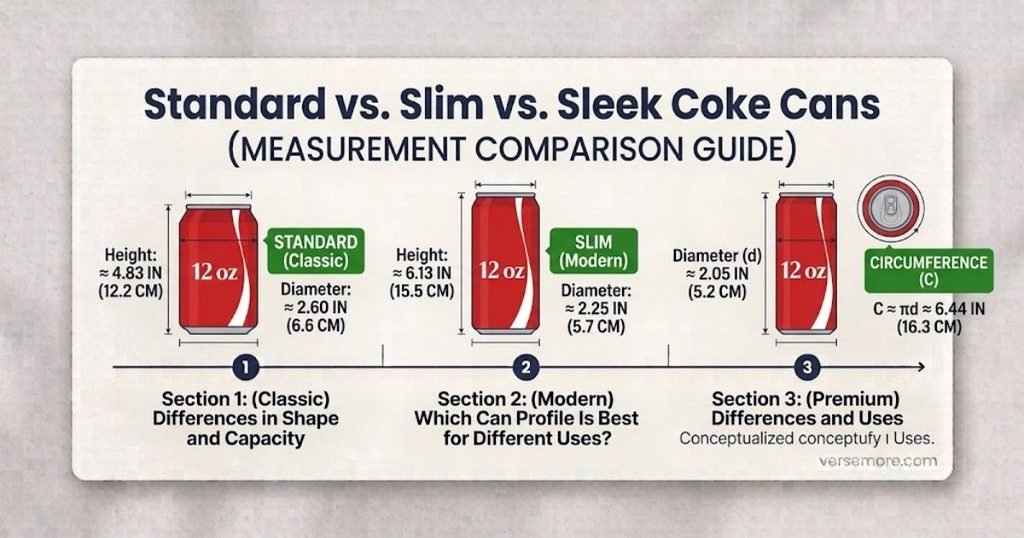
Beverage cans are produced in different profiles to suit capacity, packaging requirements, and presentation. “Standard,” “slim,” and “sleek” describe general shapes and should not be treated as universal dimensional specifications.
Differences in Shape and Capacity
A standard can typically has a familiar, relatively broad soda-can profile. A slim can usually has a narrower body, and a sleek can generally appears taller and narrower than a standard can. Capacity and shape are related, but a can’s height alone cannot tell you how much liquid it holds.
Which Can Profile Is Best for Different Uses?
| Use | What to consider |
| Refrigerator or pantry | Can height, shelf clearance, and room to remove the can. |
| Car cup holder | Body diameter, base shape, and holder depth. |
| Product photography | Height, silhouette, label area, and viewing angle. |
| Packaging or display design | Actual outer dimensions and clearance. |
| 3D modeling | Height, body diameter, rim profile, and base recess. |
| Crafts or custom holders | Widest and narrowest points of the specific can. |
How to Measure a Coke Can Correctly
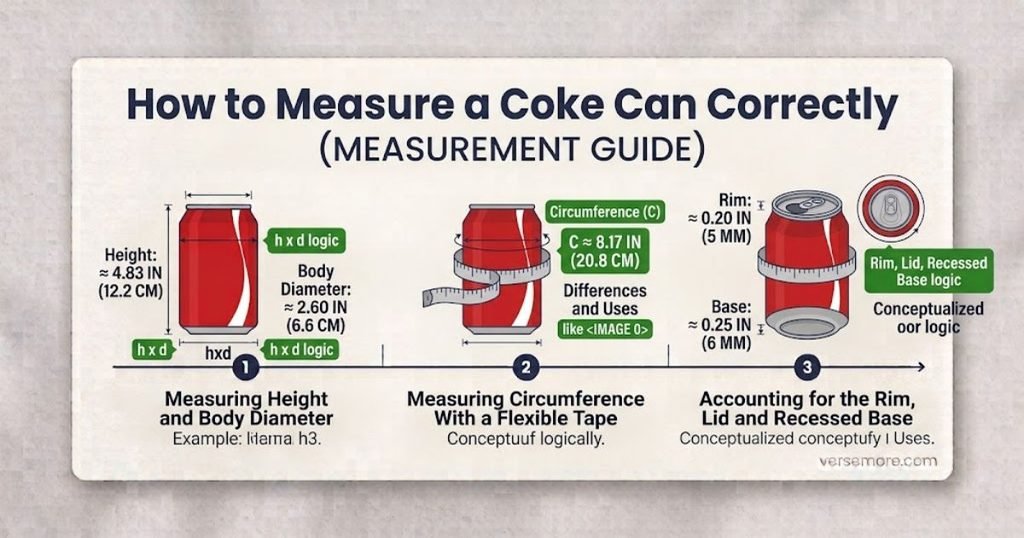
If you need accurate dimensions, measuring the actual can is usually more reliable than copying a generic online measurement. A ruler or digital caliper can help with height and diameter; a flexible measuring tape works for circumference.
Measuring Height and Body Diameter
1. Place the can upright on a flat, level surface.
2. Measure from the bottom to the highest point if you need overall height.
3. Measure straight across the widest part of the cylindrical body to find its diameter.
4. Check the rim and base separately if the can must fit inside a holder or enclosure.
5. Record measurements in millimeters or centimeters, then convert them if necessary.
Do not assume the top opening, lid, or recessed bottom has the same diameter as the main body. These features have different shapes and may affect the fit.
Measuring Circumference With a Flexible Tape
Wrap a flexible measuring tape around the can’s body, keeping it level and snug without compressing it. If you do not have a flexible tape, wrap a narrow strip of paper around the can, mark where the ends meet, and measure the marked length with a ruler.
Accounting for the Rim, Lid and Recessed Base
A beverage can is not a simple cylinder from top to bottom. Its top narrows toward the lid, and its bottom is shaped to support the can. For general comparisons, height and body diameter may be enough. For custom-fit objects, also measure the overall height, widest body diameter, top rim, base shape, and needed clearance.
Why Coke Can Dimensions Matter in Real Life
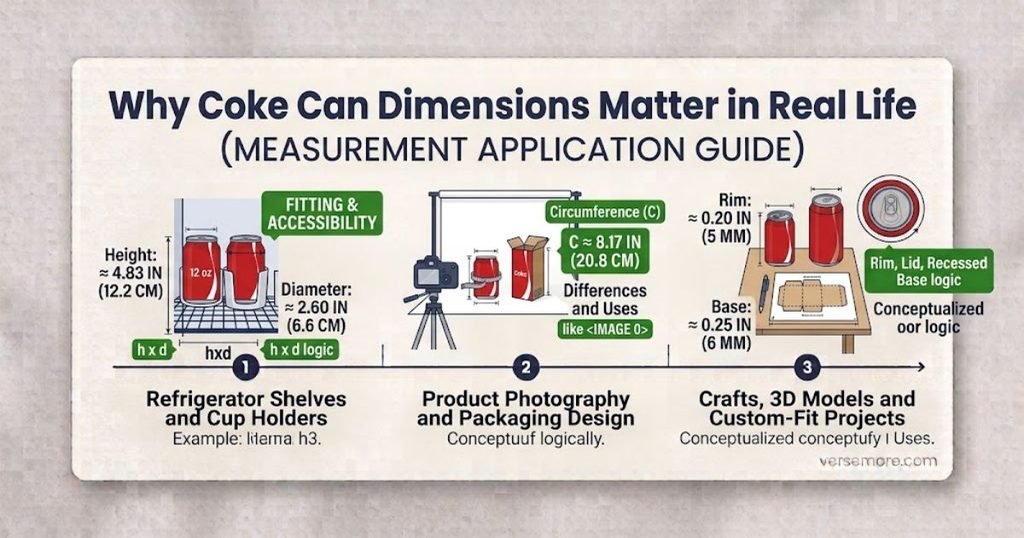
Refrigerator Shelves and Cup Holders
Check shelf height and available width before arranging cans in a refrigerator. Cup holders vary in opening size, depth, and shape. Measure the holder and compare it with the can’s widest body section and base; nominal capacity alone cannot confirm a fit.
Product Photography and Packaging Design
Can height and diameter help establish proportions in product photographs, digital mockups, packaging layouts, and promotional graphics. The profile, shoulder, lid, base, and label placement also affect appearance. Use the exact product as a reference when a design must closely match a particular can.
Crafts, 3D Models and Custom-Fit Projects
Can measurements can help with DIY organizers, decorative projects, printable models, and custom holders. Approximate dimensions may be sufficient for a visual model, but a physical part should use measured dimensions and suitable clearance. Test a prototype with the actual can before producing multiple copies.
Coke Can Dimensions vs. Actual Liquid Capacity
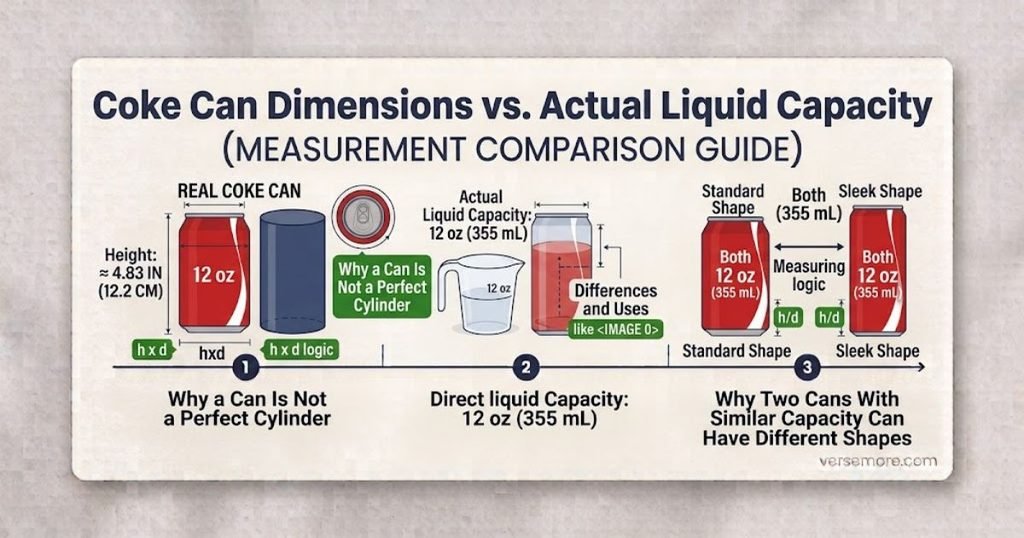
Why a Can Is Not a Perfect Cylinder
The volume of a perfect cylinder is calculated as V = π × r² × h, where V is volume, r is radius, and h is height. A real beverage can has a shaped top, a recessed base, and curved transitions. Its external dimensions therefore cannot be treated as a perfect cylinder to calculate exact liquid capacity.
Why Two Cans With Similar Capacity Can Have Different Shapes
Two cans can hold similar amounts of liquid while having different heights and diameters. For example, a shorter, wider can and a taller, narrower can may have comparable capacities. Published manufacturer examples show that even 250 mL slim and sleek formats can have different dimensions. Compare capacity, height, and diameter together rather than relying on capacity alone.
FAQ’s
How tall is a standard Coke can?
A typical US 12 US fluid ounce (355 mL) Coke can is approximately 4.8 inches (12.2 cm) tall. Exact dimensions can vary by can design and manufacturer.
How wide is a 12 oz Coke can?
A typical 12 oz can has a body diameter of approximately 2.6 inches (6.6 cm). The top rim and recessed base may have different diameters.
How many centimeters tall is a Coke can?
A typical US 12 oz can is around 12.2 cm tall. One published specification for a 330 mL can lists a height of 11.5 cm and a diameter of 6.6 cm.
What is the circumference of a standard Coke can?
For a can with a body diameter of 6.6 cm, the calculated circumference is approximately 20.7 cm (8.16 inches). Actual measurements may vary slightly.
Are 330 mL and 355 mL Coke cans the same size?
Not necessarily. They have different capacities, and their external dimensions may differ. Check the manufacturer’s specifications if precision matters.
Are Coke cans the same size worldwide?
No. Capacities and shapes vary by country, product, and packaging format. Check the dimensions for the specific market and product.
How tall is a mini Coke can?
Mini cans come in several formats, so there is no single height that applies to all of them. Check the specific product or measure the can.
Can I use standard Coke can dimensions for a 3D model?
Yes, for a rough visual model. For a model that must match a real can or fit into a holder, measure its height, body diameter, rim, and base.
What is the difference between can height and diameter?
Height is the vertical distance from the bottom to the top. Diameter is the distance across the circular body through its center.
How do I measure a Coke can without special tools?
Use a ruler for height and body width. For circumference, wrap a paper strip around the body, mark where the ends meet, and measure the strip.
Conclusion
Coke can dimensions depend on capacity, shape, and intended market. A typical US 12 oz can measures about 4.8 inches (12.2 cm) tall and 2.6 inches (6.6 cm) in body diameter, while a 330 mL can may have a different height despite a similar diameter. Use these figures as general references, convert measurements carefully, and check the actual can or its manufacturer’s specifications whenever accuracy matters.

I am the admin of VerseMore, sharing helpful, informative, and engaging content on various topics to inspire readers, provide value, and make everyday life easier.