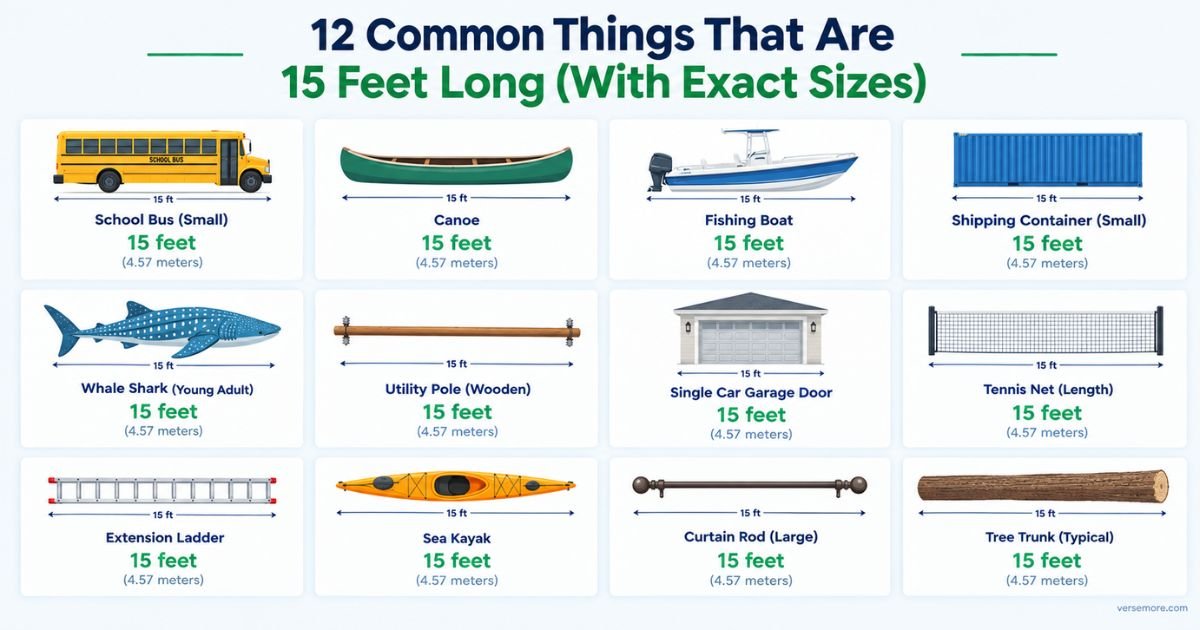
Fifteen feet doesn’t mean much as a number on its own. It’s the kind of measurement that only makes sense once you connect it to something you can actually picture — a truck, a ladder, a shark cruising past a boat.
That’s what this guide does. Instead of just converting 15 feet into other units, it walks through twelve real, everyday things that are 15 feet long, shows which ones hit that mark exactly and which are just close, and gives you a couple of practical tools for judging 15 feet on your own, without pulling out a tape measure.
Whether you’re trying to picture what will fit in a truck bed, wondering if a ladder will reach your roofline, or just curious how a great white shark stacks up against a canoe, you’ll have a clear mental ruler for 15 feet by the end of this.
15 feet is equal to 180 inches, 5 yards, or about 4.57 meters.
How Long Is 15 Feet, Exactly?
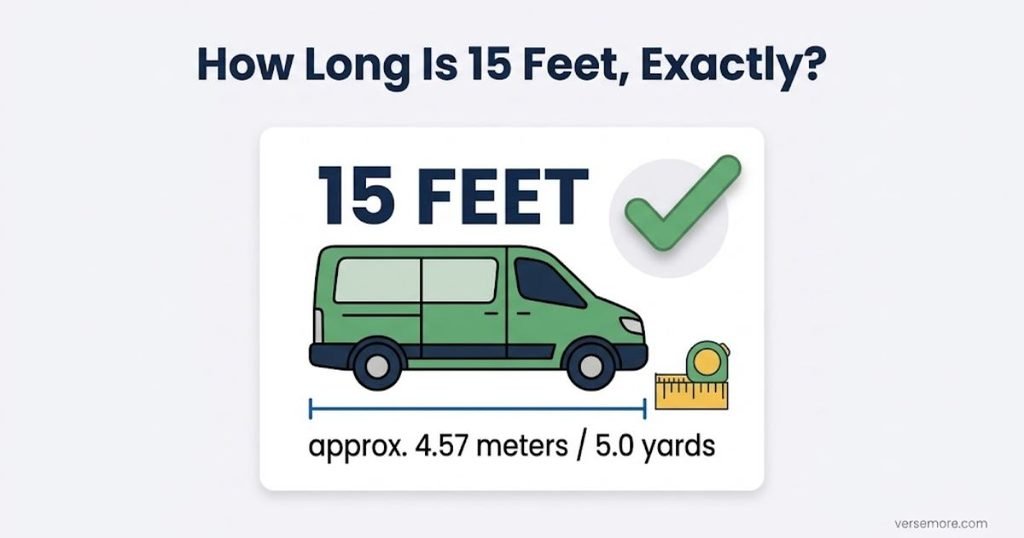
15 feet equals 180 inches, 5 yards, 4.572 meters, or 457.2 centimeters. It’s a length that shows up constantly in construction, transportation, and outdoor gear, which is part of why so many everyday objects happen to land close to it.
Here’s the full breakdown:
| Unit | Value |
| Inches | 180 in |
| Yards | 5 yd |
| Meters | 4.572 m |
| Centimeters | 457.2 cm |
| Millimeters | 4,572 mm |
| Miles | ≈ 0.00284 mi |
For readers outside the US, 4.57 meters is the number worth remembering — it’s roughly the length of a small delivery van, or a little longer than two standard doorways laid end to end.
One distinction worth making early: a lot of “15 feet” comparisons online mix up length and height — for example, describing an animal’s height as if it answers a question about length. In this guide, each entry is labeled clearly as one or the other, so you’re not left wondering which dimension you’re actually picturing.
Comparison Table: 15 Feet at a Glance
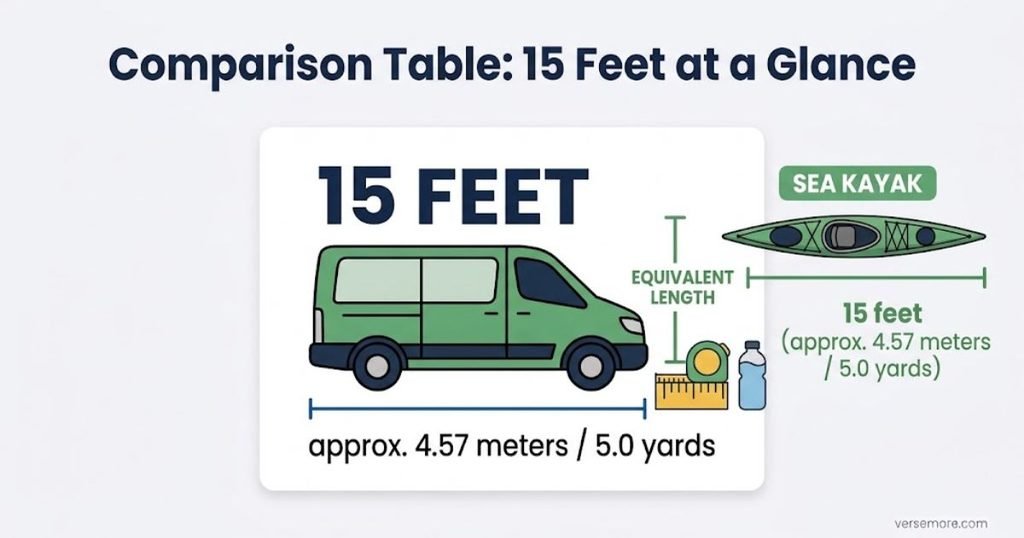
Before getting into each item individually, here’s a quick side-by-side view. “Exact” means the object is built or standardized to that length; “approximate” means it typically falls close to 15 feet but varies by model, individual, or manufacturer.
| Item | Category | Length/Height | Exact or Approx. |
| Compact SUV (e.g., Toyota RAV4) | Vehicle | ~15 ft long | Approximate |
| 15-foot box truck | Vehicle | 15 ft long | Exact (by design) |
| Small ski/fishing boat | Vehicle | ~15 ft long | Approximate |
| Great white shark (average adult) | Animal | ~15 ft long | Approximate |
| Southern elephant seal (bull) | Animal | 14–15 ft long | Approximate |
| Giraffe | Animal | ~15–19 ft tall | Height, not length |
| Recreational canoe | Recreation | ~15 ft long | Approximate |
| Bowling approach area | Recreation | 15 ft minimum | Exact (by rule) |
| Extension/step ladder | Household/DIY | 15 ft | Exact (by size) |
| Heavy-duty extension cord | Household/DIY | 15 ft | Exact (by size) |
| Residential flagpole | Outdoor | 15 ft | Exact (common size) |
| Half a standard shipping container | Cargo | 15 ft (of a 30 ft unit) | Exact (by math) |
A few of these are precise because they’re manufactured or regulated to that exact length — a ladder, a cord, a flagpole. Others, like the shark or the SUV, are natural variation around an average, so “15 feet” is a useful reference point rather than a guarantee.
Vehicles and Transportation That Are About 15 Feet Long
Compact SUV
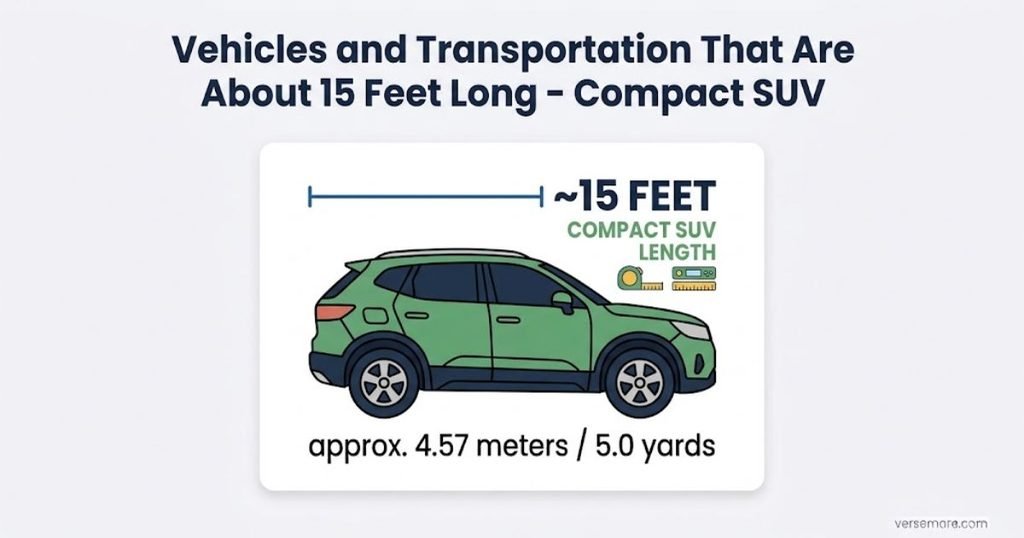
Many popular compact SUVs land right around 15 feet. The Toyota RAV4, for example, measures about 180.9 inches — just a hair over the 15-foot mark. The Ford Bronco Sport and similar crossovers fall in the same range depending on trim.
If you’ve ever parked one of these in a standard driveway or garage, you’ve already got a working sense of 15 feet. It’s a useful reference specifically because these vehicles are everywhere — no need to imagine anything exotic.
15-Foot Box Truck
Rental companies sell moving trucks by length for a reason, and the 15-foot box truck is one of the most common sizes on the lot. It’s built to hold the contents of a studio or one-bedroom apartment: a bed frame, a couch, a handful of boxes, without the extra bulk (and fuel cost) of a 20- or 26-foot truck.
Unlike the SUV example above, this one is exact by design — the cargo box itself is manufactured to that length, not just an average across similar vehicles.
Small Ski or Fishing Boat
In the boating world, 15 feet is a genuine sweet spot. It’s long enough to handle a lake comfortably and tow a water-skier, but still light enough to trailer with a mid-size vehicle and store in a standard garage bay. Aluminum fishing boats and entry-level ski boats both cluster around this length for exactly that reason — it’s a compromise between capability and convenience, not an arbitrary number.
Animals That Reach 15 Feet in Length
Great White Shark
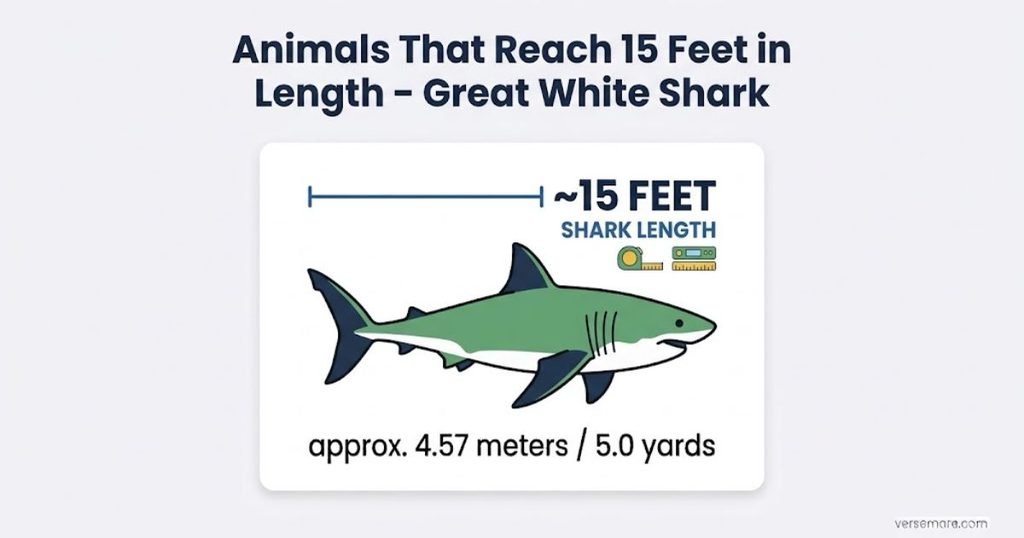
An average adult great white shark measures close to 15 feet from nose to tail, though individuals vary — some run shorter, and the largest confirmed females stretch well past 18 feet. Picturing a 15-foot shark alongside the box truck above is a useful gut-check: it’s genuinely that long, nose to tail, gliding through open water.
Southern Elephant Seal
Bull southern elephant seals typically range from 14 to 19 feet, with a “typical” adult landing right around 15 feet. Unlike the shark’s sleek profile, most of that length in a seal is bulk — these animals are built for weight and blubber, not speed, which makes the comparison feel very different even at a similar length.
Giraffe — Height, Not Length
Here’s the correction most “15 feet” articles skip: a giraffe’s neck and body are usually cited as a way to picture 15 feet, but that’s a height, not a length. An adult giraffe stands roughly 15 to 19 feet tall, measured vertically from hoof to horn. It’s still a genuinely useful mental image for the number 15 — just not for the “how long” version of the question. If you’re specifically trying to picture 15 feet laid out horizontally, the giraffe isn’t your best reference; the box truck or the shark is.
Sports and Recreation Equipment Around 15 Feet
Recreational Canoe
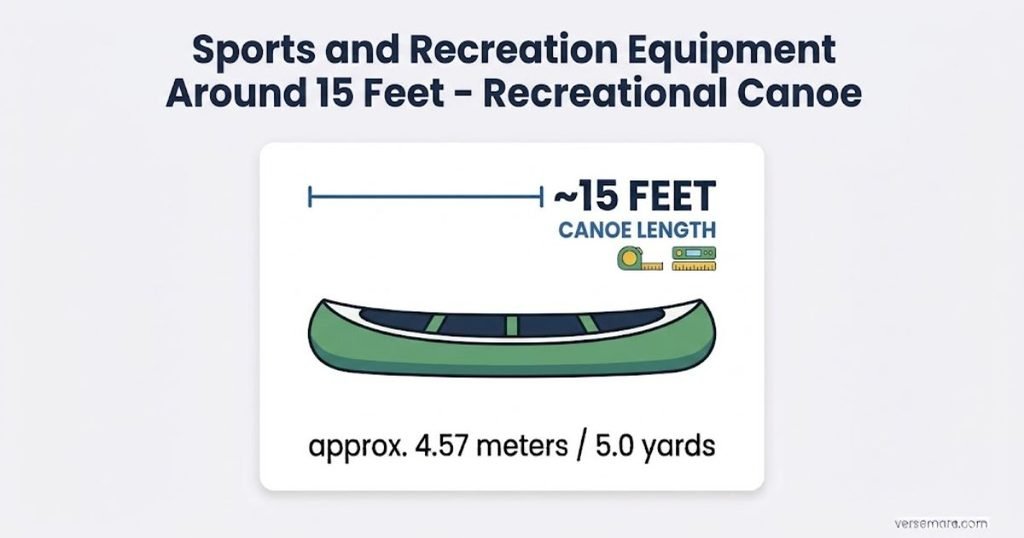
A 15-foot canoe is often described as the “all-purpose” size in paddling circles — long enough to track straight and carry two paddlers with gear, short enough to still portage or load onto a car roof without much fuss. Popular models, including aluminum double-enders, are built to this exact length for that reason.
Bowling Approach Area
Ten-pin bowling has a built-in, rule-based example of 15 feet: regulation lanes require an approach area of at least 15 feet in front of the foul line, giving bowlers room to build momentum before releasing the ball. If you’ve ever bowled, you’ve physically walked that distance without thinking about it as a measurement at all.
Household and DIY Items That Measure 15 Feet
Extension Ladder
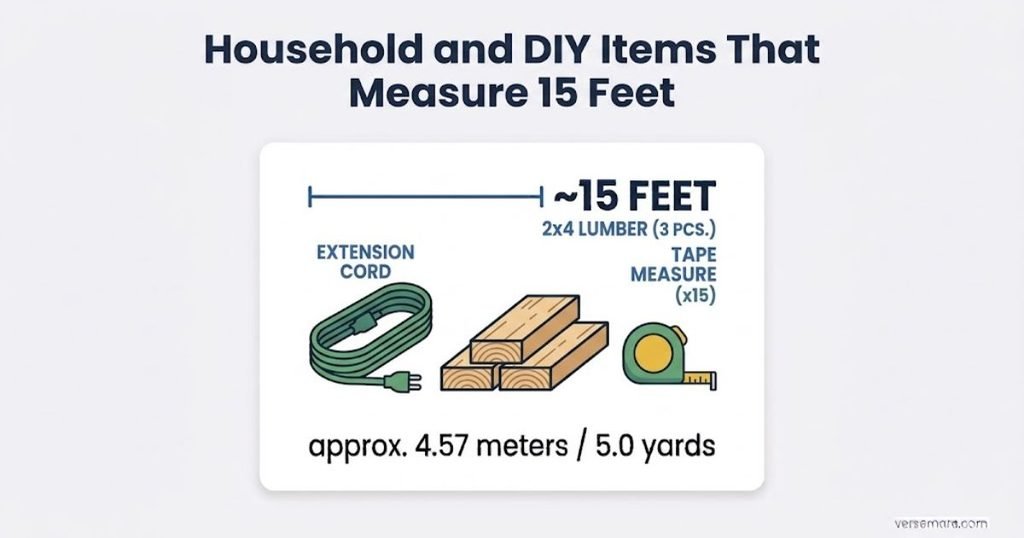
Fifteen-foot ladders are a standard size at most hardware stores, typically sold as either a straight extension ladder or a heavier-duty step ladder for outdoor jobs. They’re common enough that “how big is 15 feet” and “will a 15-foot ladder reach my gutters” are effectively the same question for a lot of homeowners — which we’ll get into in the next section.
Extension Cord
Heavy-duty extension cords are frequently manufactured at exactly 15 feet — 180 inches — using 12- or 14-gauge wire rated for power tools and larger appliances. It’s a length short enough to coil neatly but long enough to reach across most garages or job sites without a second cord.
Residential Flagpole
A 15-foot flagpole is a common choice for single-story homes, tall enough to clear a typical roofline and let a flag move freely in the wind. Telescoping and sectional flagpole kits are frequently sold at this exact height for that reason — it’s proportioned for a standard suburban yard, not a commercial or government building.
Cargo Containers: Half a Standard Unit
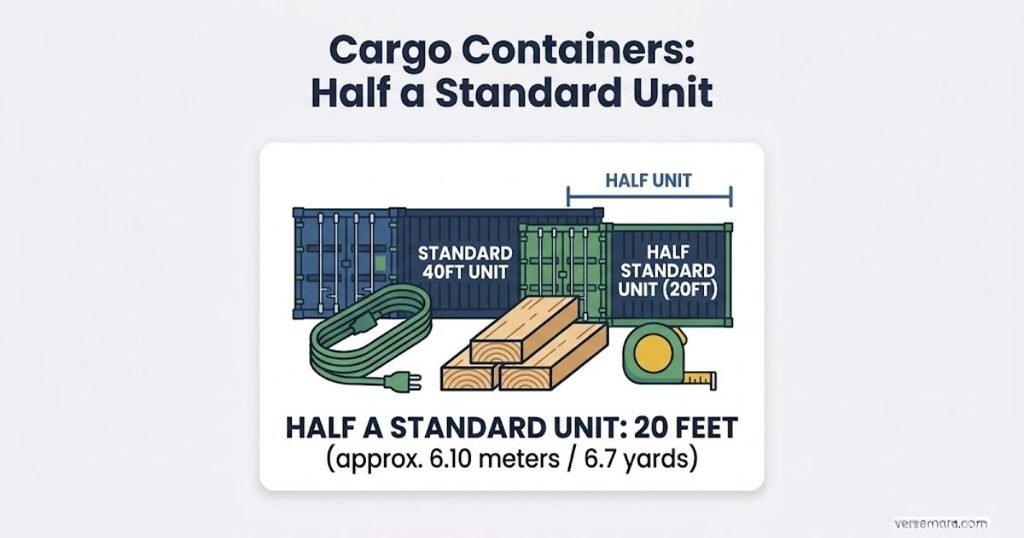
Standard shipping containers come in two common lengths: 20 feet and 40 feet. A cleaner reference point is three-quarters of a 20-foot container, or just under half of a 30-foot flatbed trailer. It’s a less clean comparison than the others on this list, which is worth admitting rather than fudging the numbers to make it fit neatly.
Is 15 Feet Long Enough? A Practical “Will It Fit” Check
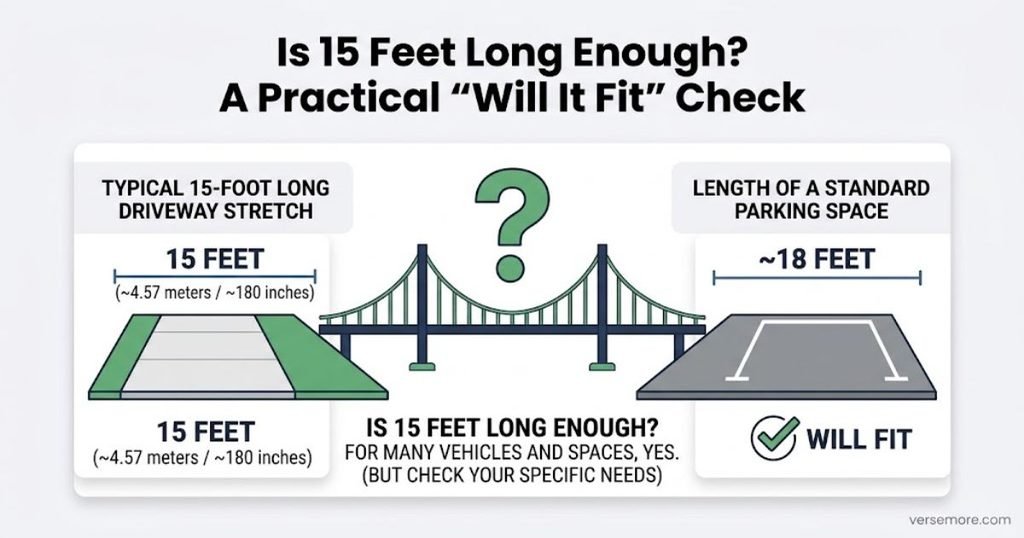
Most people searching for “15 feet long examples” aren’t doing it for trivia — they’re checking whether something specific will actually work. A few common scenarios:
Reaching a roofline with a ladder. A 15-foot extension ladder, angled properly (about a 75-degree pitch, or roughly one foot out from the wall for every four feet of height), will comfortably reach the second-story gutters of most homes, which typically sit 15 to 20 feet up. It’s usually not tall enough for a full two-story roof peak — that job generally calls for a 20- or 24-foot ladder instead.
Running a cord across a space. A 15-foot extension cord will comfortably cross a two-car garage or reach from an interior outlet to a mid-yard project, but it often falls short of reaching a detached shed or the far end of a backyard — measure the actual path, not the straight-line distance, since cords have to go around obstacles.
Storing or trailering a boat. A 15-foot boat fits in most standard single garage bays (which run about 16 to 18 feet deep) and tows behind most mid-size SUVs and trucks without needing a specialty trailer setup.
The short version: 15 feet is a “just enough for most standard situations” length across a lot of categories — which is exactly why it shows up so often in ladders, cords, and boats in the first place.
How to Estimate 15 Feet Without a Tape Measure
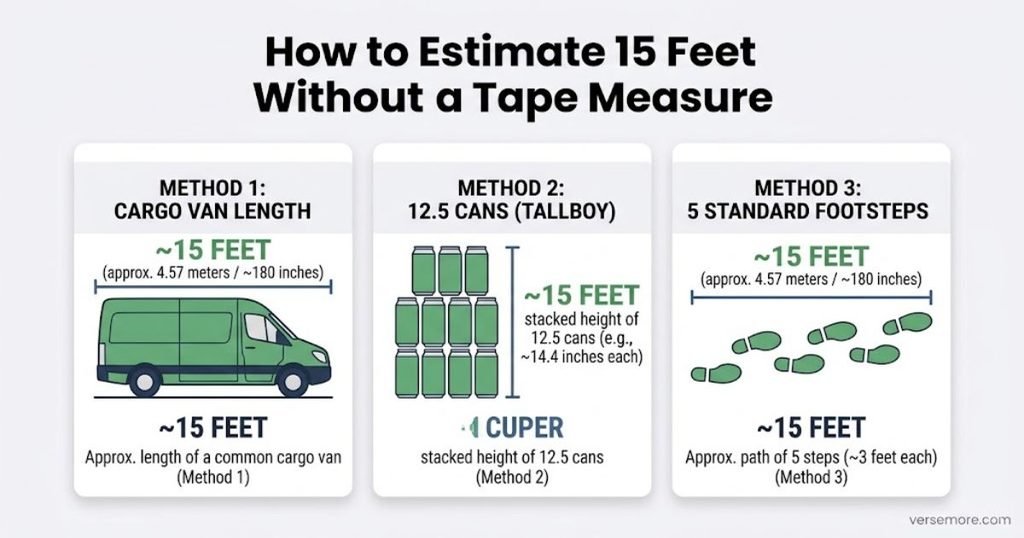
A few reliable, low-effort methods:
1. Walk it off. An adult’s natural walking stride is roughly 2.5 feet. Six normal steps (not exaggerated strides) gets you close to 15 feet.
2. Use a door as a unit. A standard interior door is about 6.7 feet tall. Two and a quarter doors, stacked mentally, equals 15 feet.
3. Picture the box truck or SUV. Since both of those are genuinely close to 15 feet long, visualizing one parked in front of you is often faster and more accurate than any manual estimation trick.
Related Length Comparisons
If 15 feet was too short for what you’re picturing, larger-scale comparisons — like everyday things that stretch to 50 miles — can help anchor much bigger distances the same way this guide anchors a small one. Linking out to your site’s other measurement comparisons (a page on shorter lengths like 10 feet, and one on nearby larger ones like 20 or 30 feet) would also help readers move naturally between related size questions.
FAQ’s
How big is 15 feet by 15 feet?
A 15-by-15-foot space equals 225 square feet. That’s roughly the size of a small bedroom or a one-car garage bay, useful context if you’re planning flooring, a deck, or a room addition.
Is a giraffe 15 feet long or 15 feet tall?
Tall, not long. A giraffe’s height — measured from hoof to horn — typically falls between 15 and 19 feet, but its body length (nose to tail) is considerably shorter. It’s a common mix-up in “how long is 15 feet” comparisons.
How long is 15 feet in meters?
15 feet equals 4.572 meters, or 457.2 centimeters. For most everyday purposes, rounding to 4.6 meters is close enough.
Will a 15-foot extension ladder reach a two-story roof?
Usually, it’ll reach second-story gutters, which typically sit 15 to 20 feet up, but it often falls short of a full two-story roof peak. For that job, a 20- or 24-foot ladder is the safer choice.
What’s the difference between an “exact” and “approximate” 15-foot object on this list?
Exact items — like a 15-foot extension cord, ladder, or flagpole — are manufactured or standardized to that specific length. Approximate items, like an SUV or a shark, vary naturally by model or individual but commonly land close to 15 feet.
How many yards is 15 feet?
15 feet equals exactly 5 yards, since there are 3 feet in a yard.
What’s a good everyday object to picture for 15 feet?
A compact SUV or a 15-foot rental box truck are two of the most reliable references, since both are common sights and genuinely close to that length.
Is a 15-foot boat big enough to trailer with a regular SUV?
Yes, in most cases. A 15-foot boat is light and short enough for most mid-size SUVs and trucks to tow without needing a specialized trailer setup or a larger tow vehicle.
Conclusion
Fifteen feet is one of those lengths that quietly shows up everywhere once you start looking for it — in the ladders and extension cords sold at every hardware store, in the trucks people rent to move apartments, in sharks and seals cruising past boats a similar size.
What makes it a genuinely useful number to understand isn’t the trivia value alone; it’s that so many real, practical decisions hinge on it, from whether a ladder will reach a roofline to whether a boat will fit in a garage. With the conversions, comparisons, and estimation tricks above, 15 feet should now be a length you can picture instantly, without needing a tape measure to confirm it.

I am the admin of VerseMore, sharing helpful, informative, and engaging content on various topics to inspire readers, provide value, and make everyday life easier.