Pick up a 12 oz beer can and it feels like the most ordinary object in the kitchen. Measure it, though, and the numbers you find online start to disagree.
Beer can dimensions depend on which part you measure: the body, the narrowed neck, or the lid. Mix them up and you end up with a koozie that won’t close or a fridge shelf that’s a few millimeters too tight.
This guide gives manufacturer-based measurements in inches and millimeters for the common sizes, from slim 8.4 oz cans to 32 oz crowlers. It also explains where the popular “2.13 inch diameter” figure really comes from.
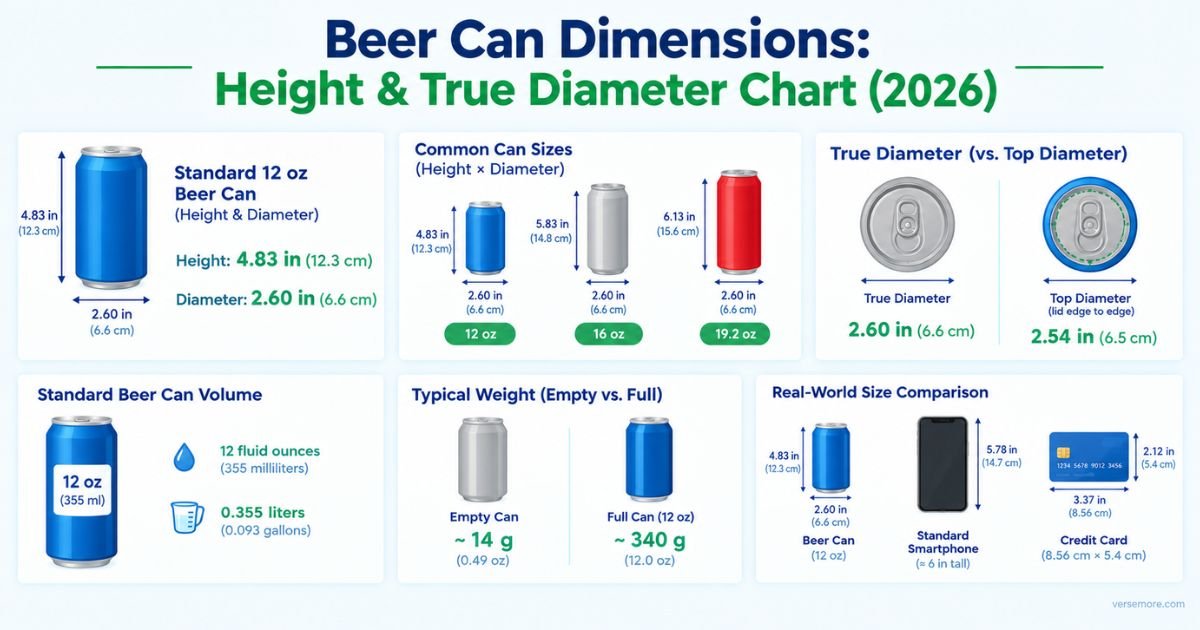
A standard 12 oz beer can is about 4.8 inches (122 mm) tall and about 2.6 inches (66 mm) wide across the body.
Key Takeaways
• A 12 oz can is 4.81 in (122.2 mm) tall with a body diameter of about 2.60 in (66.0 mm).
• The often-quoted 2.13 in (about 54 mm) is the lid and neck size, not the width of the can.
• A 16 oz tallboy has the same body width as a 12 oz can but stands 6.19 in (157.2 mm) tall.
• Size codes like 202 and 211 are nominal, so charts differ by a few hundredths of an inch.
What Are the Standard Beer Can Dimensions?
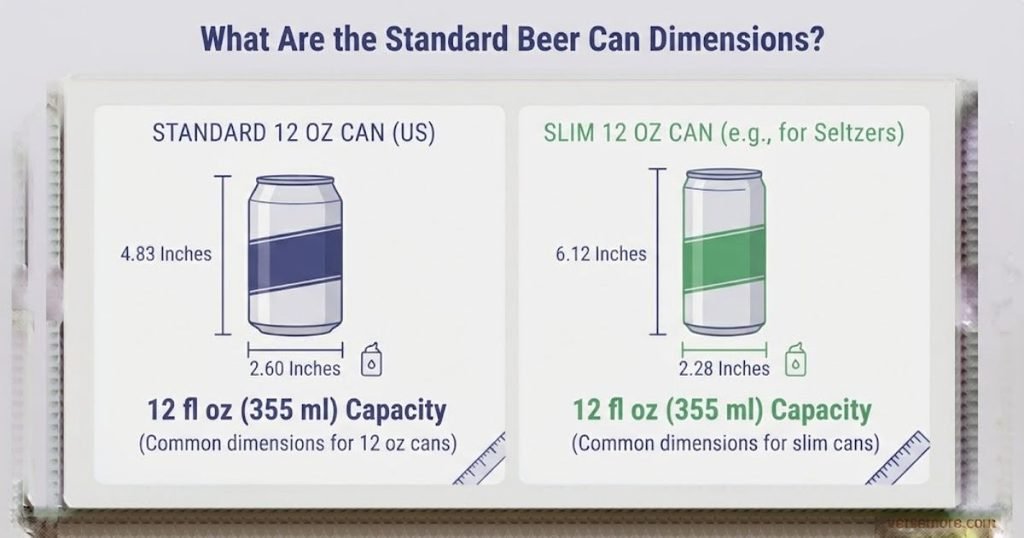
A standard 12 oz (355 mL) beer can is about 4.81 inches (122.2 mm) tall, and its body is about 2.60 inches (66.0 mm) in diameter. One packaging supplier lists the 12 oz Ardagh can at a total height of 4.81 inches and a base diameter of 2.60 inches. A patent describing necked cans agrees on the height, noting that a 12 ounce beverage can has a 211 body diameter, ends typically sized at 202 to 206, and a height of 4.8 inches.
Three separate widths matter on one can:
| Part of the can | Inches | Millimeters | Centimeters | What it is |
| Total height (seamed) | 4.81 | 122.2 | 12.2 | Base to top of the lid |
| Body diameter | 2.60 | 66.0 | 6.6 | The widest part, “211” body |
| Lid and neck | 2.13 | 54.0 | 5.4 | Nominal “202” end, 2 2/16 in exactly |
Inch figures are manufacturer specifications rounded to two decimals. Metric values are converted at exactly 25.4 mm per inch and rounded to one decimal.
The volume is 12 US fluid ounces, which is exactly 354.88 mL and is labeled as 355 mL. UK readers should know that an imperial fluid ounce is smaller, so a “12 oz” imperial can holds less (covered in the regional section).
Beer Can Size Chart in Inches and Millimeters
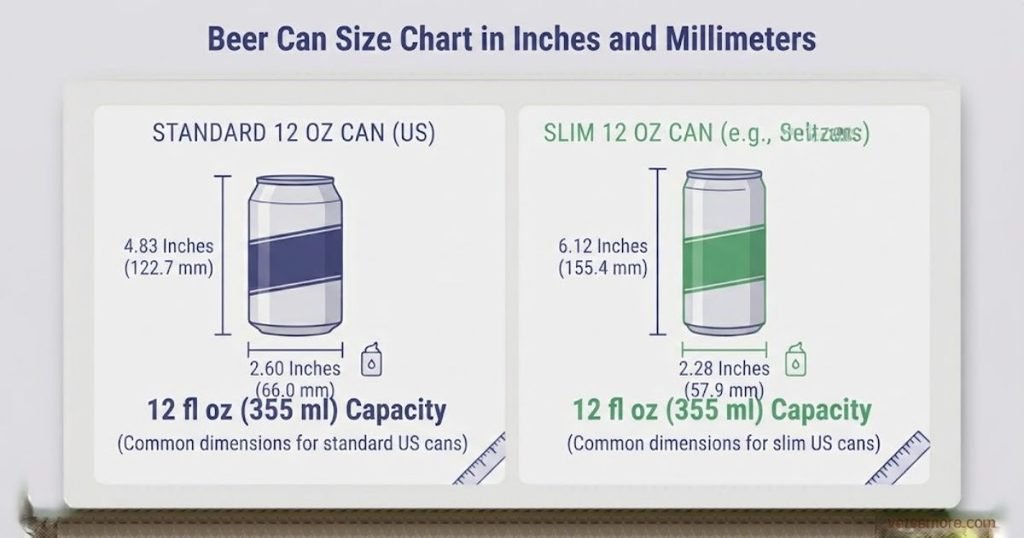
The chart below covers the formats where manufacturer specifications agree. Heights are finished-can heights, and the body column shows the nominal code with its typical measured width.
| Format | Volume | Height (in) | Height (mm) | Body |
| Slim, marketed as 8.4 oz | 250 mL | 5.25 | 133.4 | 202 (about 2.13 in / 54 mm) |
| Standard 12 oz | 355 mL | 4.81 | 122.2 | 211 (about 2.60 in / 66.0 mm) |
| Tallboy 16 oz | 473 mL | 6.19 | 157.2 | 211 (about 2.60 in / 66.0 mm) |
| Stovepipe 19.2 oz | 568 mL | 7.41 | 188.1 | 211 (about 2.60 in / 66.0 mm) |
| Crowler 32 oz | about 946 mL | 7.60 | 193.0 | 2.86 in / 72.6 mm base |
Inches rounded to two decimals, millimeters converted at 25.4 mm per inch and rounded to one decimal. The 8.4 oz height comes from the 202 × 504 can code, which is 5 4/16 in.
The sources behind those rows:
• The Ardagh 16 oz can has a 211 body, a 202 end and a finished height of 6.190 inches.
• The Ardagh 19.2 oz can holds 568 mL and stands 7.406 inches tall.
• Ball’s 32 oz crowler has a 2.86 inch base diameter and a flanged height of 7.60 inches.
• Slim energy-drink cans use a 202 × 504 code and hold 250 mL.
Sleek 12 oz cans, 24 oz cans and the metric sizes used in Europe are covered separately later in this guide. Manufacturer sources disagree on some of these, so they need more than a table row.
Why 2.13 Inches Is Not a Beer Can’s Diameter
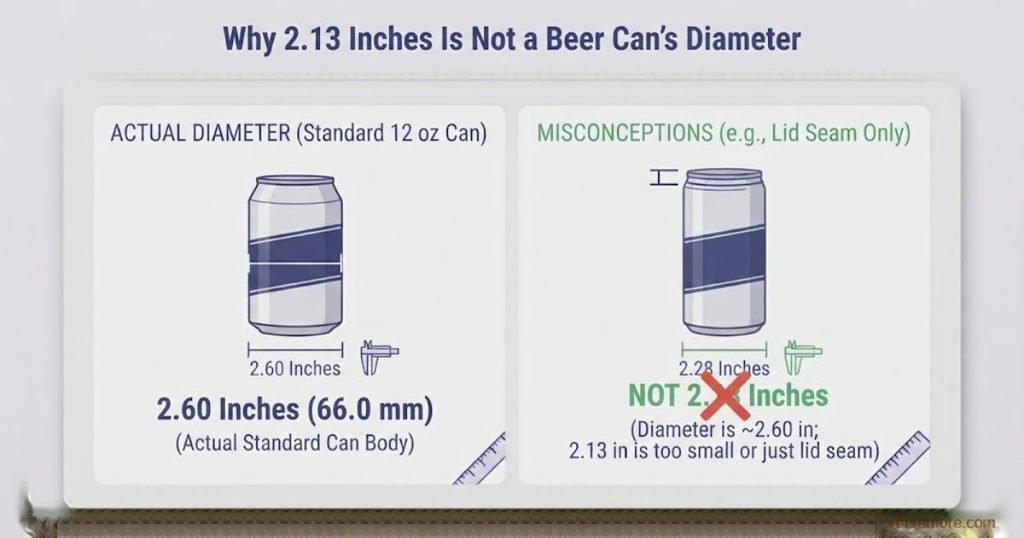
Because 2.13 inches (about 54 mm) is the nominal size of the 202 lid, not the width of the body. The lid is smaller than the can on purpose. During manufacturing, the open end of the can body is necked in over several stages, so end sizes come out smaller than body diameters.
You can see the gap in an Ardagh specification sheet for a 211-body can. It lists an outside body diameter of 66.3 mm maximum and a neck plug diameter of 52.4 mm. That’s roughly 14 mm of difference between the widest part and the top.
The can also narrows at the bottom. The same sheet gives a stand diameter of 48.3 mm maximum, so the widest point is only the middle band of the body.
If you’re checking a chart yourself, run the Lid Test:
1. Find the diameter given for a 12 oz can.
2. If it’s near 2.1 in or 54 mm, the chart is describing the lid or neck.
3. If it’s near 2.6 in or 66 mm, it’s describing the body, which is what your koozie, holder or shelf actually has to fit.
What Do 202, 204, 206 and 211 Mean on a Can?
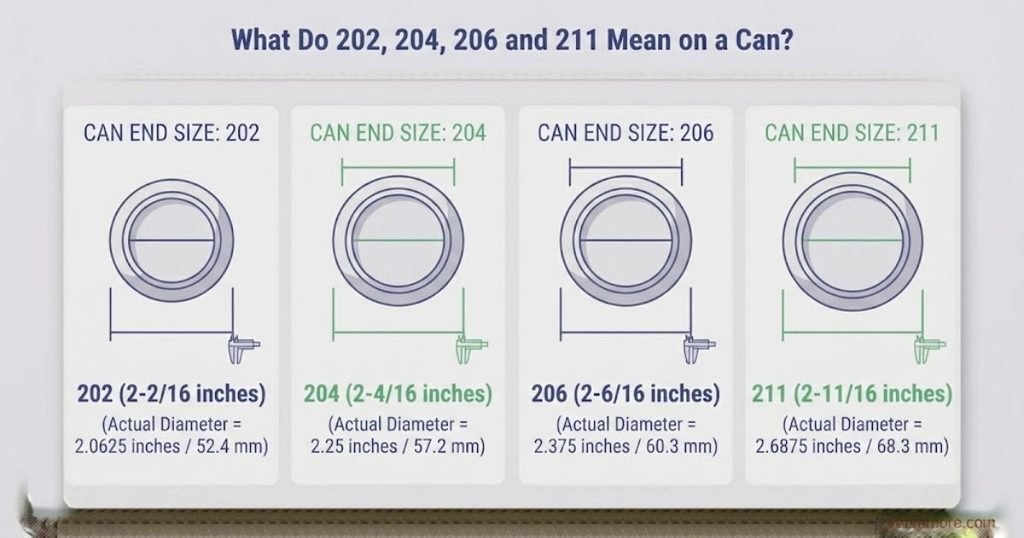
They’re width codes written as inches plus sixteenths of an inch. Wikipedia explains the format like this: imperial can-making dimensions are written as inches plus sixteenths, so “202” means 2 inches plus 2 sixteenths. The first digit is whole inches and the last two digits are sixteenths.
| Code | Exact fraction | Decimal (in) | Millimeters | Where you’ll see it |
| 200 | 2 0/16 | 2.000 | 50.8 | Ends on slim cans |
| 202 | 2 2/16 | 2.125 | 54.0 | Standard end, slim body |
| 204 | 2 4/16 | 2.250 | 57.2 | Sleek cans |
| 206 | 2 6/16 | 2.375 | 60.3 | Larger ends, some sleek bodies |
| 211 | 2 11/16 | 2.688 | 68.3 | Standard 12 oz, 16 oz and 19.2 oz bodies |
| 300 | 3 0/16 | 3.000 | 76.2 | Crowler-size ends |
Millimeters are exact conversions rounded to one decimal.
Height works the same way. The code 413 in “211 × 413” means 4 and 13/16 inches, or 4.8125 in (122.2 mm), which is the classic 12 oz height. Sencon, a can-gauge manufacturer, lists this as 202 nominally standing for about 54 mm and 211 for about 68 mm.
The codes are labels, not measuring-tape values. Since the industry moved to mini-seam technology, nominal end sizes no longer correspond to exact measurements of the outside of the seam. A 211 body is nominally 68.3 mm, but a real one measures about 66 mm. Use the code to identify a can and a specification sheet to size a fit.
12 oz Beer Can Dimensions: Standard, Sleek and Slim
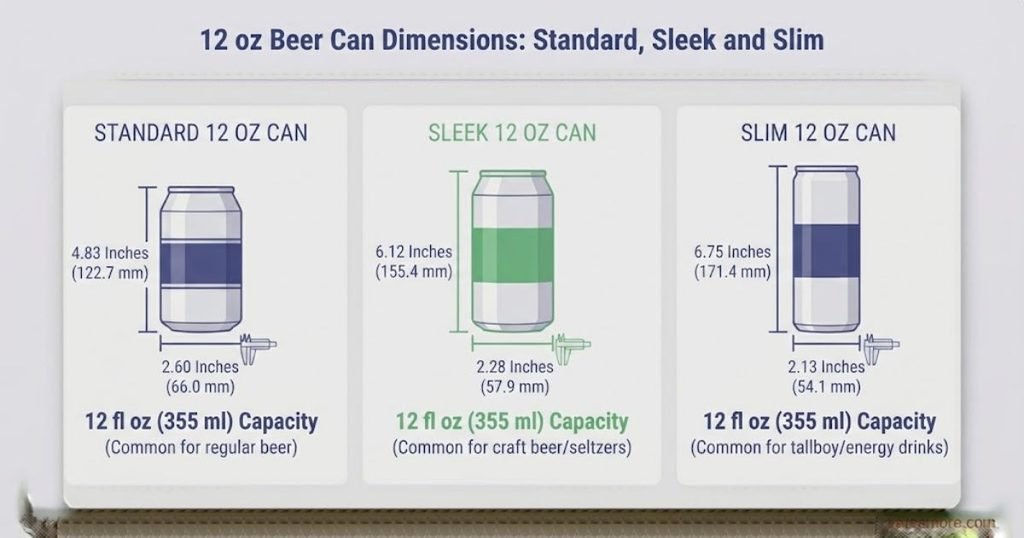
“12 oz” describes volume, not shape. Three different can profiles share it, and they don’t fit the same holders.
The standard can is the 211-body can from earlier, at 4.81 in (122.2 mm) tall. Sleek and slim cans hold similar or smaller volumes in a narrower, taller body. A patent on necked cans describes slim cans as typically having a 202 body and a height of 88, 111 or 134 mm for 150, 200 or 250 mL. It describes sleek cans as typically having a 206.5 body and a height of 114 or 145 mm for 250 or 330 mL in Europe.
The 12 oz sleek is where sources stop agreeing:
| Profile | Body width | Height | Where the figure comes from |
| Standard | 66.0 mm (2.60 in) | 122.2 mm (4.81 in) | Ardagh 12 oz specification |
| Sleek (US 12 oz), low estimate | 57 to 63 mm (2.24 to 2.48 in) | 129 to 133 mm (5.08 to 5.24 in) | Sencon’s can-code table |
| Sleek (US 12 oz), high estimate | about 58 mm (2.28 in) | about 155.7 mm (6.13 in) | A can manufacturer’s guide |
| Slim (can-maker definition) | about 54 mm (2.13 in) | 88 to 134 mm (3.46 to 5.28 in) | Patent, 150 to 250 mL cans |
Body widths and heights converted at 25.4 mm per inch and rounded. Ranges reflect conflicting sources rather than measurement error.
Retail language adds confusion. Can-makers use “slim” for a narrow 202 body on small volumes, but accessory sellers often use it for any tall, narrow 12 oz can. If you’re buying a sleeve for a sleek can, measure the actual can rather than trusting the word on the label.
16 oz Tallboy Dimensions (and Why It’s Not 24 oz)
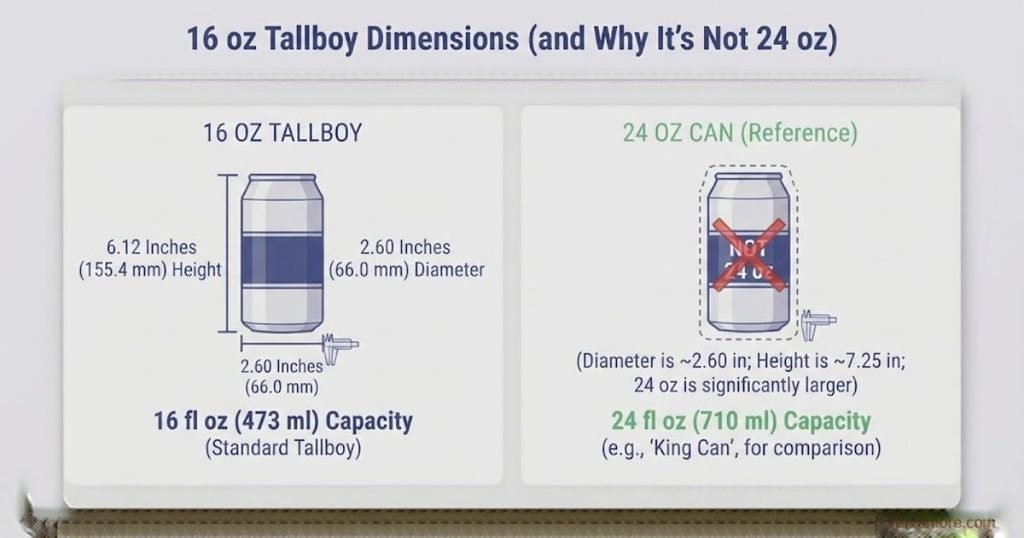
A 16 oz tallboy is 6.19 inches (157.2 mm) tall and shares the standard 211 body of the 12 oz can. Ardagh’s 16 oz can has a 211 body, a 202 end and a finished height of 6.190 inches.
Width matters more than the extra 1.38 inches (35.1 mm) of height. Because the body is the same, a tallboy slides into anything a standard can slides into, and it goes wrong only at the top. It’ll stick out above a sleeve made for 12 oz cans.
The name causes trouble. In craft beer, “tallboy” usually means 16 oz, the same volume as a US pint. Some sources still claim a tallboy holds 24 oz, which mixes up two different cans. Check the ounces printed on the can rather than the nickname.
19.2 oz Stovepipe and 24 oz Beer Can Sizes
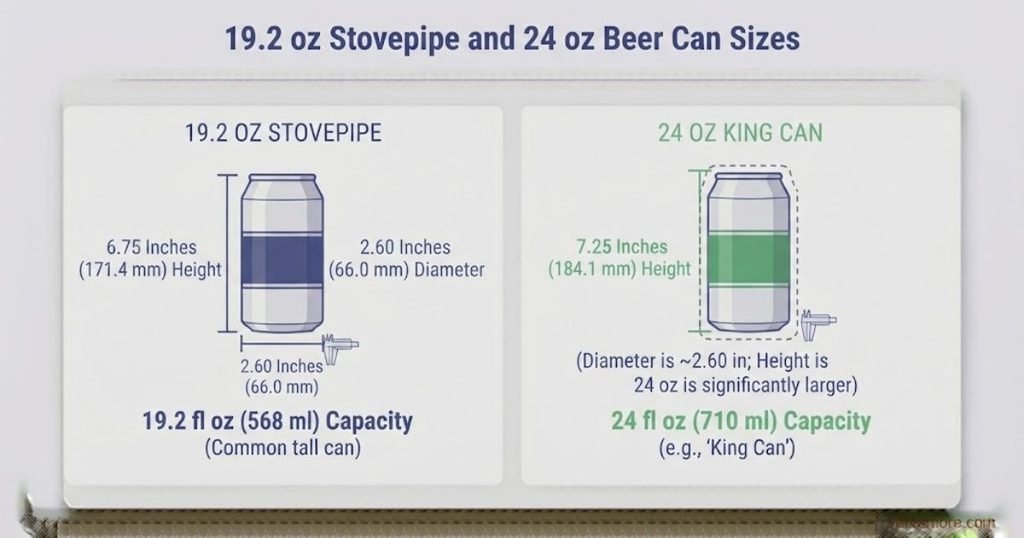
Stovepipe cans hold 19.2 oz (568 mL) and stand about 7.41 inches (188.1 mm) tall. Ardagh’s spec lists a finished height of 7.406 inches and a 202 end, the same end used on smaller cans. Trade press has described this format as roughly the height of a 24 oz can with the diameter of a 16 oz can.
The odd number has a likely explanation. 19.2 US fluid ounces is 567.8 mL, and an imperial pint is 568.3 mL. The size has been called a “royal pint,” which suggests it was built to mirror the British pint.
The 24 oz can is harder to pin down. A Ball 24 oz can with a 206 neck holds 710 mL, and its supplier lists a base diameter of 2.87 inches and a flanged height of 7.60 inches. Some size charts publish a very different figure, closer to 8.5 inches tall. Since the sources disagree, treat any 24 oz height as approximate and check the spec sheet from your supplier.
32 oz Crowler and Small-Can Dimensions
The crowler, a “can growler” usually filled to order at taprooms, is the largest common beer can. Ball’s 32 oz crowler, with a 300 end, is listed at a flanged height of 7.60 inches (193.0 mm) and a base diameter of 2.86 inches (72.6 mm).
At the small end, the same volume comes in two shapes. An 8 oz (236 mL) can can be a squat 206/211 × 306, about 86 mm tall, or a tall, narrow 202/204 × 413, about 122 mm tall (both from Sencon’s table). A 250 mL can with a standard 211 body is listed by one Indian manufacturer at 92 mm high and 66.1 mm wide. That last figure independently confirms the roughly 66 mm width of the 211 body.
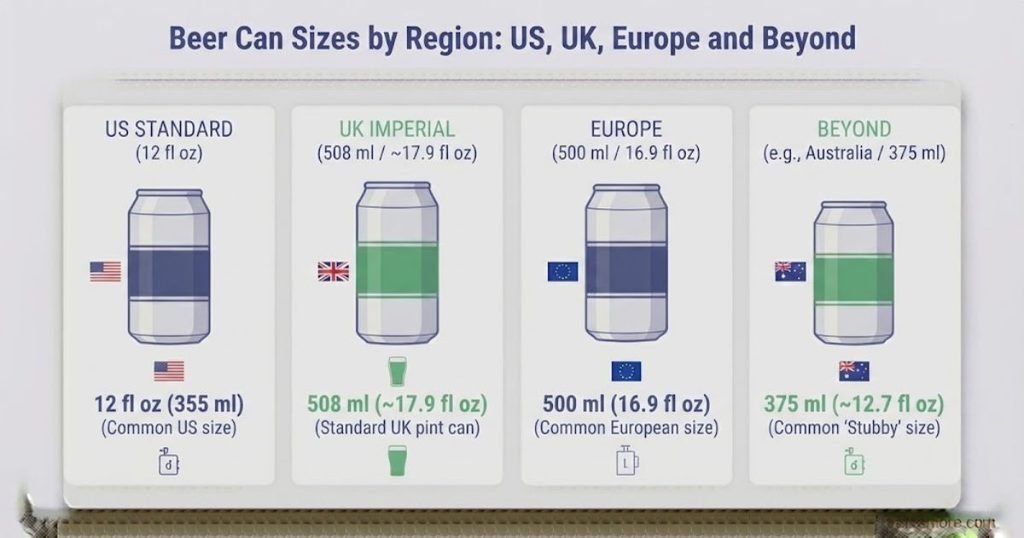
Beer Can Sizes by Region: US, UK, Europe and Beyond
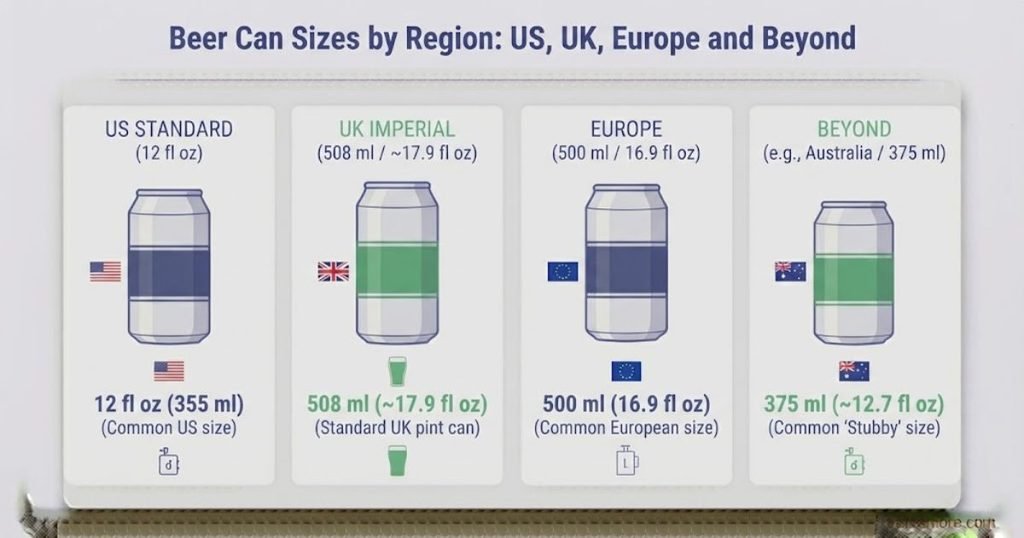
Outside North America, cans are sized in milliliters, and the ounce labeling gets slippery.
US vs Imperial Ounces
A US fluid ounce is 29.5735 mL and an imperial fluid ounce is 28.4131 mL. So “12 oz” means 354.9 mL in the US and 341.0 mL if it’s an imperial ounce, which is why 341 mL cans exist. Whenever a UK page says “12 oz,” check which ounce it means.
Common Metric Sizes (330, 440, 500 mL)
Most metric cans use a 206/211 or 202/211 code and differ mainly in height:
| Region and volume | Height (mm) | Height (in) | Code |
| Europe, 330 mL | 114 | 4.49 | 202/211 × 408 |
| UK and Europe, 440 mL | 148 | 5.83 | 206/211 × 513 |
| UK and Europe, 500 mL | 168 | 6.61 | 206/211 × 610 |
| Asia, 350 mL | 122 | 4.80 | 206/211 × 413 |
| Australia, 375 mL | 129 | 5.08 | 206/211 × 501 |
Heights from Sencon’s regional tables, converted at 25.4 mm per inch and rounded to two decimals. An Ardagh 500 mL spec sheet confirms the 168.0 mm empty can height and gives an outside body diameter of 66.3 mm maximum.
Notice the 350 mL Asian can. It matches the US 12 oz height, so cans from different markets can look nearly identical. European sleek cans are taller and narrower, at 145 mm for 330 mL according to the patent cited above.
Why Published Beer Can Measurements Disagree
Several honest reasons produce different numbers for the same can:
• Nominal versus measured: Size codes are labels. The patent notes that mini-seam technology means nominal end sizes no longer match exact seam measurements, so a “68 mm” 211 body measures about 66 mm.
• Which height: Manufacturers list empty can height, flanged can height and seamed can height. The Ardagh 500 mL sheet gives 168.0 ±0.3 mm empty and 168.0 ±0.4 mm seamed.
• Manufacturer differences: One supplier lists a 12 oz base diameter of 2.60 in, while a Ball listing for the same class shows 2.68 in.
• Copying errors: Some charts show 19.2 oz cans at about 6.7 in, more than half an inch shorter than the 7.406 in finished height in Ardagh’s specification.
• Rounding: Rounding at each conversion step compounds errors. Convert once, at 25.4 mm per inch, and round at the end.
If two cans differ by more than a millimeter or two, you’re probably comparing different can types, not measuring badly.
Will It Fit? The Three-Number Fit Check
Most fit problems come from one of three numbers. Check all three before buying a koozie, holder or shelf insert:
| Number | What to measure | Why it matters |
| Body diameter | Widest point of the can | The holder’s opening must clear it, with a few millimeters to spare |
| Total height | Base to top of the lid | Decides whether the can sticks out above a sleeve or shelf |
| Top width | The 202 lid and neck | Matters for drinking, lids and sliding into narrow openings |
This is a practical checklist rather than an industry standard.
Two examples show how the numbers work:
• 12 oz sleeve on a tallboy: The width is the same, so it fits, but the can rises about 35 mm above the top.
• Slim sleeve on a standard can: A standard body is roughly 9 to 12 mm wider than a 57 mm sleek or 54 mm slim body, so a sleeve made for the narrower can won’t close. The reverse fits, but loosely.
How to Measure a Beer Can Yourself
You need a ruler or, better, a digital caliper. The steps take a couple of minutes.
1. Stand an unopened can upright on a flat surface.
2. Measure height from the surface to the highest point of the lid seam.
3. Measure the body at mid-height with a caliper, then rotate the can 90 degrees and measure again. Average the two readings.
4. Measure the lid and neck at the top, on the outside of the seam.
5. Convert once using 25.4 mm per inch, then round.
6. Measure a second can from a different case, since suppliers vary.
Compare your results with the tables above. A body near 66 mm and a lid near 54 mm confirm a standard 211 can with a 202 end.
How Strong Is a Beer Can? Pressure, Weight and Strength
A beer can is sturdier than it feels, and the published specifications show how much. Ardagh’s sheet for its 500 mL can (a 211 body, like the standard 12 oz) lists:
| Property | Specification | Approximate equivalent |
| Internal pressure resistance | 6.2 bar minimum | about 90 psi |
| Column (top-load) strength | 675 N minimum | about 152 lbf |
| Finished can weight | 12.4 g nominal, ±0.8 g | about 0.44 oz |
Figures are for Ardagh’s 500 mL can, not every size. Conversions are rounded. A 16 oz can from another supplier lists a dome reversal pressure of 90 psi, which matches.
Carbonated beer puts real pressure on the wall, and the thin aluminum relies on its cylindrical shape to hold it. The top-load figure is the reason empty cans can be stacked on pallets many rows high.
Beer Can Sizes for Craft Brewers: Ends and Pallet Counts
Brewers choosing a format care about more than how a can looks on a shelf. Supplier listings give two useful numbers.
The first is lid compatibility. One US supplier lists its 16 oz and 19.2 oz cans as 211-body cans that take a 202 end, so the same lid can serve both sizes, which can simplify sourcing.
The second is how many empty cans arrive per pallet. The same supplier lists 6,224 cans on a full pallet of 16 oz cans and 4,668 for 19.2 oz cans. A Ball 24 oz can from another supplier is listed at 3,454 per pallet, on a pallet 44 by 90 by 56 inches. Taller cans mean fewer per pallet, and the trade-off hits freight and storage costs before it ever shows up in the beer. Pallet counts vary by supplier, so confirm them for your order.
FAQ’s
What are the dimensions of a standard beer can?
A standard 12 oz beer can is about 4.81 inches (122.2 mm) tall, with a body diameter of about 2.60 inches (66.0 mm). The lid and neck are narrower, at a nominal 2.13 inches (54.0 mm).
How big is a beer can in centimeters?
A 12 oz beer can is about 12.2 cm tall and about 6.6 cm wide across the body. The lid is about 5.4 cm wide. These come from manufacturer inch specifications converted at exactly 2.54 cm per inch.
What is the diameter of a 12 oz beer can?
The body is about 2.6 inches (66 mm) in diameter. The 2.13-inch (54 mm) figure that appears on some charts is the nominal size of the 202 lid, which is smaller because the top of the can is necked in.
How tall is a 16 oz tallboy beer can?
A 16 oz tallboy is 6.19 inches (157.2 mm) tall. It has the same 211 body as a 12 oz can, so it’s just as wide but about 1.38 inches (35.1 mm) taller.
Is a tallboy 16 oz or 24 oz?
Traditionally a tallboy is 16 oz. Some sources use “tallboy” loosely for 24 oz cans, which is where the confusion comes from. Check the ounces printed on the can rather than relying on the nickname.
Why are some beer cans 19.2 oz?
A 19.2 oz can holds 568 mL, which is almost exactly an imperial pint (568.3 mL). The size has been called a “royal pint,” and it stands about 7.41 inches (188.1 mm) tall.
Do sleek cans fit a standard koozie?
Usually not well. A sleek body is narrower than the roughly 66 mm of a standard can, so a sleeve made for a sleek can often won’t close around a standard can. A standard sleeve will take a sleek can, but it fits loosely. Measure the can’s body width against the sleeve before buying.
What size are beer cans in the UK and Europe?
The common sizes are 330, 440 and 500 mL, at about 114, 148 and 168 mm tall respectively. Watch for imperial “12 oz” labels, because an imperial ounce is smaller, and 12 imperial fluid ounces is about 341 mL rather than 355 mL.
Why do websites list different beer can measurements?
Size codes like 202 and 211 are nominal labels, so a “68 mm” body measures about 66 mm in reality. Sources also mix empty, flanged and seamed heights, and suppliers round differently. Differences of a millimeter or two are usually normal, while larger gaps usually mean different can types.
Conclusion
Beer can dimensions come down to knowing which part you’re measuring. A 12 oz can is about 4.81 inches (122.2 mm) tall and about 2.6 inches (66 mm) wide across the body, with a narrower 2.13 inch (54 mm) lid that’s often mistaken for its diameter. Tallboys, stovepipes, sleek cans and crowlers change the height or width, and the nickname on the can matters less than the ounces or milliliters printed on it.
When a fit really matters, measure the body, the height and the top of your own can, then compare it with the charts above. That takes a couple of minutes and avoids the koozie that won’t close.

I am the admin of VerseMore, sharing helpful, informative, and engaging content on various topics to inspire readers, provide value, and make everyday life easier.