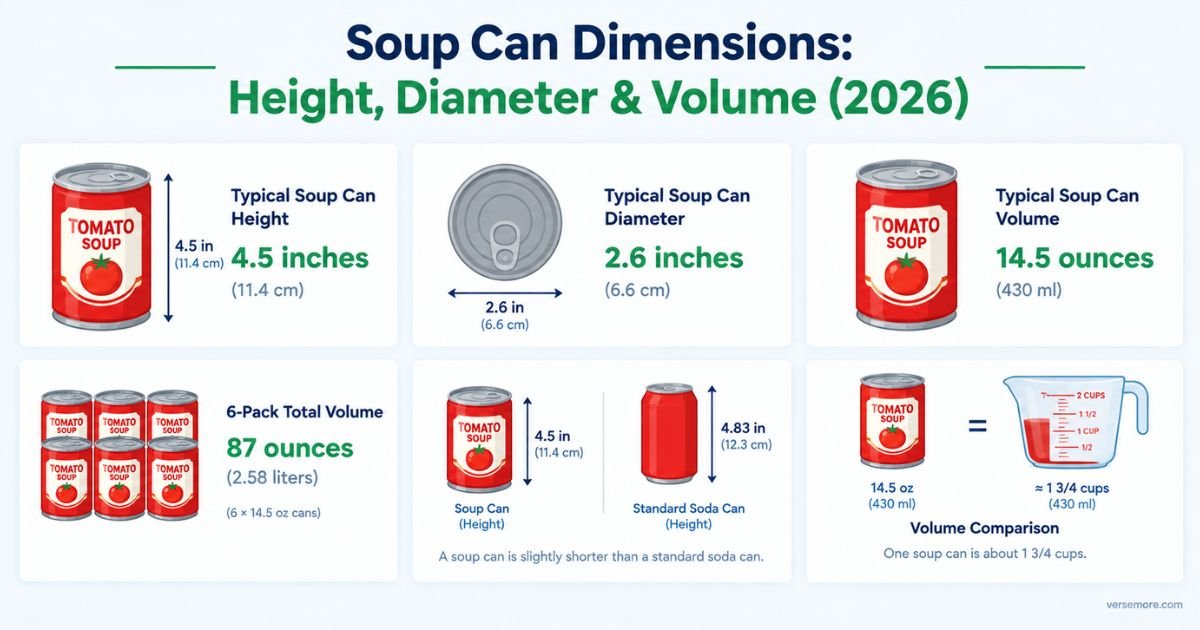
Pick up two cans of soup in the same aisle and they rarely match. One is slim and tall. The other is wider and heavier in the hand. Ask five websites for the soup can dimensions and you may get five different answers.
That is because “a soup can” is really several can sizes sharing one shelf. This guide sorts them out with exact figures, the industry code behind each, and the reasons the numbers you find online often clash.
Condensed soup usually comes in a slim can of about 2 11/16 × 4 inches (68 × 102 mm), while ready-to-serve soup uses wider cans of roughly 3 to 3 7/16 inches across and 4 3/8 to 4 9/16 inches tall.
| Key Takeaways • Condensed soup cans are commonly listed as code 211×400: 2 11/16 inches wide and 4 inches tall. • Ready-to-serve soup cans typically fall between codes 300×407 and 307×409, or 3 to 3 7/16 inches wide. • In a can code, the first digit is whole inches and the next two digits are sixteenths of an inch. • The “oz” on a soup label is net weight, not fluid volume, so it cannot be converted straight into cups. • Many sites round 4 7/16 inches up to 4.5 and quote different sizes for the same soup, so measure your own can if it matters. |
What Are Standard Soup Can Dimensions?
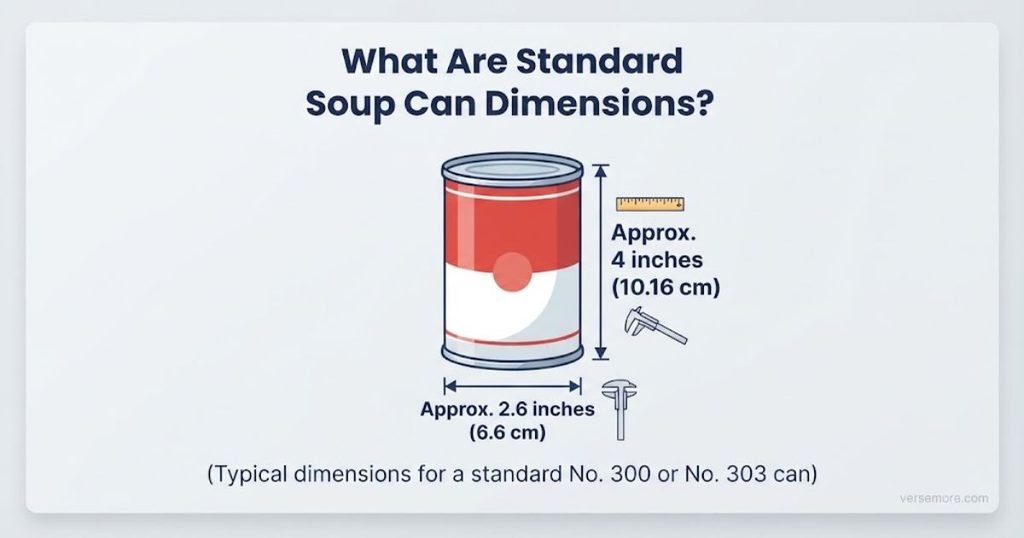
There is no single standard soup can. The size depends on the soup type and the can code. Here are the sizes most often used for soup and the larger cans that sit beside them on the shelf:
| Can type | Code | Diameter (in) | Height (in) | Diameter × height (mm) | Typical contents |
| Condensed soup (No. 1 “picnic”) | 211×400 | 2 11/16 | 4 | 68 × 102 | about 10–12 oz |
| Ready-to-serve, compact | 300×407 | 3 | 4 7/16 | 76 × 113 | about 14–16 oz |
| Ready-to-serve, mid-size | 303×406 | 3 3/16 | 4 3/8 | 81 × 111 | about 16–17 oz |
| Ready-to-serve, larger | 307×409 | 3 7/16 | 4 9/16 | 87 × 116 | about 18–19 oz |
| #2.5 | 401×411 | 4 1/16 | 4 11/16 | 103 × 119 | about 27–29 oz |
| #5 | 502×510 | 5 1/8 | 5 5/8 | 130 × 143 | about 51–56 oz |
| #10 (foodservice) | 603×700 | 6 3/16 | 7 | 157 × 178 | about 102–117 oz |
Contents are net weight in ounces and vary with the product. A can of thick chunky soup and a can of broth on the same code will not weigh the same.
The condensed row is the one most people are after. The No. 1 picnic format is commonly listed as 211 × 400, which is 2 11/16 inches across and 4 inches high, and the FDA identifies it that way. Condensed soup is a common product in this size. The 10.75 oz on a familiar red-and-white label is a weight, and it sits inside that 10–12 oz range.
Ready-to-serve soups use the wider cans. They carry more liquid and chunks and need no added water. Which brand uses which code is not published in one neutral place, so treat the ready-to-serve rows as typical ranges rather than a brand guarantee. The next section explains why.
Why Do Different Websites Give Different Soup Can Sizes?
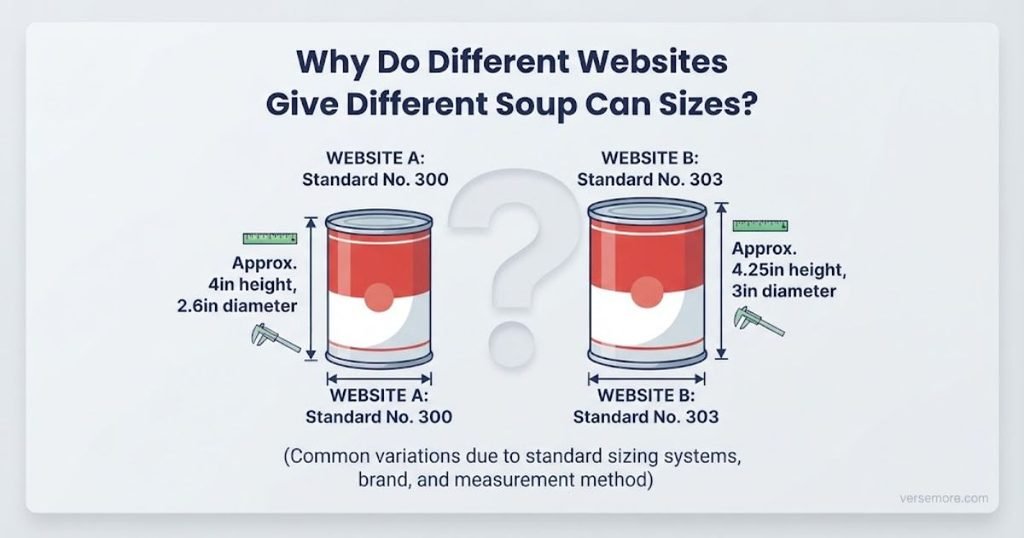
Search for the answer and you will find two camps. Some pages state that Campbell’s condensed cans are exactly 3 inches wide by 4.5 inches tall and carry code 300×407. Others put the same can at about 2.625 inches wide and 4 inches tall. Both cannot be right for the same can.
Several things cause the mismatch:
• Rounding to friendly numbers. Code 300×407 decodes to 3 inches by 4 7/16 inches (4.4375). Rounded up, that becomes “4.5,” which is a difference of 1/16 inch (about 1.6 mm). Likewise 307×409 is 3.4375 inches wide, and it often appears as “3.5.”
• Two can families blended together. The slim 211 can and the wider 300 can differ by 5/16 inch in width (about 8 mm) and by 7/16 inch in height (about 11 mm). Copy a figure from one and a label from the other and you get a can that does not exist.
• Weight mistaken for volume. A can holding 10.75 oz of soup by weight is often described as holding 10.75 fluid ounces. That is a different measurement, and the volume section below shows why it matters.
• Measuring the wrong part. The rim and the double seam at the top are slightly wider than the body, so a quick ruler check can add a millimetre or two.
• Small supplier differences. Can makers publish tolerances, and a supplier’s spec sheet can differ slightly from an industry table.
The practical rule: when exact fit matters, measure the can in your hand. Use published figures for orientation. They are close but not always exact.
How to Read Can Size Codes Like 300×407
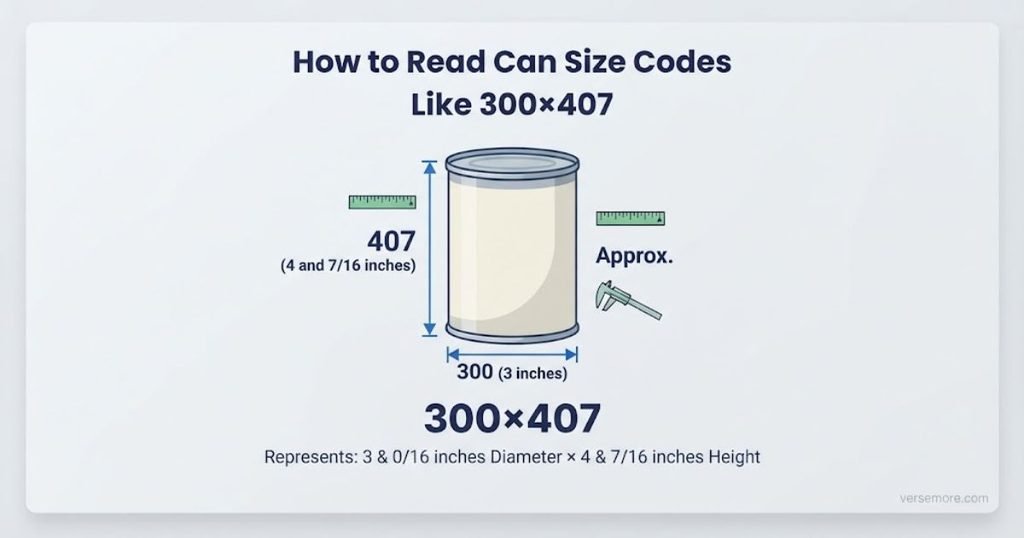
Every can code has two three-digit numbers, written diameter × height. The numbers look like decimals but are not.
1. Split each number. The first digit is whole inches. The last two digits are sixteenths of an inch.
2. Convert to a decimal. Divide the sixteenths by 16 and add the inches.
3. Convert to millimetres if needed. Multiply inches by 25.4.
Worked examples:
| Code | Diameter | Height |
| 211×400 | 2 + 11/16 = 2.6875 in (68.3 mm) | 4 + 0/16 = 4.000 in (101.6 mm) |
| 300×407 | 3 + 0/16 = 3.000 in (76.2 mm) | 4 + 7/16 = 4.4375 in (112.7 mm) |
| 303×406 | 3 + 3/16 = 3.1875 in (81.0 mm) | 4 + 6/16 = 4.375 in (111.1 mm) |
| 307×409 | 3 + 7/16 = 3.4375 in (87.3 mm) | 4 + 9/16 = 4.5625 in (115.9 mm) |
Two traps to avoid:
• Code 307 is not 3.07 inches. The 07 means seven sixteenths, so it is nearly 3.44 inches. Tables that print the digits as decimals produce wrong numbers.
• Trade names are not measurements.“#2” or “#10” are traditional names based on food-service sizing. They point to a general capacity, and the three-digit code is what gives you the dimensions.
A useful memory aid: 300 means an even 3 inches, 400 means an even 4 inches, and each step of one unit in the last two digits adds 1/16 inch, which is about 1.6 mm.
Condensed vs Ready-to-Serve: Height and Diameter by Soup Type
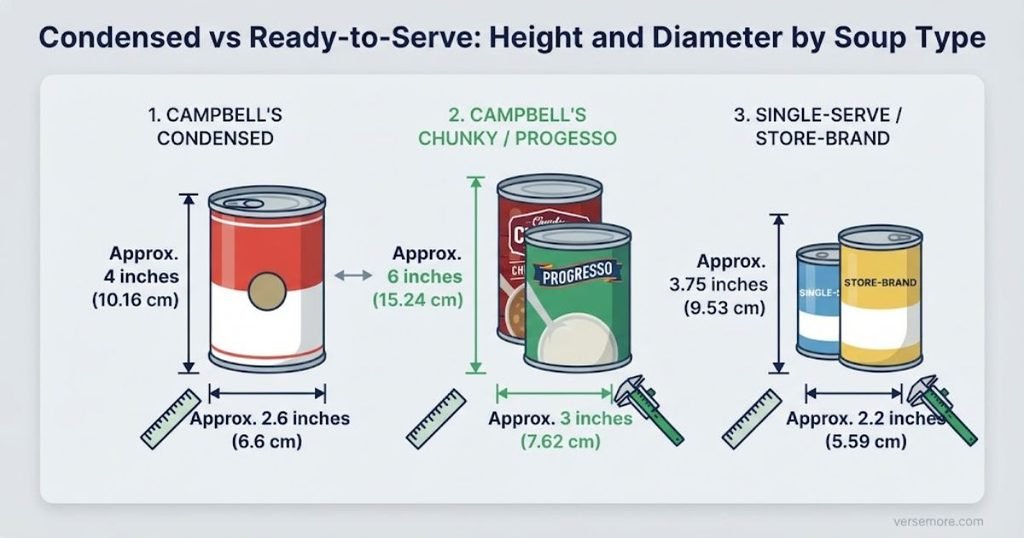
The main split on the shelf is whether the soup needs water. That one difference explains most of the size variation.
Campbell’s Condensed
Condensed soup is concentrated, and the directions say to mix the soup with one can of water. The can holds only about half of what you end up eating, so it fits the slim picnic size. That size is commonly listed as 211×400, or 2 11/16 × 4 inches (68 × 102 mm), and the familiar label shows 10.75 oz net weight.
Some sites give this can as a flat 3 × 4.5 inches instead. Set two cans side by side and the gap of 5/16 inch in width is easy to see. If precision matters for a shelf, a label or a recipe, measure your can.
Campbell’s Chunky and Progresso
Ready-to-serve soups skip the water step, so the can holds the full serving. Published figures for these cans conflict. One source lists Campbell’s Chunky at 3 inches wide by 4 3/8 inches tall, while another says Progresso and Chunky both use the 307×409 code. That leaves a width anywhere from 3 to 3 7/16 inches. Labeled net weights of about 18 to 19 oz are widely listed for these cans.
The safe reading is that they sit in the 300 to 307 family. Measure a can if you need the exact figure.
Single-Serve and Store-Brand Cans
Smaller cans do exist. The FDA container table lists an 8 oz short format at 211×300 and an 8 oz tall format at 211×304. Decoded, that is 2 11/16 × 3 inches (68 × 76 mm) and 2 11/16 × 3 1/4 inches (68 × 83 mm).
Two cans can carry the same label weight and still differ in height. The ounces on a label cannot tell you the shape.
Store brands generally aim to match the name brands so they fit the same shelf slots. That is a design goal rather than a guarantee, and the code is worth checking if you are buying in bulk.
Soup Can Volume and Capacity
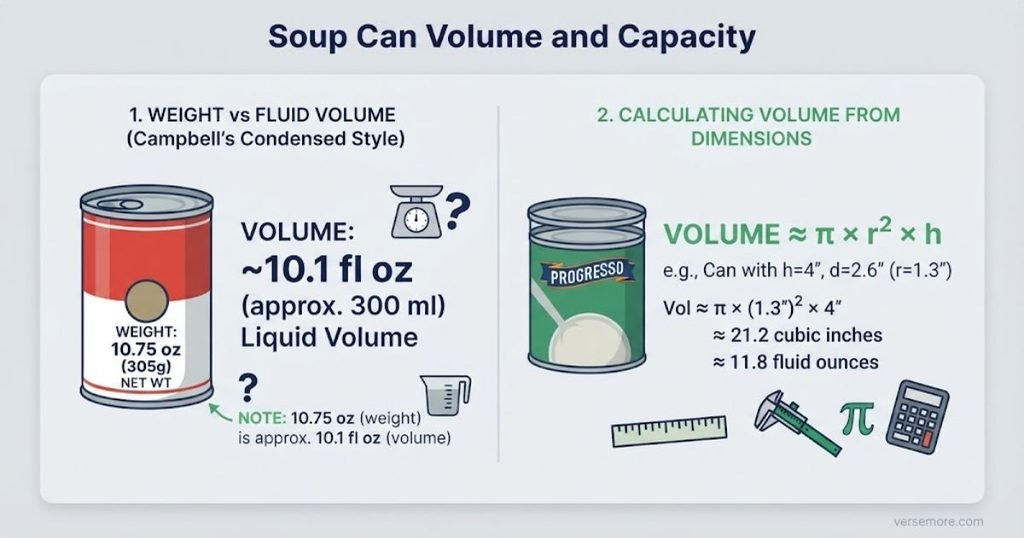
“How much does a can hold?” has two honest answers, one by weight and one by volume. Mixing them up is the most common error in soup-can articles.
Why 10.75 oz Is Not 10.75 Fluid Ounces
The “oz” on a soup label is net weight. Volume is measured in fluid ounces (fl oz), and the two only line up for liquids close to the density of water.
For water, 1 US fl oz weighs about 1.04 oz. So 10.75 oz of a watery liquid is about 10.3 fl oz, or roughly 1.3 cups. A ready-to-serve can labeled 18 to 19 oz works out to about 17.3 to 18.2 fl oz, or just over 2 cups. Chunky soups with meat and vegetables will differ, because solids take up space differently than liquid.
The Weight-vs-Volume Trap: if the label says “oz” with no “fl,” it is weight. Use the gram figure printed beside it (10.75 oz is about 305 g) and treat cups as a rough estimate only.
Working Out Volume from Height and Diameter
The formula for a cylinder is π × radius² × height. This gives the outside shape of the can, which is not the same as the amount of soup inside:
| Code | Outer volume (in³) | Outer volume (fl oz) | Outer volume (mL) |
| 211×400 | 22.7 | 12.6 | 372 |
| 300×407 | 31.4 | 17.4 | 514 |
| 307×409 | 42.3 | 23.5 | 694 |
Some pages plug 3 × 4.5 into the formula and report the answer as 10.75 fl oz. The formula actually gives about 17.6 fl oz for those numbers, and that is still only the outer cylinder.
In these examples, the soup inside fills roughly 75 to 90 percent of the outer volume. Steel walls, double seams and headspace take the rest. Treat the outer figure as a ceiling, not a capacity.
Soup Can Dimensions in Inches and Centimetres
Most searches for soup can dimensions in cm want a quick number. These are the four soup codes from earlier in metric:
| Code | Diameter (cm) | Height (cm) | Easy to remember |
| 211×400 | 6.83 | 10.16 | about 6.8 × 10.2 |
| 300×407 | 7.62 | 11.27 | about 7.6 × 11.3 |
| 303×406 | 8.10 | 11.11 | about 8.1 × 11.1 |
| 307×409 | 8.73 | 11.59 | about 8.7 × 11.6 |
Two conversions cover most needs. One inch is 2.54 cm, and one sixteenth of an inch is about 1.6 mm. If a can measures 4 inches, multiply by 2.54 and you get 10.16 cm.
UK and European Soup Tin Sizes
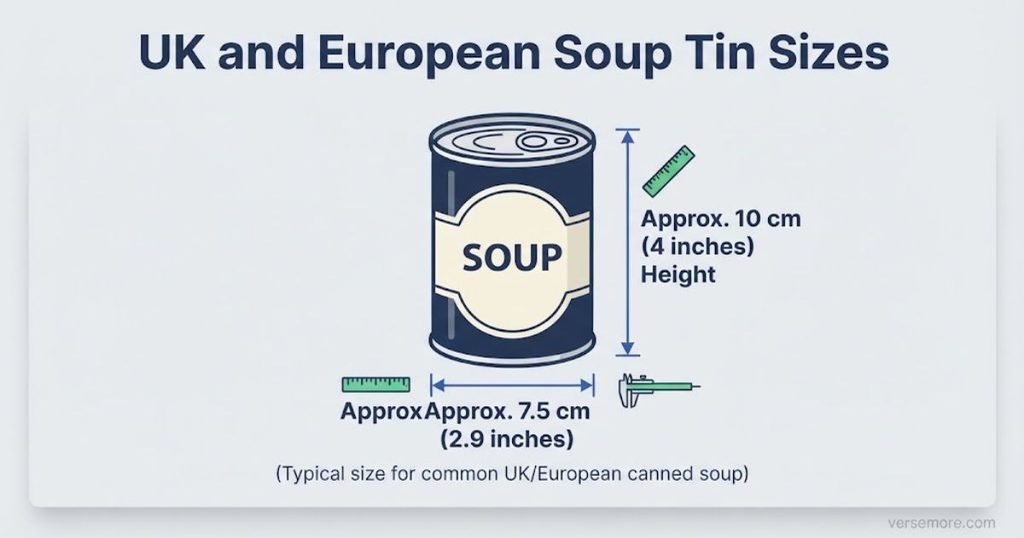
Metric markets label soup by net weight in grams. UK supermarket soups are commonly sold in 400 g tins, and Heinz sells its classic cream of tomato soup in 400g tins. A 400 g tin is about 14.1 oz, similar to the US 300-family cans.
One teaching resource measured a standard UK 400 g tin at 7.5 cm in diameter and 10.3 cm in height, measured inside the seams. That is roughly 3 × 4 inches. It is a single hand measurement with a ruler, so read it as an approximation. Outside dimensions run slightly larger.
Shape can also vary at the same weight. A review of UK tinned soups found that a Heinz tin and a Baxters tin, both 400g, had different shapes, with the Heinz tin narrower and taller. As in the US, the net weight tells you the contents, not the dimensions.
Across the rest of Europe, sizes vary by brand and country, so check the label and measure if it matters.
How to Measure a Soup Can Accurately
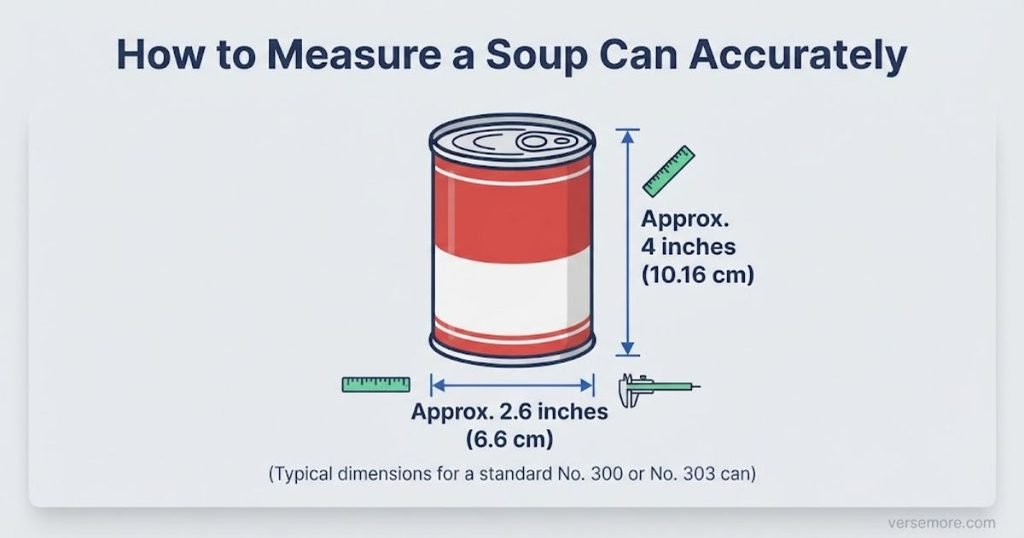
Use the 3-Step Can Check: measure, decode, then confirm.
1. Measure the body. Use calipers or a ruler across the widest part of the can body, not the rim, which is slightly wider. Take two readings at right angles to each other. Then measure the overall height from the bottom seam to the top of the top seam.
2. Decode it. Multiply each measurement in inches by 16 to get sixteenths. A width of 2.69 inches is 43 sixteenths, which is 2 11/16, so the diameter part is 211. A width of 3.02 inches is about 48 sixteenths, which is an even 3 inches, so 300.
3. Confirm with the label. Check the net weight in ounces and grams against the capacity ranges in the table in the first section.
A reading within 1/16 inch (about 1.6 mm) of a code counts as a match. Tolerances and rim effects can account for that much.
Practical Uses: Pantry Fit, Label Wraps and Crafts
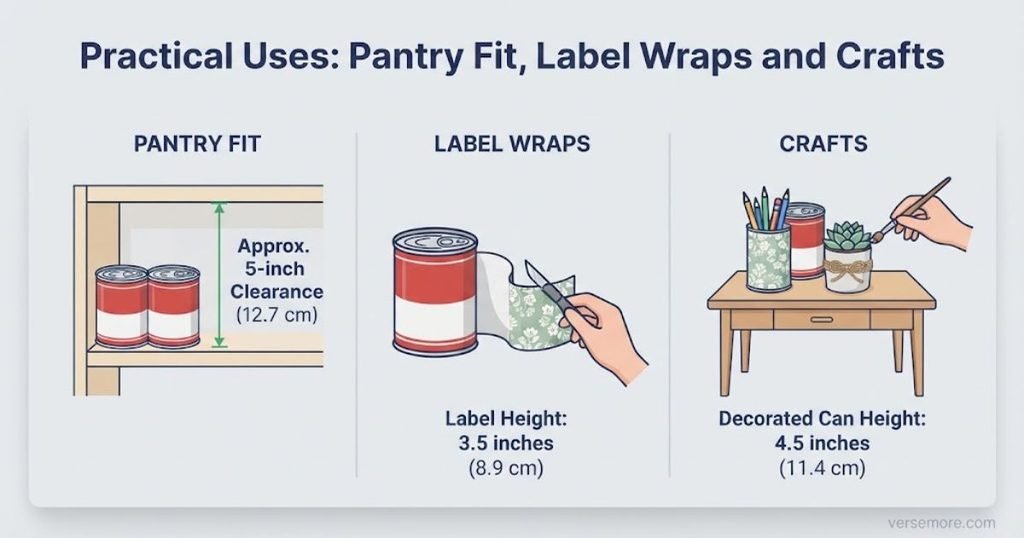
Dimensions earn their keep when a can has to fit somewhere or be wrapped, planted or stacked.
Pantry and Shelf Fit
The Shelf Fit Rule: divide the shelf width by the can diameter and round down. That tells you how many cans sit side by side before you leave any spare room. On a 12-inch shelf:
| Can | Diameter | Cans across 12 in | Width used |
| 211×400 condensed | 2 11/16 in | 4 | 10.75 in (1.25 in spare) |
| 300×407 | 3 in | 4 | 12.0 in (no spare) |
| 307×409 | 3 7/16 in | 3 | 10.3 in (1.7 in spare) |
A fit with no spare room is awkward in practice, because you cannot slide the last can in or out. Stack height works the same way. Two 300-code cans stacked are about 8.9 inches tall (2 × 4 7/16), so a shelf with 9 inches of clearance takes a two-high stack with almost no headroom. A three-high stack needs about 13.3 inches.
Mixing condensed and ready-to-serve cans in one row also wastes width because of the 5/16-inch gap between the two families. Grouping by code keeps the rows even.
Label Circumference
For a replacement label, a recipe tin or a craft wrap, the distance around the can is π × diameter:
| Code | Circumference (in) | Circumference (mm) |
| 211×400 | 8.44 | 214 |
| 300×407 | 9.42 | 239 |
| 307×409 | 10.80 | 274 |
That is the distance around the body. For the printable height, measure the flat panel between the seams and leave a small margin at each end. Add a little extra where the two edges overlap.
DIY Projects
An empty soup can makes a small planter or a pencil holder. A 300-code can is 4 7/16 inches tall and has an outer volume of about 514 mL (17 fl oz), so the real soil space is somewhat less. Punch drainage holes in the base and smooth or fold down the top edge, which can be sharp after opening. Some steel cans carry an interior coating designed for food contact, so if the plant is edible, a purpose-made pot may be the safer choice.
How Big Are #5 and #10 Cans Compared with a Soup Can?
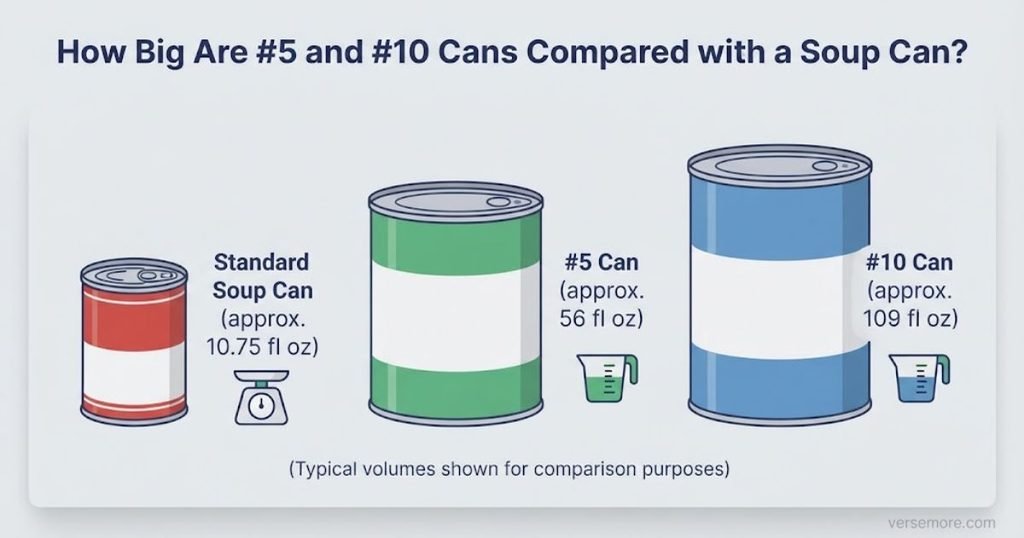
A #10 can is 3.5 inches wider and 3 inches taller than a condensed soup can (6 3/16 × 7 inches against 2 11/16 × 4). The #5 sits in between and is a common middle ground for kitchens that go through soup in batches but not by the gallon.
| Can | Outer volume (fl oz) | Times a condensed can | Net weight | Condensed cans by weight |
| 211×400 condensed | 12.6 | 1× | 10–12 oz | 1 |
| #5 (502×510) | 64.3 | 5.1× | 51–56 oz | 4.7–5.2 |
| #10 (603×700) | 116.6 | 9.3× | 102–117 oz | 9.5–10.9 |
By net weight, a #10 can holds roughly nine to eleven condensed soup cans, and by outer volume about nine times as much. The weight comparison is only a guide, because products differ in density.
The trade-off with a big can is what happens after you open it. Transfer leftovers to a covered container and refrigerate them, rather than storing food in the opened can, and plan to use the rest promptly.
FAQ’s
What are the dimensions of a standard soup can?
There is no single standard. Condensed soup is commonly packed in a 211×400 can (2 11/16 × 4 inches, or 68 × 102 mm), and ready-to-serve soup in wider cans of about 3 to 3 7/16 inches across and 4 3/8 to 4 9/16 inches tall.
How big is a can of Campbell’s condensed soup?
It is commonly listed as 2 11/16 inches wide and 4 inches tall (68 × 102 mm), with 10.75 oz net weight on the label. Some sites quote 3 × 4.5 inches instead, so measure your own can if the exact size matters.
How tall is a soup can in cm?
A condensed soup can is about 10.2 cm tall (4 inches). Ready-to-serve cans run from about 11.1 to 11.6 cm (4 3/8 to 4 9/16 inches).
How many cups are in a can of soup?
A 10.75 oz condensed can holds roughly 1.3 cups before you add water, and about 2.5 cups once you mix in one can of water. A ready-to-serve can labeled 18 to 19 oz holds just over 2 cups. These are estimates, because the label shows weight, not volume.
Is 10.75 oz fluid ounces?
No. The ounces on a soup label are net weight, and 10.75 oz is about 305 g. For a watery liquid that is roughly 10.3 fluid ounces, but thick soups will differ.
What does 300×407 mean on a can?
It is the can size code, written diameter × height. The first digit is whole inches and the last two digits are sixteenths, so 300×407 is 3 inches by 4 7/16 inches (76.2 × 112.7 mm).
What size is a Progresso soup can?
Published sizes vary, and ready-to-serve cans are generally listed at roughly 3 to 3 7/16 inches wide and 4 3/8 to 4 9/16 inches tall, with labeled weights of about 18 to 19 oz. Measure a can for an exact figure.
How many condensed soup cans equal a #10 can?
By net weight, about nine to eleven. A #10 can holds roughly 102 to 117 oz, and a condensed can is 10.75 oz. The result is approximate because different products have different densities.
Are UK soup tins the same size as US cans?
Not exactly. UK soups are commonly sold in 400 g tins, about 14.1 oz, which is close to the US 300-family cans. One hand measurement of a standard 400 g tin found about 7.5 × 10.3 cm inside the seams, but tin shapes vary between brands.
Conclusion
Soup can dimensions come down to which family of can you are holding. Condensed soup sits in the slim 211×400 can at 2 11/16 by 4 inches, and ready-to-serve soup moves into the wider 300 to 307 cans, which run 3 to 3 7/16 inches across. The code decodes with simple sixteenths arithmetic, and the ounces on the label describe weight, not volume.
When a number really matters, whether for a shelf, a label or a recipe, measure the can in your hand and treat the figures here as a reliable starting point rather than a promise.

I am the admin of VerseMore, sharing helpful, informative, and engaging content on various topics to inspire readers, provide value, and make everyday life easier.