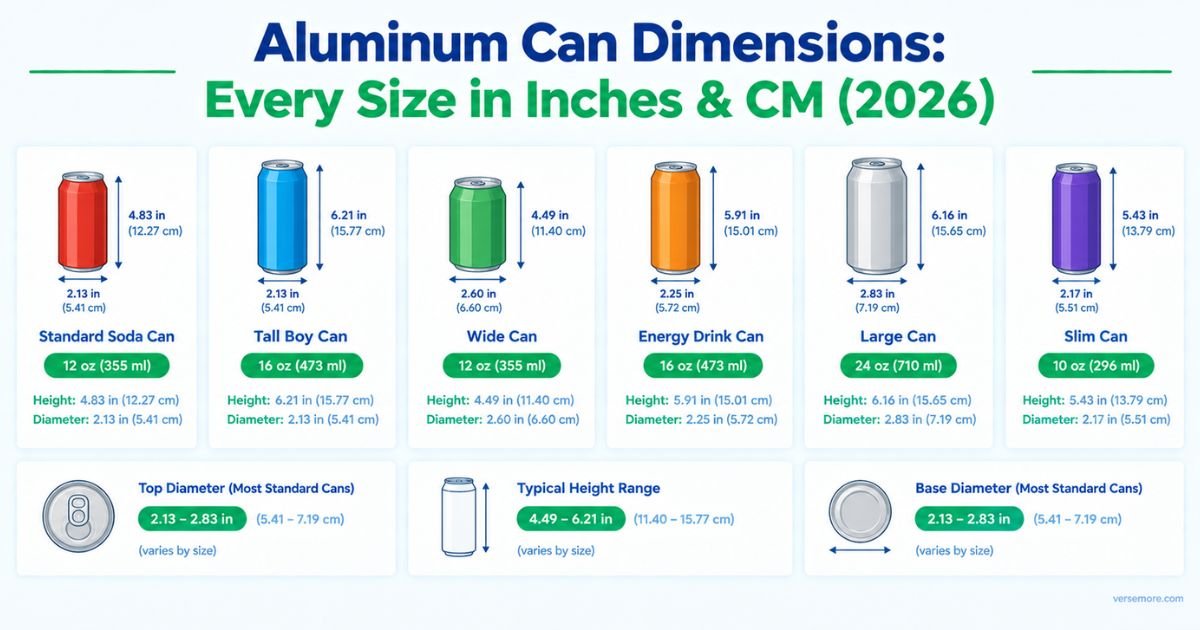
Pick up a standard soda can and you’re holding one of the most tightly standardized objects in everyday life: 4.83 inches tall, 2.6 inches wide, made to fractions of a millimeter. Pick up a slim can with the same 12 ounces inside and it stands 1.3 inches taller.
This guide lays out aluminum can dimensions for every common format, in inches, millimeters and centimeters. It also clears up the part most pages blur: a can has more than one diameter.
You’ll also find what the 202 and 211 codes mean, metric sizes for the UK and Europe, and a checklist for whether a can will fit your koozie, cup holder or 3D-printed holder.
A standard 12 oz aluminum can is 4.83 inches (122.7 mm) tall and 2.6 inches (66.0 mm) wide at the body, with a lid about 2.13 inches (54.1 mm) across.
Key Takeaways
• A standard 12 oz can is 4.83 × 2.6 inches. A 12 oz sleek can is about 6.13 inches tall and 2.25 inches wide.
• “Diameter” can mean four different things on a can. For koozies and holders, the number that matters is the widest part of the body.
• US cans hold 12 US fl oz (354.88 mL, labeled 355 mL). Most of Europe uses 330 mL.
• Codes like 202 and 211 are nominal sizes in sixteenths of an inch, not exact measurements.
What Are the Standard Aluminum Can Dimensions?
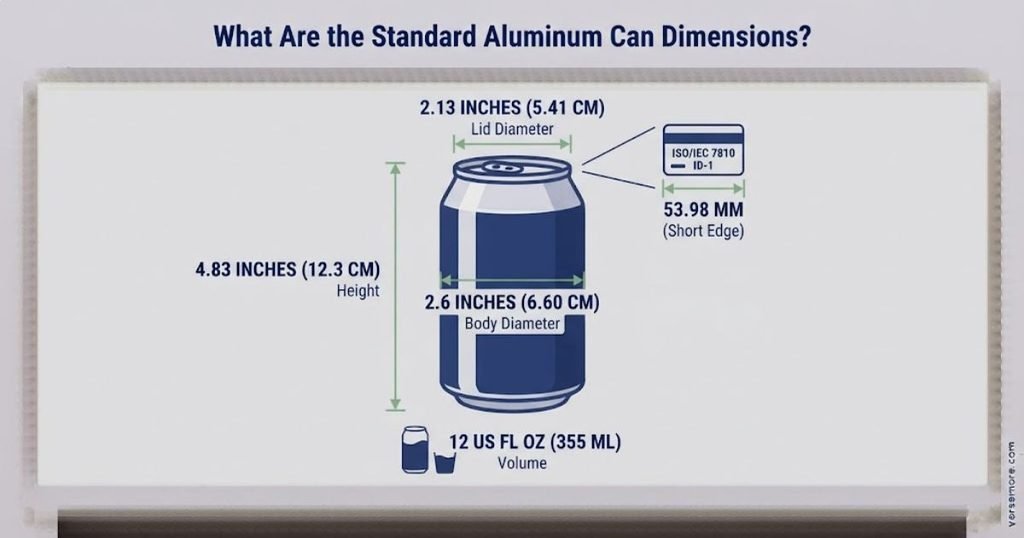
The standard US beverage can holds 12 US fluid ounces. It is 4.83 inches (12.3 cm) tall, 2.6 inches (6.60 cm) across the widest part of the body, and 2.13 inches (5.41 cm) across the lid.
| Measurement | Inches | Millimeters | Centimeters |
| Height (finished can) | 4.83 | 122.7 | 12.27 |
| Body diameter (widest point) | 2.60 | 66.0 | 6.60 |
| Lid diameter | 2.13 | 54.1 | 5.41 |
| Body circumference | 8.17 | 207.5 | 20.75 |
Inch figures are the published nominal values. Metric figures are converted at exactly 25.4 mm per inch and rounded once. Circumference is calculated as π × 2.60 in.
The lid is about as wide as the short edge of a credit card, which is 53.98 mm under the ISO/IEC 7810 ID-1 format.
The volume is 12 US fluid ounces. Converted with the exact factor (1 US fl oz = 29.5735295625 mL), that is 354.88 mL. Labels round it to 355 mL.
A cylinder with the can’s body width and full height would hold roughly 420 mL. The can holds about 84% of that, because the necked-in top, the domed base and the air gap left at filling take up the rest.
Height figures vary slightly by source. A supplier listing for Ball’s 12 oz standard can gives 4.81 inches for the empty can with its flange. The 4.83-inch figure is the one usually quoted for the finished can.
Aluminum Can Sizes Chart: Every Common Format
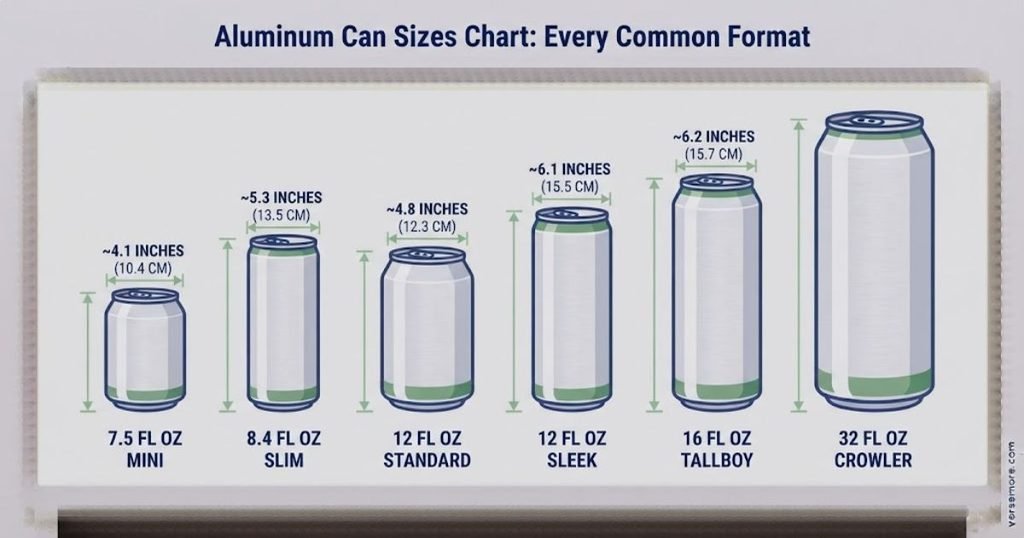
Here is the full size chart for the formats you’re most likely to meet in the US.
| Format | Capacity (US fl oz / mL) | Height (in) | Height (mm) | Body Ø (in) | Body Ø (mm) | End size |
| 7.5 oz mini | 7.5 / 221.8 | 4.09 | 103.9 | not listed | n/a | 202 |
| 8.4 oz slim | 8.4 / 248.4 | 5.17 | 131.3 | ≈2.10 | ≈53 | 200 |
| 12 oz standard | 12 / 354.9 | 4.83 | 122.7 | 2.60 | 66.0 | 202 |
| 12 oz sleek | 12 / 354.9 | 6.13 | 155.7 | 2.25 | 57.2 | 202 |
| 16 oz tallboy | 16 / 473.2 | 6.19 | 157.2 | 2.60 | 66.0 | 202 |
| 32 oz crowler | 32 / 946.4 | 7.60 | 193.0 | 2.86 | 72.6 | 300 |
Metric heights and diameters are converted from inches at 25.4 mm per inch. Capacities are converted from US fluid ounces and rounded to one decimal. Heights come from manufacturer or supplier listings (mostly Ball and TricorBraun), which measure the empty can, so finished-can heights can run a touch taller. The sleek body width comes from consumer and koozie specs, and the slim body width from a can-making patent and Ardagh’s slim can spec.
I left the 7.5 oz body diameter blank on purpose. Ball’s listing gives its height and neck size but not the body width. Competitor pages disagree, putting it at 2.1 inches on one and 2.6 inches on another, and I’d rather not copy either without a spec sheet.
Standard 12 oz and 16 oz Cans
The 16 oz tallboy keeps the 12 oz can’s 2.6-inch body and simply grows taller. That gives it 33% more liquid (473.2 mL vs 354.9 mL) for about 28% more height. Filling lines can run both formats with the same width tooling, which is why energy drinks and craft beer adopted it so easily. Beer-specific sizes and brewery formats are covered in our beer can dimensions guide.
Sleek vs Slim Cans: Why They Aren’t the Same
People use “slim” and “sleek” interchangeably, but the cans differ in width. The 8.4 oz slim can is about 2.10 inches (53 mm) wide and uses a 200 end. The 12 oz sleek can is about 2.25 inches (57.2 mm) wide and uses a 202 end.
Compared with a standard can, the sleek is roughly 0.35 inch narrower and the slim roughly half an inch narrower. That gap is why a slim can sags in a standard-width holder.
Industry sources don’t all use the same labels. Some call a 12 oz, 2.25-inch can “sleek”, while brands like White Claw market the same shape as “slim”. When you’re buying an accessory, go by the measured width rather than the name.
Mini, Stovepipe and Crowler Cans
The 7.5 oz mini is the shortest common can. Ball lists it at 4.09 inches with a 202 neck. Ball’s 8 oz “trim” can is a shorter version of its 8.4 oz slim, built with a 202 body and a 200 end.
The 19.2 oz stovepipe holds 567.8 mL, which lines up with the 20 imperial fl oz UK pint (568.3 mL). Larger 24 oz cans hold about 709.8 mL. I haven’t included heights or widths for either in the table, because published figures vary by maker and I couldn’t confirm them against a spec sheet.
The 32 oz crowler is the biggest common format at 7.60 inches tall and 2.86 inches wide, with a 300 end. Crowlers are often sealed by hand at breweries, which lets in more oxygen and shortens shelf life.
The Four Diameters of a Can (Body, Base, Neck and Lid)
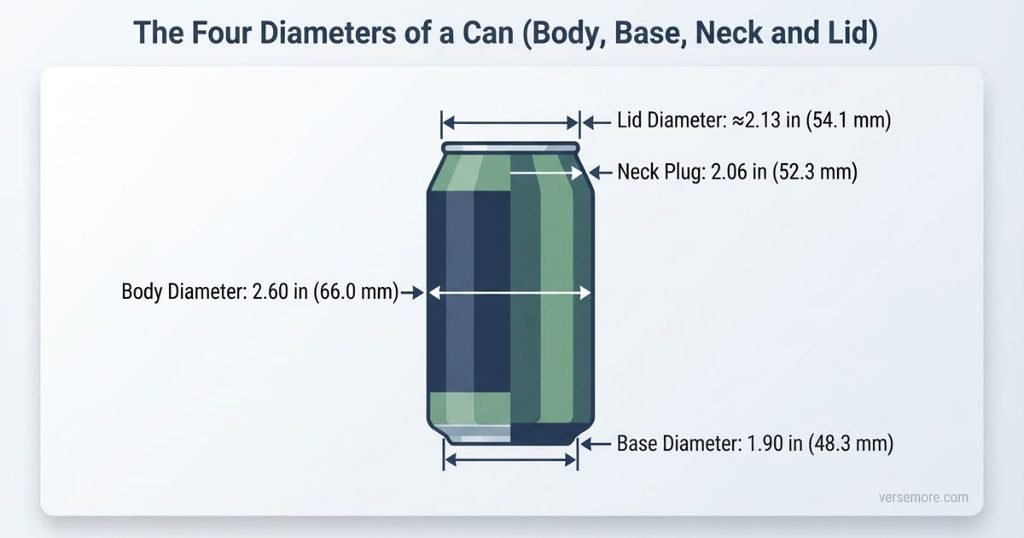
When someone asks for “the diameter” of a can, there are four answers. Competitor pages usually give just one, and sometimes mix them up. One page lists the 12 oz sleek can as 1.79 inches wide, but Ball’s own listing labels that 1.79-inch figure as the base diameter, not the body.
| Which diameter | What it is | 12 oz standard can | When it matters |
| Body | Widest point of the can wall | 2.60 in (66.0 mm) | Koozies, cup holders, coolers, labels, 3D-printed holders |
| Lid (seamed end) | The top after the end is sealed on | ≈2.13 in (54.1 mm) | Drinking, can covers, lid fit |
| Neck plug | Narrowed top where the end attaches | 2.06 in (52.3 mm) | Can makers and fillers |
| Base (stand ring) | Circle the can sits on | 1.90 in (48.3 mm) | Stability, cup holder bases, stacking |
Body, neck and base figures are from Ball’s 12 oz standard can listing, converted at 25.4 mm per inch. The lid figure is from Wikipedia.
Manufacturers’ own labels aren’t always consistent either. Ball’s 8.4 oz slim listing gives 2.08 inches as the “base diameter”, which looks like the slim body width rather than the stand ring. Ardagh’s 200 ml slim spec lists the body at 53.4 mm max, the neck plug at 50.0 mm and the stand diameter at 46.1 mm. When a figure matters, check which line is the maximum body.
Why the Bottom and Top Are Narrower Than the Body
The top is narrower because can makers shrink it on purpose. A can body is drawn and ironed at full width, then the open end is narrowed in several stages (called necking) so it can take a smaller lid. The patent describes shrinking a 211 body to take a 206, 204 or 202 end. A smaller lid uses less metal, and across billions of cans that adds up.
The base is narrower and domed for strength. Ardagh’s slim can spec calls for a minimum internal pressure resistance of 6.2 bar (90 psi), and a domed base is part of how the can handles that pressure. The narrow stand ring also lets cans nest neck-to-base when stacked.
What Do 202, 206 and 211 Can Codes Mean?
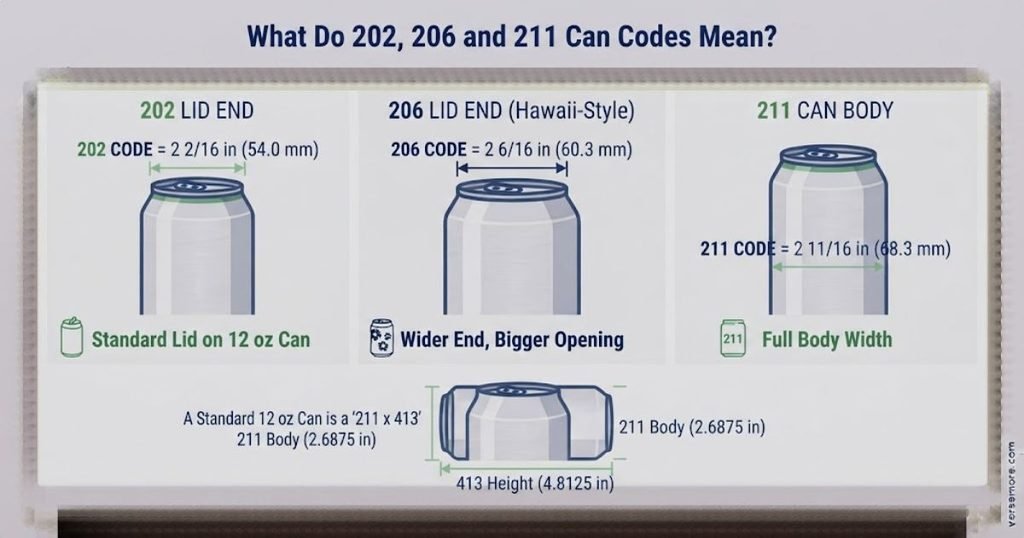
Can codes are three-digit labels, and they are not measurements. The first digit is whole inches. The last two digits are sixteenths of an inch. So 211 means 2 inches plus 11/16, which is 2.6875 inches, or 68.3 mm. Likewise 202 is 2 2/16 inches (2.125 in, 54.0 mm). The numbers are nominal, so a real can will be a hair off.
| Code | Reads as | Inches | Millimeters | Typical use |
| 200 | 2 0/16 in | 2.0000 | 50.8 | Slim can ends (body about 53 mm) |
| 202 | 2 2/16 in | 2.1250 | 54.0 | Standard lid on a 12 oz can; sleek can ends |
| 204 | 2 4/16 in | 2.2500 | 57.2 | Mid-size ends, some 16 oz cans |
| 206 | 2 6/16 in | 2.3750 | 60.3 | Wider ends, Hawaii-style cans |
| 211 | 2 11/16 in | 2.6875 | 68.3 | Full body width of a standard can |
| 300 | 3 0/16 in | 3.0000 | 76.2 | Larger formats and food cans |
A standard 12 oz can is often called a “211 × 413” can. The 211 is the body and the 413 is the height: 4 13/16 inches, or 4.8125 in (122.24 mm). That lines up with Ball’s 4.81 inches for the empty can. The filled and seamed can is a little taller, around 4.83 in (122.7 mm), because the double seam adds height above the body.
You’ll also see “202” on listings for 12 oz cans. That number is the lid, not the body. A 211 body is necked in to take a 202 end, which is why the same can can be sold as a “211” and as a “202” depending on who is describing it.
The Hawaii 206 Can
A 206 end is wider than a 202, so the can has a shorter neck taper and a bigger opening. Some cans sold in Hawaii and elsewhere use it, but I couldn’t find a manufacturer spec that pins down its overall dimensions, so I won’t quote a height or a width for it. If you need exact figures, ask the can supplier for the drawing.
Aluminum Can Dimensions in CM and Metric Sizes
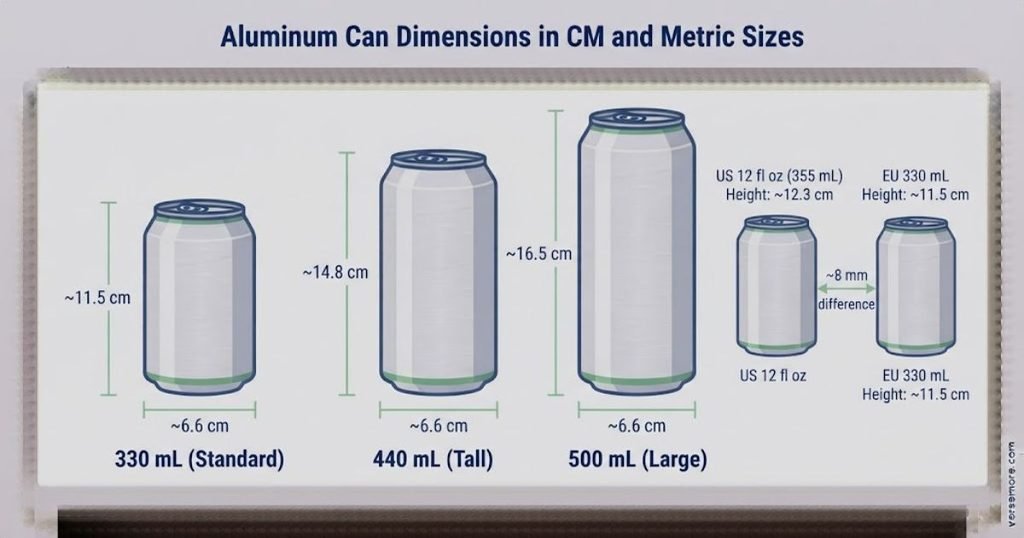
For a standard 12 oz can, the aluminum can dimensions in centimeters are about 12.3 cm tall and 6.6 cm wide (122.7 mm by 66.0 mm). Europe and much of the world sell drinks in 330, 440 and 500 mL cans instead of 12 and 16 oz. These cans share the same 66 mm body and the same lid sizes, so only the height changes.
| Can size | Volume | Approx. height | Approx. height (in) | Body width |
| Standard | 330 mL | ≈115 mm | ≈4.53 in | ≈66 mm |
| Tall | 440 mL | ≈148 mm | ≈5.83 in | ≈66 mm |
| Large | 500 mL | ≈165 mm | ≈6.50 in | ≈66 mm |
These heights are my estimates, scaled from the 12 oz can at a constant 66 mm body width. They are not manufacturer specs, so treat them as plus or minus a few millimeters. The method checks out against the 16 oz tallboy to within about 0.2 mm and matches the 330 and 440 mL figures on competitor pages.
Slim cans follow a different pattern. The slim can patent gives heights of 88 mm, 111 mm and 134 mm for 150, 200 and 250 mL cans.
US 355 mL vs European 330 mL
A US 12 oz can holds 354.88 mL (12 × 29.5735295625), which is why labels often say 355 mL. A European 330 mL can holds about 25 mL less, roughly 0.85 US fl oz. The body width is the same, and the 330 mL can is about 8 mm shorter (by my estimate), so it usually fits a US 12 oz holder, but check the height if the space is tight.
US Fluid Ounces vs Imperial Fluid Ounces
The fluid ounce differs between the US and the UK. One US fl oz is 29.5735295625 mL and one imperial fl oz is 28.4130625 mL, so the imperial ounce is about 4% smaller. A can labeled “12 fl oz” in the US holds 354.88 mL. The same number of imperial ounces would be 340.96 mL. UK cans are almost always labeled in mL (330, 440 or 500), which avoids the problem.
Will It Fit? A Can Fit Checklist
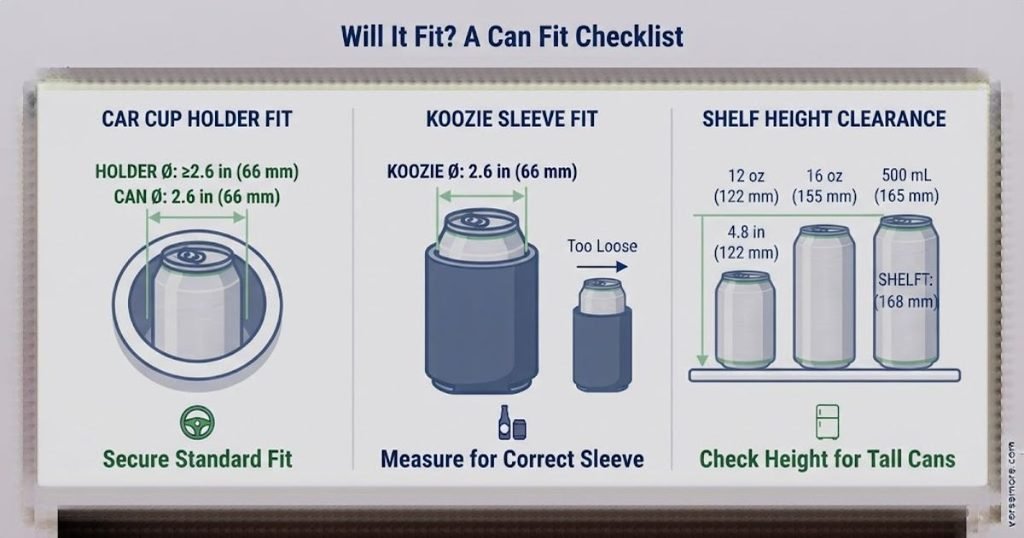
Most fit problems come down to one number: the body width. Measure the holder, then compare it with the can that will go in.
• Cup holders and bike cages: Allow at least 2.6 in (66 mm) for a standard 12 oz can. A slim can needs about 2.1 in (53 mm), and a holder sized for a slim can will not take a standard one.
• Koozies and sleeves: Standard koozies are made for the 2.6 in body. A slim can inside one will slide around, and a standard can won’t fit a slim sleeve. For measured koozie sizes, see our can koozie dimensions guide.
• Shelves and fridge doors: Check height as well as width. A 12 oz can is about 4.8 in (122 mm) tall, a 16 oz tallboy is about 6.1 in (155 mm), and a 500 mL can is about 6.5 in (165 mm).
• 3D-printed holders: Add 1 to 2 mm of clearance around the body. Printed parts shrink and warp slightly, so a design that matches the can exactly is usually too tight.
• Beer cans: Most beer cans use the same body width as soda cans, but sizes like the 16 oz and 19.2 oz are taller. Our beer can dimensions page covers those formats.
When in doubt, measure the can you actually have with calipers or a tape. The nominal figures here are accurate to a millimeter or two, which is enough for most holders but not for a tight press fit.
Why Aluminum Can Measurements Vary Slightly
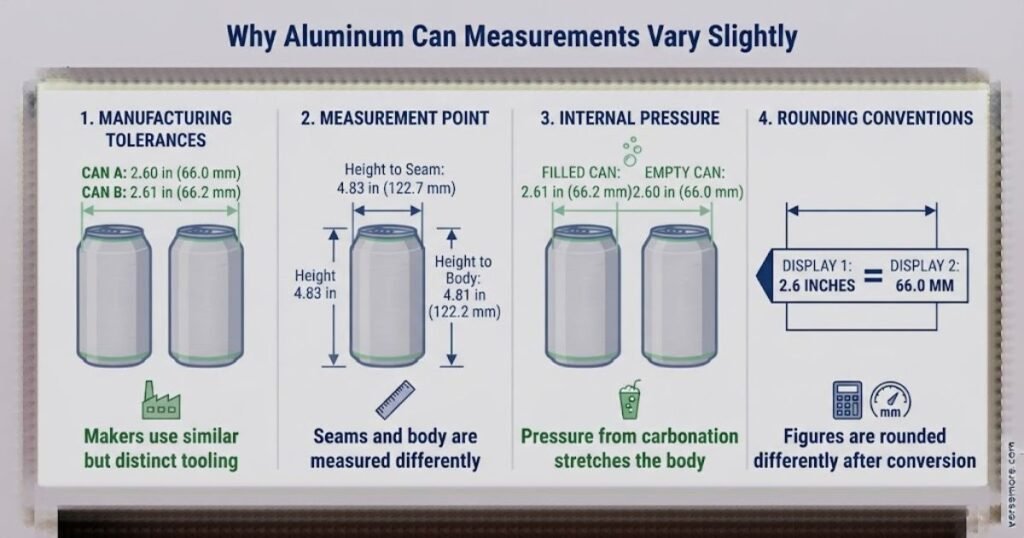
Two cans from the same shelf can differ by a millimeter or two, and that is normal. Several things cause it:
• Nominal vs real sizes. Can codes round to sixteenths of an inch, so 211 is a label for 2.6875 in, not a tolerance-checked measurement.
• Where you measure. Height changes depending on whether you include the seam, and whether the can is empty or filled and sealed. Width changes depending on whether you measure the body, the lid or the base.
• Different makers. Ball, Crown, Ardagh and others work to similar specs but not identical drawings, and each prints on its own tooling.
• Rounding. Listings convert between inches and millimeters at different precisions. A figure of 2.6 in and one of 66.0 mm are the same number rounded differently.
• Pressure. A filled can is slightly stretched by carbonation, and a can that has been opened and crushed won’t measure true at all.
For any build that has to match a can closely, buy a few of the exact product and measure them.
Aluminum Can vs Steel Can: Dimensions and Differences
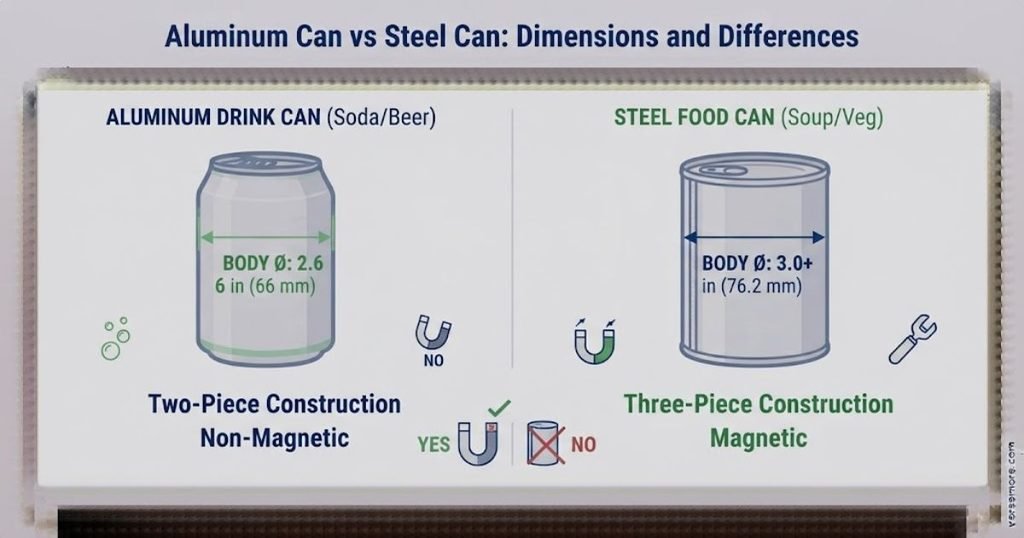
The two are different products. Drinks cans are aluminum and are made as two pieces: a drawn-and-ironed body and a separate lid. Food cans, like soup and vegetable cans, are mostly steel and are often built differently, with a thicker wall and a seam or bead on the body.
| Aluminum drink can | Steel food can | |
| Typical use | Soda, beer, energy drinks | Soup, vegetables, beans |
| Common code | 202 / 211 | 300 and up |
| Body width | 2.6 in (66 mm) for 12 oz | 3 in (76.2 mm) and wider |
| Magnetic | No | Yes |
| Pressure | Built for carbonation | Built for vacuum and heat sealing |
A quick test is a magnet: it sticks to steel and does not stick to aluminum. If you’re sizing a holder for a soup can, see our soup can dimensions page, since the sizes and codes follow a different system.
How Much Does an Aluminum Can Weigh and How Is It Made?
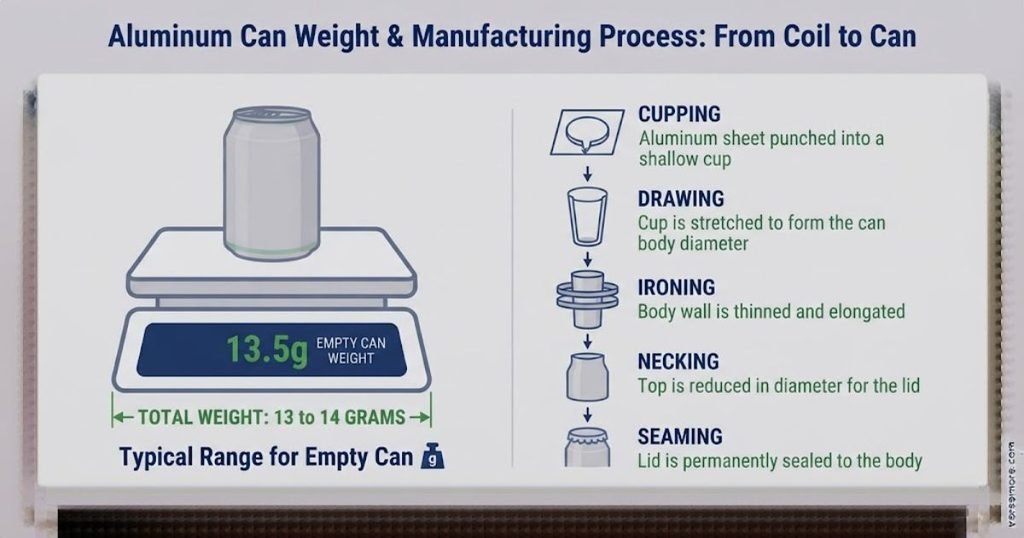
An empty US 12 oz can weighs roughly 13 to 14 grams, which works out to about 33 to 34 cans per pound (1 lb is exactly 453.59237 g). Weights vary by maker and year, since manufacturers keep thinning the walls to save metal. A full can is another story: 12 fl oz of soda adds about 355 g, so a filled can weighs close to 370 g.
The can is made in a few steps:
1. Cupping. A disc of aluminum sheet is punched into a shallow cup.
2. Drawing and ironing. The cup is pushed through a series of rings that stretch it into a tall, thin-walled body in one piece. The body alloy is usually 3004 or 3104.
3. Trimming and washing. The rim is trimmed level, then the can is washed and printed.
4. Necking. The open top is narrowed in stages so a smaller lid can fit.
5. Filling and seaming. The lid, made from a different alloy (5182), is fastened with a double seam. Filling lines run from about 15,000 to 120,000 cans per hour, depending on the plant.
Aluminum is a good fit for this process because it is light, takes the drawing without cracking, and can be recycled repeatedly without losing its properties.
FAQ’s
What are the dimensions of a standard 12 oz aluminum can?
A standard 12 oz can is about 4.83 inches (122.7 mm) tall and 2.6 inches (66.0 mm) wide at the body. The lid is about 2.13 inches (54.1 mm) across and the base is about 1.90 inches (48.3 mm). The empty can, before filling and seaming, is 4.81 inches tall.
How tall is a 16 oz aluminum can?
A 16 oz tallboy is about 6.1 inches (155 mm) tall with the same 2.6 inch body width as a 12 oz can. I scaled this figure from the 12 oz can rather than taking it from a manufacturer spec, so allow a millimeter or two either way.
What is the difference between a sleek can and a slim can?
A sleek can has a 202 end and measures about 2.25 inches across the body, while a slim can uses a 200 end and has a body about 53 mm (2.1 in) wide. Both are narrower than a standard can and both are taller for the same volume. Slim cans are the narrowest of the three, so they won’t fit a standard koozie.
What does 211 x 413 mean on a can?
It is the can’s nominal body diameter and height, written in inches and sixteenths. 211 is 2 11/16 inches (68.3 mm) and 413 is 4 13/16 inches (122.24 mm). The real can is a little narrower than 68.3 mm in practice, so treat the code as a label, not a measurement.
How many mL are in a 12 oz can?
A US 12 oz can holds 354.88 mL, which is usually printed as 355 mL. The same 12 imperial fluid ounces would be 340.96 mL, so the unit matters when you read a UK label.
What size is a 330 mL can in inches?
A 330 mL can is about 4.5 inches (115 mm) tall and 2.6 inches (66 mm) wide. The height is my estimate, scaled from the 12 oz can at a constant body width, so check a real can if you need an exact fit.
Do all aluminum cans have the same diameter?
No. Standard cans are about 66 mm wide, but slim and sleek cans are narrower, and mini cans are smaller still. Cans also have four diameters: body, lid, neck and base, so the answer depends on which one you measure.
How much does an empty aluminum can weigh?
A 12 oz can weighs roughly 13 to 14 grams empty, which is about 33 to 34 cans per pound. Makers keep thinning the walls, so newer cans can weigh slightly less than older ones.
Conclusion
Aluminum can dimensions come down to a handful of numbers. A standard 12 oz can is about 4.83 inches (122.7 mm) tall and 2.6 inches (66 mm) wide, and almost every other size is a variation on that body: taller for 16 oz and 500 mL cans, narrower for sleek and slim cans, smaller for minis. The detail most pages skip is that one can has four diameters, and a holder, sleeve or shelf only cares about the one it touches.
The can codes explain the rest. 211 is the body, 202 is the lid, and both are nominal labels in sixteenths of an inch, not measurements. When the fit has to be exact, measure the can you actually have, and use the aluminum can dimensions in this guide as the starting point. For related sizes, our beer can dimensions and can koozie dimensions pages cover the next step.

I am the admin of VerseMore, sharing helpful, informative, and engaging content on various topics to inspire readers, provide value, and make everyday life easier.










1 thought on “Aluminum Can Dimensions: Every Size in Inches & CM (2026)”