Ask how long is 2.75 inches and most pages hand you a list of objects that look convincing until you pull out a tape measure. A credit card, an AA battery and a Post-it note all show up on those lists. None of them is 2.75 inches.
This guide only counts an object if it lands within 0.05 inches of the target, and every size comes from a standard, a rulebook or a manufacturer spec. Seven things passed.
Below you’ll find the exact conversions, the seven objects, the popular “matches” that fail, and a way to measure 2.75 inches without a ruler.
2.75 inches (2¾ in) is exactly 6.985 centimeters, or 69.85 millimeters.
Key Takeaways
• 2.75 in = 6.985 cm = 69.85 mm, exactly. As a fraction it is 2¾ in.
• Seven objects pass the test: a 2¾-inch golf tee, a regular-mouth canning jar, a standard wall plate, 70 mm film, a 70 mm hole saw, the height of a UK £10 note, and two quarters plus a nickel.
• Three popular “2.75-inch” examples are wrong. A credit card is 2.125 in tall, an AA battery is about 1.99 in long, and a Post-it note is 3 in square.
• 7 cm is 2.7559 in, so it runs slightly longer than 2.75 in.
How Long Is 2.75 Inches in cm, mm and Fractions?
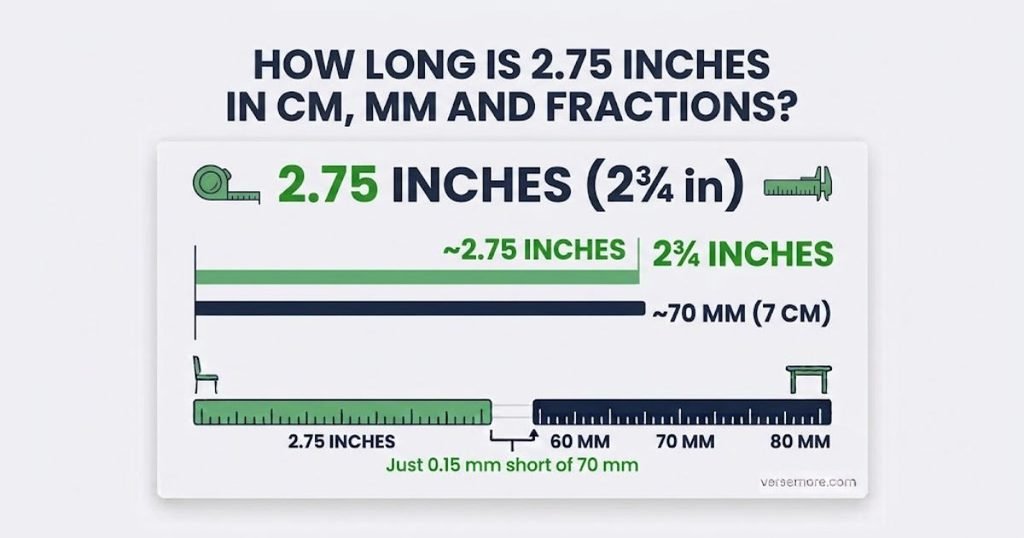
2.75 inches equals 6.985 centimeters or 69.85 millimeters. The conversion is exact because the inch has been defined as exactly 25.4 mm since July 1, 1959, a definition NIST documents from the 1959 Federal Register notice. Multiply 2.75 by 25.4 and you get 69.85, with nothing left over.
The US inch and the UK inch are the same length, so these figures hold on both sides of the Atlantic.
Exact vs. Rounded Values
| Unit | 2.75 inches equals | Exact or rounded |
| Millimeters | 69.85 mm | Exact |
| Centimeters | 6.985 cm | Exact |
| Meters | 0.06985 m | Exact |
| Feet | 0.2292 ft | Rounded (exactly 11/48 ft) |
| Yards | 0.0764 yd | Rounded (exactly 11/144 yd) |
| Fraction | 2¾ in (11/4, or 2 12/16) | Exact |
Calculators that show 6.99 cm have rounded once, at the end. That is fine for shopping or crafts, but use 6.985 cm if the number feeds into anything else.
Reading 2¾ Inches on a Ruler
On a US ruler, find the 2-inch mark and count three quarter-inch marks past it. You stop one quarter-inch short of 3 inches, which is why 2¾ looks “almost three” at a glance.
On a metric ruler, the 70 mm line sits just 0.15 mm beyond 2.75 inches, narrower than the printed line itself. For everyday purposes, 70 mm and 2.75 inches are the same length.
Everyday Objects That Measure 2.75 Inches
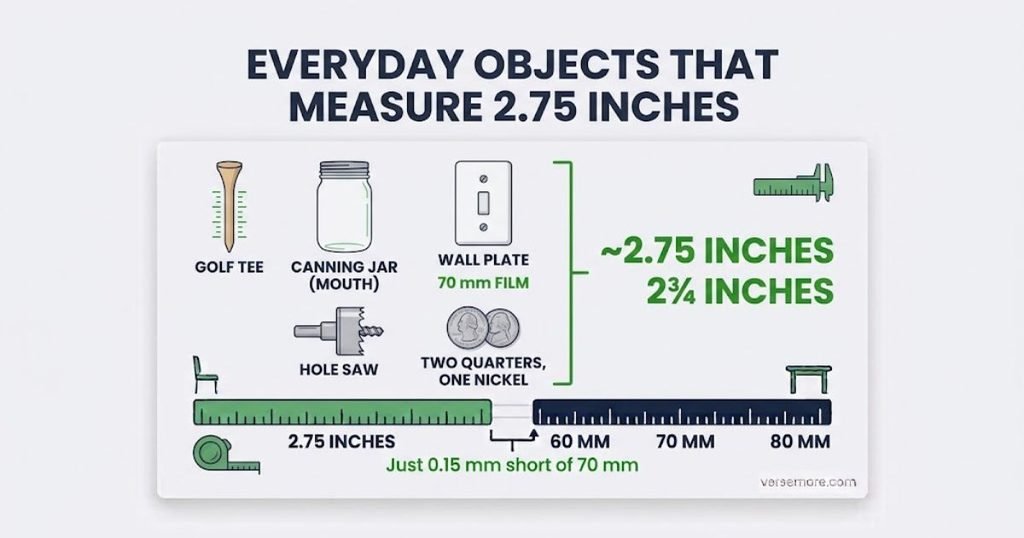
To qualify, an object must measure within 0.05 inches (about 1.3 mm) of 2.75 inches. Most of these are nominal sizes, meaning the size the product is sold as, so individual samples can vary slightly.
| Object | Measurement | Difference from 2.75 in |
| 2¾-inch golf tee | 2.75 in long | Nominal |
| Regular-mouth canning jar | 70 mm (2.76 in) mouth diameter | Nominal |
| Standard single-gang wall plate | 2.75 in wide | Nominal |
| 70 mm film | 2.756 in wide | +0.006 in |
| 2¾-inch hole saw | 70 mm (2.756 in) | Nominal |
| UK £10 polymer note | 69 mm (2.717 in) tall | −0.033 in |
| Two quarters and a nickel | 2.745 in in a row | −0.005 in |
The 2¾-Inch Golf Tee
Walk into any pro shop and the most common tee on the rack is 2¾ inches long. Tees are sold anywhere from about 1.5 to 4 inches, and 4 inches is the ceiling under the Rules of Golf, so 2¾ is a popular size and not a mandated one. Check the packaging before you rely on it as a ruler.
The Regular-Mouth Canning Jar
Mason-style jars come in two mouth sizes. The regular mouth is about 70 mm (2.75 in) across, and the wide mouth is about 86 mm (3.38 in). The figure refers to the outside of the jar’s mouth, so measure across the rim, not the opening inside. It is the same size on a half-pint jelly jar and a quart.
The Standard Single-Gang Wall Plate
A standard switch or outlet cover plate is 2.75 inches wide and 4.5 inches tall, per Home Depot’s size guide. Midsize plates (3.13 × 4.88 in) and jumbo plates (3.5 × 5.25 in) exist to cover rough drywall cuts. If the cover looks too narrow on your wall, step up a size rather than hunting for a “bigger standard.”
70 mm Film
The “70 mm” in 70 mm film is a physical width: 70 mm is 2.756 inches. Productions shoot on 65 mm negative and print on 70 mm stock, leaving the extra 5 mm for the soundtrack. IMAX uses the same width but feeds the film through horizontally.
The 2¾-Inch Hole Saw
A hole saw cuts a hole as wide as its own body, so a 2¾-inch saw makes a 2¾-inch opening. Manufacturers list the same tool as 70 mm, and a sizing chart converts it to 69.85 mm. If a plan calls for a 70 mm hole, this is the saw to buy.
The UK £10 Note, Height Only
The polymer £10 note is 69 mm tall, which is 2.717 inches. That is 0.033 inches short of the target, so it just passes the test. Only the height qualifies, because the note is much wider.
Two Quarters and a Nickel
Lay two US quarters and a nickel edge to edge. The US Mint specifies a quarter at 0.955 inches and a nickel at 0.835 inches, so the row measures 0.955 + 0.955 + 0.835 = 2.745 inches. That is within 0.005 inches of the target, the closest match in this article. Swap the nickel for another quarter and you overshoot to 2.865 inches.
Objects That Look Like 2.75 Inches But Aren’t
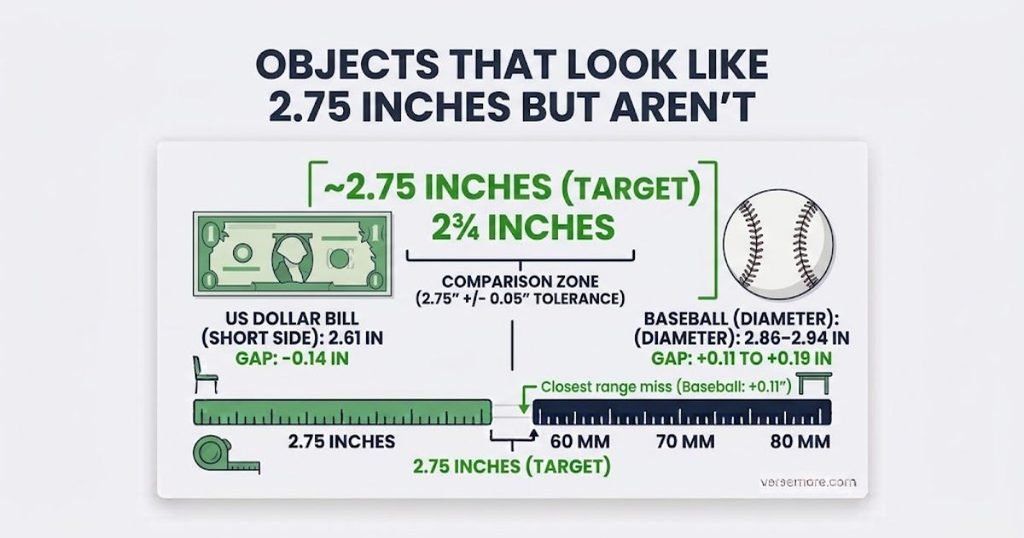
Several objects appear on nearly every “2.75-inch” list, and they miss by more than the 0.05-inch tolerance. Others are close enough to fool a quick glance but still fall outside it.
Popular “Matches” That Are Wrong
| Object | Actual size | Gap from 2.75 in |
| Credit or debit card, height | 2.125 in (53.98 mm) | −0.625 in |
| AA battery, length | 1.95–1.99 in (49.5–50.5 mm) | About −0.76 in |
| Post-it note, 3 × 3 in size | 3.0 in (76 mm) | +0.25 in |
| Tea light, diameter | About 1.5 in (38 mm) | About −1.25 in |
A standard bank card follows the ISO/IEC 7810 ID-1 format, which is 85.60 × 53.98 mm, or 3.370 × 2.125 inches. Neither side comes near 2.75 inches.
An AA cell is 49.5 to 50.5 mm long including its terminal. That is under 2 inches.
The 3-inch Post-it is listed by 3M at 76 mm square, so it overshoots by a quarter inch.
A tea light is commonly about 38 mm across, less than two-thirds of the target.
Close but Not Quite
| Object | Actual size | Gap from 2.75 in |
| Tennis ball, diameter | 2.57–2.70 in (6.54–6.86 cm, ITF) | −0.18 to −0.05 in |
| US dollar bill, short side | 2.61 in (66.3 mm) | −0.14 in |
| 12 oz aluminum can, body diameter | About 2.6 in (66 mm) | About −0.15 in |
| Baseball, diameter | 2.86–2.94 in (73–75 mm) | +0.11 to +0.19 in |
Only the very top of the tennis-ball range touches our tolerance, and most balls sit lower. The dollar bill is a good example of a near miss, because its 2.61-inch short side is a few millimeters off.
The can’s diameter is covered in our beer can dimensions guide. If you’re sizing a sleeve for it, the can koozie dimensions page covers fit. Other cans, such as soup cans, have their own measurements.
How to Measure 2.75 Inches Without a Ruler
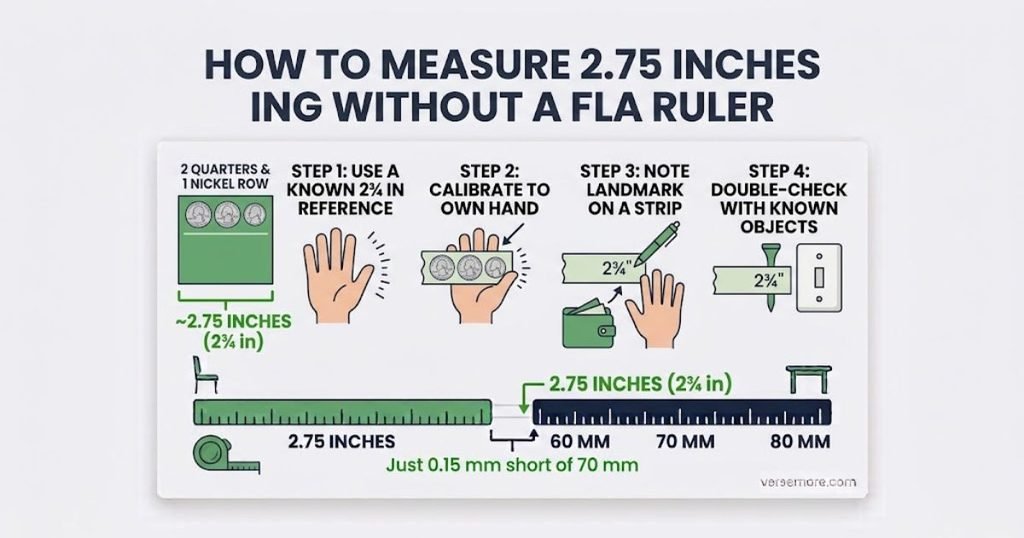
Body-part comparisons only work if you calibrate them to your own hand. That is why two competitor pages disagree, one saying “two fingers” and another “three.” Here is a calibrate-once method:
1. Mark 2¾ inches along the edge of a paper strip, using a ruler or the two-quarters-and-a-nickel row from earlier.
2. Lay the strip across your fingers and note which joint or finger width it reaches. Your hand is the unit now, not someone else’s.
3. Write that landmark on the strip and keep it in your wallet.
4. Check the landmark against a second reference, such as a standard wall plate or a 2¾-inch golf tee, before you trust it.
Treat the result as an estimate. It’s fine for sizing a gift box or judging a part online, but not for cutting or fitting. If you use a phone ruler app, check its scale against a known object like a quarter first, since screen settings can distort it.
Why So Many 2.75-Inch Things Are Really 70 mm Things
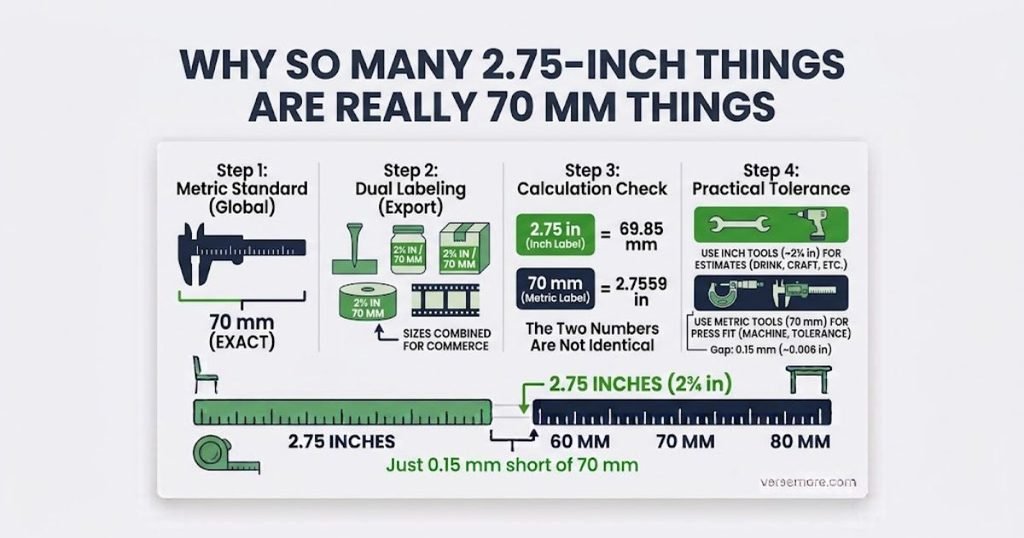
The golf tee, the jar mouth, the hole saw and the film are all sold under both inch and millimeter labels. Each is described as 2¾ in and as 70 mm, and that overlap is no coincidence of this list. It reflects how the sizes are labeled.
The two numbers are not identical. 70 mm is 2.7559 inches, and 2.75 inches is 69.85 mm. The gap is 0.15 mm, or about 0.006 inches. For a hole saw, spec sheets treat 2¾ in and 70 mm as one size, since the difference is below what most drilling tolerances can detect.
A practical rule follows from this. If a product is listed as 70 mm and you only have inch tools, 2¾ in will fit by eye for most jobs. For a press fit or a part with a tight tolerance, use the metric figure.
2.75 Inches Compared With 2.5 Inches, 3 Inches and 7 cm
| Length | Centimeters | Millimeters | Difference from 2.75 in |
| 2.5 in | 6.35 cm | 63.5 mm | −0.25 in |
| 2.7 in | 6.858 cm | 68.58 mm | −0.05 in |
| 2.75 in | 6.985 cm | 69.85 mm | 0 |
| 7 cm (≈2.7559 in, rounded) | 7 cm | 70 mm | +0.006 in |
| 2.8 in | 7.112 cm | 71.12 mm | +0.05 in |
| 3 in | 7.62 cm | 76.2 mm | +0.25 in |
All inch-to-metric figures in the table are exact. The 2.7559 value for 7 cm is rounded.
The takeaway is that 2.75 inches is a quarter inch (6.35 mm) longer than 2.5 inches and a quarter inch shorter than 3 inches. A 7 cm measurement matches it to within 0.15 mm.
FAQ’s
How many centimeters is 2.75 inches?
2.75 inches is exactly 6.985 centimeters. The conversion multiplies 2.75 by 2.54, since an inch is defined as exactly 2.54 cm. Everyday sources round this to 6.99 cm or about 7 cm.
How many millimeters is 2.75 inches?
2.75 inches is exactly 69.85 millimeters. Round it to 70 mm for most practical uses, because the 0.15 mm gap is too small to see on a ruler.
What is 2.75 inches as a fraction?
2.75 inches is 2¾ inches, which can also be written as 11/4 or 2 12/16. On a standard US ruler, find the 2-inch mark and count three quarter-inch marks past it.
How many feet is 2.75 inches?
2.75 inches is about 0.2292 feet, a rounded figure. The exact value is 11/48 of a foot. That makes it slightly less than a quarter of a foot, which would be 3 inches.
Is 7 cm the same as 2.75 inches?
Almost, but not exactly. 7 cm is 2.7559 inches, which is about 0.15 mm longer than 2.75 inches. For crafts, shopping or sizing, the two are interchangeable.
Is a credit card 2.75 inches?
No. A standard bank card is 2.125 inches tall and 3.370 inches wide under the ISO/IEC 7810 ID-1 format. Pages that list a card’s height as 2.75 inches are wrong.
Is an AA battery 2.75 inches?
No. An AA cell is 49.5 to 50.5 mm long, which is 1.95 to 1.99 inches. It is more than 0.7 inches short of 2.75 inches.
What common object is 2.75 inches long?
The most recognizable is the 2¾-inch golf tee, the most common tee length on the market. A standard single-gang wall plate is 2.75 inches wide, and a regular-mouth canning jar is about 2.75 inches (70 mm) across the mouth.
Is a US inch the same as a UK inch?
Yes. Both countries use the international inch, defined as exactly 25.4 mm since the 1959 agreement. Every measurement in this article is identical in the US and UK.
Conclusion
So how long is 2.75 inches? It is exactly 6.985 centimeters, a little under three inches and about the size of a golf tee, a standard wall plate’s width or the mouth of a regular canning jar. The seven objects above all land within 0.05 inches, while the popular credit card, AA battery and Post-it examples do not.
When you need to check a size without a ruler, stick to objects with published specs, such as two quarters and a nickel at 2.745 inches. And when a product is listed as 70 mm, you can treat it as 2¾ inches for most everyday purposes.

I am the admin of VerseMore, sharing helpful, informative, and engaging content on various topics to inspire readers, provide value, and make everyday life easier.