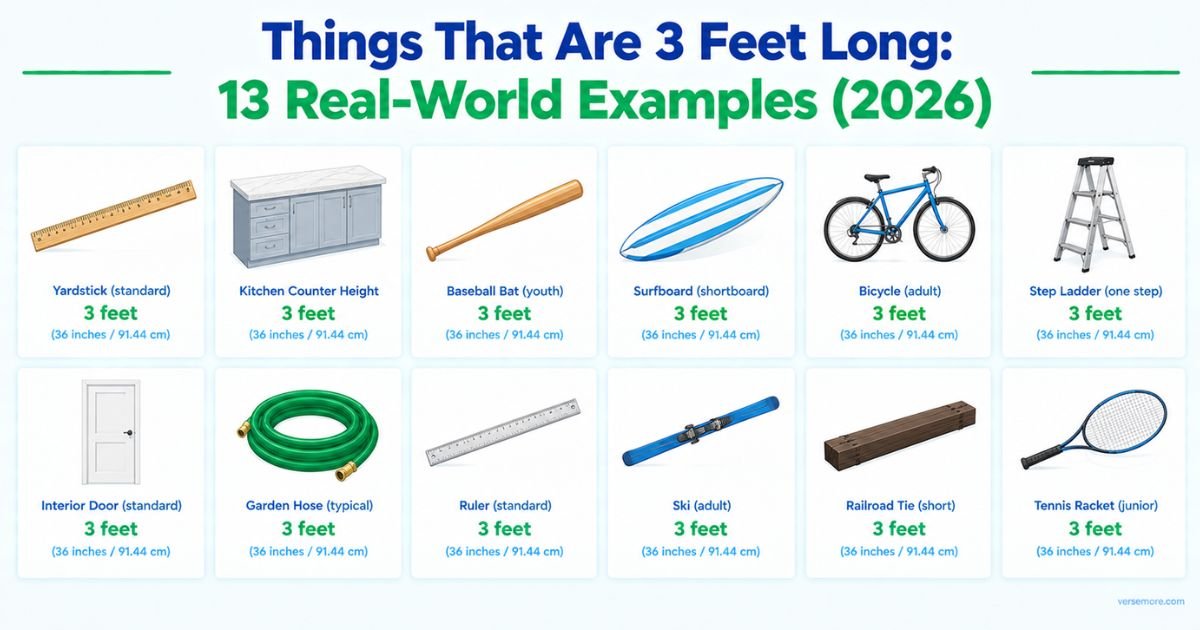
Three feet is a length most people can feel before they can name it. It’s a long stride, a kitchen counter against your hip, a yardstick leaning in a classroom corner.
This guide covers 13 common things that are 3 feet long. Each one is checked against a rulebook, a building code, or a published standard rather than a guess. You’ll also get exact conversions and a way to measure 3 feet when there’s no tape in sight.
A few popular examples turn out to be wrong, and those are flagged too.
3 feet is exactly 36 inches, 1 yard, or 0.9144 meters (91.44 cm).
Key Takeaways
•        3 feet equals 36 in, 1 yd, 91.44 cm and 0.9144 m. All four are exact, not rounded.
•        A 1-meter stick is about 3.37 in longer than 3 feet.
•        The 36-inch counter, 36-inch entry door, and tennis net at the center are all precisely 3 ft by rule or standard.
•        Most interior doors are 32 in wide, not 36 in, so they're a poor "3 feet" example.
How Long Is 3 Feet?
3 feet is 36 inches, which is the same as one yard. In everyday terms it’s a little under a meter, roughly the height of a kitchen counter, and about the distance from the floor to an adult’s hip.
The foot in this article is the international foot, defined as exactly 0.3048 meters. The US and UK both use it, so unlike a gallon or a ton, there’s no American-versus-British split to worry about. Surveyors once used a slightly different “US survey foot,” but that unit was retired after December 31, 2022 (NIST).
3 Feet in Inches, Centimeters, Meters and Yards
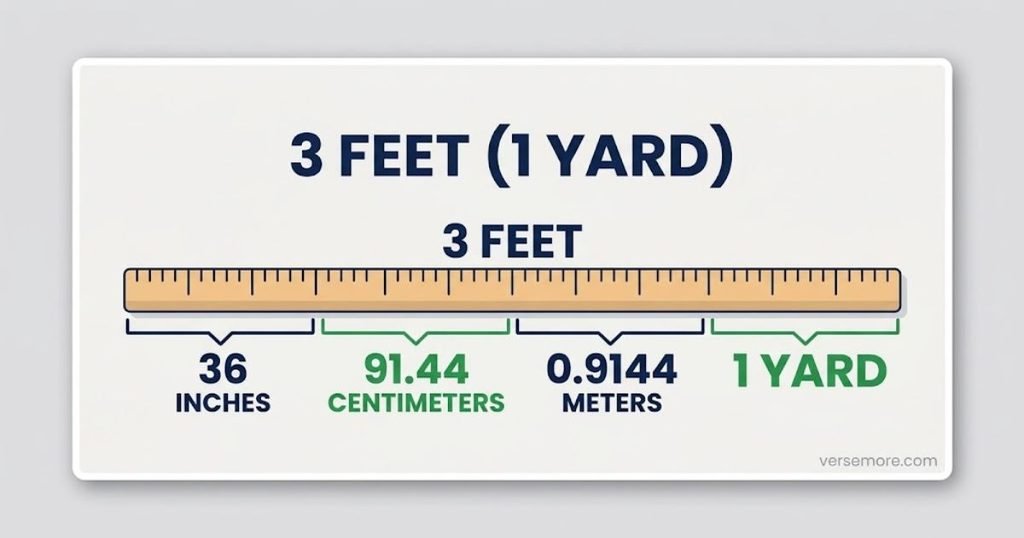
Because the foot is defined from the meter, every conversion of 3 feet is exact. Only the last row below is rounded.
| Unit | 3 feet equals | Exact or rounded |
| Inches | 36 in | Exact |
| Yards | 1 yd | Exact |
| Meters | 0.9144 m | Exact |
| Centimeters | 91.44 cm | Exact |
| Millimeters | 914.4 mm | Exact |
| Kilometers | 0.0009144 km | Exact |
| Miles | about 0.000568 mi | Rounded (3 ÷ 5,280) |
For any other length, multiply feet by 0.3048 to get meters, or by 12 to get inches.
A meter is 100 cm, so it’s 8.56 cm (about 3.37 in) longer than 3 feet. That gap is small enough that people treat the two as interchangeable, but it matters when you’re cutting wood or fitting furniture.
The old survey foot barely changes the result. Three survey feet differ from three international feet by about 0.0018 mm, which is far too small to measure with any ordinary tool.
Things That Are 3 Feet Long Around the House
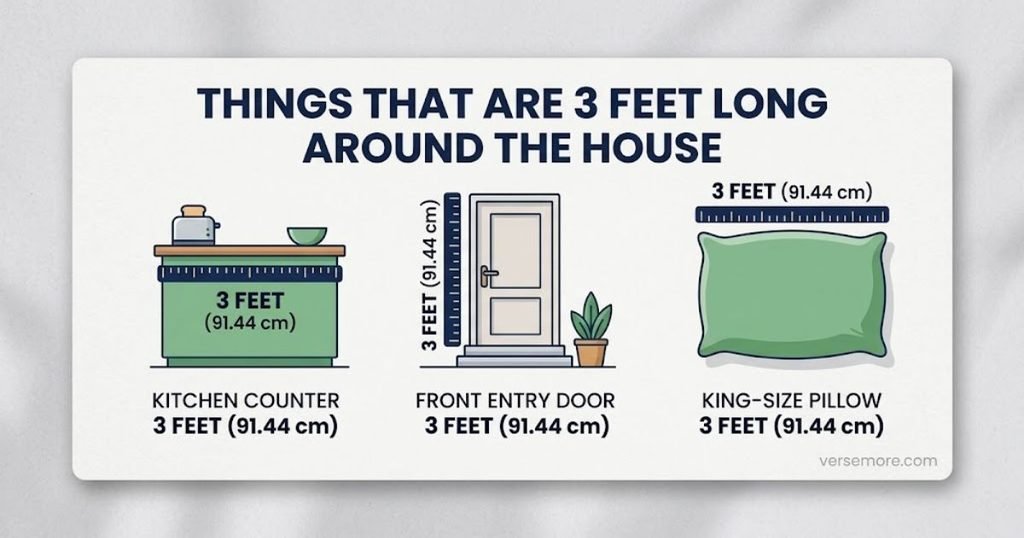
These three are the easiest to find without leaving your living space.
Kitchen Counter
The standard US kitchen countertop sits 36 inches above the finished floor. It’s usually built from a base cabinet around 34½ inches tall plus a countertop roughly 1½ inches thick, which is why the total lands on a round yard.
Accessibility guidelines for kitchen work surfaces in certain covered dwelling units cap the height at 34 inches, or allow an adjustable surface that spans 29 to 36 inches. So a lower counter is common in accessible kitchens, and 36 inches is the default for everyone else.
Front Entry Door
The standard exterior entry door is 36 inches wide (Bob Vila). That makes it one of the few doors that really is 3 feet across.
Don’t use an interior door as your reference. The most common interior door is 32 inches wide, with 30- and 28-inch doors common in older homes, closets and small bathrooms. A 36-inch door is also the usual route to the 32-inch clear opening that accessibility rules require, because the door slab and hardware eat into the opening when it swings open.
King-Size Pillow
A king pillow measures 20 by 36 inches, so its long side is exactly a yard (Amerisleep). Lay one flat on the bed and you’re looking at 91.44 cm.
Brands vary a little, so treat this as a typical size, not a law. A standard pillow is 20 × 26 in and a queen is 20 × 30 in. The king is the one that matches 3 feet.
Things That Are 3 Feet Long in Building Codes
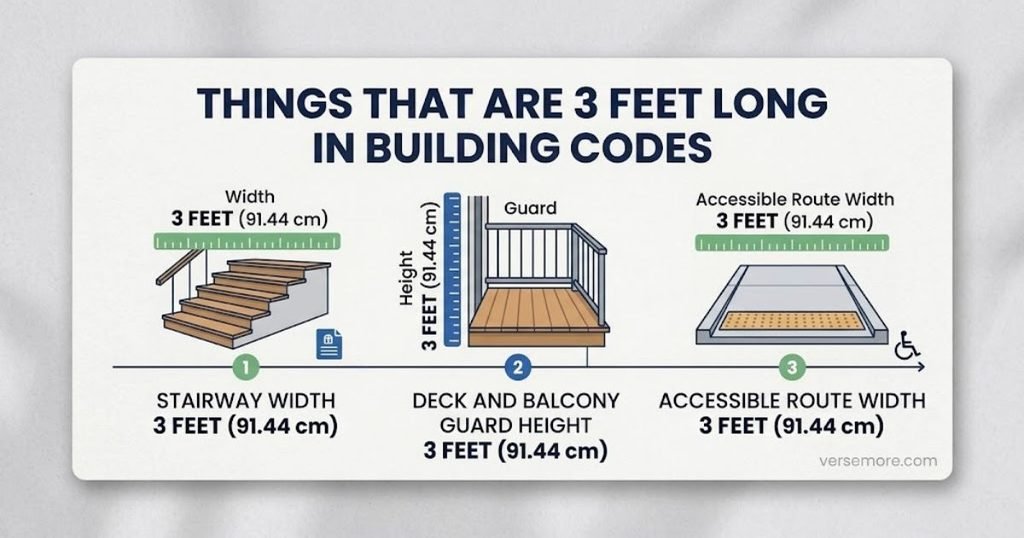
Building codes turn 3 feet into a legal minimum in several places. The figures below come from the US International Residential Code (IRC) and the ADA Standards, so check your local rules, especially outside the United States.
Stairway Width
The IRC requires stairways to be at least 36 inches wide in clear width above the permitted handrail height (IRC R311.7.1 via Tucson). Handrails may project into that space by up to 4½ inches on each side.
Below handrail height, the clear width can narrow to 31.5 inches with one handrail, or 27 inches with handrails on both sides. So the full 3 feet only has to be free above the rail.
Deck and Balcony Guard Height
Porches, balconies, ramps and raised floor surfaces more than 30 inches above the floor or grade below need a guard at least 36 inches high. Guard openings must also stop a 4-inch sphere from passing through.
That makes a typical residential deck railing a 3-foot object. Stand next to one and it will usually reach about your hip.
Accessible Route Width
Under the ADA Standards, an accessible route needs a clear width of at least 36 inches (Access Board). The route can pinch down to 32 inches for up to 24 inches of length, as long as those narrow spots are separated by at least 48 inches of full 36-inch width.
These rules generally cover public and commercial buildings, not most private homes. Even so, they explain why hallways, ramps and store aisles so often come out at 3 feet.
Things That Are 3 Feet Long in Sports
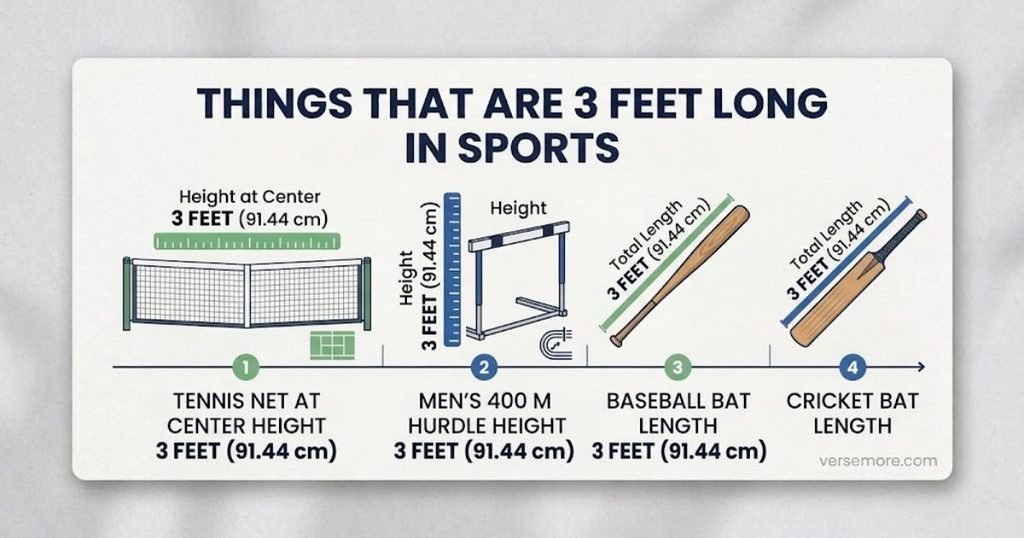
Sports rulebooks fix several dimensions at or near a yard. Four of them follow.
Tennis Net at Center
The International Tennis Federation sets the net height at exactly 3 feet (0.914 m) at the center, where a strap holds it down (ITF Rules of Tennis). The net is higher at the posts, at 3½ feet (1.07 m), so it sags toward a yard in the middle.
Only that one point is the 3-foot mark. If you measure a net near the post, you’ll read half a foot too tall.
Men’s 400 m Hurdle
Men’s 400 meter hurdles stand 91.4 cm (36 inches) high, while women’s are 76.2 cm (30 inches) (World Athletics). The rulebook rounds to 91.4 cm, so the hurdle is a whisker (0.04 cm) shy of a mathematically exact yard.
Don’t confuse it with the sprint hurdles. The men’s 110 m hurdle is taller, at 106.7 cm (42 inches). The 400 m hurdle is the one that matches 3 feet.
Baseball Bat
Major League rules cap a bat at 42 inches long and 2.61 inches in diameter (Rule 3.02). Most adult players use bats between 33 and 36 inches (Baseball-Reference), so a 36-inch bat sits at the long end of normal, not at the legal limit.
Bats are often described by “drop,” meaning weight in ounces minus length in inches. A 36-inch bat with a −3 drop weighs about 33 ounces.
Cricket Bat
Law 5 of the Laws of Cricket limits a bat to 38 inches (96.52 cm) overall (MCC). Very few commercial bats exceed 35 inches, so a typical adult cricket bat is a little under 3 feet.
That makes it a good “almost a yard” reference for readers in the UK and elsewhere. Just don’t call it exactly 36 inches.
Roads, Tools and People Around 3 Feet
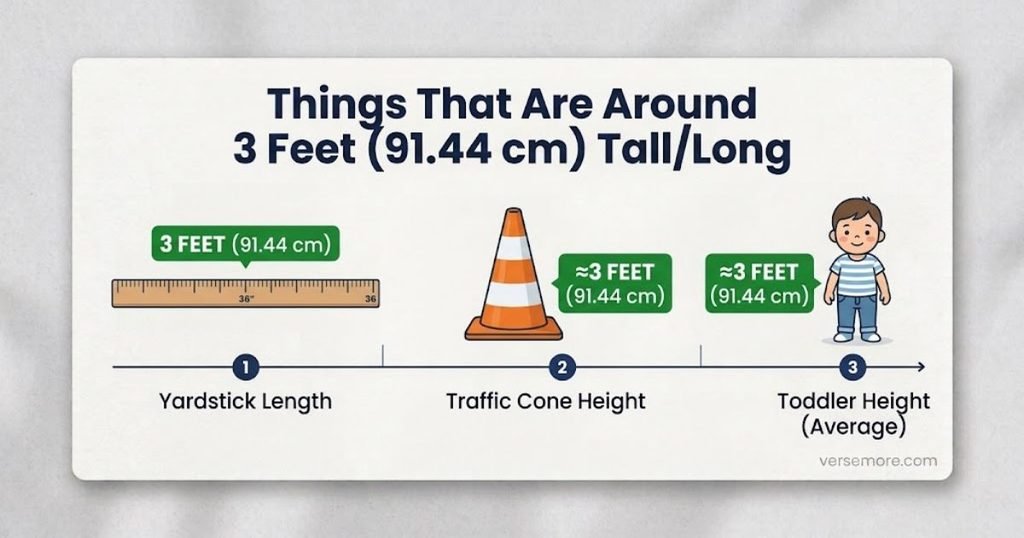
The last three examples are a tool, a piece of road equipment, and a person.
Yardstick
A yardstick is the only object on this list built to be 3 feet. It’s 36 inches long because the yard has been defined as exactly 0.9144 meters since 1959 (Wisconsin State Cartographer’s Office).
Pick up a meter stick and a yardstick together and the difference is plain: the meter stick runs about 3.4 inches longer.
Traffic Cone
Federal traffic-control rules set cone minimums, not a standard 36-inch size. Cones must be at least 18 inches on daytime, low-speed roads, and at least 28 inches on freeways, at night, or when more conspicuous guidance is needed (Traffic Safety Store, summarizing MUTCD).
A 36-inch cone is a real 3-foot object. It’s simply a taller option that many agencies choose for visibility, so it isn’t “the” legal size.
Toddler
According to CDC growth data, the median girl reaches 36 inches (91.44 cm) at roughly 32 months, or about 2 years 8 months (CDC data via Merck Manuals). That’s earlier than the “age 3 to 4” many pages claim.
At 36 months, the 5th to 95th percentile range runs about 35 to 41 inches for boys and 34.5 to 40 inches for girls (chart summary). Healthy children vary widely, so treat this as a visual reference, not a growth benchmark.
For adults, 3 feet is a little over half of standing height. On someone 5 feet 9 inches (69 inches) tall, 36 inches is about 52 percent, which usually lands somewhere around the hip. That varies from person to person, which is why the measuring section below has you check yours.
Near Misses: Things People Wrongly Call 3 Feet Long
These objects show up on many “3 feet” lists but don’t match. Figures are typical sizes, rounded to the nearest inch where noted.
| Object | Typical size | Gap from 36 in |
| Interior door (width) | 32 in (30 or 28 in common in older homes) | About 4 in short |
| Acoustic guitar (overall) | About 38–41 in, varies by body style | About 2–5 in over |
| Great Dane (shoulder height) | About 34 in for males, 32 in for females (GDCA) | A true 36 in is a larger-than-average Dane |
| 4-year-old child (height) | About 40 in (girls’ median is 101 cm) | About 4 in over |
| Meter stick | 39.37 in | 3.37 in over |
The guitar range comes from general guidance, not a single standard, so check a manufacturer’s spec if you need an exact figure.
How to Measure 3 Feet Without a Tape Measure
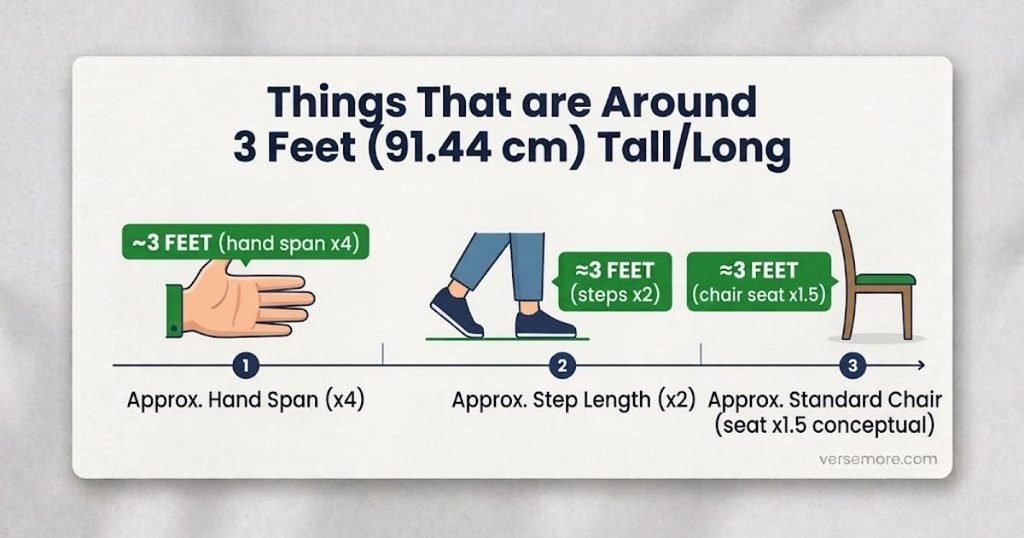
Use these steps in order, from most to least accurate.
1. Stack three 12-inch rulers end to end. Three feet is 3 × 12 inches, so this is exact.
2. Hold a known reference against the space. A yardstick works best. In a US home, a standard kitchen counter, a king-size pillow’s long side, or the width of a front entry door all come close to 36 inches.
3. Run the 3-Foot Calibration Check once, then reuse it. Measure three of your own body lengths against a yardstick or tape: your half arm span (center of your chest to your fingertip with the arm held straight out), your forearm from elbow to fingertip doubled, and one long, deliberate stride, heel to toe. Note which of the three lands closest to 36 inches. That becomes your personal ruler. Body measurements differ from person to person, so a “typical” figure is a guess, but your own number is reliable.
4. Sanity-check against a meter. If you have a meter stick, 3 feet falls 8.56 cm short of it, a little under 3.5 inches.
3 Feet Compared With Other Lengths
Three feet sits between a 2-foot and a 4-foot length, and just under a meter. This table lines up the neighbors so you can see where it falls.
| Length | Inches | Centimeters | Note |
| 2 feet | 24 in | 60.96 cm | Exact |
| 3 feet | 36 in | 91.44 cm | Exact |
| 1 meter | 39.37 in | 100 cm | Inches rounded |
| 4 feet | 48 in | 121.92 cm | Exact |
| 57 inches | 57 in (4 ft 9 in) | 144.78 cm | Exact |
| 6 feet | 72 in | 182.88 cm | Exact |
Double 3 feet and you get 72 inches, which is 6 feet. We cover that length in our guide to how long 72 inches is. If you’re sizing something a little taller than a yard, 57 inches comes out to 4 feet 9 inches.
Larger lengths are easy too, because a yard is 3 feet. Fifteen feet is five yards laid end to end, as shown in things that are 15 feet long. Stretch that to ten yards and you reach 30 feet.
The Length, Area and Volume Trap
“3 feet” is a length. It is not the same as 3 square feet or 3 cubic feet, and mixing them up leads to wrong purchases.
• A square that is 3 feet on each side covers 9 square feet, or 1 square yard.
• A cube that is 3 feet on each side holds 27 cubic feet, or 1 cubic yard.
So a “3 by 3” patio slab is 9 square feet of floor, not 3. That trips people up when buying tile, mulch or concrete.
Where 3 Feet Shows Up as a Safety Rule
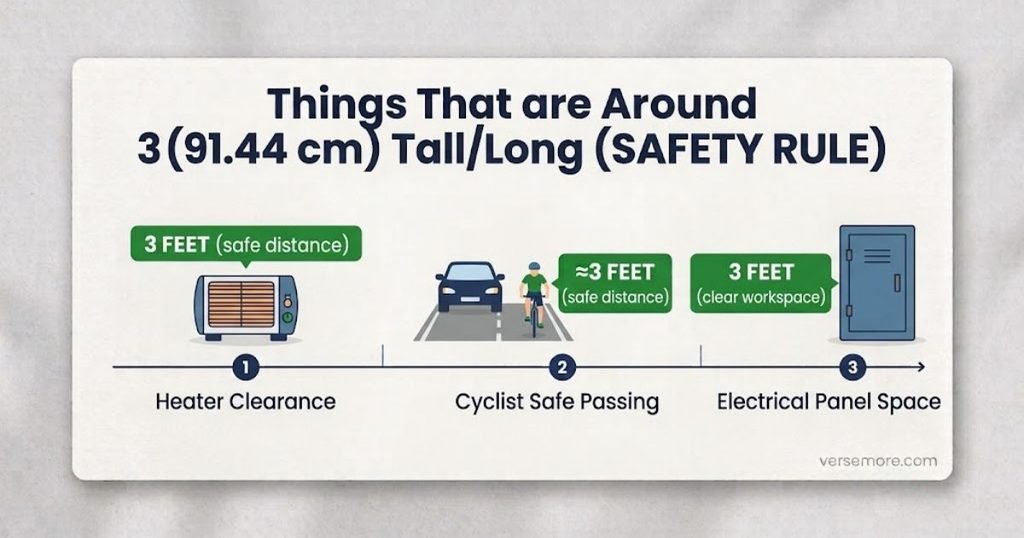
Three feet also appears as a distance people are told to keep. These are US rules and guidelines, so check your local requirements.
Heaters and Anything That Can Burn
The National Fire Protection Association (NFPA) says to keep anything that can burn at least 3 feet from heating equipment such as space heaters, fireplaces, wood stoves and furnaces. It also recommends a 3-foot “kid-free zone” around open fires and space heaters (NFPA guidance via Wentzville FPD). A kitchen counter’s height is a handy picture of that gap.
Passing a Cyclist
Many US states require drivers to leave at least 3 feet when passing a bicyclist. NHTSA counted 35 states plus DC as of September 2021 (NHTSA), while a newer Bike League summary counts 38 states plus DC with a defined distance (Bike League). A few states set a longer distance, so 3 feet is a minimum, not a universal rule.
Space in Front of an Electrical Panel
The National Electrical Code calls for a working space at least 30 inches wide, 36 inches deep and 78 inches high in front of an electrical panel (Kansas State Fire Marshal). Nothing should be stored in that space. Higher-voltage equipment needs more depth, so this is the minimum for typical household panels.
FAQ’s
How long is 3 feet in inches?
3 feet is exactly 36 inches, because each foot has 12 inches and 3 × 12 = 36. It also equals one yard.
How many centimeters and meters is 3 feet?
3 feet is exactly 91.44 centimeters, or 0.9144 meters. Both figures are exact because the foot is defined as 0.3048 meters.
Is 3 feet the same as 1 yard, and how does it compare with a meter?
Yes, 3 feet equals exactly 1 yard. A meter is a little longer, by about 8.56 cm (3.37 inches), so the two are close but not interchangeable for precise work.
What is the best everyday example of 3 feet?
A yardstick is the most exact, since it’s built to be 36 inches. In a US home, a standard kitchen counter at 36 inches and a king pillow’s 36-inch side are close seconds.
How tall is 3 feet compared to a person?
For a 5-foot-9 adult, 3 feet is a little over half of standing height, usually around the hip. A typical child reaches 36 inches at about 2 years 8 months according to CDC median data for girls, and boys run slightly taller on average.
How can I measure 3 feet without a tape measure?
Lay three 12-inch rulers end to end, or hold a yardstick against the space. Without either, calibrate your own half arm span, doubled forearm or stride against a known 36 inches once, then reuse that number.
Is a standard interior door 3 feet wide?
Usually not. Most interior doors are 32 inches wide, and 36 inches is the standard for an exterior entry door.
How many square feet is a 3 by 3 foot area?
It’s 9 square feet. A 3-foot cube is 27 cubic feet, so length, area and volume are three different measures.
Does the US survey foot change what 3 feet means?
For everyday use, no. The survey foot was retired after December 31, 2022, and 3 survey feet differ from 3 international feet by only about 0.0018 mm.
Conclusion
The 13 things that are 3 feet long here, from the yardstick and tennis net to the 36-inch counter and entry door, give you real pictures for a length that is exactly 36 inches or 91.44 cm. Where a popular example falls short, like the 32-inch interior door or the 42-inch men’s sprint hurdle, the numbers above show why. Keep a yardstick or three 12-inch rulers handy, calibrate your own body ruler once, and you can judge 3 feet in almost any room.

I am the admin of VerseMore, sharing helpful, informative, and engaging content on various topics to inspire readers, provide value, and make everyday life easier.