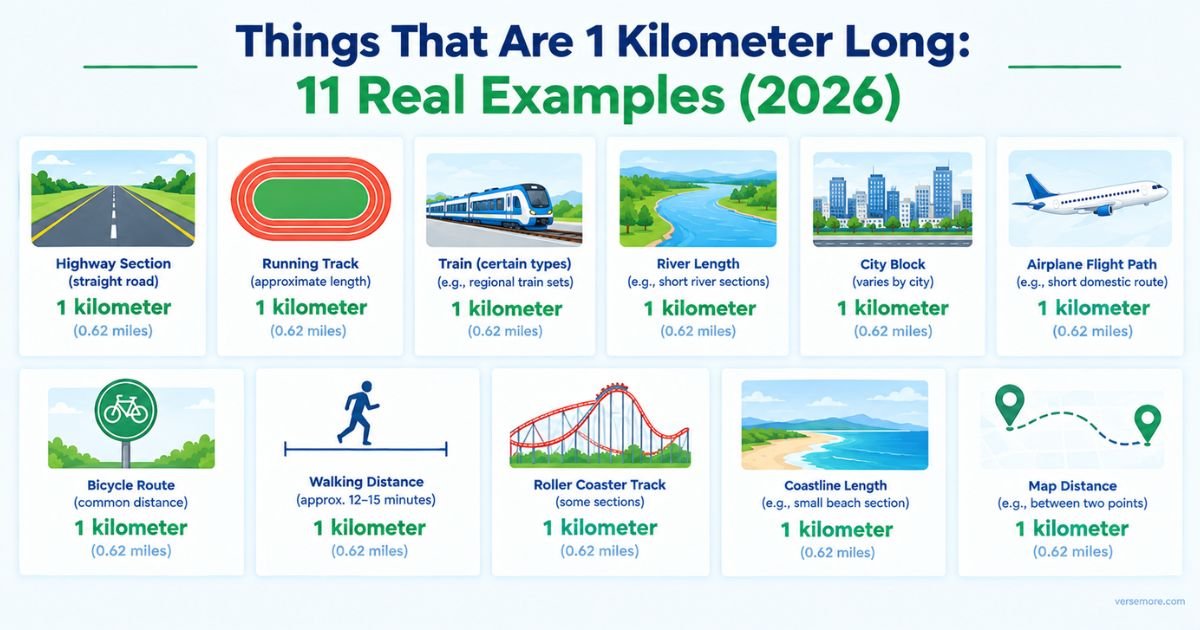
Ask someone to picture 1,000 meters and most people go blank. The number is easy to say and surprisingly hard to see. Yet it comes up constantly, on road signs, running apps, hiking maps and school worksheets.
This guide gives you things that are 1 kilometer long (or “kilometre” if you’re reading from the UK) that you can actually check. Every comparison below uses a measured length, not a guess passed down from site to site.
You’ll also get exact conversions to miles and feet, plus a few corrections to comparisons that circulate widely and don’t hold up.
One kilometer is exactly 1,000 meters, or about 0.62 miles (roughly 3,281 feet).
Key Takeaways
• 1 km = 1,000 m = 0.6214 mi = 3,280.84 ft = 1,093.61 yd.
• It’s 2.5 laps of a standard 400 m track, or 20 lengths of a 50 m pool.
• “10 football fields” is a rounding shortcut. An American field with end zones is about 109.7 m, so 1 km is closer to 9.
• Two real bridge spans come within 1.3% of 1 km: the Forth Road Bridge (1,006 m) and Lisbon’s 25 de Abril Bridge (1,013 m).
How Long Is 1 Kilometer?
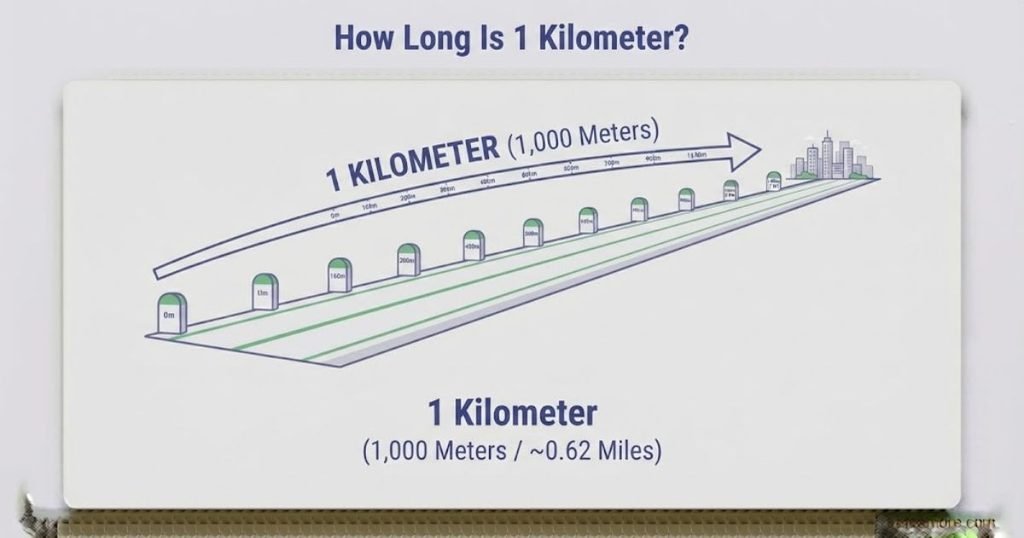
A kilometer is a metric unit of length equal to 1,000 meters. The “kilo” prefix means one thousand, and the kilometer is the standard unit for land distances in most of the world. The main exceptions are the United States and the United Kingdom, where road distances are still given in miles.
In everyday terms, 1 km is a little more than half a mile. Here are the main conversions:
| Unit | Equal to 1 km | Type |
| Meters | 1,000 m | Exact |
| Centimeters | 100,000 cm | Exact |
| Miles (international) | 0.6214 mi | Rounded |
| Feet | 3,280.84 ft | Rounded |
| Yards | 1,093.61 yd | Rounded |
| Nautical miles | 0.5400 nmi | Rounded |
These come from the definitions of the international foot (0.3048 m exactly) and the mile (1,609.344 m exactly), so every rounded figure above is rounded only once, at the end. In practice, “about 3,281 feet” and “about 0.62 miles” are accurate enough for anything outside engineering work.
Sports Venues That Measure Out to 1 Kilometer
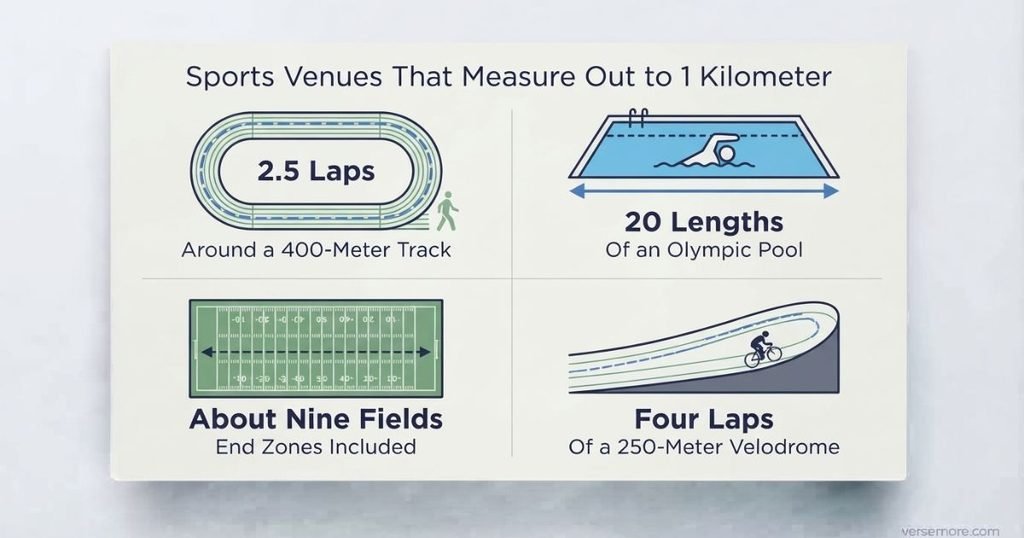
Sports venues are some of the best references because their dimensions are standardized. If you’ve stood at the edge of one, you already carry a ruler in your head.
2.5 Laps Around a 400-Meter Track
A standard outdoor running track is 400 meters per lap, measured along the inside lane. So 1 km works out to exactly two and a half laps: two full circuits, then the straight and bend on the far side. Indoor tracks are usually 200 m, which makes 1 km five laps.
One catch: outer lanes are longer than the inside lane, so if you jog in lane 4, you’ll cover your kilometer in slightly fewer than 2.5 laps.
20 Lengths of an Olympic Pool
An Olympic-size pool is 50 meters long, so 1 km is 20 lengths, or 10 there-and-back trips. That’s the classic swimmer’s kilometer.
Short pools change the count. A 25-meter pool needs 40 lengths. A 25-yard pool, common in the US, is only 22.86 m long, so 1,000 m takes about 44 lengths.
About Nine American Football Fields, End Zones Included
You’ll often see “10 football fields” as the answer. It’s close but not accurate. A full American football field, including both end zones, is 120 yards, or about 109.7 meters. That puts 1 km at roughly 9.1 fields.
If you count only the 100-yard playing area between the goal lines (91.44 m), it’s about 10.9 fields. So the round “10” only works if you quietly ignore the end zones. Soccer pitches land in a similar range: international matches use pitches of 100 to 110 meters, so 1 km is somewhere between 9 and 10 of them.
Four Laps of a 250-Meter Velodrome
Olympic-standard cycling velodromes are 250 meters around, so 1 km is exactly four laps. That’s the distance of the track cycling “kilo,” a standing-start time trial that’s essentially one all-out kilometer. It’s a good reminder that a distance that feels short in a car can be brutal under your own power.
Bridges and Skyscrapers Close to 1 Kilometer
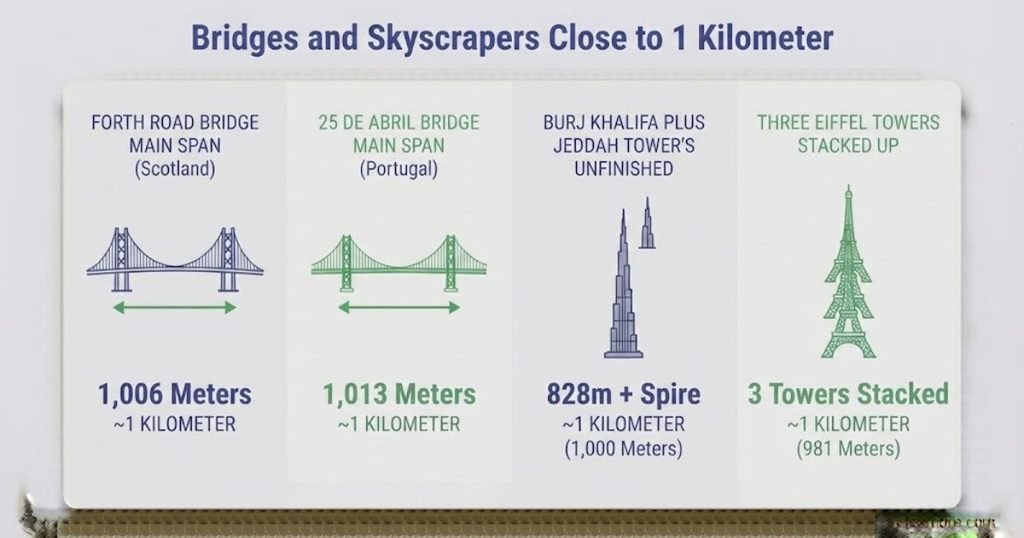
Large structures are harder to reach than a track but easier to remember once you’ve seen them. These four sit at or near the 1,000-meter mark.
Forth Road Bridge Main Span (1,006 m)
Scotland’s Forth Road Bridge, near Edinburgh, has a central suspension span of 1,006 meters. That’s just 6 meters over a kilometer. Its total length with approaches is 2,512 meters, so don’t use that figure for this comparison. Only the main span between the towers is close to 1 km.
The bridge opened in 1964. Since the Queensferry Crossing took over motorway traffic in 2017, the older bridge has been reserved mainly for public transport, with pedestrians and cyclists still allowed.
25 de Abril Bridge Main Span (1,013 m)
In Lisbon, the 25 de Abril Bridge crosses the Tagus River with a main span of 1,013 meters. It makes a good European counterpart to the Forth, and it has the same quirk: the full bridge is longer than a kilometer, but the span between the towers is almost exactly one.
Burj Khalifa Plus Jeddah Tower’s Unfinished 1 km
The Burj Khalifa in Dubai stands 828 meters tall. That means 1 km is the Burj Khalifa plus another 172 meters, roughly half again the height of the Eiffel Tower.
The first building designed to reach 1,000 meters is Jeddah Tower in Saudi Arabia. It is still under construction, and reports in 2026 put it somewhere above 400 meters, with sources disagreeing on the exact figure. Its final height hasn’t been officially revealed, so treat it as a future 1 km landmark, not a finished one.
Three Eiffel Towers Stacked Up
The Eiffel Tower is 330 meters to its tip. Three of them stacked vertically make 990 meters, only 10 meters short of a kilometer. It’s a quick way to feel how tall a vertical kilometer would be.
Everyday Ways to Feel 1 Kilometer
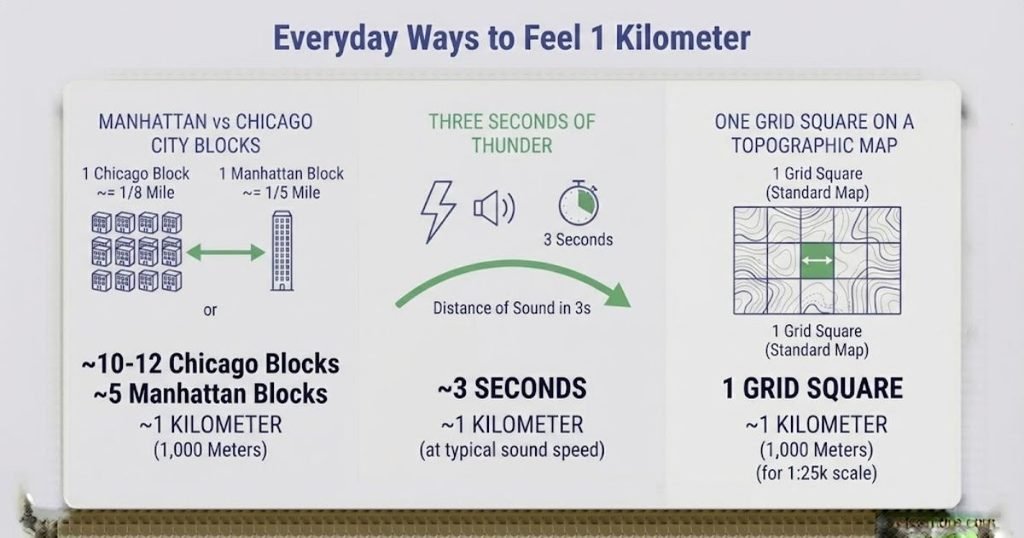
Not every kilometer comes with a stadium attached. These three comparisons work on an ordinary street, in a thunderstorm, or with a map open on the table.
Manhattan vs Chicago City Blocks
“About 10 city blocks” is the most repeated answer to how far 1 km is, and it only works in some cities. Block length depends on the city and on which way you’re walking:
| Street pattern | Typical block length | Blocks in 1 km (approx.) |
| Manhattan, north–south (street to street) | about 264 ft (80.5 m) | about 12.4 |
| Manhattan, avenue to avenue | about 750–900 ft (229–274 m) | about 3.6–4.4 |
| Chicago, long block | about 660 ft (201 m) | about 5.0 |
| Chicago, short block | about 330 ft (101 m) | about 9.9 |
Figures are approximate and rounded to one decimal. Real blocks vary, and Manhattan below Houston Street doesn’t follow the grid at all.
So “10 blocks” is right for Chicago’s short side, but a New Yorker walking uptown crosses about 12 streets, and a Chicagoan walking the long way crosses 5. If you want a block-based kilometer, use your own city’s numbers.
Three Seconds of Thunder
Sound travels at roughly 343 meters per second in air at 20 °C, so it covers 1 km in about 2.9 seconds. Light arrives almost instantly by comparison. Count the seconds between a lightning flash and its thunder, divide by three, and you have the distance to the strike in kilometers.
A 6-second gap means about 2 km. Temperature shifts the speed of sound slightly, so treat it as a close estimate, not an instrument reading.
One Grid Square on a Topographic Map
On many topographic maps, the grid lines are drawn 1 km apart. On a British Ordnance Survey Landranger map (1:50,000), 1 km is 2 cm on paper. On an Explorer map (1:25,000), it’s 4 cm. Once you know that, you can lay a ruler over any such map and read off a kilometer without a scale bar.
Walkers and orienteers use this constantly, and it’s one of the few places where a kilometer appears as a literal square you can count.
How Long Does It Take to Walk 1 Kilometer?
At a typical walking speed of about 5 km/h (around 3.1 mph), 1 km takes roughly 12 minutes. Most people land between 10 and 15 minutes.
| Walking pace | Speed | Time for 1 km |
| Slow stroll | 3 km/h | 20 min |
| Relaxed | 4 km/h | 15 min |
| Normal | 5 km/h | 12 min |
| Brisk | 6 km/h | 10 min |
The number of steps depends on stride length, so a single “1,300 steps” figure hides a wide range:
| Stride length | Steps per 1 km (rounded) |
| 0.60 m | 1,667 |
| 0.70 m | 1,429 |
| 0.75 m | 1,333 |
| 0.80 m | 1,250 |
Hills change the time more than most people expect. A traditional hillwalking rule of thumb, Naismith’s rule, adds about an hour for every 600 meters climbed, which is around 6 extra minutes per 100 m of ascent. A steady uphill kilometer can easily take twice as long as a flat one.
1 Kilometer vs 1 Mile
A mile is longer: 1 international mile is exactly 1.609344 km, so a kilometer is about 62% of a mile. That 1.609344 figure is exact because the mile is defined as 1,609.344 meters. The US survey foot was retired at the end of 2022, so modern US conversions use the international foot throughout.
Race distances show how the two units line up:
| Distance | Kilometers | Miles (rounded) |
| 5K | 5.000 | 3.107 |
| 10K | 10.000 | 6.214 |
| Half marathon | 21.098 | 13.109 |
| Marathon | 42.195 | 26.219 |
Mental shortcuts differ a lot in accuracy:
• Multiply km by 0.6: about 3.4% low. Fine for a quick estimate.
• Multiply km by 5, divide by 8: about 0.6% high. 8 km becomes 5 miles (the exact answer is 4.97).
• Miles to km, multiply by 1.6: about 0.6% low.
Some classroom shortcuts (“take half, then add 10%”) are worse. For 10 km they give 5.5 miles against a true 6.21, an 11% miss.
If you need the reverse conversion in detail, see our guide to 1 mile in kilometers.
Why Comparisons for 1 Kilometer Often Go Wrong
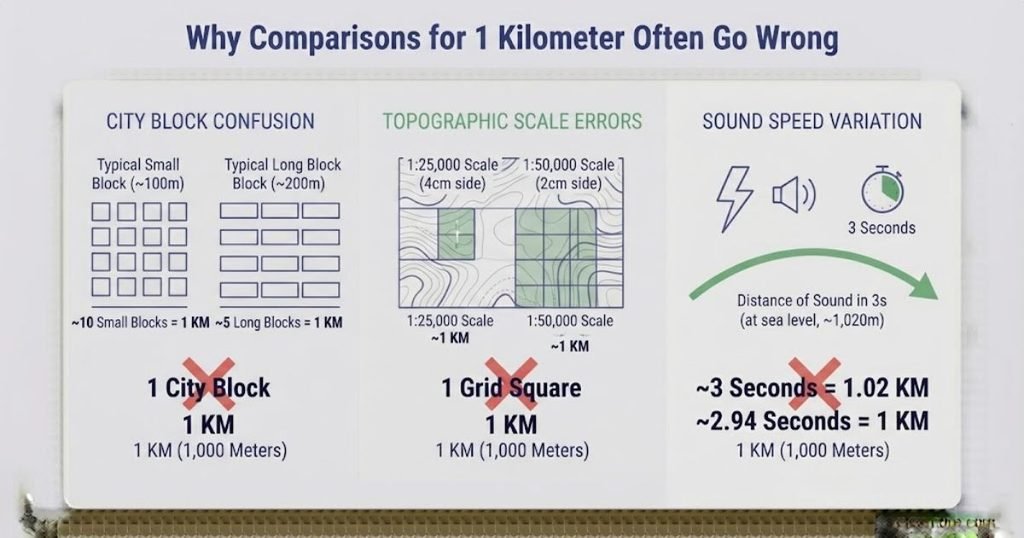
Object comparisons get copied between sites without anyone redoing the division. One example that circulates puts 1 km at about 16 school buses. A full-size school bus is roughly 12 meters long, so the real figure is closer to 80. A single unchecked “16” can survive across dozens of pages.
Use this four-step test, the Local Anchor Check, before trusting any comparison, including the ones in this article:
1. Find the measured length. Use a standards body, the venue’s official specification, or a map measurement, not another blog.
2. Divide 1,000 by it. Keep full precision until the final step.
3. Record the range, not a single number. Football fields, blocks and strides all vary.
4. Pick one anchor from your own life. Measure a loop in your local park or a stretch of your commute with a map app, and keep that as your personal kilometer.
The last step is the one that sticks. A kilometer you’ve walked beats any landmark you’ve only read about.
Where Kilometers Are Used: US, UK and Europe
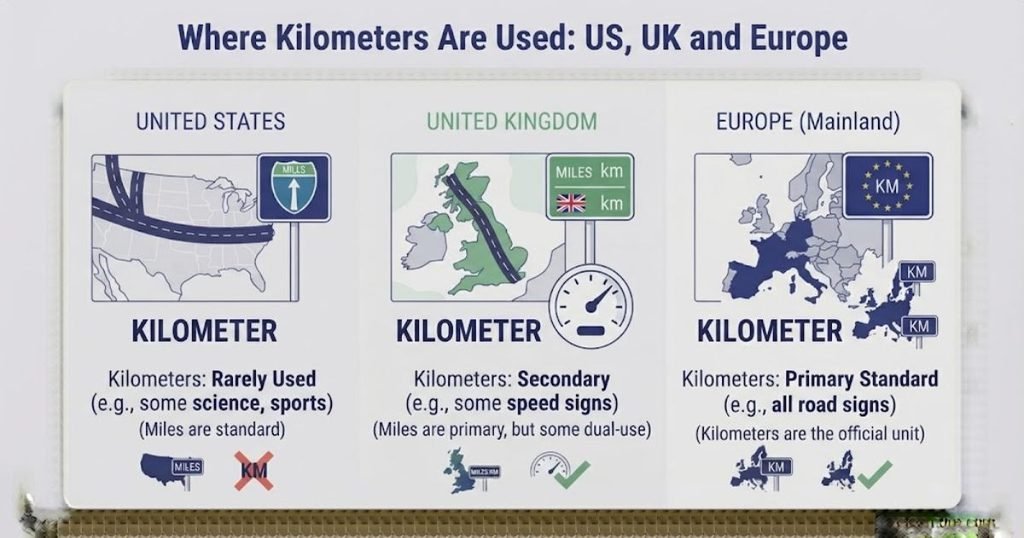
Most of the world measures road distances in kilometers. The notable exceptions are the United States, the United Kingdom and Liberia, where the mile still rules road signs. Ireland went the other way: it moved its road signs to kilometers in 2005.
In the US, kilometers still turn up in running (5K and 10K races), science, and anything tied to international sport. In the UK, roads and speed limits stay in miles and mph, while athletics, schools and most science use metric, so many people switch units without thinking. Across continental Europe, kilometers are the default for everything from road signs to rail posts.
The kilometer’s origin is the metric system created in revolutionary France in the 1790s. The meter was originally tied to the size of the Earth, and today it’s defined through the speed of light, which keeps the kilometer constant and exact.
FAQ’s
How long is 1 kilometer?
One kilometer is 1,000 meters, or about 0.62 miles (3,281 feet). It’s a little more than half a mile and takes about 12 minutes to walk at a normal pace.
How many miles is 1 km?
One kilometer is 0.6214 miles, rounded. Going the other way, 1 mile is exactly 1.609344 km. For a fast estimate, multiply kilometers by 5 and divide by 8.
How long does it take to walk 1 km?
At 5 km/h, about 12 minutes. A brisk walker (6 km/h) takes 10 minutes, and a slow stroll (3 km/h) takes 20. Hills add roughly 6 minutes per 100 meters climbed.
How many steps are in 1 km?
Roughly 1,250 to 1,670 steps, depending on stride length. At a typical 0.75 m stride, it’s about 1,333 steps.
How many laps of a track is 1 km?
2.5 laps of a standard 400 m outdoor track. On a 200 m indoor track it’s 5 laps, and on a 250 m velodrome it’s 4.
How many football fields is 1 km?
About 9 American football fields including end zones (120 yards, or about 109.7 m each). Counting only the 100-yard playing area, it’s closer to 11.
How many city blocks are in 1 km?
It depends on the city. Manhattan’s north–south blocks give about 12, Chicago’s long blocks give about 5, and Chicago’s short blocks give about 10.
Is a kilometer longer than a mile?
No. A mile is 1.609 km, so a kilometer is only about 62% of a mile.
What’s the easiest way to visualize 1 km?
Picture 2.5 laps around a running track or 20 lengths of a 50 m pool. For a longer view, think of the Forth Road Bridge’s main span, which is 1,006 m.
Conclusion
A kilometer feels abstract until you attach it to something you’ve stood next to. Things that are 1 kilometer long turn up in more places than most people expect: a running track and a swimming pool, the main span of the Forth Road Bridge, three Eiffel Towers stacked end to end, or a three-second count after a flash of lightning.
The most useful habit is checking each comparison for yourself, because the popular ones, from “10 football fields” to “10 blocks”, only hold up under certain conditions. Find one anchor you’ve actually walked, and you’ll always have a kilometer in your head.

I am the admin of VerseMore, sharing helpful, informative, and engaging content on various topics to inspire readers, provide value, and make everyday life easier.