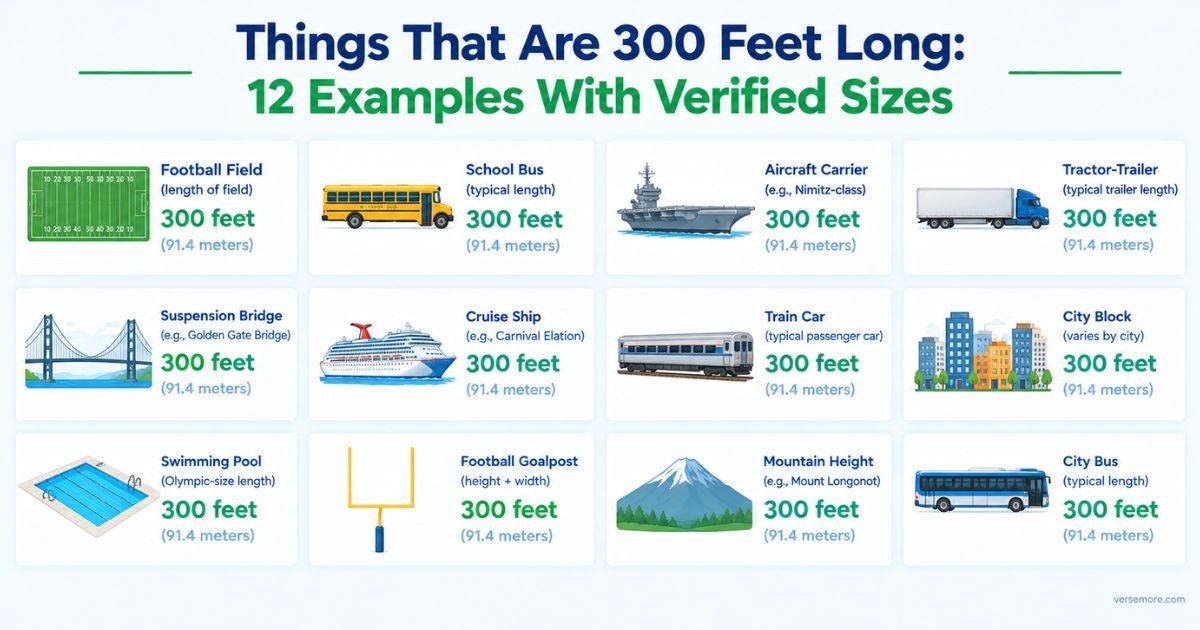
Three hundred feet is a distance most people can’t feel. It’s too far to judge by eye and too short to feel like a trip.
This guide covers things that are 300 feet long, or close enough to be useful, and tells you exactly how close each one is. Some are landmarks, some are machines, and a few are practical, like how long an Ethernet cable can run before it breaks the standard.
Every figure comes from an official or primary source. Where a popular comparison is shaky, you’ll see the correction.
300 feet is exactly 100 yards, or 91.44 meters.
| Key Takeaways • 300 ft = 100 yd = 3,600 in = 91.44 m, all exact, because the foot is defined as 0.3048 m. • An American football field is 300 ft only between the goal lines. With end zones it is 360 ft. • The Statue of Liberty, at 305 ft 1 in from ground to torch tip, is the closest famous landmark. • At a normal 3 mph walk, 300 feet takes about 68 seconds, not “under a minute.” • “Three blue whales” overshoots slightly: the largest properly measured blue whale was about 98 ft. |
How Long Is 300 Feet?
300 feet equals 100 yards, 3,600 inches and 91.44 meters. These conversions are exact. The international foot is defined as exactly 0.3048 meters, so there’s no rounding involved.
| Unit | 300 feet equals | Exact or rounded |
| Yards | 100 yd | Exact |
| Inches | 3,600 in | Exact |
| Meters | 91.44 m | Exact |
| Centimeters | 9,144 cm | Exact |
| Kilometers | 0.09144 km | Exact |
| Miles | 0.0568 mi | Rounded (300 ÷ 5,280 = 0.056818…) |
In everyday terms, it’s about 120 to 135 walking steps. You’d cover it in just over a minute at a relaxed pace, and a car at 70 mph covers it in under 3 seconds. The sections below make that concrete.
Sports Fields That Are About 300 Feet Long
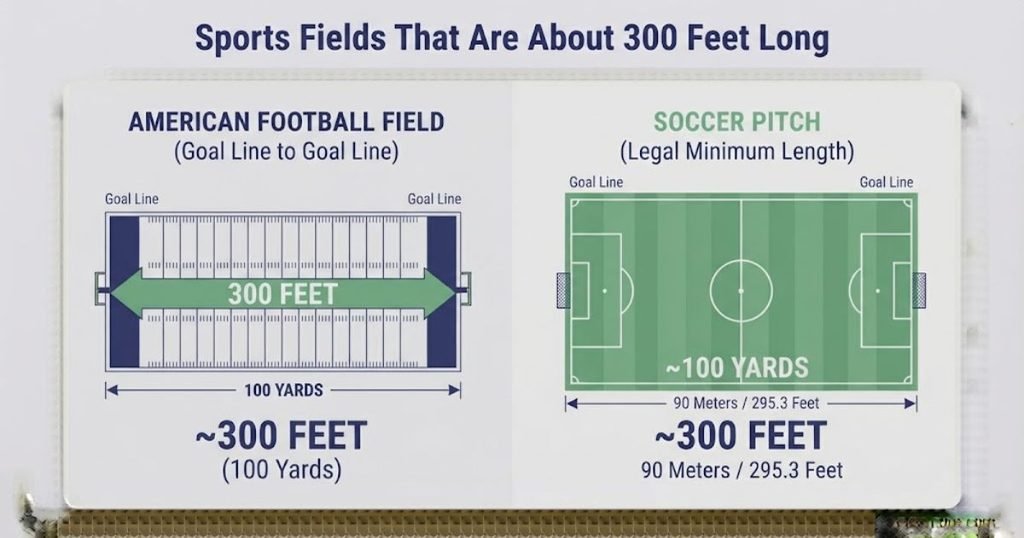
Sports fields give the cleanest comparisons, because their dimensions are set by rulebooks. They also come with a trap, which is knowing where the measurement starts and stops.
American Football Field (Goal Line to Goal Line)
An American football field is exactly 300 feet long between the two goal lines. That’s 100 yards, the playing field you see yard markers on.
The full surface is longer. Each end zone adds 10 yards (30 feet), so the total from end line to end line is 120 yards, or 360 feet. The width is 160 feet.
Canadian football is different. The CFL field runs 110 yards (330 feet) between goal lines, with 20-yard end zones, for 150 yards (450 feet) overall. If someone says “a football field” and they mean the Canadian version, the 300-foot comparison is off by 30 feet.
A Soccer Pitch at the Legal Minimum Length
Soccer pitches vary, and the rules leave room at the short end. Under Law 1 of the IFAB Laws of the Game, a touchline must be between 90 and 120 meters for ordinary matches. For international matches the range tightens to 100–110 meters.
A 300-foot pitch is 91.44 meters. That makes it legal for a local or club match, only about 1.4 meters above the minimum, and too short for any international fixture. At the other end, a 110-meter international pitch is 360.9 feet, almost identical to an American field with its end zones.
(The Laws pair the 90 m minimum with a rounded “100 yds.” The exact figure is 98.4 yards, or 295.3 feet.)
Landmarks and Ships Close to 300 Feet
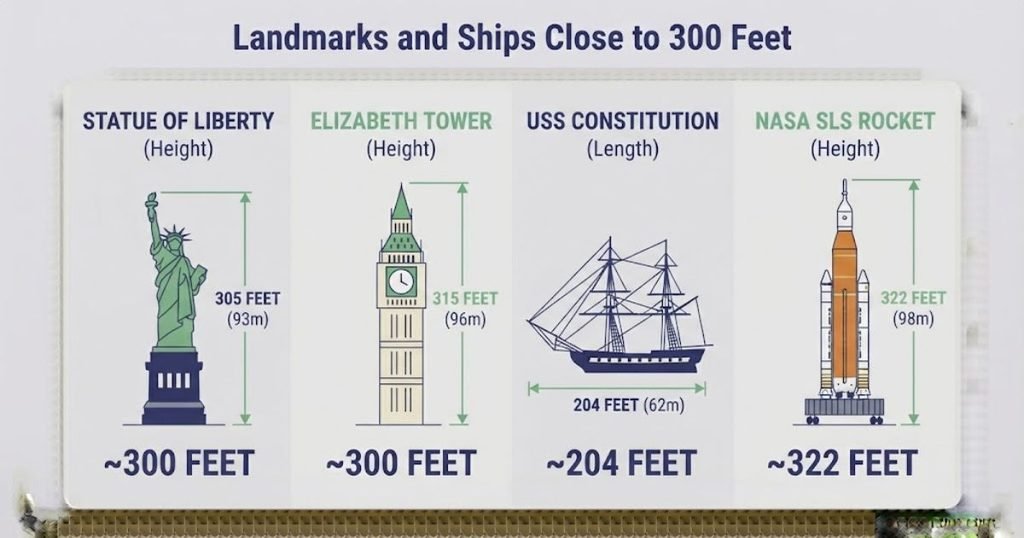
Landmarks are the comparisons people remember. They’re also the easiest to get wrong, because “height” and “length” depend on where you start measuring.
Statue of Liberty
The Statue of Liberty is 305 feet 1 inch (93 meters) from ground level to the tip of the torch, according to the National Park Service. The copper statue alone is 151 feet 1 inch, and the pedestal adds 154 feet.
That makes it about 5 feet over 300. The NPS likens the whole monument to a 22-story building, which is a useful reminder that “30 stories” isn’t a safe stand-in for 300 feet.
Elizabeth Tower (Big Ben)
The clock tower at the Palace of Westminster stands 96 meters tall, which is 315 feet. UK Parliament lists the climb to the belfry at 334 steps, and the tower has 11 floors.
Strictly, “Big Ben” is the Great Bell inside. The tower was renamed Elizabeth Tower in 2012. At 315 feet it’s 15 feet over 300, and the metric figure of 96 m gives UK and European readers an easy mental anchor.
USS Constitution
“Old Ironsides” shows how much “length” depends on the measuring convention. The U.S. Navy’s fact sheet lists three numbers for the same ship:
• 305 feet overall, bowsprit to the end of the spanker boom
• 207 feet from billet head to taffrail, the length of the hull itself
• 175 feet at the waterline
Only the first is close to 300. Some sources round it to 304 feet. A ship can honestly be called 300 feet long or 175 feet long, depending on what you count.
NASA’s SLS Block 1 Rocket
NASA’s Space Launch System Block 1, the rocket used for the Artemis missions, stands 322 feet (98 meters) tall with the Orion spacecraft on top. That’s about 22 feet over 300, and taller than the Statue of Liberty.
It’s still shorter than the Saturn V, at 363 feet. The planned Block 1B version is about 364 feet.
Machines and Animals Near 300 Feet
Antonov An-225 Mriya (Wingspan)
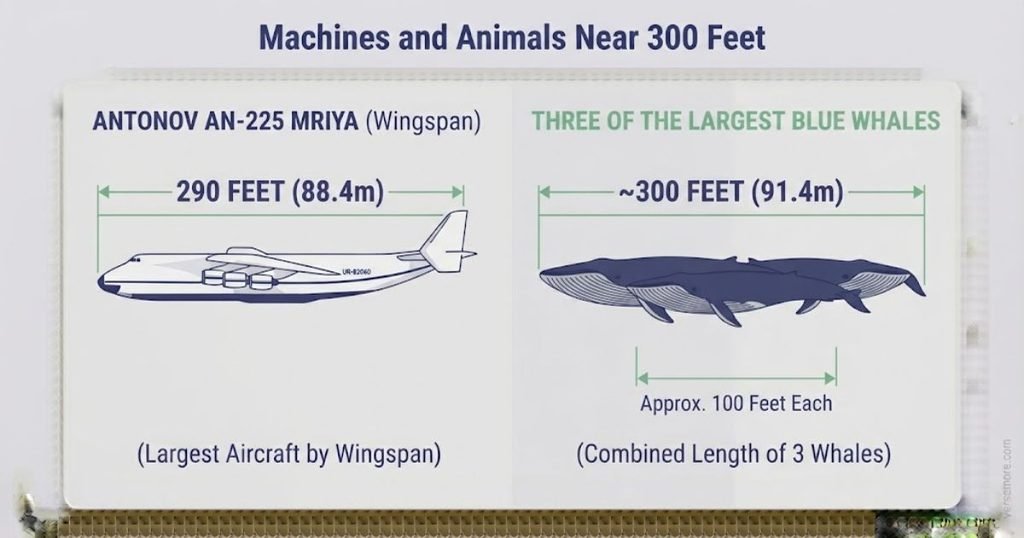
The Antonov An-225 Mriya had a wingspan of 88.4 meters (290 feet) and a length of 84 meters (275 feet 7 inches). Only one was ever completed. Antonov confirmed it was destroyed on February 27, 2022.
Its wingspan is 10 feet short of 300, about 3% under. The Hughes H-4 Hercules, the “Spruce Goose,” was wider, at roughly 97.5 meters or 320 feet. So the two giants bracket 300 feet from either side.
Three of the Largest Blue Whales
NOAA Fisheries lists blue whales at up to 100 feet. The largest one properly measured by scientists was about 98 feet (29.9 m).
Three of those whales nose to tail would be about 294 feet, roughly 2% under 300. Most adults are shorter than the record, though, so three average whales would fall well short. “Three blue whales” is a fair visual shortcut and a poor “exactly 300 feet” claim.
Everyday and Technical 300-Foot Distances
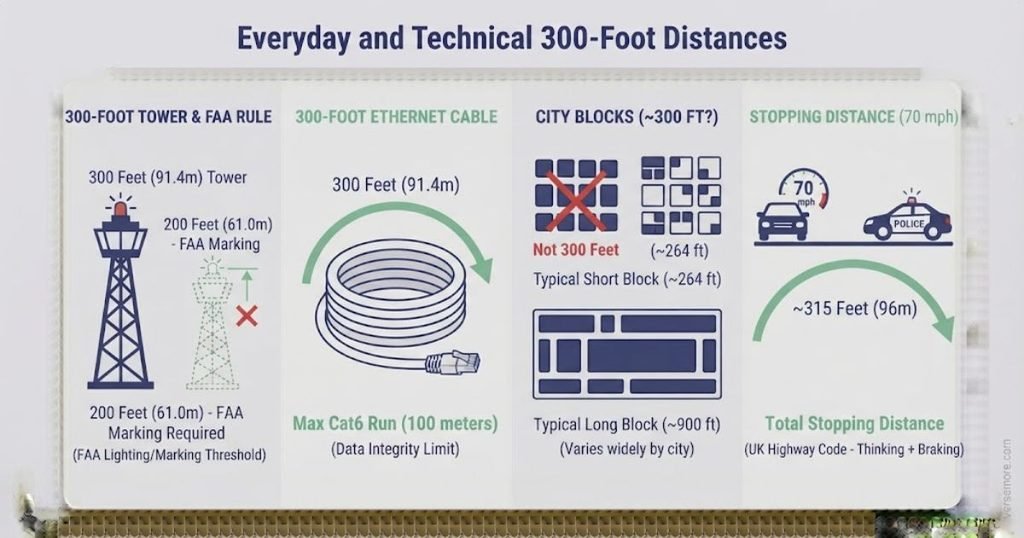
A 300-Foot Tower and the FAA’s 200-Foot Rule
In the United States, 14 CFR § 77.9 requires notice to the FAA for any construction or alteration more than 200 feet above ground level. A 300-foot cell or broadcast tower is 100 feet past that line.
Near airports the trigger can be lower. Slope-based notice surfaces extend 20,000 feet from the nearest point of a runway longer than 3,200 feet. So 300 feet is well into regulated territory for any tall structure.
A 300-Foot Ethernet Cable Run
This is where 300 feet becomes a practical number. Under the ANSI/TIA-568 structured cabling standards, a permanent link of solid copper cable can run 90 meters, about 295 feet. Patch cords at each end can add up to 10 meters, for a 100-meter (328-foot) channel.
A solid-cable run of exactly 300 feet is 91.44 meters. That’s about 4.7 feet beyond the permanent-link allowance. It may well work, but it’s out of spec, and errors can appear under load. The standard fixes are a switch at the midpoint or fiber, not a thicker copper cable.
City Blocks: Why “One Block” Isn’t 300 Feet
“A city block is about 300 feet” is repeated everywhere, and it’s only loosely true. Typical sizes include:
• Manhattan: about 264 feet between numbered streets, and roughly 750 to 920 feet between avenues
• Chicago: typically 330 by 660 feet
• Portland, Oregon: about 200 feet
• Salt Lake City: about 660 feet per side
So 300 feet sits between a Manhattan street block and a Chicago one. If someone tells you a place is “a block away,” the real distance could be anywhere from 200 to 660 feet.
Stopping Distance at 70 mph (UK Highway Code)
The UK Highway Code gives a typical overall stopping distance of 96 meters, or 315 feet, at 70 mph on a dry road. That’s 21 meters of thinking distance plus 75 meters of braking. At 60 mph it’s 73 meters (240 feet).
A car at 70 mph covers 300 feet in about 2.9 seconds. Those figures are for a typical car in good conditions. Wet roads can roughly double the braking part.
How Close Is Each Example to 300 Feet?
Not every example is equally “300 feet.” This table, the 300-Foot Accuracy Ladder, ranks them by how far off each one is. Figures are rounded to one decimal place.
| Example | Measured figure | Difference from 300 ft | Tier |
| American football field (goal line to goal line) | 300.0 ft | 0.0% | Exact |
| Soccer pitch at the legal minimum (90 m) | 295.3 ft | −1.6% | Within 2% |
| Ethernet permanent-link limit (90 m) | 295.3 ft | −1.6% | Within 2% |
| Statue of Liberty (ground to torch) | 305.1 ft | +1.7% | Within 2% |
| USS Constitution (length overall) | 305.0 ft | +1.7% | Within 2% |
| Three record-length blue whales | 294.0 ft | −2.0% | Within 5% |
| Antonov An-225 wingspan | 290.0 ft | −3.3% | Within 5% |
| Elizabeth Tower | 315.0 ft | +5.0% | Within 5% |
| UK stopping distance at 70 mph | 315.0 ft | +5.0% | Within 5% |
| NASA SLS Block 1 | 322.0 ft | +7.3% | Within 10% |
| Chicago block (short side) | 330.0 ft | +10.0% | Within 10% |
| Manhattan street block | 264.0 ft | −12.0% | Looser |
The football field is the only exact match. Everything else is a close neighbor, which is a better way to think about it.
How Long Does It Take to Walk 300 Feet?
At a normal 3 mph, you walk 4.4 feet per second, so 300 feet takes about 68 seconds. The number you’ll often see, “under a minute,” only holds if you walk briskly.
| Walking pace | Feet per second | Time to walk 300 ft |
| 2 mph (slow stroll) | 2.9 | about 102 seconds |
| 3 mph (average) | 4.4 | about 68 seconds |
| 3.5 mph (brisk) | 5.1 | about 58 seconds |
| 4 mph (fast) | 5.9 | about 51 seconds |
| 5 mph (very fast) | 7.3 | about 41 seconds |
In steps, a 2.5-foot stride takes 120 steps to cover 300 feet, and a 2.2-foot stride takes about 136. Your own number depends on your height and pace.
One more way to feel the distance: sound travels 300 feet in about a quarter of a second, so a shout from the far end of a football field arrives almost instantly. For another walkable benchmark, try our guide to things that are 80 feet long.
How to Measure or Picture 300 Feet Without a Tape Measure
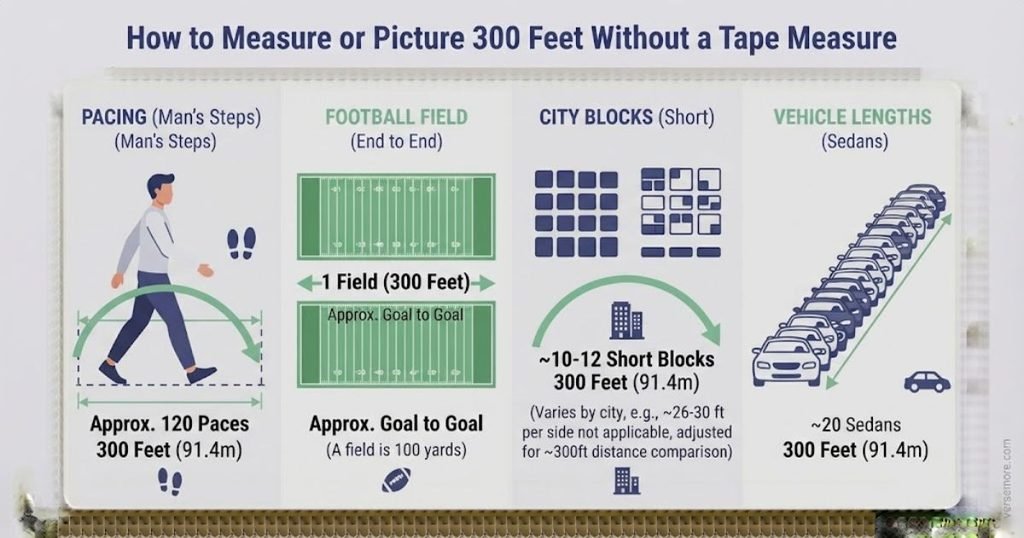
Here’s a method that works anywhere:
1. Calibrate your pace. Measure a short known distance, such as 15 feet (our guide to things that are 15 feet long has easy references), and walk it naturally.
2. Count your steps. Divide the distance by the number of steps to get your stride length in feet.
3. Divide 300 by that stride. If your stride is 2.5 feet, you need 120 steps.
4. Walk it, counting. Keep a natural pace and pick a landmark at the end to stay straight.
5. Check it. If a football field is nearby, the distance between the goal lines is exactly 300 feet. Pace it once to confirm your count.
For longer or irregular distances, a mapping app’s measure-distance tool or a measuring wheel gives more reliable results than pacing.
Common Mistakes When Comparing Things to 300 Feet
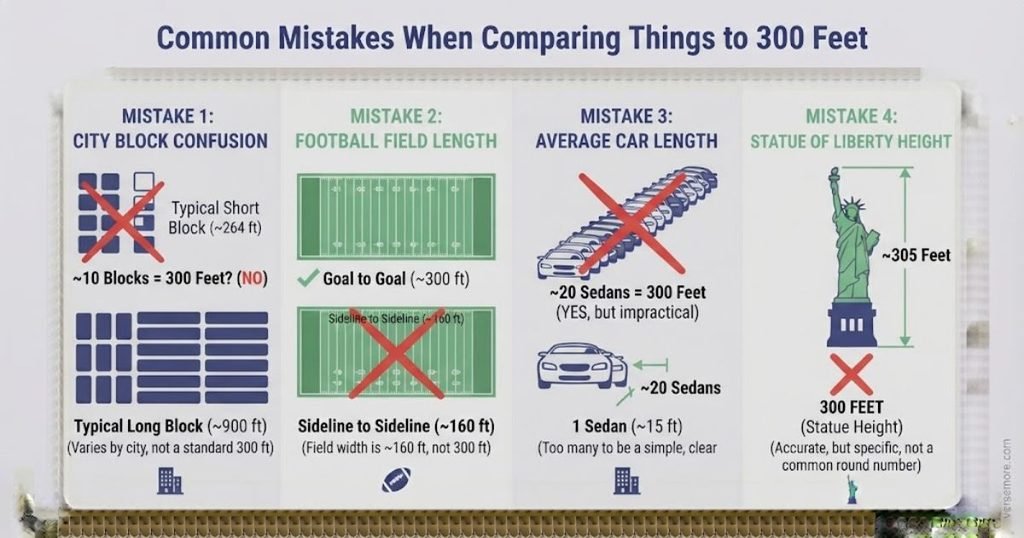
A few comparisons get repeated without anyone rechecking them:
• Counting the end zones. An American football field is 300 feet only between goal lines. Include the end zones and it’s 360 feet.
• Treating blue whales as exactly 100 feet. NOAA says “up to 100 feet,” and the largest properly measured whale was about 98 feet.
• Stacking Niagara Falls. The Horseshoe Falls drop is about 188 feet (57 meters), not 100. Two of them is already 376 feet, well past 300.
• Equating 300 feet with 30 stories. A story’s height varies. The National Park Service compares the 305-foot Statue of Liberty to a 22-story building.
• Using “exactly” loosely. Most real objects are near 300 feet, not on it. The Accuracy Ladder above shows how near.
• Assuming a short walk time. At 3 mph it’s about 68 seconds, not 30 to 45.
Is a US Foot the Same as a UK Foot?
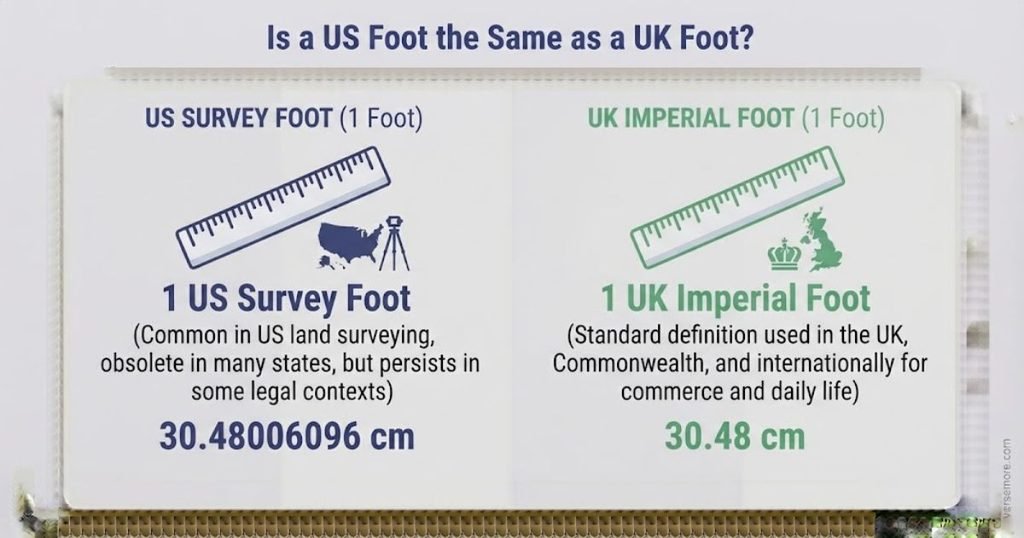
For length, yes. The foot and the yard are the same in US customary and British Imperial use. Both are defined from the international foot, exactly 0.3048 meters, and the yard is exactly 0.9144 meters. So 300 feet is 91.44 meters whether you’re in Ohio or Oxford.
The units that differ between the two systems are mostly liquid and weight measures, like gallons, pints and tons. Length isn’t one of them.
There is one historical footnote. The US survey foot (1200/3937 meter) was slightly longer than the international foot. NIST and the National Geodetic Survey deprecated it after December 31, 2022. Over 300 feet the difference would be about 0.0006 feet, roughly 0.007 inches, so it doesn’t matter for anything in this article.
300 Feet vs 300 Meters
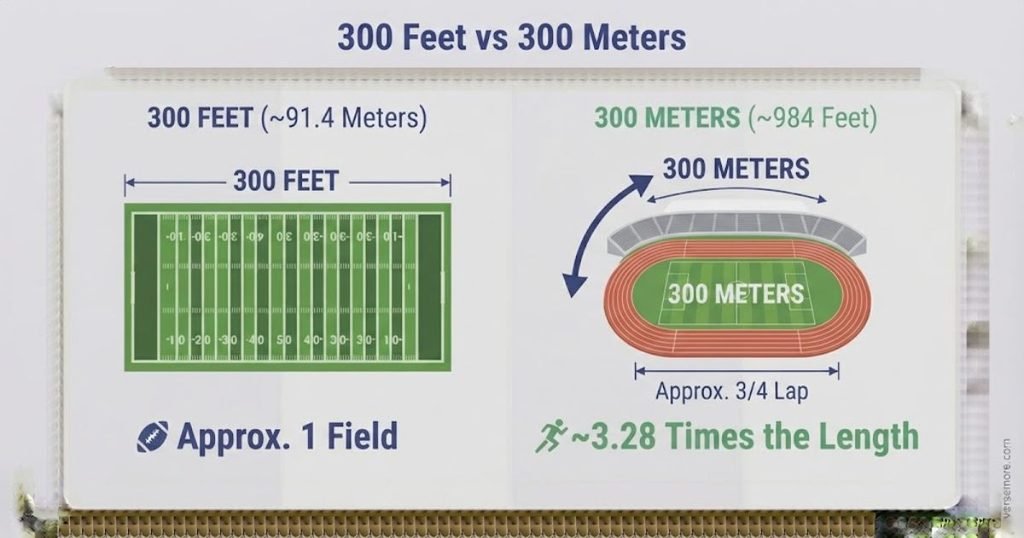
These are easy to mix up, and the gap is big. 300 meters is 984.25 feet (rounded), or 328.1 yards, about 3.3 times longer than 300 feet.
For scale, 300 meters is roughly three Elizabeth Towers stacked end to end (96 m × 3 = 288 m), or a little over three football fields between goal lines. If a source gives a figure without units, check which one it means before comparing.
For the opposite end of the scale, see our guides to things that are 10 miles long and things that are 50 miles long.
FAQ’s
How long is 300 feet?
300 feet is 100 yards, 3,600 inches or 91.44 meters. That’s the distance between the goal lines on an American football field. It takes about 68 seconds to walk at a normal pace.
How many meters is 300 feet?
300 feet is exactly 91.44 meters. The conversion is exact because one foot is defined as 0.3048 meters, so 300 × 0.3048 = 91.44.
Is 300 feet the length of a football field?
Yes, if you measure goal line to goal line. An American football field is 100 yards, or 300 feet, between the goal lines. With both end zones added, the full field is 360 feet.
How many steps is 300 feet?
About 120 to 136 steps for most adults. A 2.5-foot stride gives 120 steps, and a 2.2-foot stride gives about 136. You can find your own number by pacing a known distance.
How long does it take to walk 300 feet?
About 68 seconds at 3 mph. A slow 2 mph stroll takes about 102 seconds, and a fast 4 mph walk takes about 51 seconds.
How tall is 300 feet in stories?
Roughly 22 to 30 stories, depending on floor height. The National Park Service compares the 305-foot Statue of Liberty to a 22-story building, while a rule of thumb of 10 feet per story gives 30.
How far is 300 feet in miles?
About 0.0568 miles, or roughly one-eighteenth of a mile. A mile is 5,280 feet, so 300 ÷ 5,280 = 0.0568 when rounded.
Is 300 feet a long distance?
It depends on the task. It’s a short walk of about a minute, but long for an Ethernet cable run, since the standard allows about 295 feet for a permanent link. For a tower, it’s tall enough to trigger FAA notice.
Which is longer, 300 feet or 300 meters?
300 meters is much longer, at 984.25 feet. 300 feet is only 91.44 meters. Always check the unit.
Conclusion
Things that are 300 feet long range from a football field to a rocket, and they differ in how close they really are. Only the football field between its goal lines is exactly 300 feet. The Statue of Liberty and USS Constitution are about 5 feet over, and Elizabeth Tower is about 15 feet over. The Antonov An-225’s wingspan is about 10 feet short.
The rest come down to what you measure and where you start. A ship can be 305 feet or 175 feet, a block can be 200 or 660, and a “300-foot” cable can break a standard that stops at 295. The most reliable way to picture 300 feet is to pace it once, count your steps, and keep one exact reference, like a football field, in mind.

I am the admin of VerseMore, sharing helpful, informative, and engaging content on various topics to inspire readers, provide value, and make everyday life easier.