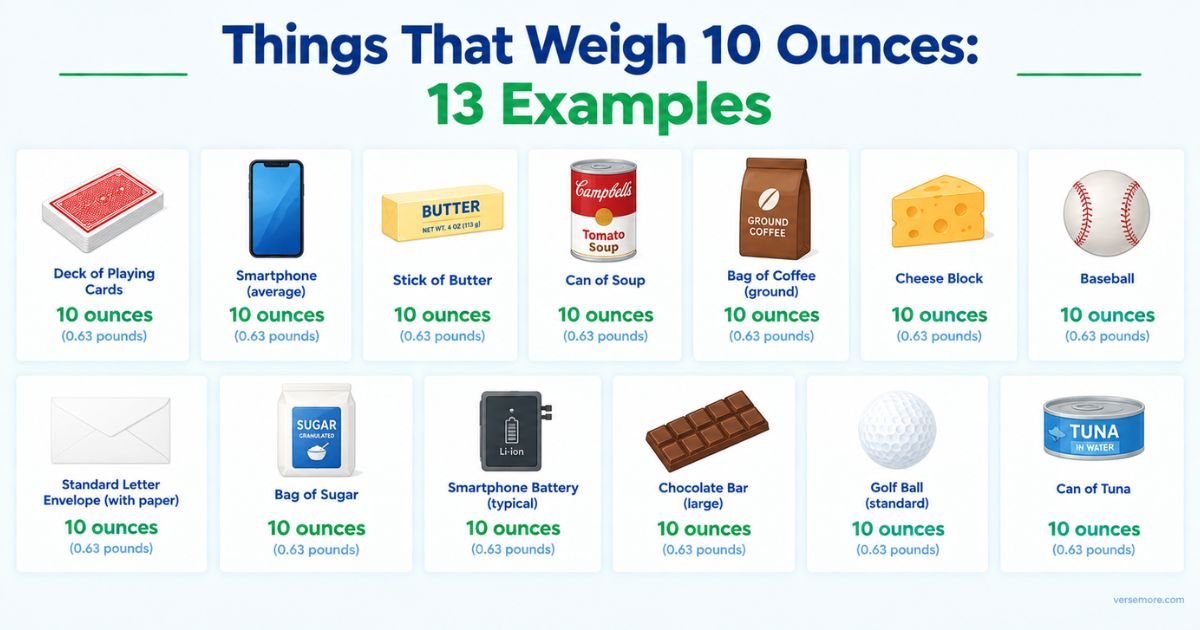
Ten ounces is light enough to hold comfortably in one hand, but it is still a noticeable amount of weight. The challenge is that most people have no natural sense of what 10 ounces actually feels like until they compare it with something familiar.
The everyday ounce used for food, shipping, and most consumer products is the avoirdupois ounce. According to NIST, one ounce is exactly 28.349523125 grams, so 10 ounces equals exactly 283.49523125 grams, usually rounded to 283.5 grams. Ten ounces is also 0.625 pound, or five-eighths of a pound.
Below are 13 practical references, including sports equipment, electronics, coins, batteries, paper, and familiar household items. Some are very close to 10 ounces by specification, while flexible items such as books and wallets are better treated as estimates rather than exact standards.
What Weighs 10 Ounces?
The most reliable way to understand 10 ounces is to compare it with objects whose mass is published or can be calculated from a known specification.
| Common reference | Approximate weight | How close to 10 oz? |
| 50 U.S. quarters | 283.5 g | Exactly 10 oz |
| Five regulation tennis balls | 280–297 g | About 9.9–10.5 oz |
| Two regulation baseballs | 283.5–297.7 g | About 10–10.5 oz |
| Five large eggs | Around 283 g or more | Roughly 10 oz |
| 12 Energizer AA alkaline batteries | 276 g | About 9.7 oz |
| 63 sheets of U.S. Letter 20-lb paper | About 286 g | About 10.1 oz |
| Sony RX100 VII compact camera | 302 g | About 10.7 oz |
| Apple iPad mini (Wi-Fi) | 293 g | About 10.3 oz |
| Sony DualSense controller | 280 g | About 9.9 oz |
| Xbox Wireless Controller with batteries | 287 g | About 10.1 oz |
| A 10-ounce boxing glove | 284 g nominally | About 10 oz |
| A typical paperback novel | About 8–12 oz | Close, depending on the book |
| A loaded everyday wallet | Around 9–11 oz | Close, but highly variable |
The strongest exact comparison in this table is the 50 U.S. quarters. A current U.S. quarter weighs 5.670 grams, so 50 quarters total 283.5 grams, essentially the exact mass of 10 avoirdupois ounces.
The sports comparisons are also useful because their specifications are standardized. An ITF-approved tennis ball has a permitted mass of 56.0–59.4 grams, meaning five balls together weigh about 280–297 grams. MLB’s official baseball specification is 5 to 5¼ ounces per ball, putting two baseballs at roughly 10 to 10½ ounces.
Technology provides another surprisingly good mental reference. Apple’s current iPad mini Wi-Fi model is listed at 293 grams, or about 10.3 ounces. Sony’s RX100 VII compact camera is 302 grams with its battery and memory card, while the PlayStation DualSense controller is approximately 280 grams. A current Xbox Wireless Controller is about 287 grams with batteries.
There is also a useful paper-based comparison. A standard U.S. Letter sheet of 20-lb bond paper weighs about 4.54 grams. A stack of 63 sheets therefore comes to roughly 286 grams, just over 10 ounces. This is a particularly useful reference for office and shipping situations because the weight can be estimated by simply counting sheets.
One subtle point matters when using these comparisons: 10 ounces of weight is not the same thing as 10 fluid ounces of volume. A fluid ounce measures volume, while an avoirdupois ounce measures mass. Ten U.S. fluid ounces of water, for example, occupy about 295.7 mL and weigh slightly more than 10 avoirdupois ounces; other liquids can differ substantially because density varies.
That distinction is why a labeled “10 fl oz” drink should not automatically be listed as an object that weighs exactly 10 ounces. Likewise, a product marked “10 oz net weight” may contain 10 ounces of product while the complete package weighs more.
For the most dependable at-home reference, use objects with a defined specification—such as 50 quarters, five tennis balls, two baseballs, or a specified electronic device. Flexible everyday objects such as books, wallets, candles, and clothing can vary considerably, so they are better for developing a general feel for 10 ounces than for making a precise measurement.
Sports Equipment That Weighs About 10 Ounces
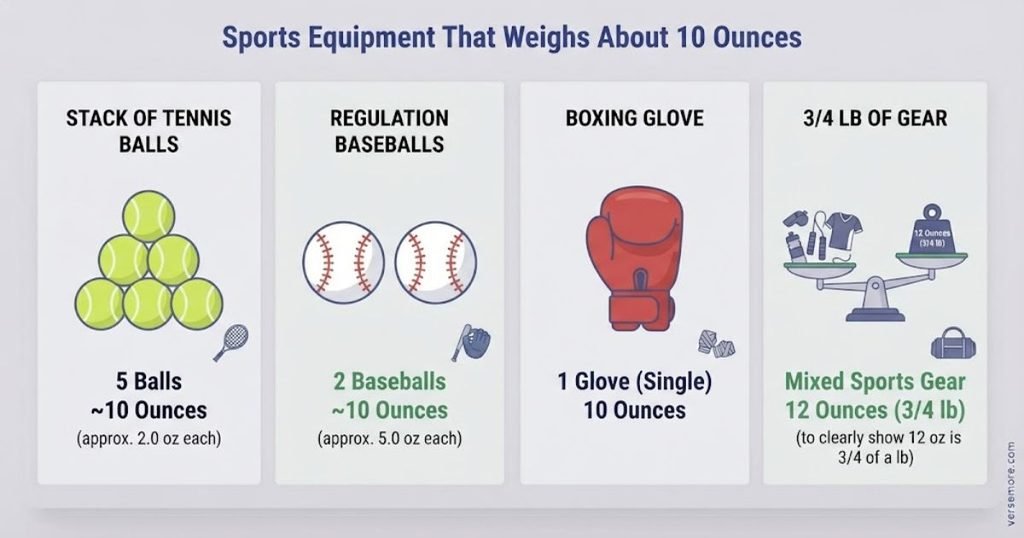
Sports equipment provides some of the clearest ways to understand this weight because many pieces of equipment have defined specifications rather than wildly varying household sizes.
A stack of five tennis balls
A regulation tennis ball weighs between 56.0 and 59.4 grams under the International Tennis Federation’s technical specifications. Five balls therefore weigh between 280 and 297 grams, putting a set of five very close to the 283.5-gram 10-ounce target.
Two regulation baseballs
A regulation baseball weighs between 5 and 5¼ ounces, or approximately 142–149 grams. Two baseballs therefore come to about 10 to 10½ ounces. Two baseballs are especially useful as a comparison because the difference from exactly 10 ounces is small enough to notice only when precise measurement matters.
A 10-ounce boxing glove
A 10-ounce boxing glove is another direct reference because “10 oz” is a standardized glove-weight designation in competitive boxing. World Boxing competition rules specify gloves at approximately 284 grams for the 10-ounce size, with a permitted tolerance around that nominal weight.
Three-quarters of a pound of sports gear
Another simple mental model is to think of 10 ounces as 0.625 pound. So an item that is a little heavier than half a pound but noticeably lighter than three-quarters of a pound is in the general range. This comparison is useful when an item’s packaging gives its weight in pounds rather than ounces, such as some sporting accessories or small pieces of training equipment.
Everyday Household and Food Items Around 10 Ounces
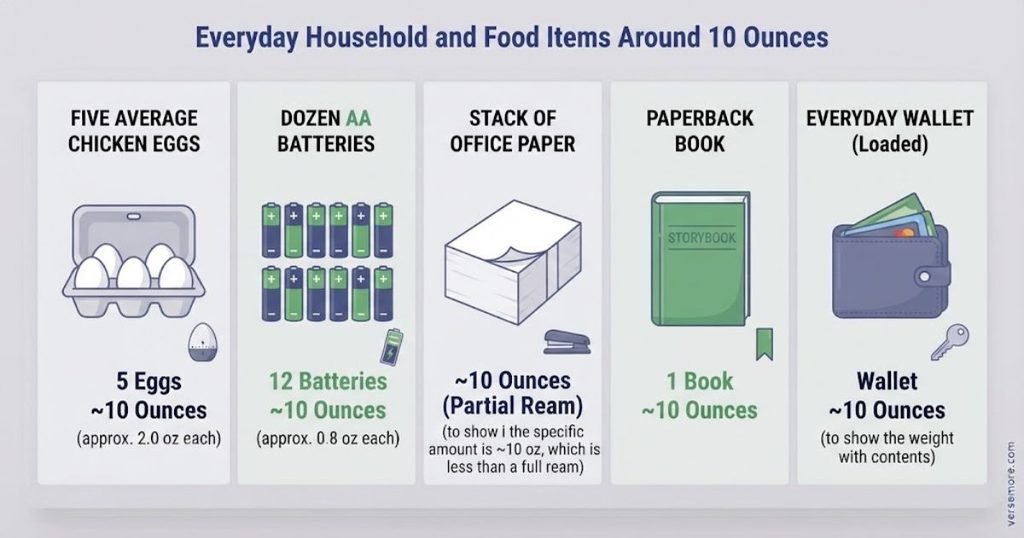
Not every useful 10-ounce comparison has a manufacturer’s specification. Some everyday objects naturally land near this weight, but their actual mass can change with size, material, or contents. These examples are best used to develop a physical sense of 10 ounces rather than as substitutes for a scale.
Five average chicken eggs
An average chicken egg weighs about 57 grams (2 ounces), according to the USDA Agricultural Marketing Service. Five eggs therefore add up to about 285 grams, which is remarkably close to 10 ounces. That makes five whole eggs one of the easiest kitchen comparisons for this weight. The actual number can vary because eggs come in different size grades, so five unusually small or large eggs will not land at exactly 10 ounces. The comparison is especially useful when a recipe gives an ingredient quantity in ounces but you do not have a kitchen scale handy. It gives you a rough visual and physical reference, not a precise measurement.
A dozen AA alkaline batteries
A standard Energizer E91 AA alkaline battery has a typical weight of 23.0 grams. Twelve batteries would therefore weigh about 276 grams, or roughly 9.7 ounces. A group of 12 batteries is a useful comparison because the individual cells are familiar but surprisingly light. You can also adjust the comparison easily: 10 batteries are about 230 grams, while 12 bring the total much closer to the 283.5-gram target. Battery weight can differ between brands and chemistries, so this example should be treated as a product-specific reference rather than a universal rule for every AA battery.
A stack of office paper
Paper is another practical way to picture 10 ounces, especially in an office or classroom. The useful trick is to think in terms of the weight of a known number of sheets, rather than saying every stack of paper weighs 10 ounces. Paper varies by basis weight, sheet size, coating, and manufacturer, so two stacks containing the same number of sheets can have different masses. For ordinary U.S. Letter copy paper, a small stack of roughly 60–65 sheets of 20-pound stock is in the neighborhood of 10 ounces. That makes a little more than one-tenth of a typical 500-sheet ream a reasonable visual reference. This is also a good example of why “what weighs 10 ounces?” has no single universal household answer. The same object category can span a surprisingly broad range once its size and material change.
A paperback book
A typical paperback novel can weigh somewhere around 8 to 12 ounces, depending on its page count, trim size, paper thickness, and cover construction. A short, compact paperback may be well below 10 ounces, while a large trade paperback can exceed it. Unlike the 50-quarters comparison, there is no standard paperback mass that can be used to calculate an exact 10-ounce equivalent. Still, a paperback is useful when the question is simply, “How heavy does 10 ounces feel?” A book around this weight feels light enough to carry easily in one hand but substantial enough to notice.
An everyday wallet with cards and cash
A wallet is another familiar object that can approach 10 ounces once it is fully loaded. The problem is variability. An empty slim wallet might weigh only a few ounces, whereas a wallet carrying numerous cards, cash, receipts, coins, and other items can become considerably heavier. For that reason, a loaded wallet should be considered a rough 10-ounce reference, not a standardized object. It is most useful as a personal comparison: placing your own wallet on a kitchen scale can tell you whether you are carrying roughly 10 ounces, substantially less, or substantially more.
Small Electronics That Weigh About 10 Ounces
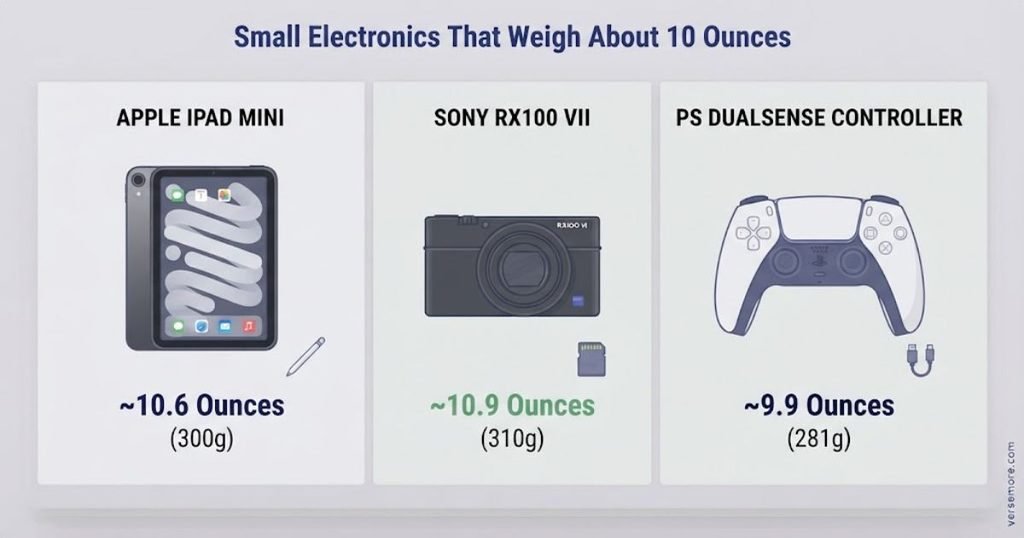
Small electronics are particularly useful for weight comparisons because manufacturers often publish exact product weights. They also make it easier to visualize how much mass can fit into a relatively compact object.
Apple iPad mini
The current iPad mini Wi-Fi model weighs 293 grams, equivalent to about 10.3 ounces. The Wi-Fi + Cellular version weighs 297 grams, or about 10.5 ounces. The Wi-Fi model is only about 9.5 grams heavier than the exact 10-ounce target. That makes an iPad mini one of the strongest modern technology comparisons for anyone trying to understand what 10 ounces feels like. It is also a useful reminder that an object does not have to weigh exactly 283.5 grams to be a practical comparison. A difference of a few grams is small enough that the two objects will feel very similar when held.
Sony RX100 VII compact camera
A compact camera such as the Sony RX100 VII is another close comparison. Its published weight is around 302 grams with its battery and memory card, putting it at approximately 10.7 ounces. That is slightly above the target, but still close enough to provide a useful hand-held reference. Compared with a much larger interchangeable-lens camera, a compact camera in this weight class demonstrates how 10 ounces can represent a substantial amount of technology in a small package. When using camera weight as a comparison, always check whether the specification includes the battery, memory card, lens, or other accessories. Those details can materially change the final number.
PlayStation DualSense wireless controller
The PlayStation 5 DualSense controller is another object that sits close to the 10-ounce range. Its weight is approximately 280 grams, which is about 9.9 ounces. That makes the controller almost an exact everyday comparison for 10 ounces. It is particularly useful because most people can immediately picture its size and can estimate its weight from having held one. A controller also demonstrates an important point about perceived weight: two objects with the same mass can feel very different depending on their shape and how that weight is distributed. A compact object held close to the center of your hand may feel different from a long or awkwardly shaped object with the same measured weight.
How 10 Ounces Compares With Other Common Weights
A single weight can be difficult to visualize until it is placed between familiar numbers. At 10 ounces, or about 283.5 grams, the amount sits between one-half pound and three-quarters of a pound and is well below a full pound.
| Weight | Grams | Difference from 10 oz |
| 4 oz | 113.4 g | 6 oz lighter |
| 8 oz | 226.8 g | 2 oz lighter |
| 10 oz | 283.5 g | Reference weight |
| 12 oz | 340.2 g | 2 oz heavier |
| 16 oz | 453.6 g | 6 oz heavier |
| 1 lb | 453.6 g | 6 oz heavier |
| 300 g | 300 g | About 0.6 oz heavier |
| 250 g | 250 g | About 1.2 oz lighter |
10 ounces vs. 8 ounces
An 8-ounce object weighs approximately 226.8 grams, making it 56.7 grams lighter than 10 ounces. That difference is equivalent to two additional ounces, or about one-fifth of the 10-ounce target. This means an object that feels noticeably lighter than the examples in this article may be closer to 8 ounces rather than 10.
10 ounces vs. 12 ounces
At 340.2 grams, 12 ounces is exactly two ounces heavier than 10 ounces. The difference is large enough to notice when comparing two similar objects side by side. This is useful when estimating the weight of packaged goods: something labeled around 12 ounces should not be treated as interchangeable with a 10-ounce item simply because both are under a pound.
10 ounces vs. 1 pound
One pound contains 16 ounces, so 10 ounces represents 62.5% of a pound. Another way to picture it is that you need six more ounces to turn a 10-ounce object into a full pound. In metric terms, the gap is approximately 170.1 grams.
10 ounces vs. 250 grams
250 grams is a common metric reference, but it is lighter than 10 ounces. Ten ounces equals approximately 283.5 grams, so the difference is about 33.5 grams. For someone accustomed to metric measurements, thinking of 10 ounces as “a little more than a quarter kilogram” is more useful than treating 10 ounces and 250 grams as the same quantity.
How Can You Measure 10 Ounces Accurately?
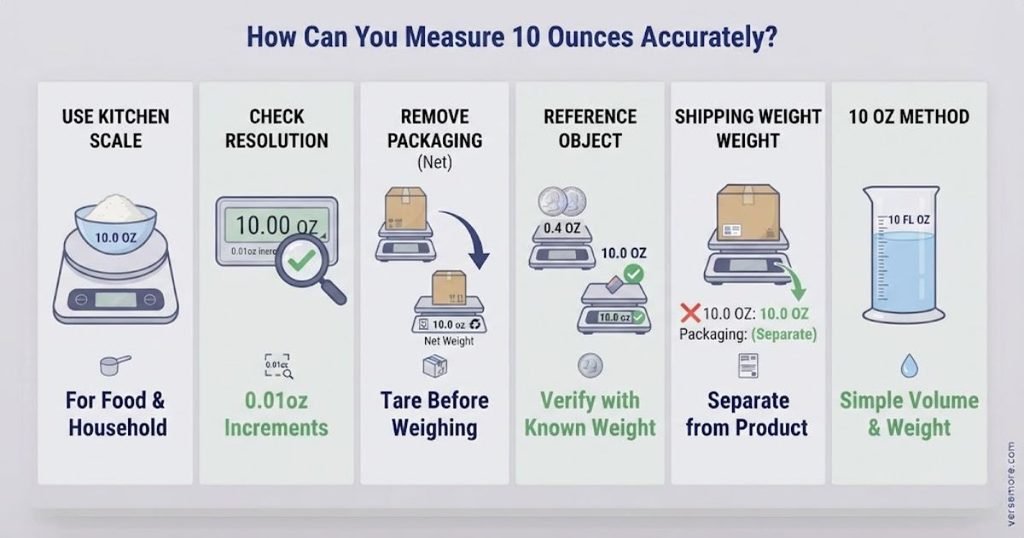
The only dependable way to determine whether an arbitrary object actually weighs 10 ounces is to weigh it with an appropriate scale. Familiar objects are useful comparisons, but they cannot account for differences in size, materials, moisture, packaging, or contents.
Use a kitchen scale for food and small household items
A digital kitchen scale is usually the simplest choice for ingredients, small packages, and household objects. Place the empty container on the scale first and use the tare function to return the displayed weight to zero. Then add the item until the scale shows 10 ounces, or approximately 283.5 grams. For greater precision, switch the scale to grams and target 283.5 g rather than relying on a coarse ounce display.
Check the scale’s resolution
Not every scale is equally suitable for a 10-ounce measurement. A scale that displays whole ounces can show 10 oz even when the actual measured value is somewhat different. A scale that reads in 1-gram increments gives considerably more information. For ordinary household use, the goal does not need to be laboratory-level precision. The important point is to understand the difference between an estimate and a measured value.
Remove packaging when measuring net weight
A common mistake is weighing a product together with its box, wrapper, bottle, or other container and assuming that total is the advertised product weight. A label stating 10 oz net weight refers to the specified contents, not necessarily the complete shipping package. The container and outer packaging can add additional mass.
Use a known reference object as a quick check
When a scale is available, known-weight objects can provide a useful sanity check. For example, 50 U.S. quarters total 283.5 grams, which corresponds exactly to 10 avoirdupois ounces based on the standard quarter weight of 5.670 grams. That makes a set of 50 quarters a convenient check for a scale’s general reading, although it should not replace proper calibration when precision is important. A 280-gram DualSense controller is another close comparison, but its published weight is approximate, so it is less suitable as a calibration reference.
Consider shipping weight separately
When 10 ounces is being used for shipping or mailing, the relevant weight may be the complete package, not just the item inside it. Packaging materials can push an item into a different shipping category. USPS, for example, applies specific weight increments and rounding rules for some services, so an item that is just above a threshold can be charged differently from one just below it. Always check the current rules for the service and destination rather than assuming every carrier handles ounces the same way.
A simple 10-ounce measurement method
For a quick household measurement: 1) Put your empty container on the scale. 2) Press tare/zero. 3) Select ounces or grams. 4) Add the material until it reaches 10 oz or 283.5 g. 5) If the weight matters for shipping, include the packaging and measure the complete parcel separately. This approach is much more reliable than trying to estimate weight from an object’s size or appearance.
How Heavy Does 10 Ounces Feel?
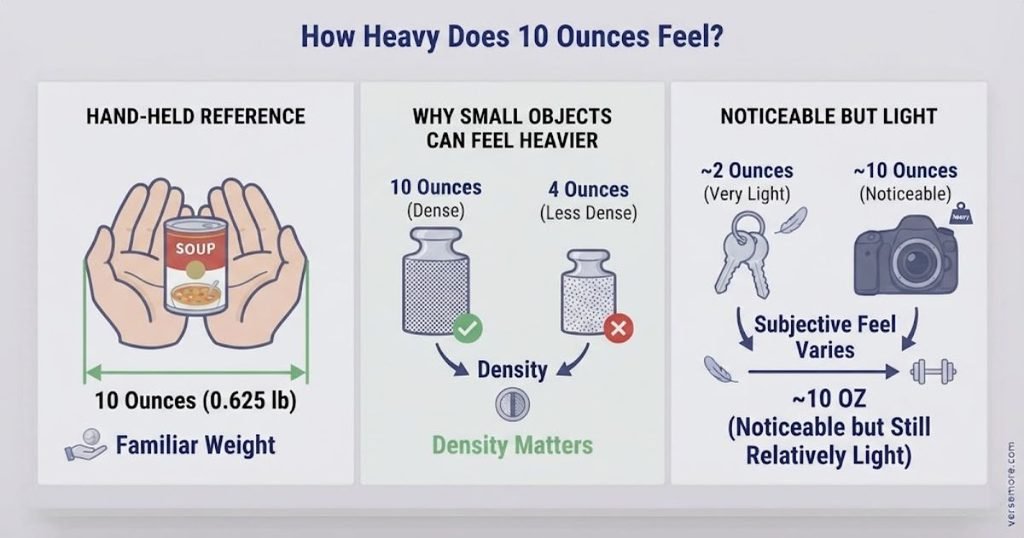
The physical feel of 10 ounces depends on more than the number on a scale. An object weighing 283.5 grams can feel surprisingly different from another object with the same mass because size, shape, grip, and weight distribution all affect how it is handled.
A useful hand-held reference
A good way to develop a sense of 10 ounces is to compare several objects that are close to the target instead of relying on just one. Five tennis balls can total between about 280 and 297 grams because each regulation ball is permitted to weigh 56.0–59.4 grams. A PlayStation DualSense controller is around 280 grams, while the current standard U.S. quarter weighs 5.670 grams, making 50 quarters exactly 283.5 grams. Holding these objects gives you three different physical experiences of approximately the same mass: five tennis balls are light, bulky, and spread across a larger volume; a game controller is compact but distributed around a shaped grip; fifty quarters are dense and concentrated into a much smaller mass. That comparison demonstrates why “10 ounces feels heavy” does not have one universal answer. The scale measures mass, but your hands respond to how that mass is presented.
Why a small object can feel heavier
Density is one reason a compact item may seem heavier. When roughly 283.5 grams is packed into a small volume, the object can feel substantial immediately when picked up. The opposite can happen with a bulky object. A larger item can weigh exactly the same but may feel lighter because its mass is spread out and easier to support. Grip also matters. An object with handles or a shape that distributes pressure across your palm can feel easier to hold than a dense object that concentrates pressure onto a small area.
Ten ounces is noticeable but still relatively light
At 0.625 pound, 10 ounces is well below the weight of many common handheld tools and household objects. Yet it is heavy enough to notice during extended carrying, especially when the same weight is added to something you already carry. That is why 10 ounces can matter for products such as cameras, controllers, tablets, travel accessories, packaged goods, and sports equipment. A few ounces may not sound like much, but repeated carrying can make the difference meaningful.
When Does 10 Ounces Matter?
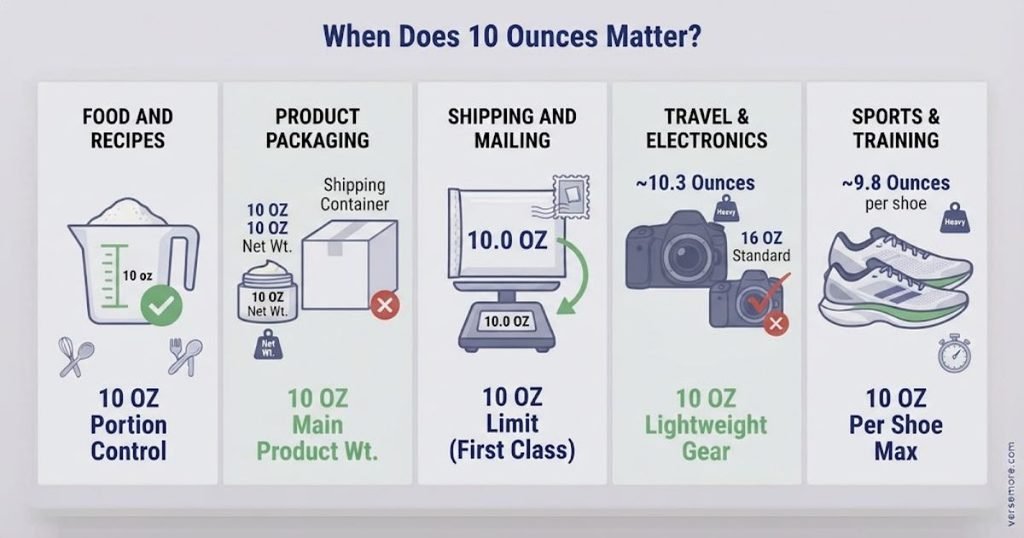
The practical importance of 10 ounces depends on what you are measuring. For a kitchen ingredient, it may simply be a convenient quantity. For shipping, travel, or equipment, the same 10-ounce difference can have a much greater practical effect.
Food and recipes
For food, 10 ounces usually describes mass, not volume. Ten ounces of flour, cheese, meat, or another ingredient can occupy very different amounts of space because different materials have different densities. This is why measuring food by weight is more consistent than assuming that a certain number of fluid ounces equals the same number of ounces by mass. When a recipe calls for 10 ounces by weight, a kitchen scale is the best option. The target is approximately 283.5 grams.
Product packaging
A package marked 10 oz net weight should not automatically be assumed to weigh only 10 ounces on the scale. Net weight refers to the stated quantity of the contents, while the outer container, wrapper, bottle, or box contributes additional mass. This distinction becomes important when comparing products, checking portions, or trying to reproduce a labeled quantity at home.
Shipping and mailing
For shipping, the relevant number is generally the weight of the shipment being presented to the carrier, including the packaging required by the service. A product that weighs 10 ounces by itself may therefore cross a shipping threshold once placed inside a box or padded mailer. Anyone trying to minimize shipping cost should measure the finished package, not just the item inside it.
Travel and portable electronics
Ten ounces can also be significant when you carry an object for hours. A 10-ounce difference between two similar cameras, chargers, accessories, or travel items may seem trivial when looking at a specification sheet. But travelers who carry several items together experience the combined difference. Replacing three separate accessories that each weigh a few ounces can produce a larger total saving than focusing on one item alone. Weight comparisons are therefore most useful when considered as part of the complete load.
Sports and training equipment
A nominal 10-ounce specification can also have a specific purpose in sports. Boxing gloves, for example, are sold in different ounce weights, and tennis balls have defined mass ranges rather than arbitrary labels. The ITF lists regulation tennis balls at 56.0–59.4 grams each. This means an ounce value on sports equipment may identify a standardized category rather than simply describing an approximate household weight.
Regular Ounces, Troy Ounces, and Fluid Ounces Are Not the Same
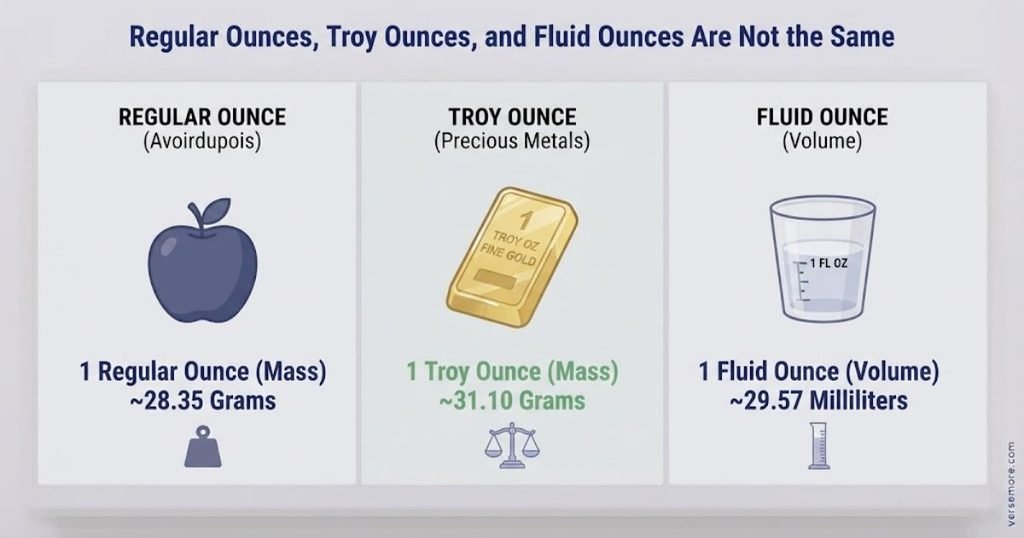
The word ounce can refer to different measurements, so the context matters. For ordinary everyday objects, food, and most consumer products, the relevant unit is generally the avoirdupois ounce. NIST gives one avoirdupois ounce as exactly 28.349523125 grams. A troy ounce, used for precious metals such as gold and silver, is heavier at about 31.1034768 grams. Ten troy ounces therefore do not equal 10 ordinary avoirdupois ounces. A fluid ounce is different again because it measures volume rather than mass. Ten fluid ounces tell you how much space a liquid occupies under a specified measurement system; they do not establish that the liquid has a mass of exactly 10 ounces.
Which ounce should you use for everyday objects?
For a question such as “What are some things that weigh 10 ounces?”, use the avoirdupois ounce unless the context specifically says otherwise. That is the unit behind the 283.5-gram figure used throughout this article. It is also why a 10-ounce object should not be compared directly with a 10-fluid-ounce container or a 10-troy-ounce precious-metal item. Keeping these three definitions separate prevents one of the most common mistakes in weight-comparison articles: treating every occurrence of “oz” as though it represented the same physical quantity.
FAQ’s
How much does 10 ounces weigh in grams?
Ten avoirdupois ounces equals exactly 283.49523125 grams, which is normally rounded to 283.5 grams for everyday use. In kilograms, that is approximately 0.2835 kg.
What are some common things that weigh 10 ounces?
Useful comparisons include 50 U.S. quarters, about five tennis balls, two regulation baseballs, five average eggs, a PlayStation DualSense controller, and an iPad mini. Most everyday objects will vary slightly, so these should be treated as close comparisons unless a published specification gives an exact weight.
Is 10 ounces the same as 10 fluid ounces?
No. 10 ounces by weight measures mass, while 10 fluid ounces measures volume. A liquid’s weight depends on its density, so 10 U.S. fluid ounces of different liquids can have different masses.
How much is 10 ounces in pounds?
Ten ounces equals 0.625 pound, because one avoirdupois pound contains 16 ounces. In other words, 10 ounces is five-eighths of a pound.
Is 10 ounces considered heavy?
For an individual handheld object, 10 ounces is relatively light, but it is still noticeable. How heavy it feels depends on the object’s size, shape, grip, and how its mass is distributed.
What weighs almost exactly 10 ounces?
Several familiar objects are very close. Fifty U.S. quarters weigh 283.5 grams, which corresponds exactly to 10 avoirdupois ounces when the standard quarter weight of 5.670 grams is used. A PlayStation DualSense controller and five tennis balls can also land close to the same range.
Can I use a household object to estimate 10 ounces?
Yes, but household objects are only estimates unless their weight is known. A paperback book, loaded wallet, five eggs, or a group of batteries can help you develop a rough sense of 10 ounces, but their actual weights vary. For anything that needs accuracy, use a digital kitchen or postal scale and target 283.5 grams.
Is a 10-ounce product actually 10 ounces with its packaging?
Not necessarily. When a product states 10 oz net weight, the stated weight generally refers to the contents rather than the complete package. The container, wrapper, or shipping materials add additional weight.
What is the easiest way to measure 10 ounces at home?
Place an empty container on a digital scale, use the tare function, and then add the item until the display reaches 10 ounces or about 283.5 grams. Using grams can be more precise when the scale has a fine enough resolution.
Are troy ounces the same as regular ounces?
No. A troy ounce is used for precious metals and is heavier than an ordinary avoirdupois ounce. Ten troy ounces therefore weighs more than 10 regular ounces, so the two measurements should not be mixed when comparing everyday objects.
Conclusion
Ten ounces is a surprisingly useful reference weight because it is light enough to carry comfortably while still being substantial enough to notice. In the standard avoirdupois system, 10 ounces equals exactly 283.49523125 grams, or about 283.5 grams.
The easiest way to visualize the amount is by comparing it with familiar objects. Fifty U.S. quarters provide an especially precise reference, while five tennis balls, two baseballs, a DualSense controller, or an iPad mini offer more practical examples of objects in roughly the same weight range.
Remember that everyday comparisons are estimates unless the item’s weight is specifically defined. When accuracy matters for cooking, shipping, product checking, or portioning, a digital scale is far more reliable than judging an object’s weight by appearance.
Understanding the difference between regular ounces, troy ounces, and fluid ounces also prevents common measurement mistakes. Once those distinctions are clear, identifying things that weigh 10 ounces becomes much easier—and 283.5 grams gives you a reliable metric reference wherever you are.

I am the admin of VerseMore, sharing helpful, informative, and engaging content on various topics to inspire readers, provide value, and make everyday life easier.