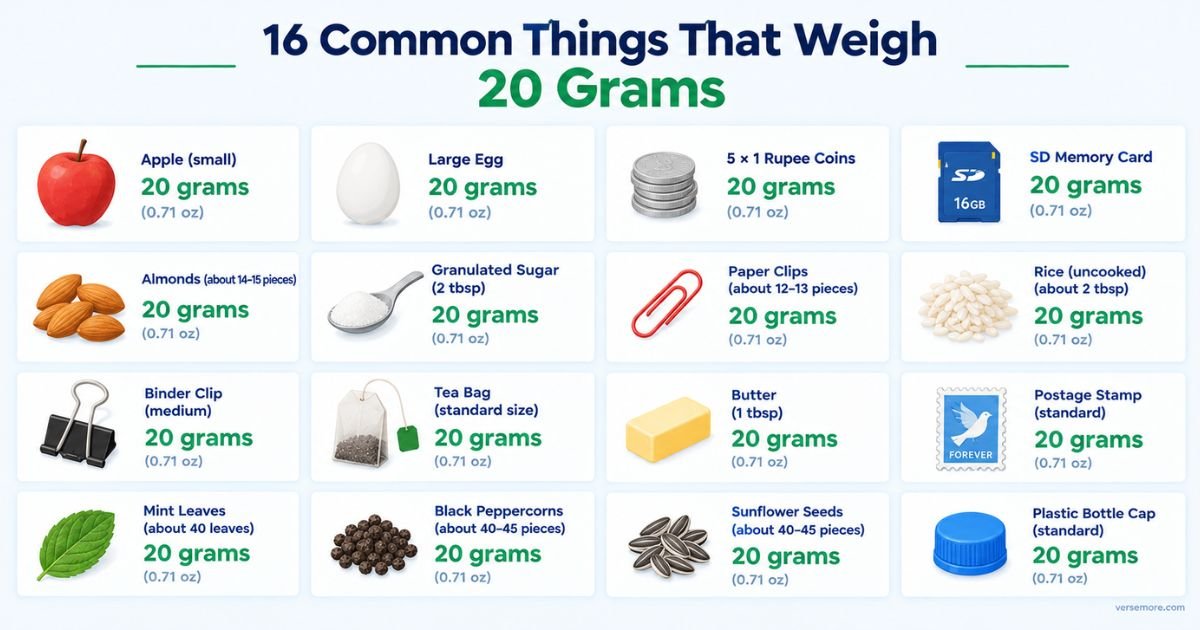
Pick up a small object right now — a house key, a couple of coins, a pen cap — and you’re probably within a few grams of a number most people can’t actually picture: 20 grams. It’s too light to feel substantial and too small to look impressive on a kitchen scale, which is exactly why recipes, nutrition labels, and shipping forms keep using it without giving you any real sense of scale.
This guide fixes that. Instead of vague comparisons, you’ll get things that weigh 20 grams that you can actually verify — some hit the number with near-mathematical precision, others are close biological or manufactured averages, and each one is labeled so you know which is which.
Twenty grams is almost exactly the weight of four U.S. nickels (5 grams each) — one of the few everyday objects that lands on the number with real precision rather than a rough guess.
By the end, you’ll be able to picture 20 grams instantly, convert it into ounces and tablespoons, and understand why the same weight fills a different-sized spoon depending on what’s inside it.
How Much Is 20 Grams, Exactly?
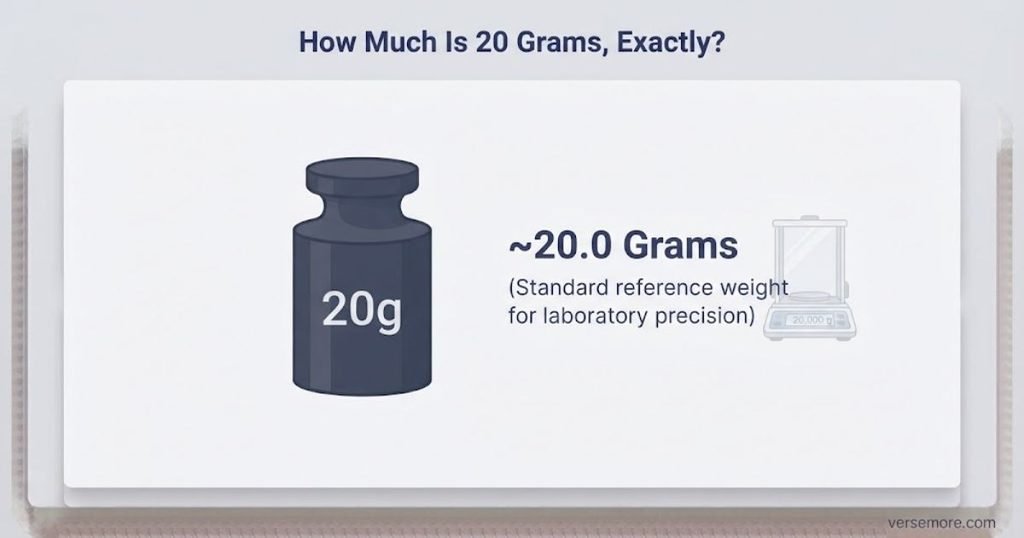
Twenty grams equals about 0.71 ounces (0.705 oz precisely) — a little under three-quarters of a standard imperial ounce, which is why it can feel like an oddly small amount if you’re used to thinking in pounds and ounces rather than metric mass.
A gram is the metric system’s base unit for very light mass, small enough that a standard kitchen scale needs at least one decimal place to register anything under 5 grams reliably. Twenty grams sits in a useful middle zone: too light to estimate confidently by hand, but heavy enough that a handful of common coins, a single battery, or a small snack portion can land on it almost exactly.
| Unit | Approximate Value |
| Ounces | 0.71 oz |
| Pounds | 0.044 lb |
| Teaspoons (granulated sugar) | ~5 tsp |
| Tablespoons (granulated sugar) | ~1.5 tbsp |
| Tablespoons (all-purpose flour) | ~2.5 tbsp |
Because grams measure mass and tablespoons measure volume, that last row isn’t a fixed rule — it changes depending on what you’re weighing, which is why the tablespoon conversions for sugar and flour aren’t the same number. We’ll unpack exactly why later in this guide.
Exact Matches: Coins and Cash That Weigh 20 Grams
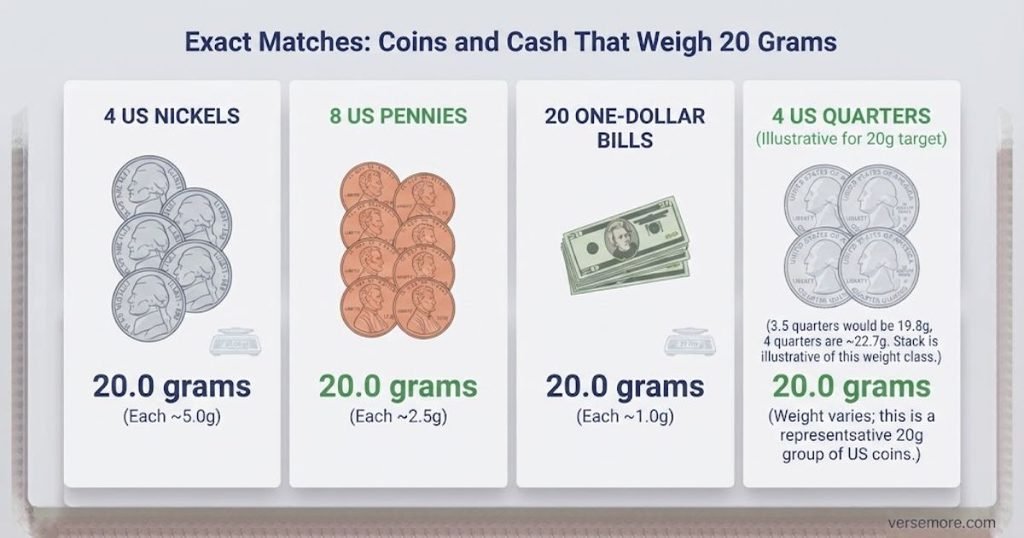
Unlike almost anything else on this list, these four items aren’t approximations — they’re manufactured to a legal, regulated tolerance, so the numbers below are as close to guaranteed as a household object gets.
4 US Nickels
The US Mint manufactures every nickel to a fixed 5-gram standard. Stack four of them and you have 20 grams on the nose — no rounding, no “about.” If you want to build 20 grams at home without a scale, this is the most reliable way to do it.
8 US Pennies
Since 1982, the US penny has weighed exactly 2.5 grams. Eight of them land precisely at 20 grams, making a pocketful of pennies just as accurate a reference as the nickel stack above — just bulkier.
20 One-Dollar Bills
Every US bill, regardless of denomination, weighs about 1 gram thanks to its standardized 75% cotton / 25% linen blend. Twenty singles — or any twenty bills of mixed denominations — come out to roughly 20 grams, a fun way to visualize the number if you’re picturing a stack of cash rather than coins.
4 US Quarters
A modern clad quarter weighs 5.670 grams, so four of them total 22.68 grams — close to 20 grams but running about 13% heavy. It’s a useful “almost, but not quite” comparison that shows coin math doesn’t always land perfectly, unlike the nickel stack above.
Batteries and Small Electronics Near 20 Grams
A Single AA Battery
A standard alkaline AA battery weighs approximately 23 grams — heavier than 20 grams, but close enough that if you’ve ever tossed one in your pocket, you’ve already felt roughly what 20 grams feels like.
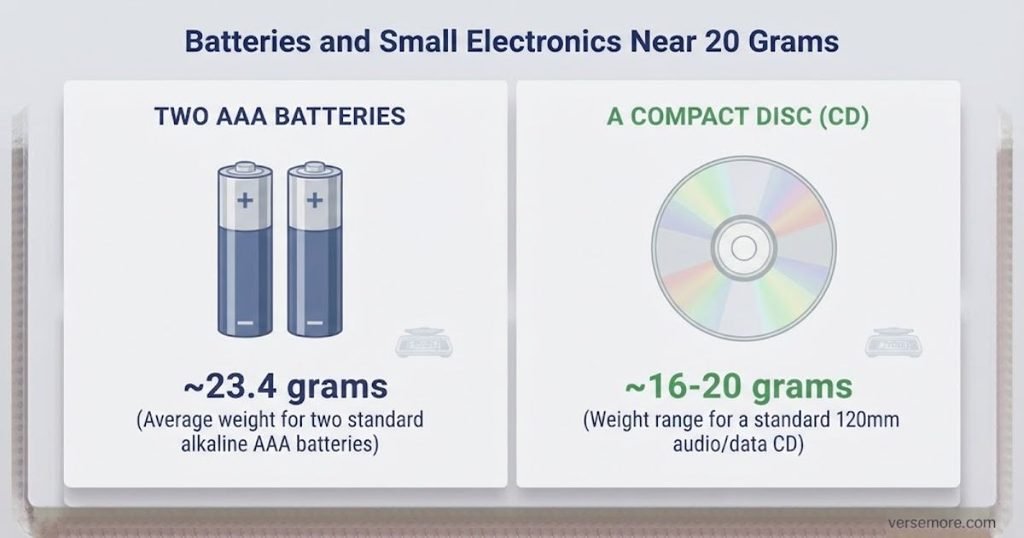
Two AAA Batteries
A single AAA battery weighs around 12 grams, so a pair comes to about 24 grams. It’s a less common comparison than the AA battery, but a genuinely useful one if AAA is what you happen to have lying around a junk drawer.
A Compact Disc
CDs are lighter than most people assume — a standard disc weighs around 15 to 16 grams. It’s on the lighter side of this list, but it’s a good visual anchor for anyone old enough to remember stacking them on a spindle.
Kitchen and Food Items That Weigh About 20 Grams
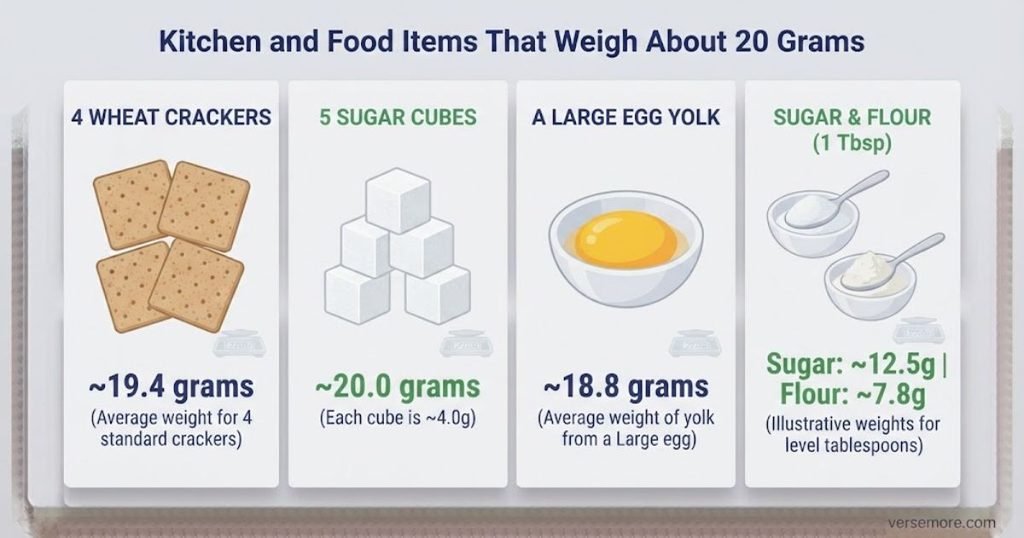
4 Wheat Crackers
A common serving reference for wheat crackers puts four crackers at exactly 20 grams. It’s one of the few food items on this list that isn’t just “close” — it’s a standard portion figure used in nutrition tables.
5 Sugar Cubes
A standard sugar cube weighs around 3 to 4 grams. Five of them land right around 20 grams, which makes a small sugar bowl a surprisingly precise way to visualize this weight if you take your coffee or tea sweetened.
A Large Egg Yolk
According to figures from the British Egg Information Service, the yolk of a large egg weighs about 17.1 grams, and a very large egg’s yolk runs closer to 19 grams. Separate the yolk from a large egg and you’re holding something very close to 20 grams — a genuinely overlooked comparison, since most “egg” references online talk about the whole egg (around 50 grams) rather than just the yolk.
Sugar and Flour, by the Tablespoon
About 1.5 tablespoons of granulated sugar weighs 20 grams, while all-purpose flour — lighter and more prone to trapping air — takes closer to 2.5 tablespoons to hit the same mass. Same target weight, two different spoon counts, for reasons explained further down.
Office Items You Already Have
20 Standard Paperclips
A single steel paperclip weighs about 1 gram, so a small pile of 20 — easily counted out of any office desk drawer — weighs almost exactly 20 grams. It’s one of the more precise non-currency comparisons on this list, and it’s the same benchmark math teachers have used for decades to teach the gram as a unit.
Nature: Living Things Near 20 Grams
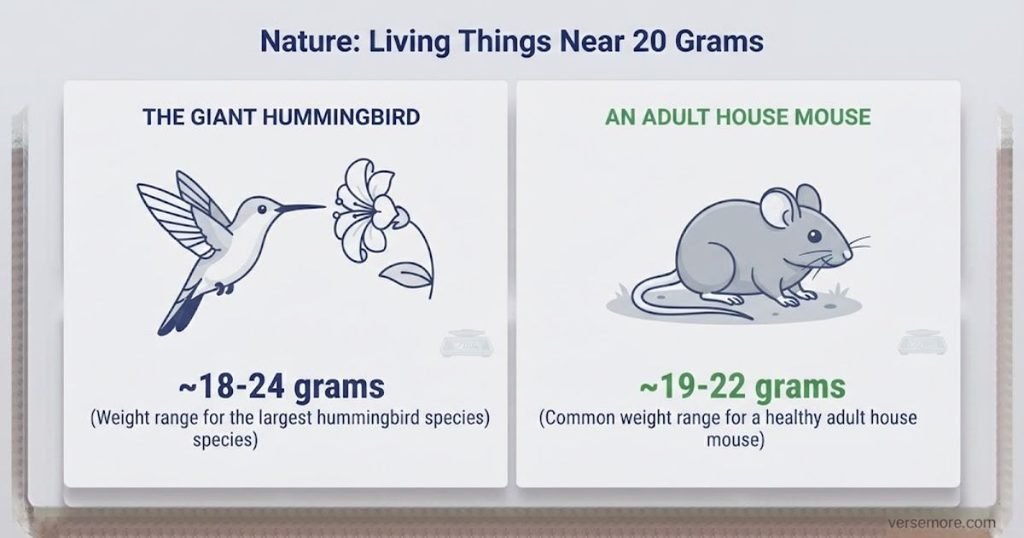
The Giant Hummingbird
The giant hummingbird (Patagona gigas), native to the Andes, is the heaviest hummingbird species in the world — and it weighs 18 to 24 grams, putting a living, flying animal almost exactly at this article’s target weight. For context, most hummingbird species people picture, like the ruby-throated hummingbird, weigh only 3 to 4 grams, so the giant hummingbird is roughly five times heavier than what “hummingbird” usually brings to mind.
An Adult House Mouse
A fully grown house mouse (Mus musculus) typically weighs somewhere between 12 and 30 grams, depending on age, sex, and diet, putting a healthy adult mouse squarely in the middle of that range at right around 20 grams. It’s a helpful mental image for anyone who’s ever picked one up in a live trap and wondered just how light it actually felt.
Why the Same Weight Fills a Different Spoon
Grams measure mass — how much matter something contains. Tablespoons measure volume — how much space something takes up. Those are two different things, and the only reason they ever line up neatly is density, which varies by ingredient.
Water is the one substance where the two nearly match: one milliliter of water weighs almost exactly one gram, which is part of why the metric system was designed around water in the first place. But food ingredients aren’t water. Granulated sugar is dense and settles tightly, so it takes less volume to reach 20 grams (about 1.5 tablespoons). Flour is lighter and traps air between its particles, so the same 20 grams needs roughly 2.5 tablespoons to level out. Butter sits in between, at around 1.4 tablespoons for 20 grams, because it’s dense but semi-solid rather than granular.
This is also why “scoop and level” methods produce inconsistent baking results — scooping flour directly with a tablespoon compacts it, quietly adding extra grams you didn’t intend to include. Spooning the ingredient into the spoon first, then leveling it off, keeps the volume-to-weight ratio closer to the standard conversions above.
FAQ’s
How much is 20 grams in ounces?
Twenty grams equals approximately 0.71 ounces, or 0.705 oz using the precise conversion factor (1 oz = 28.3495 g). It’s a little under three-quarters of a standard imperial ounce.
What household items weigh exactly 20 grams?
Four US nickels (5 grams each) and eight US pennies (2.5 grams each, minted after 1982) both weigh exactly 20 grams, since both coins are manufactured to a strict, regulated weight standard rather than an approximate one.
Is 20 grams of sugar a lot?
Twenty grams of sugar is roughly 1.5 tablespoons, or about 5 teaspoons. Whether that counts as “a lot” depends on the context you’re comparing it to (a daily intake guideline, a single food label, or a recipe), so it’s worth checking against the specific reference you’re using rather than judging the number in isolation.
How can I measure 20 grams without a kitchen scale?
The most reliable no-scale method is counting coins: four US nickels or eight US pennies both land on exactly 20 grams because US coinage is manufactured to a fixed weight tolerance, unlike most food or household items.
What weighs less than 20 grams that people often assume is heavier?
A compact disc (about 15–16 grams) and a single AAA battery (about 12 grams) both weigh noticeably less than 20 grams, despite feeling substantial in the hand.
What weighs a bit more than 20 grams?
A single AA battery (about 23 grams) and four US quarters (about 22.7 grams) both run slightly over 20 grams — close enough to use as a rough comparison, but not an exact match like the nickel or penny stacks.
What’s a real animal that weighs about 20 grams?
The giant hummingbird, the heaviest hummingbird species in the world, weighs 18 to 24 grams. An adult house mouse also falls in this range, typically weighing between 12 and 30 grams.
Why does 20 grams of flour need more tablespoons than 20 grams of sugar?
Because tablespoons measure volume, not weight, and flour is less dense than sugar — it traps more air between its particles. The same 20-gram mass simply takes up more space when it’s flour than when it’s granulated sugar.
Conclusion
Twenty grams stops being an abstract number once you’ve held it: four nickels, eight pennies, a small pile of paperclips, or a single AA battery all put that exact weight in your hand. Some of these comparisons are mathematically exact because they’re built to a manufacturing standard, while others — a mouse, a hummingbird, an egg yolk — are natural approximations that still land remarkably close to the mark.
The most useful takeaway isn’t any single item on this list, but the method behind it: reach for a regulated object like a coin or a battery when you need a fast, trustworthy reference, and remember that volume measurements like tablespoons will always shift depending on what you’re weighing. With that distinction in mind, you’ll never need to guess at 20 grams again.

I am the admin of VerseMore, sharing helpful, informative, and engaging content on various topics to inspire readers, provide value, and make everyday life easier.