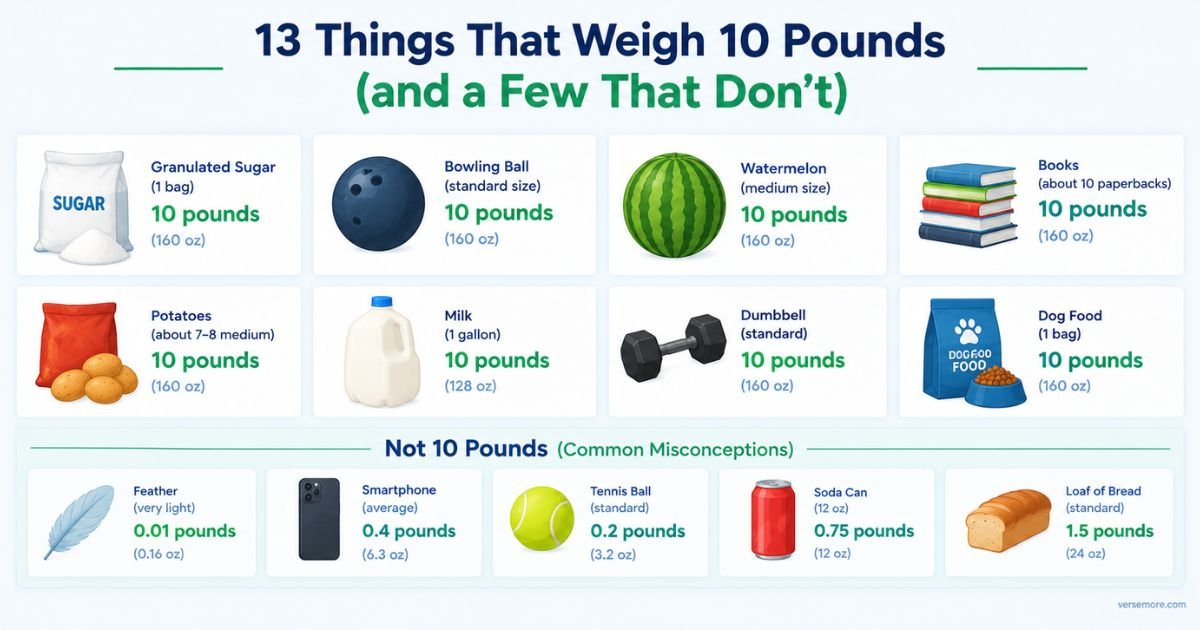
Ten pounds is easy to say and surprisingly hard to picture. It sits between a bag of groceries and something you’d think twice about carrying upstairs.
This guide covers 13 things that weigh 10 pounds, or close to it. Each one was checked against a standard, a manufacturer figure or plain arithmetic, and where the weight shifts with size or brand, you’ll see the range.
You’ll also get exact metric conversions, UK and European equivalents where the numbers differ, and a short list of popular claims that don’t hold up.
10 pounds is exactly 4.5359237 kilograms, or 160 ounces. For everyday use, call it 4.54 kg.
Key Takeaways
• 10 lb = 4.5359237 kg (exact) = 160 oz. Rounded, that’s 4.54 kg.
• A US letter ream of 500 sheets weighs 5 lb, so two reams make 10 lb.
• An imperial gallon of water was originally defined as 10 lb, while a US gallon of water is only about 8.3 lb.
• Metric shortcut: halve 10 lb to get 5, then subtract a tenth of that. You land on 4.5 kg.
How Heavy Is 10 Pounds?
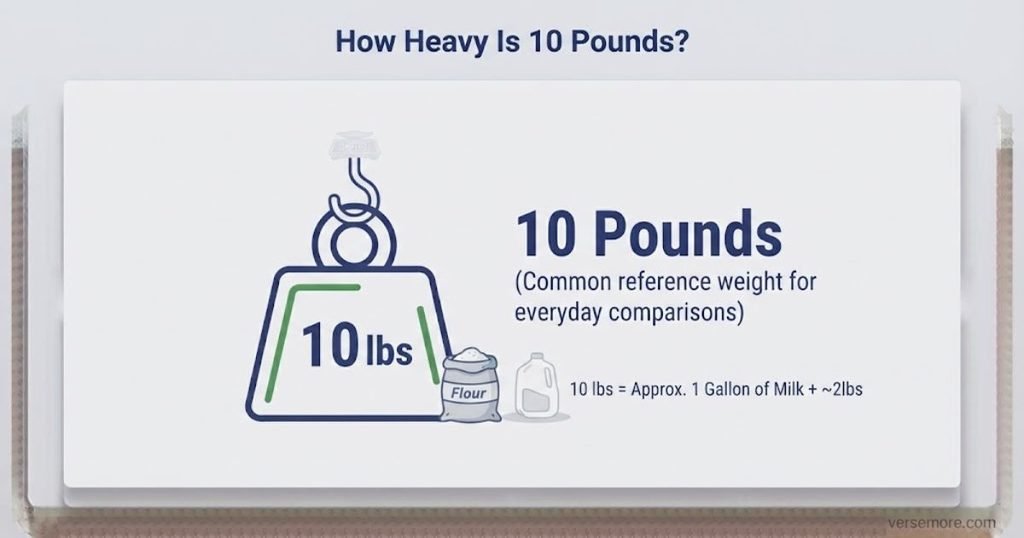
Ten pounds equals exactly 4.5359237 kilograms, which is 160 ounces or 4,535.9237 grams. Since the 1959 international agreement, the avoirdupois pound has been defined as exactly 0.45359237 kilograms. That definition is the same in the US and the UK, so the pound itself never differs between the two systems. Gallons, tons and fluid ounces do differ, and the imperial gallon comes up later in this guide.
| Unit | 10 lb equals | Exact or rounded? |
| Ounces | 160 oz | Exact |
| Grams | 4,535.9237 g | Exact |
| Grams | 4,536 g | Rounded to whole grams |
| Kilograms | 4.5359237 kg | Exact |
| Kilograms | 4.54 kg | Rounded to 2 decimals |
Going the other way, 10 kg is about 22.05 lb, so the two are easy to confuse.
Two mental shortcuts save a calculator:
• Pounds to kilograms: halve the number, then subtract a tenth of that half. Ten pounds becomes 5, minus 0.5, which is 4.5 kg.
• Kilograms to pounds: double the number, then add a tenth. Ten kilograms becomes 20, plus 2, which is 22 lb.
Both land within a fraction of a percent of the exact answer.
Things That Weigh 10 Pounds: 13 Everyday Examples
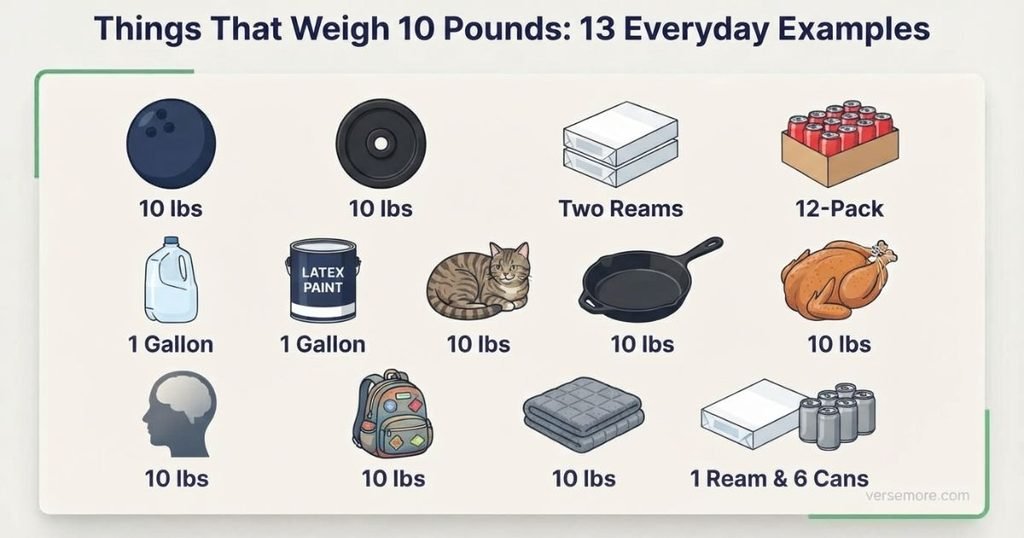
Some of these are labeled at exactly 10 lb, and others land within a few percent. Where an item varies, the range is stated.
1. A 10-Pound House Bowling Ball
Bowling balls come in whole-pound weights, and 10 lb sits comfortably in the middle. USBC rules cap ball weight at 16 pounds and require a diameter between 8.500 and 8.595 inches. Because the size is fixed, a 10-pound ball is simply less dense than a 15-pound one.
That produces an odd result. A sphere 8.5 inches across holds about 5.27 liters, enough water to support roughly 11.6 lb. At the 8.595-inch upper limit it’s about 12 lb. That’s my own arithmetic from the sphere formula, ignoring finger holes. It means a 10-pound ball would float in principle, while a 14-pound one sinks.
2. A 10-Pound Weight Plate
A plate stamped 10 lb is the easiest way to get exactly ten pounds, because the number is printed on it. Plates sold in pounds often carry a kilogram label of 4.5 kg. That’s rounded, since 10 lb is really 4.536 kg.
Gyms that work in kilograms typically stock 5 kg plates, and 5 kg is 11.02 lb. Two of them weigh 22.05 lb, not 10. When buying online, check whether the listing is per plate or per pair. Some 10 lb bumper plates are sold as a pair, which delivers 20 lb.
3. A 10-Pound Bag of Flour
Flour is the classic pantry reference because the bag is honest about its weight. King Arthur’s ingredient chart puts a cup of all-purpose flour at 120 grams, or 4¼ ounces. At that figure, 10 lb of flour is about 37.8 cups.
Ten-pound bags are a US format. Where flour is sold in metric bags, the nearest match is about 4.5 kg, or four and a half 1 kg bags.
4. Two Reams of Paper
One ream is not ten pounds, which is a common mistake in lists like this. Domtar explains that 20 lb bond paper is weighed as 500 sheets of the uncut 17 x 22 inch basic size, so 500 letter-size sheets come to 5 pounds. Two reams, or 1,000 sheets, make 10 lb before the wrapper.
Metric paper shifts the total slightly, because A4 sheets are a different size and are often heavier.
| Paper (500 sheets per ream) | One ream | Two reams |
| US letter, 20 lb bond | 5.00 lb (2.27 kg) | 10.00 lb (4.54 kg) |
| A4, 75 gsm | 5.16 lb (2.34 kg) | 10.31 lb (4.68 kg) |
| A4, 80 gsm | 5.50 lb (2.49 kg) | 11.00 lb (4.99 kg) |
Figures are rounded to two decimals, exclude packaging, and the A4 rows are my own calculation from sheet area and paper weight.
5. A 12-Pack of Soda Cans
A full 12-ounce soda can weighs almost exactly a pound and a half less than you’d think, and twelve of them land right at 10 lb. UC Santa Barbara’s physics demonstrations measured a full can of regular Coke at about 384 grams and a can of Diet Coke at about 370 grams. Twelve regular cans come to 4.608 kg, or 10.16 lb. Twelve diet cans come to 4.440 kg, or 9.79 lb. The cardboard carton adds a little more.
The gap comes from the sugar dissolved in the regular soda. Other brands and can sizes will differ slightly, so treat this as a reference rather than a spec.
6. An Imperial Gallon of Water
This is the one that surprises people. The British Weights and Measures Act 1824 defined the gallon as the volume of 10 pounds of distilled water, under set conditions of temperature and air pressure. The 1985 Act later fixed it at exactly 4.54609 liters.
A US gallon is a smaller unit. A US liquid gallon of water weighs about 8.33 pounds. The imperial gallon is roughly 1.2 US gallons. So a UK source saying a gallon of water weighs 10 lb and a US source saying 8.3 lb are both right, because they’re using different gallons.
7. A Gallon of Latex Paint
Paint is the reference most people already have in the garage. Weight depends on the formulation. Latex is usually put at about 10 lb per gallon, while oil-based paints run heavier at 11 to 12 lb, and the metal can adds a little more. That range is the reason “a gallon of paint weighs 10 lb” is a fair rule of thumb but not a spec.
In metric terms, a US gallon is 3.785 liters, so a 4-liter tin is slightly larger than the gallon these figures describe.
8. A Healthy Adult Cat
A healthy adult domestic cat typically weighs 8 to 12 pounds, and most sit close to 10. That’s an average, not a target. Body frame and breed change what’s healthy, and vets judge a cat on a 9-point body condition score, where 4 to 5 is considered ideal. A lean Maine Coon can weigh far more than 10 lb, and a small Siamese-type cat can be heavy at 10.
A cat is a poor calibration weight because it moves. It works well as a mental picture, though, since most people already know how a cat feels when lifted.
9. A 15-Inch Cast-Iron Skillet
The most repeated skillet claim is that a “large” cast-iron pan weighs 10 lb. It depends entirely on diameter. A Lodge 12-inch skillet is listed at about 8 lb, while retailer listings put the Lodge 15-inch at 11.5 lb and another 15-inch model at about 10.5 lb.
So a 15-inch skillet is a fair 10-pound reference, give or take a pound. A 12-inch pan is two pounds short. Weights also differ from maker to maker, so check the label on your own.
10. A 10-Pound Turkey
A 10-pound turkey is a practical reference because USDA planning rules attach real numbers to it:
• Servings: USDA advises about one pound per person, or a pound and a half for hearty eaters or leftovers. At that rate, a 10-lb bird feeds about 10 people, or 6 to 7 if you want leftovers.
• Fridge thawing: allow roughly 24 hours per 4 to 5 pounds, which works out to 2 to 2.5 days for a 10-lb bird.
• Cold-water thawing: about 30 minutes per pound, so around 5 hours.
USDA also notes that hens generally weigh under 16 lb, so a 10-lb bird is comfortably a hen.
11. The Average Adult Human Head
An adult head is commonly given as 10 to 12 pounds, so 10 lb is the low end. That’s the neck’s constant load.
The often-quoted “text neck” numbers come from a 2014 spine-surgeon study, which used a 3D model to estimate that a forward tilt raises the effective load on the neck to 27 lb at 15 degrees, 40 lb at 30, 49 lb at 45 and 60 lb at 60. That was a computer model, not a measurement in living people, so treat the numbers as estimates.
12. A Loaded Child’s Backpack
A 10-lb backpack is a useful benchmark because pediatric guidance is written as a percentage of the child’s weight. The American Academy of Pediatrics guideline is widely quoted at 10 to 15%, and some hospital and safety-organization guidance says 10% or even 5 to 10%. On the 10 to 15% guideline, a 10-lb pack sits in the range only for children above roughly 67 lb.
| Child’s weight | 10-lb pack as % of body weight | Against 10 to 15% |
| 50 lb | 20% | Above |
| 67 lb | 15% | Top of range |
| 80 lb | 12.5% | Within |
| 100 lb | 10% | Lower end |
| 120 lb | 8.3% | Below |
Percentages are my own calculation and are rounded. Check the current guidance from your child’s pediatrician.
13. A Weighted Blanket
Weighted blankets are one of the few consumer products sold by weight class, and 10 lb is a standard size. The Sleep Foundation gives a range of 5 to 12% of body weight, with most people preferring about 10%. By that math, a 10-lb blanket suits an adult of about 83 to 200 lb, with a best fit near 100 lb.
Children are a different case. Sleep Foundation advises caution with the 10% rule for kids and suggests consulting a physician, and a children’s hospital advises no more than 10% of a child’s weight and not using the blanket overnight. That makes a 10-lb blanket an adult product.
Things People Say Weigh 10 Pounds (But Don’t)
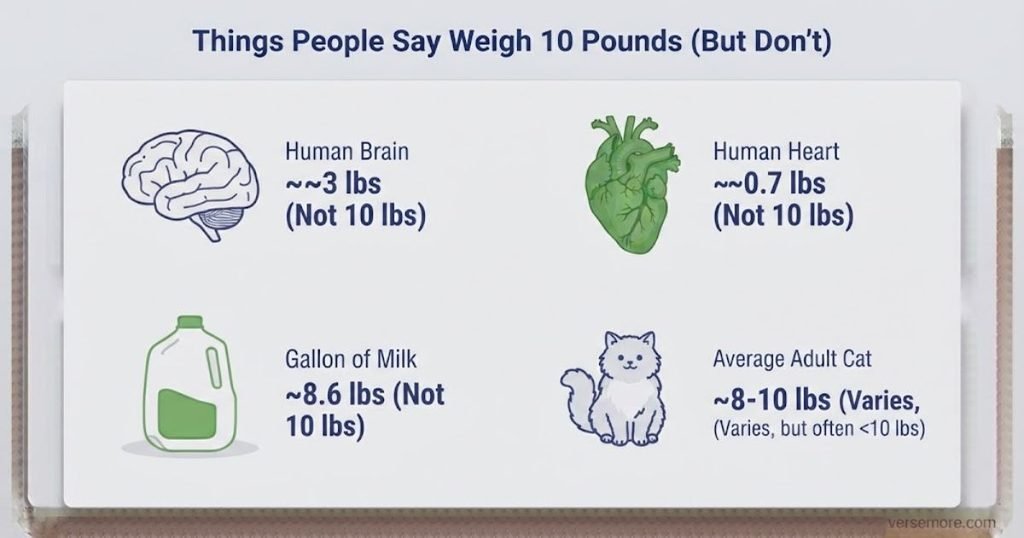
Several claims about 10-pound objects circulate widely, and they don’t survive a quick check.
| Claim | Real weight | Why the mix-up happens |
| A basketball weighs 10 lb | About 1.4 lb (NBA size 7: 1.375 lb) | It feels substantial in the hands, but it’s mostly air |
| A small microwave weighs 10 lb | About 20 to 24 lb for a 0.7 cu ft countertop unit | A small footprint doesn’t mean a light appliance |
| A 5-gallon bucket of paint weighs 10 lb | Roughly 30 to 60 lb of paint, plus the bucket | 10 lb is about one gallon, not five |
| A gallon of milk weighs 10 lb | About 8.6 lb for whole milk (density of about 1.03 g/mL) | Milk is denser than water, but a US gallon of water is only 8.3 lb; 10 lb is the imperial gallon |
| A newborn weighs 10 lb | About 7.5 lb on average; full-term babies range from 5 lb 8 oz to 8 lb 13 oz | A 10-lb newborn is above that healthy full-term range |
Milk figure: my arithmetic from the density and 3.785 L per US gallon.
Why 10 Pounds Feels Heavier in Some Objects Than Others
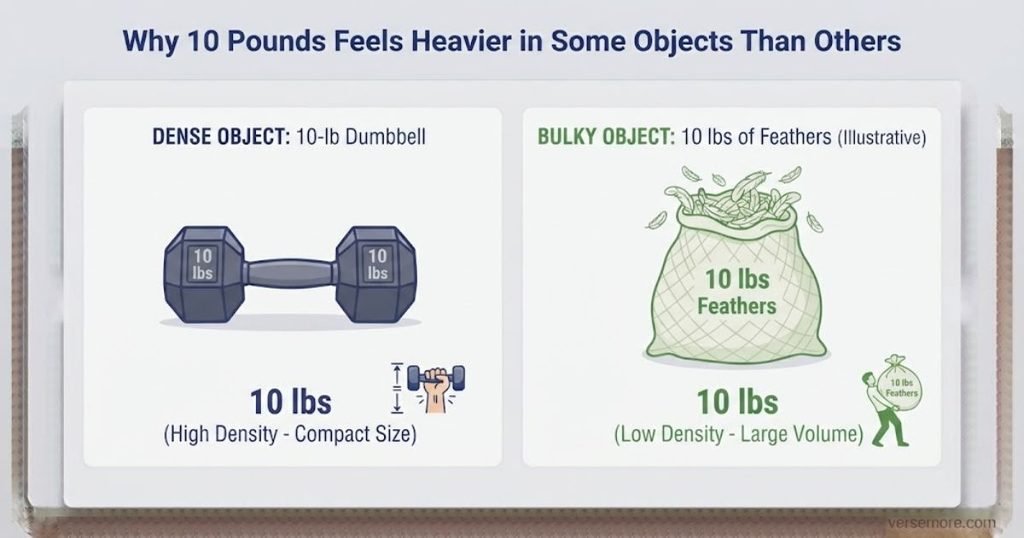
Two objects at exactly 10 lb can feel like different weights in your hands. That’s a documented effect, not just a matter of opinion.
The size-weight illusion has been studied for over 130 years, since Charpentier’s 1891 paper. When two objects have the same weight but different sizes, the smaller one feels heavier. In some experiments, small objects felt up to 50% heavier than larger ones of the same mass. The usual explanation is expectation: your brain predicts that bigger objects are heavier and sets your lifting force accordingly, then registers the surprise.
There’s a related material-weight illusion, in which an object that looks like it’s made of a low-density material feels heavier than an identically weighted object that looks dense.
This explains a lot about the examples above. A 10-lb bowling ball, a compact weight plate and a bulky, soft 10-lb blanket or a loaded backpack all carry the same load but feel different. How you carry it matters too. A backpack spreads its weight across your shoulders and back, while a bag of flour hangs from one hand and tires your grip first.
How to Measure 10 Pounds at Home Without a 10-Pound Weight
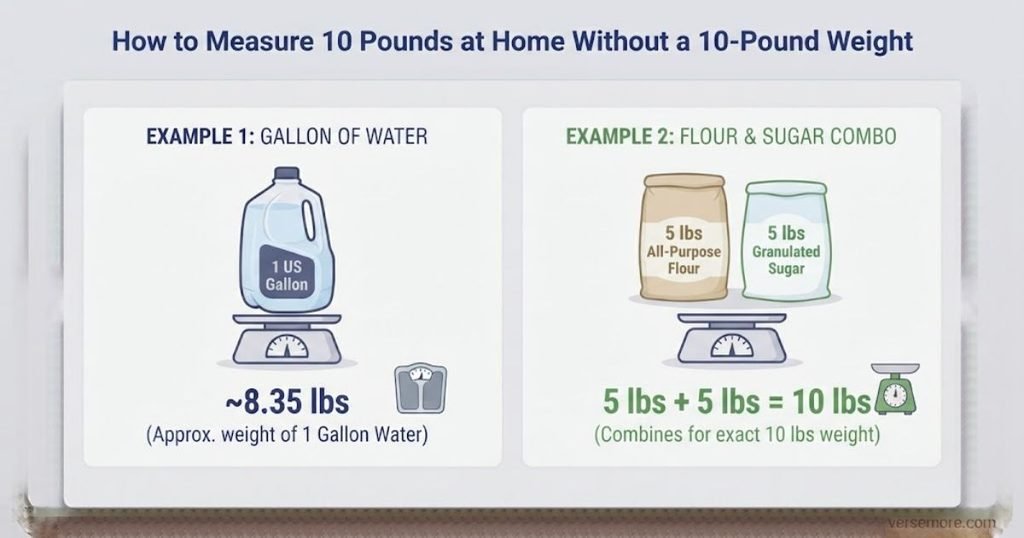
You can check any object against 10 lb with a few household tools. Here is a simple three-step approach, the Ten-Pound Check:
1. Use a kitchen scale first. The target is 4,536 g (4.536 kg). Check your scale’s maximum first, since many kitchen scales stop at about 5 kg (11 lb), which leaves little room once a container is on it.
2. Otherwise, subtract on a bathroom scale. Weigh yourself, weigh yourself again holding the object, and subtract. Bathroom scales often read in coarse steps, which is a large error for a 10-lb object, so repeat the weighing two or three times and average.
3. Or build the weight from water. Water is the easiest known mass to make at home. Three full 1.5-liter bottles hold 4.5 liters, which weighs about 4.5 kg, or 9.92 lb. The empty plastic adds only a few ounces, which lands you close to 10 lb.
If you have none of these, use the labeled references from this article. A 10 lb bag of flour or a plate stamped 10 lb is more trustworthy than a guess.
10 Pounds in Stone, Troy Weight and Other Units
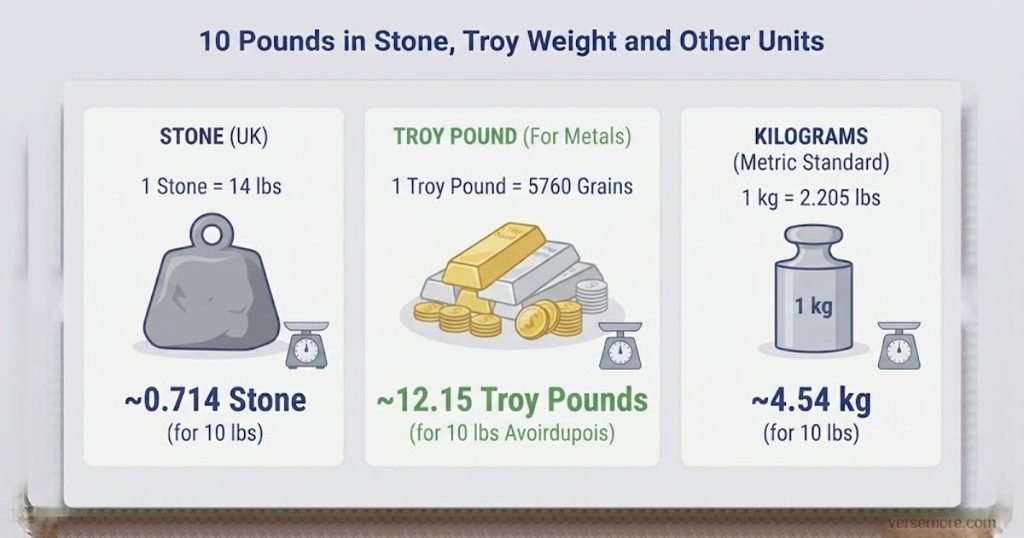
Stone. In the UK and Ireland, body weight is often given in stone. One stone equals exactly 14 pounds, so 10 lb is about 0.71 stone. Someone described as “10 stone 10” weighs 150 lb, not 10 lb — the stone comes first in that convention.
Troy weight. Precious metals use a different pound entirely. The troy pound is exactly 373.2417216 grams and contains 12 troy ounces, while the everyday avoirdupois pound is 453.59237 grams and contains 16 ounces. A troy pound is about 82% of an avoirdupois pound, even though the troy ounce (31.10 g) is heavier than the avoirdupois ounce (28.35 g). So “10 troy pounds” of gold is lighter than 10 regular pounds: it comes to about 8.22 avoirdupois pounds.
Why this rarely causes confusion in practice: unlike the gallon, the everyday pound is identical in the US and UK. If someone in London and someone in Chicago both say “10 pounds,” they mean the same mass. The exceptions are stone (a multiple of the pound) and troy weight (a different pound reserved for precious metals), and both are usually signaled by context.
When 10 Pounds Matters
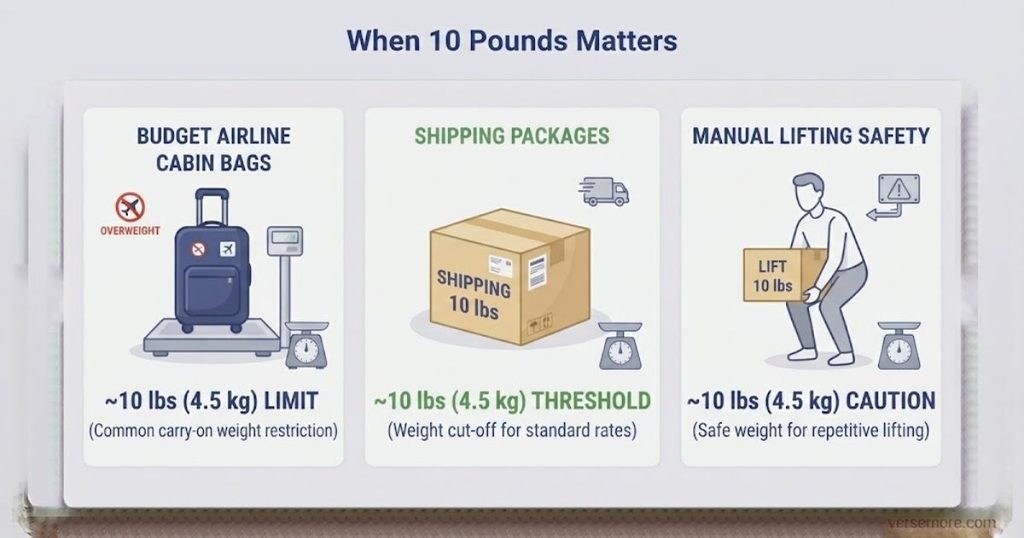
Budget Airline Cabin Bags
Several major European low-cost carriers cap their free or add-on cabin bag at 10 kg, which is 22.05 lb, not 10 lb. That’s worth flagging because the two numbers look similar but aren’t the same: a bag at 10 lb (4.54 kg) is comfortably under every one of these limits, while a bag at 10 kg is more than double that. Ryanair’s Priority cabin bag, Wizz Air’s under-seat and cabin bags, Jet2, TUI and Transavia all use a 10 kg ceiling. Airlines that don’t cap cabin-bag weight, such as EasyJet on some fares, judge instead by whether you can lift the bag into the overhead locker yourself.
Shipping
USPS Priority Mail flat-rate boxes charge one flat price regardless of the parcel’s actual weight, up to a cap of 70 lb. A 10-lb package fits easily within any flat-rate box’s weight allowance, so the deciding factor for cost is the box size, not whether the parcel happens to weigh close to 10 lb.
Manual Lifting
NIOSH’s lifting equation sets an ideal-conditions ceiling of 51 lb for a single, well-positioned two-handed lift, which then gets reduced for frequency, reach, twisting and grip. A 10-lb object sits well inside that ceiling under almost any posture, which is one reason it’s a common weight for starter dumbbells, kettlebells and weight plates: light enough to lift repeatedly without a real strain risk, heavy enough to register as resistance.
FAQ’s
How many kilograms is 10 pounds?
10 pounds is exactly 4.5359237 kilograms, commonly rounded to 4.54 kg.
How many ounces is 10 pounds?
10 pounds equals exactly 160 ounces, since one avoirdupois pound is defined as 16 ounces.
What household items weigh about 10 pounds?
A 10-lb bag of flour, two reams of letter paper, a gallon of latex paint, a healthy adult cat, and a 15-inch cast-iron skillet are all common 10-pound references, though skillet and cat weights vary with size and breed.
Does a gallon of water weigh 10 pounds?
Only under the imperial gallon, which the UK defined in 1824 as the volume of 10 lb of water. A US gallon of water weighs about 8.33 lb, since the US gallon is roughly 17% smaller than the imperial gallon.
How many 12-ounce soda cans make 10 pounds?
About 12 cans of regular soda come close to 10 lb, based on a measured can weight of roughly 384 grams each. Diet soda cans run lighter, so it takes slightly more than 12 to reach the same total.
Is 10 pounds heavy to lift?
For most healthy adults, 10 lb is a light, easily manageable lift. NIOSH’s lifting guidelines treat even 51 lb as an acceptable single lift under ideal conditions, so 10 lb carries little strain risk on its own; repetition, awkward posture and how far you reach for the object matter more than the number itself.
How many 1.5-liter water bottles make 10 pounds?
Three full 1.5-liter bottles hold 4.5 liters of water, which weighs about 9.92 lb, close enough to serve as a homemade 10-lb reference.
Is a troy pound the same as a regular pound?
No. A troy pound, used for precious metals, is 373.24 grams, while the everyday avoirdupois pound is 453.59 grams. Ten troy pounds of gold weighs less than 10 regular pounds of anything else.
Is 10 lb the same as 10 kg?
No, and this is a common mix-up. 10 lb is 4.54 kg, while 10 kg is 22.05 lb. The two only look similar because both use the digits “10.”
Conclusion
Once you’ve picked up a 10-pound bag of flour, a bowling ball or a couple of reams of paper, the number stops being abstract. What varies is less the weight itself than how it’s packaged: two reams of paper and a gallon of imperial-gallon water land at 10 lb by design, while a cat, a skillet or a turkey only gets there by coincidence of size. The most useful habit is checking the unit as closely as the number — an imperial gallon isn’t a US gallon, a troy pound isn’t an avoirdupois pound, and 10 kg is more than twice as heavy as 10 lb. With those distinctions in hand, 10 pounds is one of the easier weights to picture accurately, in any kitchen, gym bag or airport queue.

I am the admin of VerseMore, sharing helpful, informative, and engaging content on various topics to inspire readers, provide value, and make everyday life easier.