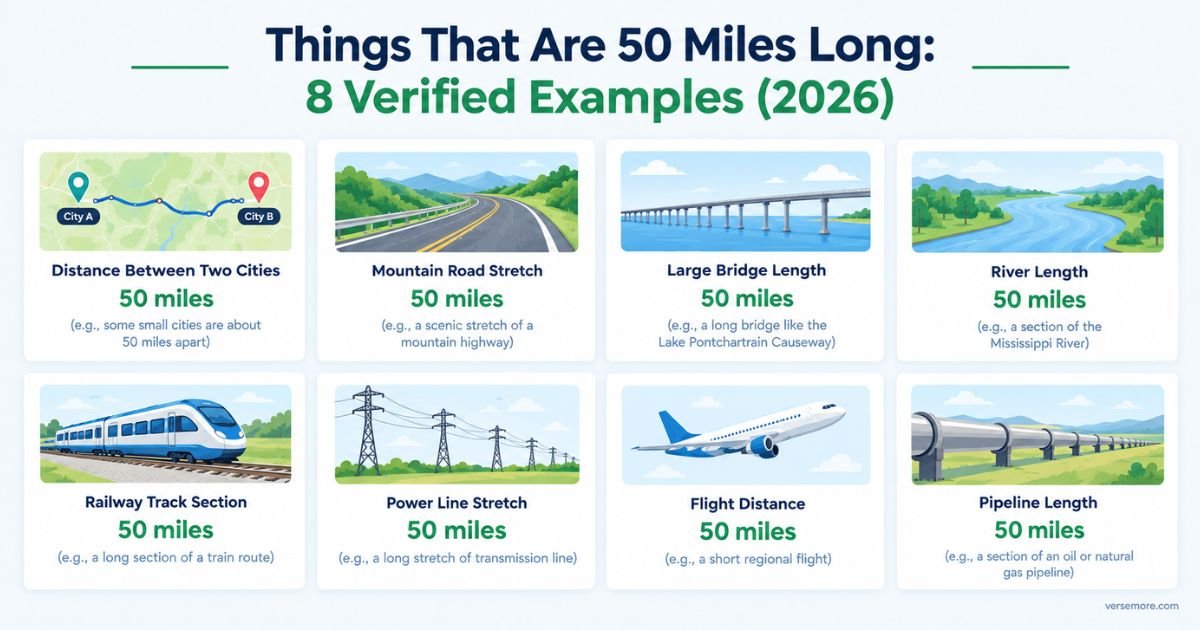
Fifty miles sounds precise and feels vague. It is longer than most commutes, shorter than most road trips, and hard to picture without something familiar beside it.
This guide covers things that are 50 miles long, from a canal that joins two oceans to an island off the Scottish coast. Each figure is checked against its source rather than rounded into a tidy claim. Some land almost exactly on 50, and others miss by several miles, so you’ll see which is which.
You’ll also get unit conversions, travel times and a few scale comparisons that make the distance easier to hold in your head.
50 miles equals 80.47 kilometers, 264,000 feet or 88,000 yards, and the Panama Canal, Going-to-the-Sun Road and the Isle of Skye all come close to that length.
Key Takeaways
• One mile is defined as exactly 1,609.344 meters, so 50 miles is exactly 80.4672 kilometers.
• The Panama Canal measures about 50 miles from deep water to deep water, but only about 40 miles from shoreline to shoreline. Which figure you see depends on how it was measured.
• Going-to-the-Sun Road is commonly given as about 50 miles, while the National Historic Landmark nomination records 48.7 miles.
• At an ordinary walking pace of 3 mph, 50 miles takes nearly 17 hours before a single rest stop.
How Long Is 50 Miles?
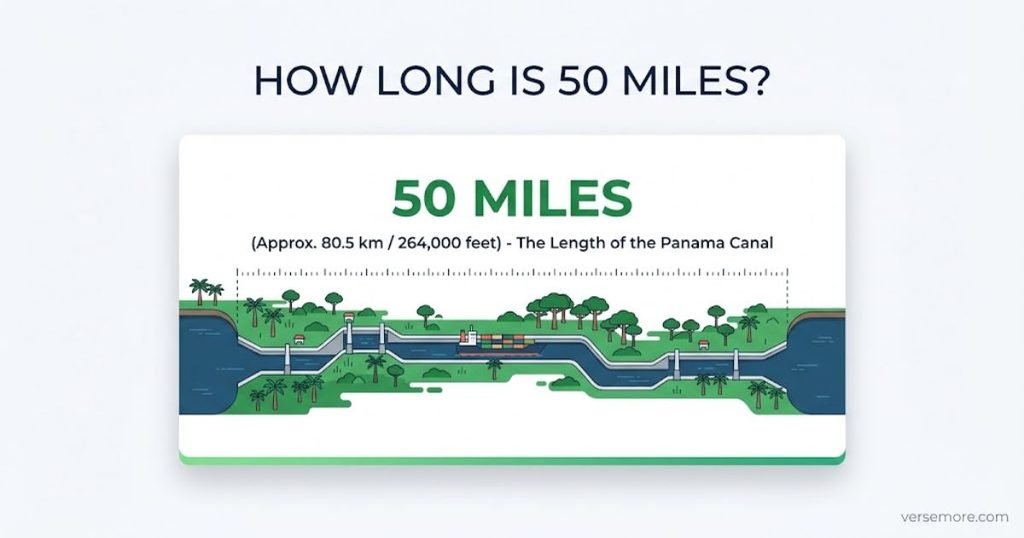
50 miles is 80.47 kilometers (kilometres in UK spelling), or exactly 80,467.2 meters. The reason is simple: the international mile is defined as 1,609.344 meters, so the conversion is fixed and not an approximation.
| Unit | 50 miles equals |
| Kilometers | 80.47 |
| Meters | 80,467 |
| Feet | 264,000 |
| Yards | 88,000 |
| Nautical miles | 43.45 |
For quick mental math, remember that 5 miles is about 8 kilometers. Multiply 50 by 1.6 and you land on 80, which is close enough for planning a trip.
Two mix-ups are worth avoiding:
• Distance versus speed. 50 miles is a distance of about 80 kilometers. Driving at 50 mph means about 80 km/h. Some online pages blur the two, but the units measure different things.
• Statute versus nautical miles. A nautical mile is 1,852 meters, so 50 nautical miles is about 92.6 kilometers, noticeably farther than 50 statute miles. Unless a source says otherwise, “50 miles” on land almost always means statute miles.
Regional habits matter too. UK road signs use miles, so a British reader will meet “50 miles” on the road. Most of continental Europe uses kilometers, so the same journey shows up as roughly 80 kilometers on a sign.
With the numbers settled, the more interesting question is what actually measures out to about 50 miles in the real world.
Things That Are About 50 Miles Long
The clearest things that are 50 miles long are the Panama Canal, Going-to-the-Sun Road in Montana and the Isle of Skye in Scotland. Lake Balaton, London’s Central line and the London to Brighton ride sit within a few miles either side.
Very little measures exactly 50 miles, so each example gets a grade on what I’m calling the 50-Mile Accuracy Scale. Spot on means within 2 miles of 50, near miss means 2 to 5 miles off, and loose means more than 5. The gap is measured against the figure the source gives, not a rounded version.
| Example | Where | Measured length | Gap from 50 miles | Accuracy grade |
| Panama Canal | Panama | About 50 miles deep water to deep water; about 40 miles shoreline to shoreline | 0 (or −10 by shoreline) | Spot on / loose, depending on method |
| Going-to-the-Sun Road | Montana, USA | About 50 miles; 48.7 miles in the landmark nomination | 0 to −1.3 | Spot on |
| Isle of Skye | Scotland | Around 50 miles long, 25 miles at its widest | About 0 | Spot on |
| Lake Balaton | Hungary | 78 km (48 miles) maximum length | −2 | Spot on |
| Central line | London, UK | 46 miles (74 km) across 49 stations | −4 | Near miss |
| London to Brighton Bike Ride | England | 54 miles (86.9 km) | +4 | Near miss |
| Edge-of-space line | Vertical | 50 miles (80 km) up, as used by several US agencies | 0 | Spot on |
| 50-mile ultramarathon | Various | Zane Grey course is closer to 55 miles | 0 to +5 | Spot on by name, near miss in practice |
Panama Canal, Panama
The Panama Canal is the textbook answer, but the number depends on where you start counting. Britannica gives about 50 miles (82 km) from deep water in the Caribbean to deep water in the Pacific, and only about 40 miles (65 km) from shoreline to shoreline. A marine services firm attributes the extra ten miles to dredged approach channels that reach out to sea. Wikipedia rounds the other way, listing 82 km, or 51 miles.
Ships don’t sail a straight line either. Vessels are lifted 85 feet through three locks into Gatún Lake, follow about 23 miles of lake channel, and take 8 to 10 hours on average to transit. One oddity is that the Pacific end lies about 25 miles east of the Atlantic end, because the canal runs northwest to southeast across the isthmus.
Going-to-the-Sun Road, Montana
Going-to-the-Sun Road is the best drivable answer in the United States. It’s commonly described as about 50 miles long, spanning Glacier National Park between the east and west entrance stations. The National Historic Landmark nomination records 48.7 miles, measured from just outside the west entrance to Divide Creek in St. Mary. Both figures are honest. They just start and stop in slightly different places.
The road crosses the Continental Divide at Logan Pass, 6,646 feet up, and was built between 1921 and 1932 before its dedication in 1933. The terrain also limits when you can use it, since it’s open only seasonally, with dates that depend on the weather. There is a short spring window when the plowed road is closed to cars and open to hikers and cyclists, and the ride between Lake McDonald Lodge and Rising Sun is 32.5 miles. That is a shorter stretch than the full road.
Isle of Skye, Scotland
Skye is 50 miles long the way most islands are, which is roughly and along the longest axis. It measures around 50 miles from end to end and about 25 miles across at its widest. With an area of 639 square miles, it’s the second-largest island in Scotland after Harris and Lewis. Its name is traced to an Old Norse word for cloud island.
Walkers can follow the Skye Trail, a long-distance route that runs south to north along the island’s longest length while visiting both the east and west coasts and crossing mountain and moorland. That winding route is a different measurement from the island’s end-to-end length.
Lake Balaton, Hungary
Lake Balaton, the largest lake in Central Europe, comes up just short of 50 miles. Its maximum length is 78 km (48 miles) and its maximum width is 14 km (8.7 miles), yet the average depth is only about 3.3 meters. It is long, wide and very shallow.
The shoreline gives a different answer. It’s listed at about 235 km (146 miles), with a note that shore length is not a well-defined measure. The more crinkled an edge is, the more the answer depends on how closely you trace it. The lake also pinches in the middle, where the Tihany Peninsula narrows the water to roughly 1.5 km.
London Underground’s Central Line
At 46 miles, the Central line is a near miss, though it’s the London answer people reach for first. It serves 49 stations over 46 miles (74 km), making it the longest line on the Tube, with western ends at West Ruislip or Ealing Broadway and north-eastern ends at Epping or Woodford via Hainault.
The catch is that 46 miles counts every branch, so no single train covers it. An older TfL statement puts the longest journey without changing, from West Ruislip to Epping, at 34.1 miles. Another source gives 37 miles, so that figure varies by source.
The London to Brighton Bike Ride Route
Cyclists know 50 miles as the number on the odometer at the worst possible moment. On the British Heart Foundation’s ride, the 54-mile route from Clapham Common to Madeira Drive in Brighton reaches Ditchling Beacon after roughly 50 miles. The climb is over a mile long with an average grade above 1 in 10.
The organizer lists the route as 54 miles or 86.9 km, mostly on closed roads, with staggered start times between 6:00 and 9:00 a.m. Figures for the same ride drift a little. One charity partner listed 53.45 miles for its 2024 entry. A former ultramarathon on the same corridor, from Westminster Bridge to The Level in Brighton, was 54 miles 198 yards.
Fifty Miles Straight Up: Where the US Says Space Begins
This one is a line pointing at the sky instead of a road or a lake. The FAA, US Air Force, NOAA and NASA generally use 50 miles (80 km) as the boundary of space, and the Air Force grants astronaut wings to pilots who fly higher. The international body FAI uses 100 km, or 62 miles.
The 50-mile idea dates back to NASA’s predecessor, the NACA, and was used to award wings starting with X-15 rocket-plane pilots in the 1960s. Three X-15 pilots who had flown between 90 and 108 km were awarded their wings retroactively. For scale, the International Space Station orbits at an average of about 240 miles, so 50 miles up is about a fifth of the way there.
The 50-Mile Ultramarathon
Fifty miles is a recognized race distance in its own right, and ultramarathon runners often enter 50-mile events. The label and the odometer don’t always agree, though.
The Zane Grey Highline Trail 50 Mile Run in Arizona shows how far apart they can be. Its actual distance is closer to 55 miles, with over 10,000 feet (3,048 m) of cumulative climbing. Only 6 of the 17 runners who signed up for the first race in 1990 finished. The course records are 7:30:42 for men, set by Charlie Ware in 2018, and 8:52:41 for women, set by Sandi Nypaver in 2025. So a “50-mile” race may be spot on in its name and a near miss in practice.
Why “About 50 Miles” Isn’t Always 50 Miles
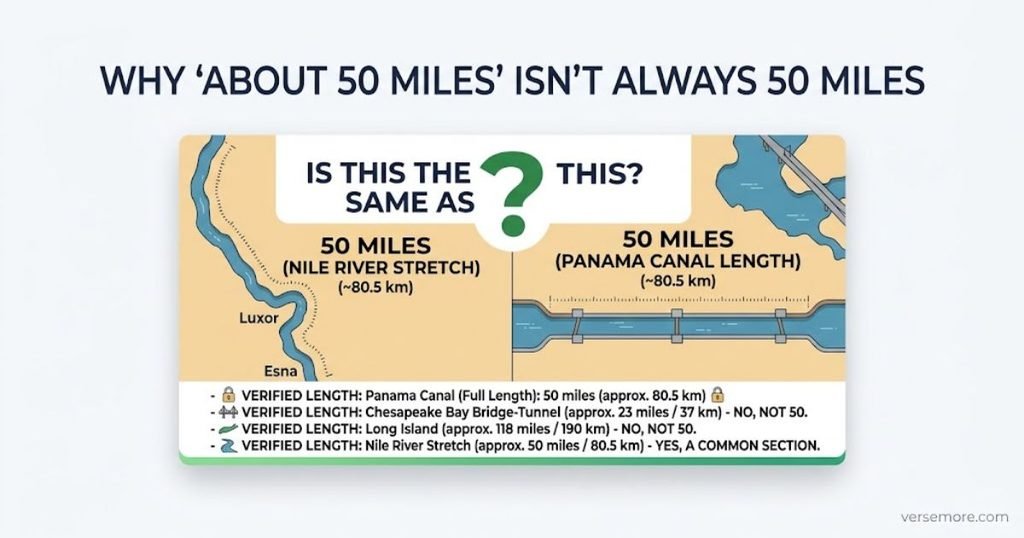
When two reliable sources disagree by a few miles, they have usually measured different things, and neither is wrong. The Which-50 Check is four questions that explain most of these gaps. It also sits behind the accuracy grades in the table above.
1. What path is being measured? A straight line, a road and a trail are three different distances. A road can never be shorter than the straight line between its ends, and winding mountain or coastal roads can run well beyond it. The Skye Trail wanders across the island, so it isn’t the same measurement as the island’s end-to-end length.
2. Where does it start and stop, and what counts? Going-to-the-Sun Road changes with its end points. The Panama Canal changes with whether you include the dredged sea channels. The Central line’s total changes with whether you count every branch.
3. Who set the number? A survey, a tourist board and a race organizer have different aims. An event called “50 Mile” may keep the name even when the course runs longer, as the Zane Grey run shows.
4. Is it a length, a radius or a diameter? A 50-mile circle covers very different amounts of ground depending on which one is meant, as the radius section below shows.
If two reputable sources differ by more than a couple of miles, look for the question above that they answered differently before deciding which one is wrong.
How Long Does It Take to Cover 50 Miles?
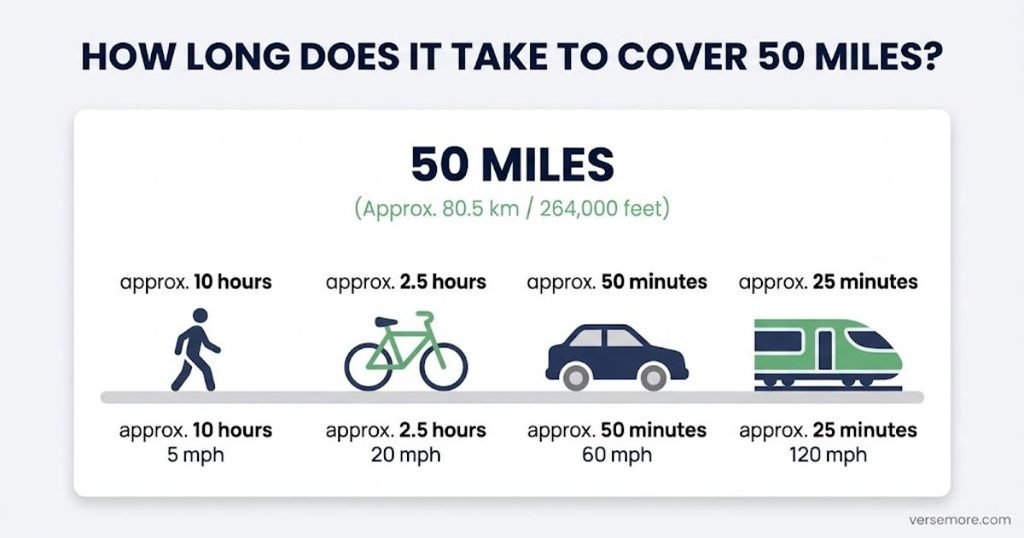
At highway speed a car covers 50 miles in roughly 45 minutes to an hour, a cyclist needs about 3 to 4 hours, and a walker needs around 17. Every time below is distance divided by speed, with no stops.
| Mode | Assumed speed | Time for 50 miles |
| Walking | 3 mph | 16 h 40 min |
| Running | 12-minute miles / 10-minute miles | 10 h / 8 h 20 min |
| Cycling | 12–15 mph | 4 h 10 min – 3 h 20 min |
| Driving, city traffic | 30 mph | 1 h 40 min |
| Driving, open road | 50–60 mph | 1 h – 50 min |
| Driving, fast highway | 70 mph | 43 min |
| Regional train | 60 mph | 50 min |
| High-speed train | 150 mph | 20 min |
| Airliner at cruise (flight only) | 500 mph | 6 min |
How Speed Limits Change the Drive
The driving row depends heavily on where you are. On US interstates with limits of 70 to 75 mph, 50 miles takes about 40 to 43 minutes, and on 55 to 65 mph highways about 46 to 54 minutes. British motorways are limited to 70 mph, just under 113 km/h, which lands you at the same 43 minutes.
Much of continental Europe is faster. France and many other countries post 130 km/h motorway limits, which is about 81 mph and turns 50 miles into roughly 37 minutes. Germany has no general limit on some autobahn stretches and recommends 130 km/h. These are best cases. A single slow town section or a traffic jam will erase them, so “one hour” is a motorway answer, not a door-to-door one.
Why Walking 50 Miles Takes Longer Than the Math Suggests
The 16 h 40 min figure is a baseline, and real walks vary widely. One UK hillwalking forum thread gives a rough sense of the range, though it is anecdote and not data. A poster there reports 48.1 miles of mixed path and road in Jersey taking 15 hours, and a 50-mile navigation event over muddy Oxfordshire farmland taking just over 24 hours. The same thread names blisters as the usual thing that stops an average-fit walker, and warns that anyone still going after 1 a.m. tends to fall asleep on their feet.
The takeaway is that terrain, weather and navigation can move a finish time by many hours. If you’re comparing this with your own plans, our guide to how long it takes to walk 50 miles goes deeper on pacing.
What Does 50 Miles Look Like? Scale Comparisons
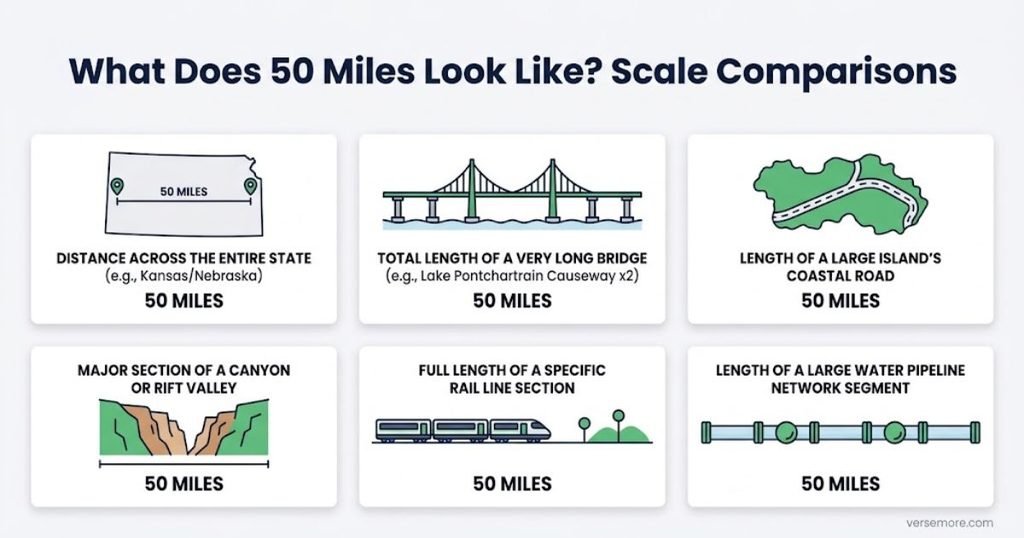
50 miles is just under two marathons, about 880 American football fields end to end, or around nine Mount Everests stacked on top of each other.
| Comparison | Length used | Fits into 50 miles |
| Marathons | 26.2 miles (42.195 km) | 1.9 |
| American football fields | 100 yards (120 with end zones) | 880 (733 with end zones) |
| Soccer pitches | 105 m | about 766 |
| 400 m track laps | 400 m | about 201 |
| Kentucky Derby runs | 1.25 miles | 40 |
| Mount Everests, stacked | 8,849 m | about 9 |
The marathon comparison is the one runners feel most, and if you want the full breakdown, see how long a marathon is.
How High Would You Need to Stand to See 50 Miles?
This is my own calculation, so treat it as a worked example and not as sourced data. The standard geometric rule is the distance to the horizon in miles is about 1.22 times the square root of your height in feet. With your eyes 6 feet up, that gives about 3 miles. The rule ignores haze and refraction. Allowing for typical refraction raises the multiplier to about 1.32.
• Seeing the ground 50 miles away needs eyes at roughly 1,680 feet with the plain rule, or about 1,435 feet with refraction. So the range is roughly 1,400 to 1,700 feet.
• From a beach with eyes at 6 feet, a target must rise about 1,480 feet above the water to be visible 50 miles away, because the two horizons add together.
• Two towers of equal height could see each other across 50 miles if each stood about 420 feet tall.
• From an airliner cruising at 35,000 feet, the horizon is about 228 miles away, so 50 miles sits comfortably inside it.
This is why a 50-mile view is a mountain-top or aircraft experience and not a ground-level one.
Is 50 Miles a Long Way? Commutes, Day Trips and the 50-Mile Radius
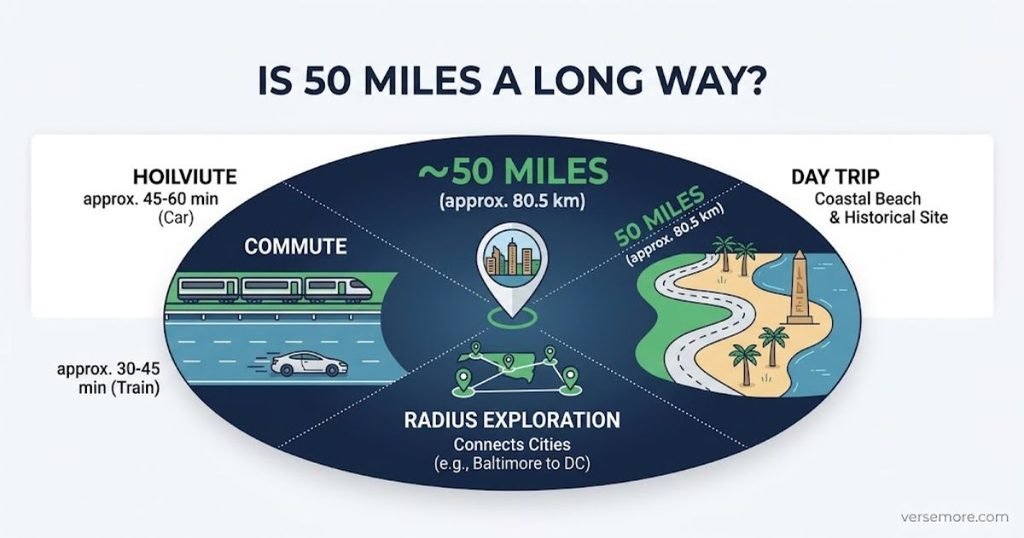
It depends on how you travel. 50 miles is a long daily commute, an easy day trip and a serious effort on foot. A 25-mile drive each way adds up to 50 miles a day, and at 60 mph that is about 50 minutes each way, or just under 1 hour 40 minutes behind the wheel daily. The same distance is a comfortable outing once a week, which is why people describe it as both “far” and “nothing.”
What Is a 50-Mile Radius?
A 50-mile radius is a circle 100 miles across that covers about 7,854 square miles (roughly 20,340 km²). That is the area formula, π × 50².
Radius and diameter are easy to confuse, and the gap is large. A circle with a 50-mile diameter covers only a quarter of that area, about 1,963 square miles. For scale, the Isle of Skye covers 639 square miles and Lake Balaton covers about 230 square miles. A 50-mile radius is roughly 12 times the size of Skye and 34 times the size of Balaton.
This matters for “within 50 miles” searches such as delivery zones, job listings and service areas. The radius is measured in a straight line, so the drive to the edge is usually longer than 50 miles, and the gap grows where roads wind or rivers and coasts force detours.
Nearby Distances: 25, 62 and 100 Miles
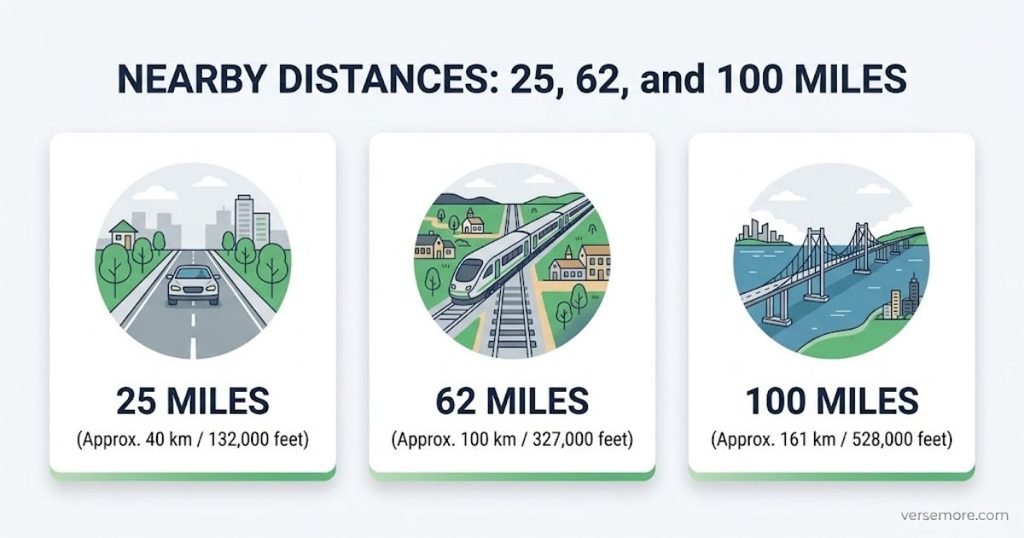
Knowing the neighbors makes 50 miles easier to place. If you’re converting between units often, a miles to kilometers converter saves the arithmetic.
| Distance | Kilometers | Useful anchor |
| 25 miles | 40.2 | Half of 50; also one leg of a 50-mile daily commute. See how long 25 miles is. |
| 31 miles | 50 | Not the same as 50 miles. 50 km is only about 62% of the distance. |
| 62 miles | 100 | The Kármán line used by the international body FAI, about 12 miles higher than the 50-mile US boundary. |
| 100 miles | 160.9 | Twice as far. Compare things that are 100 miles long. |
Distances measured in feet are a different world. 50 feet is less than one hundredth of a mile, so a page on things that are 50 feet long covers a completely different set of objects.
FAQ’s
How long is 50 miles in kilometers?
50 miles is 80.47 kilometers (exactly 80.4672 km, since one mile is defined as 1,609.344 meters). A quick check is that 5 miles is about 8 kilometers, so 50 miles is about 80. In nautical miles, the figure is 43.45.
What is exactly 50 miles long?
Almost nothing is exactly 50 miles, but a few things come very close. The Panama Canal is about 50 miles (82 km) from deep water to deep water, Going-to-the-Sun Road is approximately 50 miles long, and the Isle of Skye is approximately 50 miles long at its longest. Each figure depends on how and where it is measured.
Is the Panama Canal 50 miles long?
Yes, if you measure from deep water in the Caribbean to deep water in the Pacific. Measured from shoreline to shoreline, the canal is only about 40 miles (65 km). Most sources quote the longer deep-water figure.
How long does it take to walk 50 miles?
At a steady 3 mph, 50 miles takes about 16 hours 40 minutes without stops. Real walks vary a lot. One forum thread reports 48.1 miles in 15 hours on mixed path and road, and a 50-mile navigation event taking just over 24 hours, so terrain and conditions matter as much as pace.
How long does it take to drive 50 miles?
It takes about 43 minutes at 70 mph, 50 minutes at 60 mph and a full hour at 50 mph. On a 130 km/h European motorway (about 81 mph), it’s roughly 37 minutes. In city traffic at 30 mph, it stretches to 1 hour 40 minutes.
How many marathons is 50 miles?
50 miles is about 1.9 marathons, since a marathon is 26.2 miles. That leaves it roughly 2.4 miles short of two full marathons. It’s also the reason 50-mile events are the classic first step into ultrarunning.
Is 50 miles far?
For a daily commute, yes, because it means roughly 1 hour 40 minutes of driving a day at 60 mph. For a day trip or a weekend outing, most people treat it as easy. On foot it’s a serious challenge, and by bike it takes an experienced rider about 3 to 4 hours.
How high is 50 miles up, and is it space?
The FAA, US Air Force, NOAA and NASA generally use 50 miles (80 km) as the boundary of space, with the Air Force granting astronaut wings to pilots who fly higher. The international body FAI places the line at 100 km, or 62 miles. There is no single physical boundary, so both conventions are in use.
How big is a 50-mile radius?
A 50-mile radius is a circle 100 miles across covering about 7,854 square miles (roughly 20,340 km²). A circle with a 50-mile diameter covers only about 1,963 square miles, a quarter of that. Because the radius is a straight-line measure, the actual drive to the edge is usually longer than 50 miles.
Conclusion
The things that are 50 miles long turn out to be a mixed group. The Panama Canal, Going-to-the-Sun Road and the Isle of Skye come close to the mark, while Lake Balaton, London’s Central line and the London to Brighton ride miss by a few miles in either direction. What separates them is less the number itself than what was measured and how.
Remembering 80.47 kilometers gets you through most conversions, and the Which-50 Check helps when two sources disagree about a length. Whether you’re planning a drive, a ride or a long walk, 50 miles is a distance worth reading carefully before you trust the round figure.

I am the admin of VerseMore, sharing helpful, informative, and engaging content on various topics to inspire readers, provide value, and make everyday life easier.