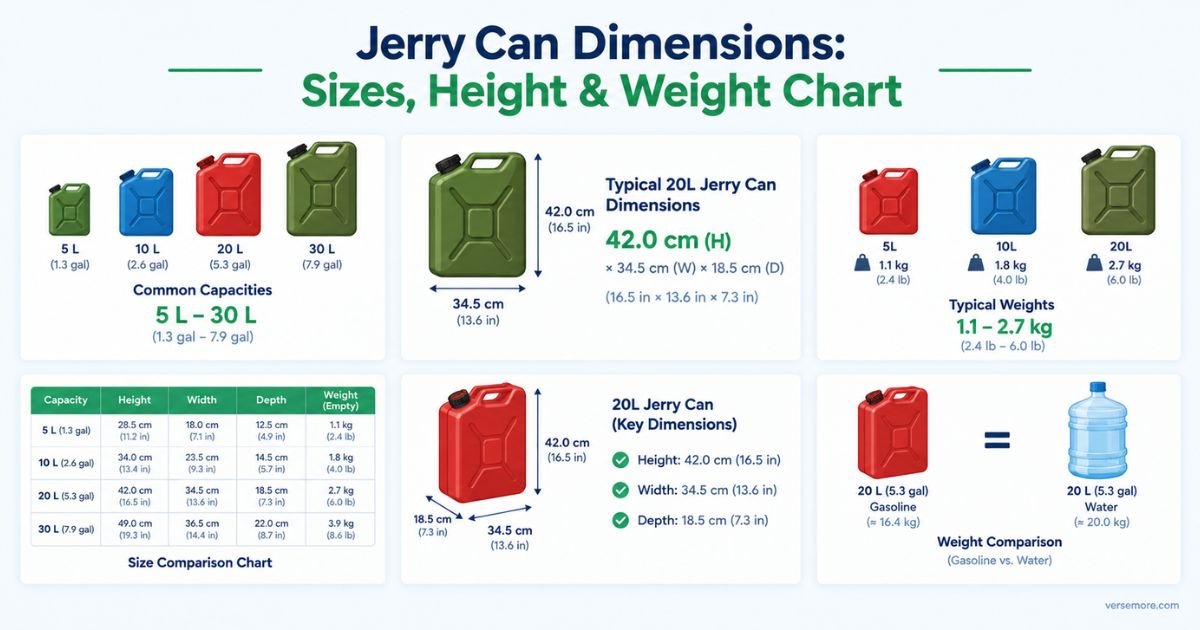
If you’ve ever tried to fit a jerry can into a truck bed cutout, a shelf built for “standard” containers, or a vehicle-mounted holder, you’ve probably discovered that “standard” doesn’t mean quite what you’d expect. Military-spec cans, commercial fuel cans, and modern plastic versions all carry slightly different numbers under the same name.
A standard 20-liter (5-gallon) jerry can measures 17.75 inches tall, 13.5 inches long, and 6.5 inches wide — the NATO military specification that most other sizes are measured against.
Commercial plastic versions sold in the US often run an inch or two taller due to EPA-mandated spill-proof spouts added after 2009, which is where a lot of the confusion online comes from.
This guide breaks down exact dimensions for every common jerry can size, explains why the numbers shift between military and commercial versions, and covers weight, materials, and whether a given size will actually fit your space.
How Big Is a Standard Jerry Can?
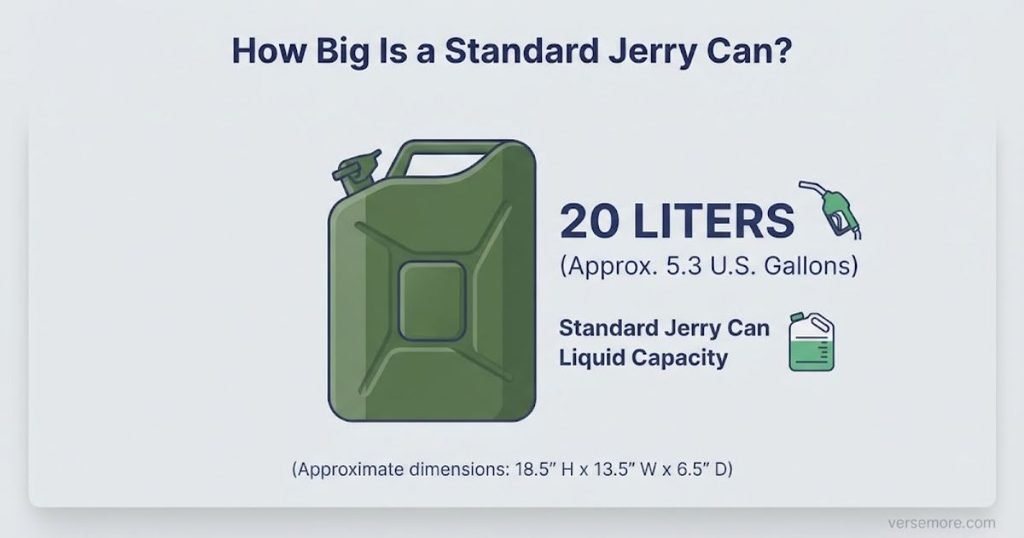
A standard jerry can holds 20 liters (5.3 gallons) and measures 17.75 inches (450mm) tall, 13.5 inches (345mm) long, and 6.5 inches (165mm) wide. This is the NATO military specification, developed from the WWII-era German Wehrmachtskanister design, and it remains the reference point that every other jerry can size is compared against — whether it’s steel, aluminum, or plastic.
Two things make this “standard” less simple than it sounds:
● Military-spec cans stick to exact numbers. Genuine NATO/mil-spec steel cans are built to 17.75″ × 13.5″ × 6.5″ without much variation, since the design is a fixed manufacturing standard.
● Commercial cans vary by brand and country. A plastic 5-gallon can sold at a US hardware store might measure 18 to 19 inches tall once you include a modern EPA-compliant spout and cap assembly — taller than mil-spec, even though it holds the same volume.
So when a source lists “17–19 inches,” they’re usually blending both categories rather than being imprecise. The chart below separates sizes clearly, and the section after it breaks down military vs. commercial specs in more detail.
Jerry Can Dimensions by Size (Chart)
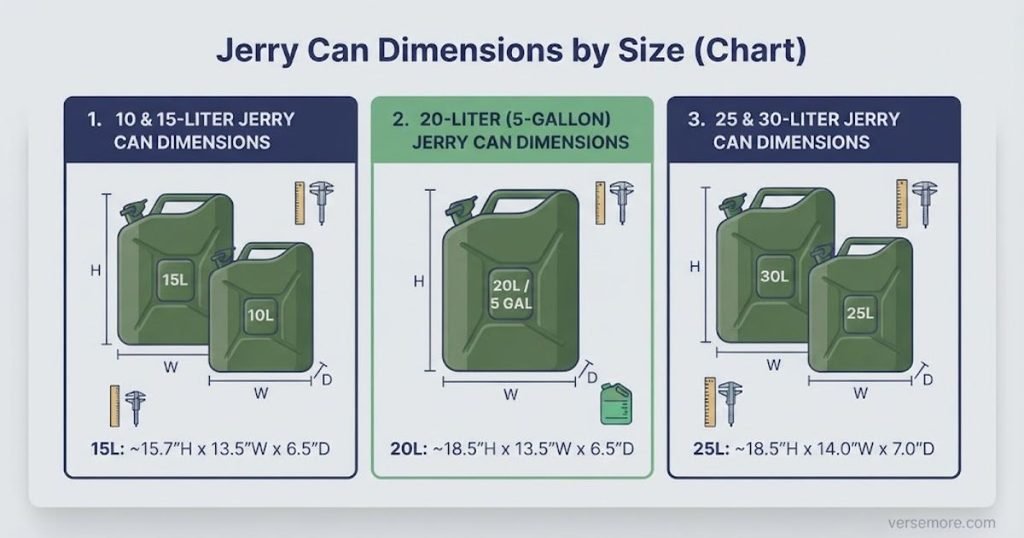
Jerry can capacity and external size scale together, but not in a straight line — extra liters often add more to height than to footprint, since manufacturers keep the same stackable base for shelf and vehicle compatibility. Here’s how the most common sizes compare:
| Capacity | Height | Length | Width | Empty Weight (steel) |
| 5 L (1.3 gal) | 10–12 in (25–30 cm) | 8–9 in (20–23 cm) | 4–5 in (10–13 cm) | 1–1.5 lbs |
| 10 L (2.6 gal) | 14–16 in (36–41 cm) | 10–11 in (25–28 cm) | 5–6 in (13–15 cm) | ~2.5 lbs |
| 15 L (4 gal) | 16–17 in (41–43 cm) | 10–11 in (25–28 cm) | 5–6 in (13–15 cm) | ~3 lbs |
| 20 L (5.3 gal) | 17.75–19 in (45–48 cm) | 13.5–14 in (34–36 cm) | 6.5–7 in (17–18 cm) | 6–8 lbs |
| 25 L (6.6 gal) | 18–20 in (46–51 cm) | 14–16 in (36–41 cm) | 7–8 in (18–20 cm) | 8–10 lbs |
| 30 L (7.9 gal) | 19–21 in (48–53 cm) | 15–17 in (38–43 cm) | 7–8 in (18–20 cm) | 10–12 lbs |
Ranges reflect real variation between manufacturers and materials rather than imprecision — treat the 20L NATO figures (17.75 × 13.5 × 6.5 in) as the one fixed reference point, and everything else as “close to” rather than exact.
5-Liter Jerry Can Dimensions
The 5L can is the smallest common size, standing roughly 10 to 12 inches tall with an 8 to 9-inch length and a 4 to 5-inch width. Empty weight lands around 1 to 1.5 pounds, which is light enough that it’s rarely the limiting factor — volume is. This size is built for topping off rather than sustained supply: motorcycle panniers, backpacks, ATV racks, and glovebox or under-seat storage in a car are its typical homes. It’s the size most people reach for as an emergency splash of fuel to get to the next station, not a primary reserve.
10 & 15-Liter Jerry Can Dimensions
Step up to 10L and the can grows to 14–16 inches tall with a 10–11-inch length and 5–6-inch width, weighing around 2.5 pounds empty. The 15L version barely changes the footprint — still 10–11 inches long and 5–6 inches wide — but adds an inch or so of height to squeeze in 50% more volume than the 10L can. That’s a useful data point on its own: at this size range, manufacturers are stretching the can vertically rather than widening the base, which keeps it compatible with the same racks and holders across both capacities. These sizes are common for agricultural chemicals, small-engine fuel, and fieldwork where a full 20L can is more weight than the job needs.
20-Liter (5-Gallon) Jerry Can Dimensions
This is the size most people mean when they say “jerry can.” The military specification is exact: 17.75 inches tall, 13.5 inches long, 6.5 inches wide. Commercial plastic versions sold in the US typically run 18 to 19 inches tall because of the spill-proof spout and cap hardware added after 2009 EPA rules — same footprint, taller profile. Some manufacturers also sell a narrower “slim” 20L variant (5.5–6 inches wide, 18.5–19 inches tall) specifically so it clears the frame rails on Jeeps and overlanding rigs where the standard 6.5-inch width won’t fit. Same 20 liters, different shape, for a different mounting problem.
25 & 30-Liter Jerry Can Dimensions
Beyond 20L, jerry cans move from personal/vehicle use toward stationary and bulk storage. A 25L can measures roughly 18–20 inches tall, 14–16 inches long, and 7–8 inches wide, while a 30L can reaches 19–21 inches tall with a 15–17-inch length at a similar 7–8-inch width. The size increase looks modest on paper, but the practical difference is weight, not dimensions — a filled 25L can already exceeds 55 pounds, which is where these sizes shift from “carry it” to “roll it or leave it in place.”
NATO Military Spec vs. Commercial Jerry Can Dimensions
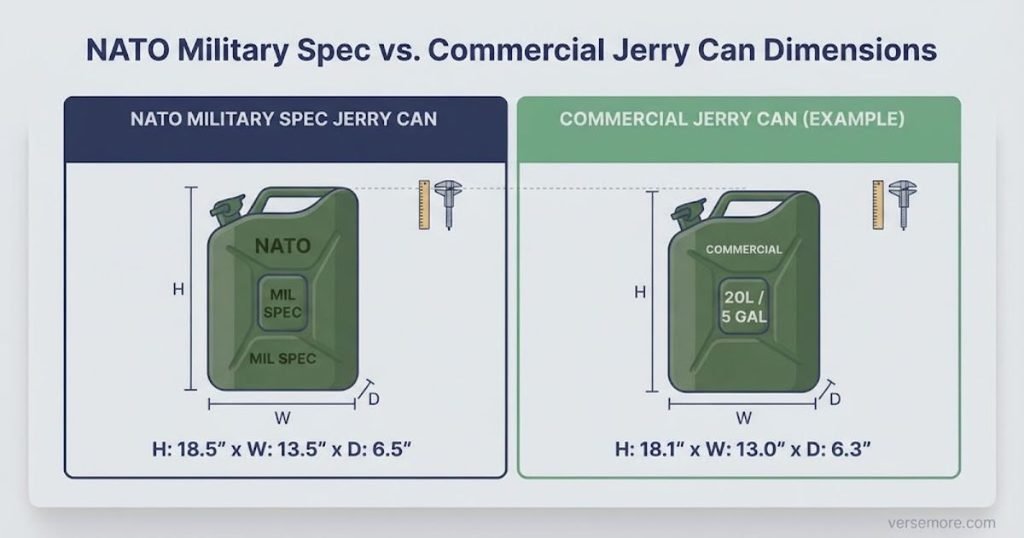
This is where most jerry can guides blur two genuinely different products together, and it’s worth separating them plainly:
| NATO/Military Spec | Commercial (US retail) | |
| Height (20L) | 17.75 in (450mm) exactly | 18–19 in |
| Length | 13.5 in (345mm) exactly | 13.5–14 in |
| Width | 6.5 in (165mm) exactly | 6.5–7 in |
| Material | Steel (0.8mm typical) | HDPE plastic, some steel/aluminum |
| Cap/spout | Simple screw cap, no shutoff | Child-resistant cap, automatic shutoff, vapor-control spout |
| US road-fuel legal? | Not DOT/EPA/CARB compliant on its own | Yes, when certified |
The military can’s dimensions are fixed because they’re a manufacturing standard tied to interoperability — a can made in one country needs to fit racks, mounts, and transport crates designed for the same spec everywhere else. Commercial cans have no such constraint; each brand designs around EPA and CARB requirements first and dimensions second, which is why “5-gallon jerry can” height varies by an inch or more between brands even though the volume is identical. If you’re comparing a can you own against numbers you found online, check which category the source is describing — a mil-spec figure and a retail-shelf figure are both correct, just for different products.
Jerry Can Weight: Empty vs. Full
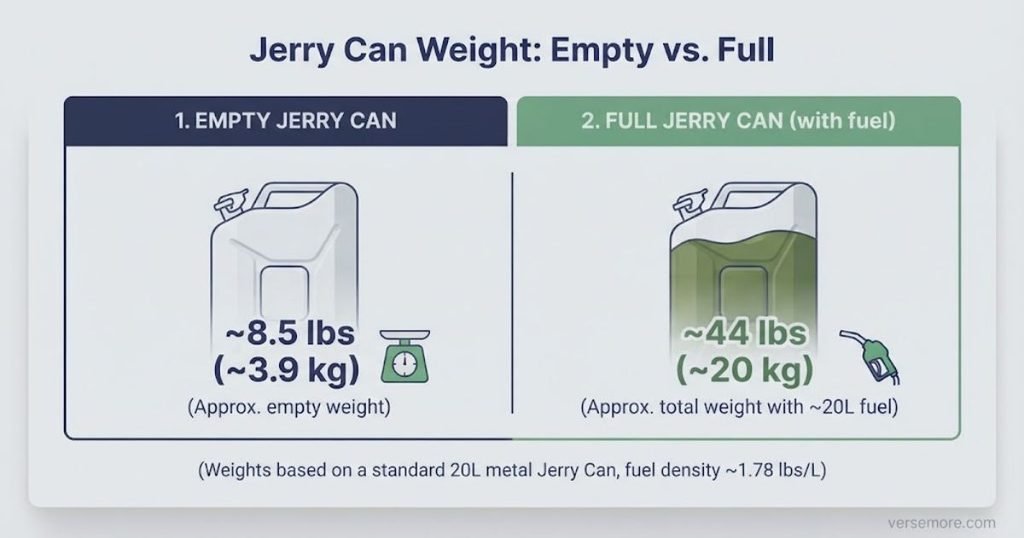
External size only tells half the story — the number that actually determines whether you can lift, carry, or stack a jerry can is filled weight, and it depends heavily on what’s inside it. Water weighs about 2.2 lbs per liter, gasoline around 1.6 lbs per liter, and diesel roughly 1.85 lbs per liter — different enough that the same can feels noticeably different depending on contents.
| Capacity | Empty (steel) | Filled: Water | Filled: Gasoline | Filled: Diesel |
| 5 L | 1.5 lbs | 12.5 lbs | 9.5 lbs | 10.75 lbs |
| 10 L | 2.5 lbs | 24.5 lbs | 18.5 lbs | 21 lbs |
| 15 L | 3 lbs | 36 lbs | 27 lbs | 31 lbs |
| 20 L | 6–8 lbs | ~51 lbs | ~39 lbs | ~44 lbs |
| 25 L | 8–10 lbs | ~64 lbs | ~49 lbs | ~55 lbs |
| 30 L | 10–12 lbs | ~77 lbs | ~59 lbs | ~66.5 lbs |
A full 20L water can at roughly 51 pounds is genuinely awkward for a lot of people to lift one-handed by the top handle — which is exactly why the original design gave it three handles rather than one, letting it be carried two-handed, passed hand-to-hand along a line, or carried in pairs by a single person (one can per hand). Plastic cans of the same capacity run 2–4 lbs lighter empty than steel, and aluminum sits in between — a real consideration if you’re mounting cans on a vehicle where every pound of unsprung or roof-rack weight matters.
How Jerry Can Dimensions Are Measured
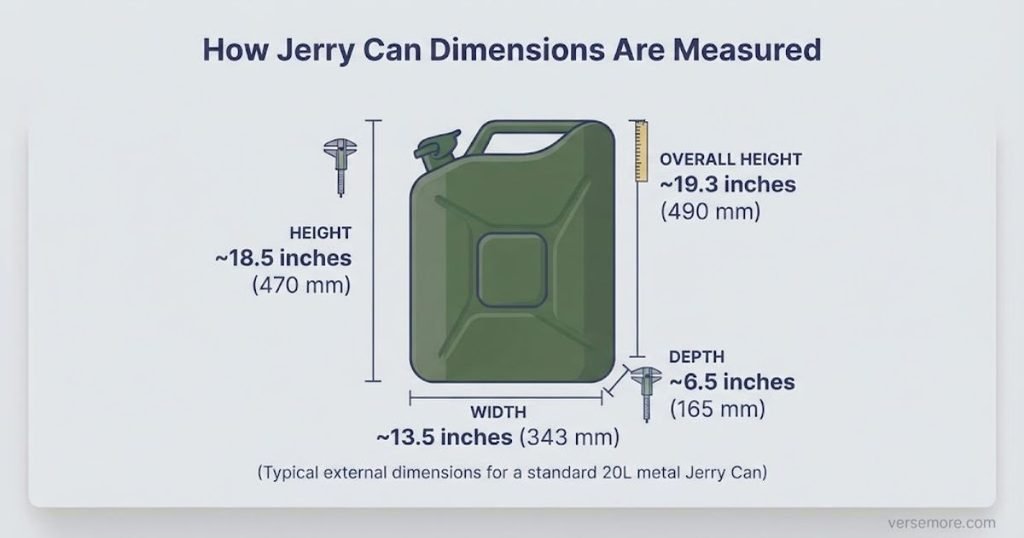
Manufacturers and retailers aren’t always consistent about what counts toward a jerry can’s stated size, which explains some of the discrepancy between sources:
1. Height is measured from the base to the top of the cap assembly — not the body alone. A can with a tall vapor-control cap can measure an inch taller than an identical body with a low-profile cap.
2. Length and width are taken at the container’s widest point, which is usually the ribbed side panels rather than the flat base — the base itself is often slightly narrower to allow cans to nest or stack.
3. Handles and spouts are usually excluded from the headline number but can add 1–2 inches to the real footprint you need to plan for on a shelf or in a vehicle cutout.
If you’re measuring your own can to compare against a spec sheet, measure with any spout or nozzle removed and note whether you’re including the cap — that single choice accounts for a lot of the “17.75 vs. 19 inches” confusion you’ll see across different sources.
Steel vs. Plastic vs. Aluminum: Does Material Change the Size?
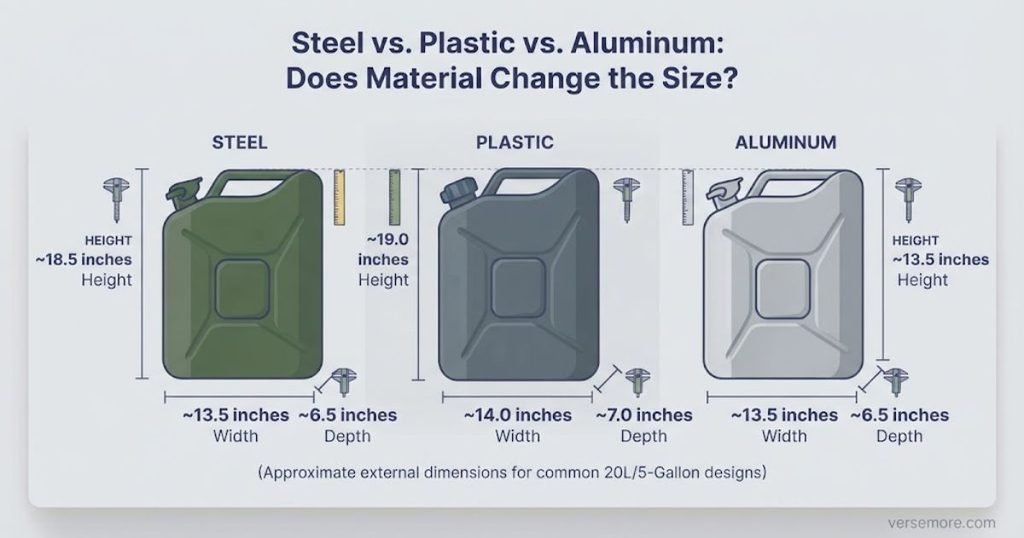
The external footprint stays close to identical across materials at a given capacity — a 20L steel, aluminum, or plastic can is built around the same 13.5 × 6.5-inch base regardless of what it’s made from, since that footprint is what lets them share holders, crates, and shelving. What changes is wall thickness and cap design:
● Steel (typically 0.8mm gauge) holds the tightest, most consistent dimensions to mil-spec and is the heaviest empty at 6–8 lbs for a 20L can.
● Aluminum uses the same external dimensions as steel but drops empty weight to 4–5 lbs, trading some dent resistance for weight savings — common in aviation and motorsport use.
● Plastic (HDPE) cans are usually 1–2 inches taller than mil-spec steel at the same capacity, purely because of bulkier EPA-mandated cap and spout hardware, not because the body itself is bigger. Internal volume can also run slightly under the stated capacity once you account for wall thickness, which is why some plastic “5-gallon” cans are rated for 4.5 gallons usable.
How to Tell If Your Jerry Can Is Genuine NATO Surplus
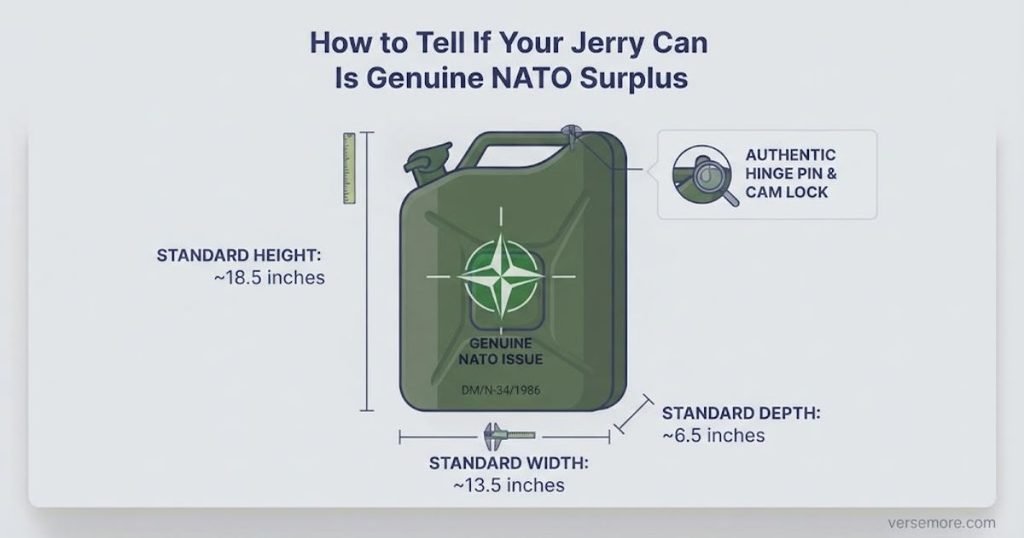
This is a common question among collectors and off-roaders buying secondhand cans, and dimensions alone won’t settle it — a few design details will:
● Three handles, not one. The original design places two handles on top and one lower on the side, specifically so a full can can be carried by two people, passed hand-to-hand, or carried as a pair by one person gripping the top handles of two cans at once. A single-handle can is not mil-spec.
● A lever-cam closure, not screw threads. Genuine military cans open with a short lever arm that locks a cap over a wide spout — no threading required, since threads were considered too slow and too prone to cross-threading in the field. A can with a threaded screw cap is a commercial reproduction, not an original.
● Fluted (ribbed) side panels. The X-shaped indentations on the flat faces aren’t decorative — they let the steel body flex under fuel expansion in heat without splitting a seam, and they add rigidity for stacking. Smooth-sided cans are almost always modern reproductions or non-mil-spec commercial containers.
● Stamped markings. Genuine surplus cans typically carry a manufacturer’s stamp, a date of manufacture, and sometimes a NATO stock number on the body or base — markings a reproduction usually omits or fakes inconsistently (wrong font, wrong placement).
Will a Jerry Can Fit Your Vehicle or Storage Space?
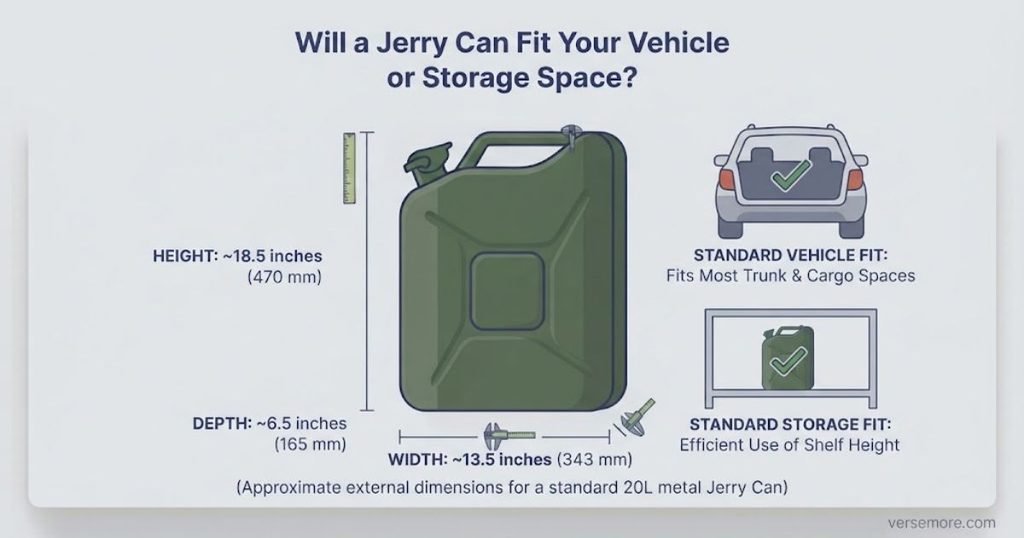
Because most aftermarket jerry can holders and mounts — the kind bolted to a Jeep’s rear tire carrier, a truck bed rack, or an overlanding trailer — are built around the exact NATO 20L footprint (13.5 × 6.5 inches), this is one area where the military-vs-commercial size gap actually matters practically, not just academically. A commercial plastic 5-gallon can that’s an inch wider or taller than mil-spec may not seat properly, or may not latch, in a holder designed for the true military dimensions. Before buying a mount, check whether it’s rated for “NATO/mil-spec” cans specifically or for “standard 5-gallon” cans generally — the two aren’t always interchangeable.
For trunk or cargo-area storage, the practical planning number is the footprint plus handle clearance: budget roughly 15 × 8 inches of floor space per 20L can, and remember that a full can needs to be lifted up and over a trunk lip or tailgate, not just slid — which is where the ~39–51 lb filled weight (depending on contents) becomes the real limiting factor, not the external size.
Why the Jerry Can’s Shape and Size Have Never Really Changed
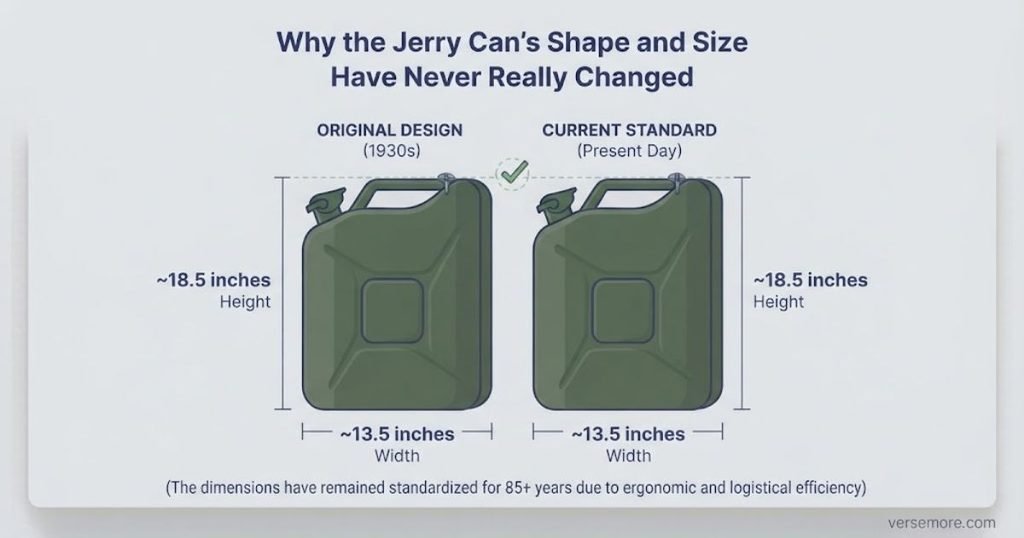
The 20-liter, rectangular, flat-sided design dates to the late 1930s, when German engineers developed it for the Wehrmacht as a container that solved several problems at once: it stacked without wasted space (unlike round drums), it could be carried, poured, and opened quickly without tools, and its capacity was deliberately capped near 20 liters so that a full can stayed within a weight a single soldier could reasonably lift and carry.
Allied forces reverse-engineered and adopted the same design after encountering it during WWII, and it became the NATO standard shortly after — which is why the dimensions have stayed remarkably stable for over 80 years. Modern commercial variations adjust caps and spouts for safety regulation, but no one has seriously redesigned the core footprint, because the original size already balances capacity, stackability, and one-person portability about as well as a rigid container can.
FAQ’s
How many gallons does a jerry can hold?
A standard 20-liter jerry can holds 5.3 gallons. Smaller sizes include the 5L (1.3 gallons) and 10L (2.6 gallons), while larger industrial versions go up to 25L (6.6 gallons) and 30L (7.9 gallons).
What is the standard size of a jerry can?
The standard is the 20-liter NATO military specification, measuring 17.75 inches tall, 13.5 inches long, and 6.5 inches wide. Commercial retail versions of the same capacity often run slightly taller due to modern spill-proof caps.
How tall is a 20-liter jerry can?
A mil-spec steel 20L can stands exactly 17.75 inches tall. Commercial plastic versions typically measure 18 to 19 inches due to EPA-compliant cap and spout hardware.
Why is it called a “jerry” can?
Allied soldiers in WWII nicknamed the German-designed fuel container after “Jerry,” their slang term for German troops, once they began capturing and using the containers themselves.
How much does a full jerry can weigh?
A full 20-liter jerry can weighs roughly 39 lbs with gasoline, 44 lbs with diesel, or 51 lbs with water, plus 6–8 lbs for the empty steel container itself. The exact weight depends on the liquid’s density.
What is the difference between a jerry can and a gas can?
“Jerry can” typically refers to the rectangular, military-derived design, often steel, used for fuel, water, or other liquids. “Gas can” more often refers to modern plastic containers built specifically to US EPA and CARB fuel-dispensing regulations, which include child-resistant caps and automatic shutoff spouts.
Are all jerry cans the same size?
No. While 20 liters is the most common capacity, exact dimensions vary between military-spec, commercial, and international manufacturers — even at the same stated capacity, height can differ by an inch or more depending on cap design.
Can you legally use a NATO jerry can for gasoline on US roads?
Generally no. Genuine mil-spec steel jerry cans typically aren’t certified to US DOT, EPA, or CARB standards for on-road fuel transport, since those standards require specific spouts, vents, and safety features that the original military design doesn’t include. Check current DOT/EPA/CARB requirements in your state before using one for vehicle fuel.
What is a Type 1 vs. Type 2 gas can?
Type 1 refers to pre-2009 designs with a simple spout and manual pour. Type 2 refers to post-2009 EPA-compliant designs with child-resistant closures and automatic shutoff or vapor-control spouts, which typically add 1–2 inches of height compared to Type 1 cans of the same capacity.
Conclusion
The confusion around jerry can dimensions almost always comes down to which product a source is actually describing — the fixed 17.75 × 13.5 × 6.5-inch NATO military specification, or one of the many commercial variants that adjust height and cap design to meet modern safety regulations while keeping the same footprint and capacity.
Once you know which category you’re dealing with, the numbers stop conflicting: pick the mil-spec figures if you’re buying a holder, mount, or genuine surplus can, and expect an inch or two of extra height if you’re buying a modern retail fuel container. Either way, the 80-year-old rectangular design has earned its place as the reference point for a reason — it still stacks, carries, and stores better than most alternatives at the same capacity.

I am the admin of VerseMore, sharing helpful, informative, and engaging content on various topics to inspire readers, provide value, and make everyday life easier.