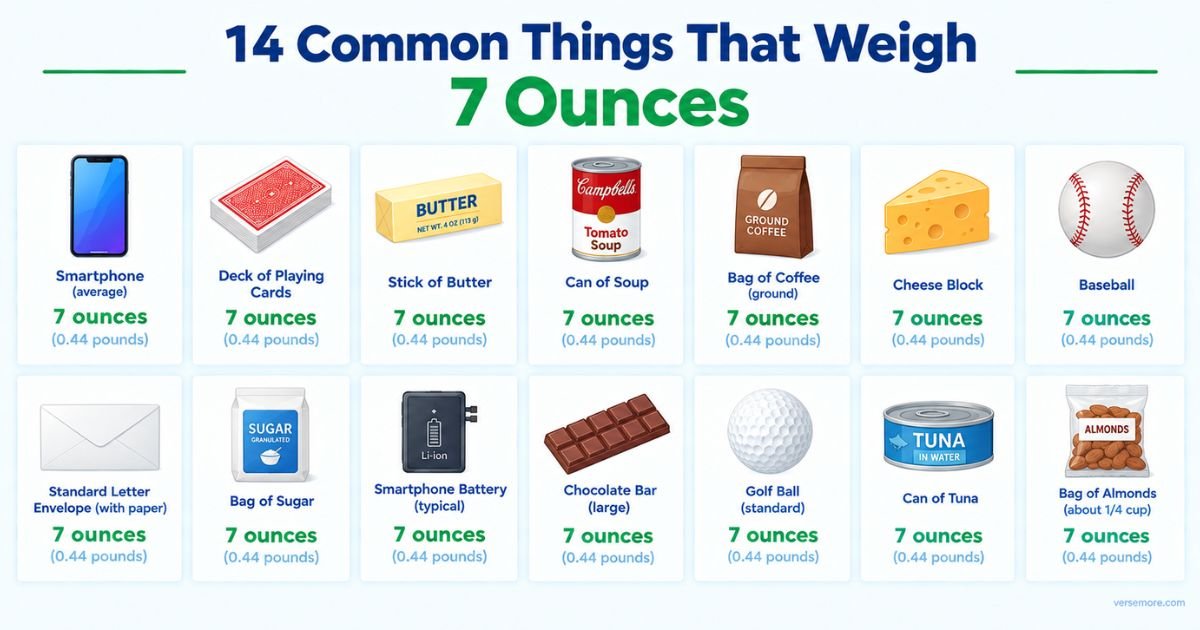
Seven ounces is small enough to carry comfortably but substantial enough to feel noticeable in your hand. The difficulty is that most people do not naturally visualize ounces, especially when they are more familiar with grams or pounds.
So, what does 7 ounces actually look and feel like? The easiest way to understand it is to compare it with familiar foods, household items, coins, money, and everyday objects.
The standard avoirdupois ounce used for ordinary weights equals 28.349523125 grams. That means 7 ounces comes to about 198.45 grams, or 0.4375 pounds.
The examples below focus on objects and quantities that are genuinely close to this target rather than forcing unrelated items into a 7-ounce list.
How Heavy Is 7 Ounces?
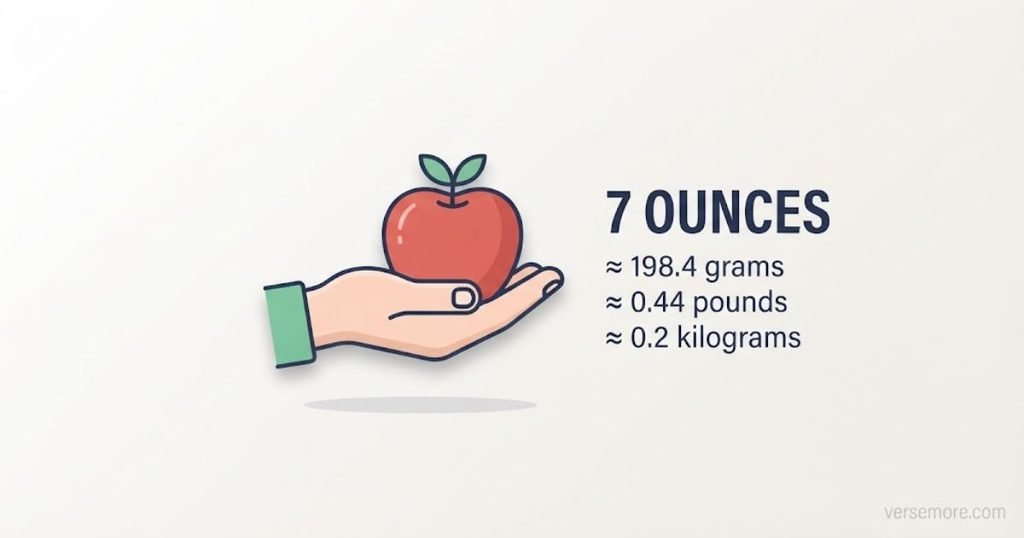
Seven ounces weighs 198.45 grams, or 0.4375 pounds, which is just under half a pound. In everyday terms, it is a light-to-moderate weight that most people can easily hold in one hand.
Seven ounces is also exactly one ounce less than half a pound. Since a standard pound contains 16 ounces, half a pound is 8 ounces.
That makes the relationship easy to remember:
| Weight | Equivalent |
| 7 ounces | 198.45 grams |
| 7 ounces | 0.19845 kilograms |
| 7 ounces | 0.4375 pounds |
| 7 ounces | 198,446.66 milligrams |
| 8 ounces | 0.5 pound |
The gram figure above uses the exact avoirdupois conversion factor and is rounded only at the final step.
7 Ounces in Grams, Pounds, and Kilograms
To convert ounces to grams, multiply by 28.349523125:
7 × 28.349523125 = 198.446661875 grams
For everyday use, you can round this to 198.45 grams or simply about 200 grams.
In pounds:
7 ÷ 16 = 0.4375 pounds
And in kilograms:
198.446661875 ÷ 1,000 = 0.198446661875 kilograms
So if a recipe, package, or product specification says 7 ounces, you can think of it as approximately 200 grams.
What 7 Ounces Feels Like in Your Hand
Seven ounces is not particularly heavy. It is noticeably heavier than a very small lightweight object but far below the weight of a typical one-pound item.
A useful mental reference is a stack of U.S. quarters. A current U.S. circulating quarter weighs 5.670 grams according to the U.S. Mint. Thirty-five quarters therefore weigh about 198.45 grams—almost exactly 7 ounces.
That is an unusually good comparison because the individual coin weight is officially specified rather than estimated.
14 Things That Weigh About 7 Ounces
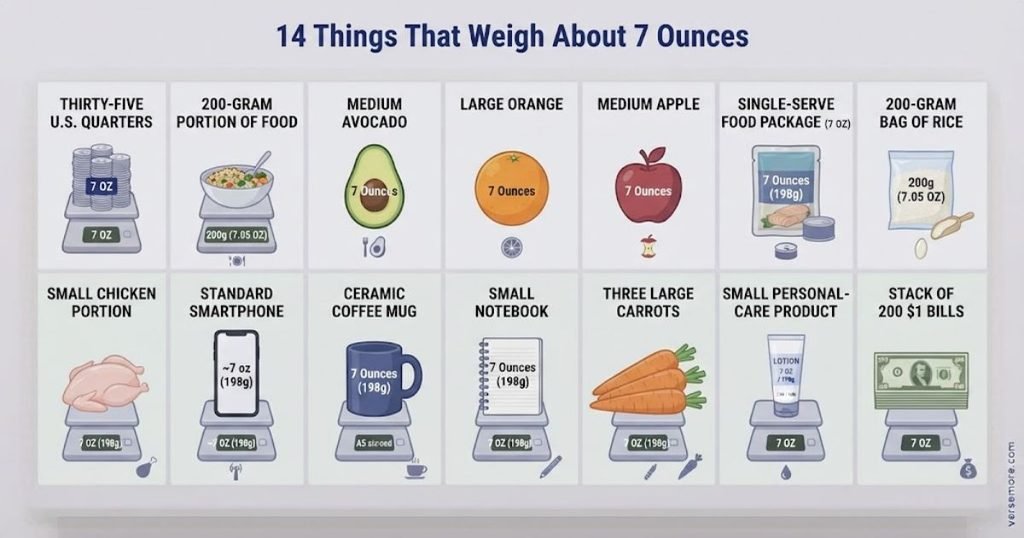
Not every everyday object has a fixed weight. An apple, phone, mug, or potato can vary substantially depending on its size and design.
For that reason, the examples below are divided conceptually into close references and variable everyday examples. When an item’s weight depends on its size or model, it is described as an approximation rather than an exact 7-ounce object.
1. Thirty-Five U.S. Quarters
Thirty-five current U.S. quarters provide one of the most precise everyday comparisons for 7 ounces.
The U.S. Mint lists the weight of a circulating quarter at 5.670 grams. Multiplying that by 35 gives 198.45 grams, which is essentially the same as 7 ounces at normal practical precision.
Weight: about 198.45 g
Equivalent: almost exactly 7 oz
2. A 200-Gram Portion of Food
A measured 200-gram portion of food is extremely close to 7 ounces.
Since 7 ounces equals 198.45 grams, the difference between 200 grams and 7 ounces is only about 1.55 grams. That is less than 1% of the target weight. This is why 200-gram food packages and portions can serve as practical references when you are trying to visualize seven ounces.
The 200 grams is the measured quantity, not the weight of every particular food item.
3. A Medium Avocado
A whole avocado can come surprisingly close to 7 ounces.
USDA-based food data commonly lists an avocado at about 201 grams. That works out to roughly 7.09 ounces, putting it only a little above the target.
Typical reference: about 201 g
Approximate weight: 7.1 oz
4. A Large Orange
A large orange is another useful fruit comparison.
A USDA-based reference gives a large orange at approximately 184 grams. That equals about 6.49 ounces, so it is somewhat lighter than 7 ounces but still close enough to help visualize the range.
The variety, size, peel thickness, and moisture content can all affect its actual weight.
5. A Medium Apple
Apples are convenient weight references because their size varies enough to produce examples across the 6- to 8-ounce range.
A medium apple can be close to 7 ounces, but there is no universal apple weight. Smaller apples can fall well below the target, while particularly large apples can exceed it.
For an exact measurement, use a scale rather than relying on appearance.
6. A Single-Serve Food Package Labeled 7 Ounces
Some packaged foods are manufactured and sold in 7-ounce sizes.
This can include certain yogurt products, snack foods, sauces, cheese products, and other packaged foods. In these cases, the printed net weight is a much stronger reference than trying to estimate the physical object from its appearance.
Check whether the package says 7 oz net weight. The packaging itself may add additional weight.
7. A 200-Gram Bag of Rice
A 200-gram bag or portion of rice is another straightforward comparison.
At 200 grams, it is only about 1.55 grams heavier than 7 ounces. The useful comparison here is specifically the mass stated on the package, not a particular volume of rice.
Don’t confuse a 200-gram package of dry rice with a cup of cooked rice; cooking changes the mass and volume.
8. A Small Chicken Portion Around 7 Ounces
Chicken is frequently weighed by ounces when people portion meals.
A chicken breast or trimmed chicken portion can weigh around 7 ounces, but its actual weight depends on the cut and whether it is measured raw or cooked.
Cooking can change the weight because water and other components are lost during preparation.
9. A Standard Smartphone With a Suitable Model
Some smartphones fall close to the 7-ounce range, making them a convenient household comparison.
Smartphone weights vary by model, screen size, materials, battery, and whether a case or accessories are attached. A particular phone may be noticeably lighter or heavier than 7 ounces.
Use your own phone as a reference only after checking its listed weight.
10. A Ceramic Coffee Mug
An empty ceramic coffee mug can sometimes fall near the 7-ounce range, especially when it is relatively small and lightweight.
Mugs are highly variable. A thin porcelain cup can weigh considerably less than a thick ceramic mug, while a large stoneware mug can weigh substantially more.
A particular mug becomes a useful reference only after its actual weight is checked.
11. A Small Notebook
A small notebook can also fall around the 7-ounce range depending on its dimensions, paper thickness, cover, and binding.
A thin paperback notebook may be much lighter, while a hardcover journal with several hundred pages can be considerably heavier.
The individual notebook needs to be weighed or its manufacturer-listed weight checked.
12. Three Large Carrots
Several carrots together can approach 7 ounces.
Three large carrots may land in this neighborhood, but the result depends heavily on their size. One grocery-store carrot can be much smaller or larger than another.
Weigh the particular carrots together if the exact amount matters.
13. A Small Personal-Care Product
Small bottles and containers of shampoo, lotion, cleanser, or similar personal-care products can be found around the 7-ounce range.
Product labels often use fluid ounces, which measure volume rather than mass. A bottle labeled 7 fl oz does not automatically weigh 7 ounces.
Look for a net-weight statement in ounces if you need a true 7-ounce mass comparison.
14. A Stack of 200 U.S. One-Dollar Bills
U.S. paper currency provides another interesting comparison.
A Federal Reserve note is commonly specified at approximately 1 gram. Therefore, 200 bills would be about 200 grams, which is very close to 7 ounces.
200 grams is approximately 7.05 ounces, so this is a close conceptual comparison rather than an exact 7-ounce stack.
How to Compare 7 Ounces Without a Scale
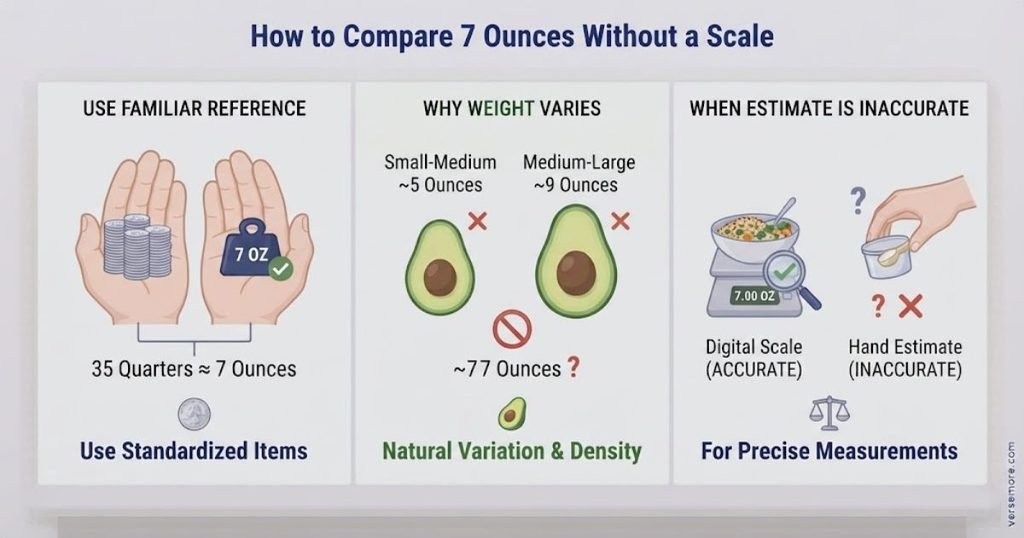
If you do not have a kitchen or postal scale, you can still develop a rough mental reference for seven ounces.
The safest method is to compare the target with an object whose weight is already known.
Use a Familiar Object as Your Reference
For an exact comparison, 35 U.S. quarters are especially useful because each circulating quarter has a specified weight of 5.670 grams. Together, 35 quarters are approximately 198.45 grams, essentially 7 ounces.
For a simpler everyday reference, think of approximately 200 grams.
7 ounces ≈ 200 grams
· Slightly less than half a pound
· About 198.45 grams
· Just over 6 ounces
· 1 ounce below 8 ounces
· Very close to 200 grams
Why Object Weight Can Vary
An everyday object does not have a single universal weight unless it has a standardized specification.
For example, two apples can look similar but have different masses. Two smartphones from different manufacturers can have different batteries and materials. Two ceramic mugs can have noticeably different wall thicknesses.
This is why phrases such as “a phone weighs 7 ounces” should be understood as an approximation unless a specific model has been identified.
The same principle applies to food. A “medium apple” or “large orange” is a size category, not a promise that every individual fruit has exactly the same mass.
When an Estimate Is Not Accurate Enough
Use an actual scale when the weight matters for:
· Shipping and postage
· Medication or laboratory measurements
· Precise cooking or baking
· Nutrition tracking
· Product packaging
· Commercial transactions
· Any situation with a strict weight limit
USPS recommends using a kitchen scale or postal scale for accurate package weights and including packing materials when determining shipping weight.
A visual comparison is useful for understanding the concept of 7 ounces, but it should not replace an actual measurement when precision matters.
7 Ounces vs. Common Weight Benchmarks
| Weight | How it compares with 7 oz |
| 1 ounce | 6 ounces lighter |
| 4 ounces | 3 ounces lighter |
| 5 ounces | 2 ounces lighter |
| 6 ounces | 1 ounce lighter |
| 7 ounces | 198.45 g |
| 8 ounces | 1 ounce heavier |
| 12 ounces | 5 ounces heavier |
| 16 ounces | 9 ounces heavier |
7 Ounces vs. Half a Pound
Seven ounces is not quite half a pound.
A standard pound contains 16 ounces, so half a pound is exactly 8 ounces.
7 oz = 0.4375 lb
8 oz = 0.5 lb
This means seven ounces is exactly one ounce below half a pound.
7 Ounces vs. 200 Grams
Seven ounces and 200 grams are extremely close.
Seven ounces equals approximately 198.45 grams, while 200 grams is approximately 7.05 ounces.
The difference is only about 1.55 grams.
For everyday mental estimation, you can therefore treat 7 ounces as roughly 200 grams. For precise work, use 198.45 grams rather than rounding to 200 grams.
7 Ounces vs. 1 Pound
A pound is significantly heavier than 7 ounces.
Since one pound equals 16 ounces, 7 ounces represents:
7 ÷ 16 = 43.75% of a pound
So if you imagine a one-pound object, seven ounces is a little less than half of it.
Where a 7-Ounce Weight Is Commonly Used
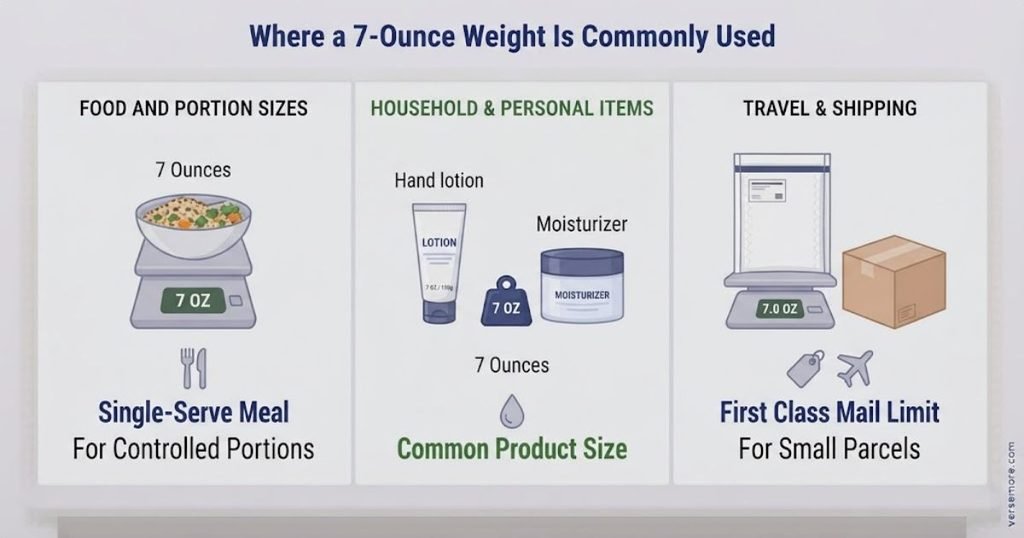
Food and Portion Sizes
Food is one of the most common places to encounter ounce measurements.
Meat, cheese, snacks, prepared foods, and packaged products may all be sold or portioned using ounces. When the weight is important, the label provides a more reliable number than judging the food by its apparent size.
This is particularly useful because two foods with identical weights can look completely different due to density.
Household and Personal Items
Small household objects can fall around 7 ounces, but their weights are rarely standardized.
A phone, mug, notebook, toiletry container, or small electronic accessory might be close to 7 ounces, but the exact model or design determines its actual mass.
That is why these items are best used as visual references, not guaranteed measurements.
Travel and Shipping
Small packages often make ounce-level weight differences important.
A package weighing 7 ounces is still a relatively light parcel, but its exact weight can affect postage depending on the service and destination. USPS advises users to weigh the complete package, including packing material, when preparing mail.
For shipping, always use the actual measured weight rather than estimating from an everyday object.
FAQ’s
How many grams is 7 ounces?
Seven standard avoirdupois ounces equals 198.446661875 grams, usually rounded to 198.45 grams. For everyday purposes, you can think of it as approximately 200 grams.
Is 7 ounces close to half a pound?
Yes. Seven ounces is exactly one ounce less than half a pound. Half a pound equals 8 ounces, while 7 ounces equals 0.4375 pounds.
What does 7 ounces look like?
Seven ounces is difficult to judge visually because objects have different densities. A useful mental reference is approximately 200 grams, or 35 current U.S. quarters, which weigh about 198.45 grams in total.
What common household item weighs 7 ounces?
There is no single household object that universally weighs exactly 7 ounces. Some smartphones, ceramic mugs, notebooks, and small personal-care products can fall near this range, but their actual weights vary.
What fruit weighs about 7 ounces?
An avocado can be a particularly close reference. A USDA-based reference lists an avocado at about 201 grams, which is approximately 7.1 ounces. Large oranges and medium apples can also be useful approximate comparisons, although individual fruit weights vary.
Is 7 ounces considered heavy?
No. Seven ounces is generally a light everyday weight. It is less than half a pound and can normally be held or carried easily with one hand.
How can I measure 7 ounces without a scale?
For a rough comparison, think of approximately 200 grams. A particularly close standardized reference is 35 U.S. quarters, which together weigh about 198.45 grams. For an accurate measurement, however, use a kitchen or postal scale.
Is 7 oz the same as 200 grams?
Not exactly. Seven ounces equals approximately 198.45 grams, while 200 grams equals approximately 7.05 ounces. The difference is only about 1.55 grams, so they are very close for rough estimates.
How much is 7 ounces in kilograms?
Seven ounces equals approximately 0.19845 kilograms. Rounded for everyday use, that is about 0.2 kg.
Conclusion
Seven ounces is a surprisingly easy weight to understand once it is connected with familiar references. The exact value is 198.45 grams or 0.4375 pounds, placing it just one ounce below half a pound.
Some comparisons are especially useful because they are close to the target by measurement rather than appearance. For example, 35 U.S. quarters total about 198.45 grams, while a 200-gram portion is only slightly heavier than 7 ounces.
Other everyday examples, such as apples, oranges, avocados, mugs, smartphones, and notebooks, can help you develop a visual sense of the weight, but their actual masses vary.
So, when someone asks what weighs 7 ounces, the simplest answer is to remember about 200 grams and just under half a pound. When accuracy matters, skip the guesswork and use a scale.

I am the admin of VerseMore, sharing helpful, informative, and engaging content on various topics to inspire readers, provide value, and make everyday life easier.