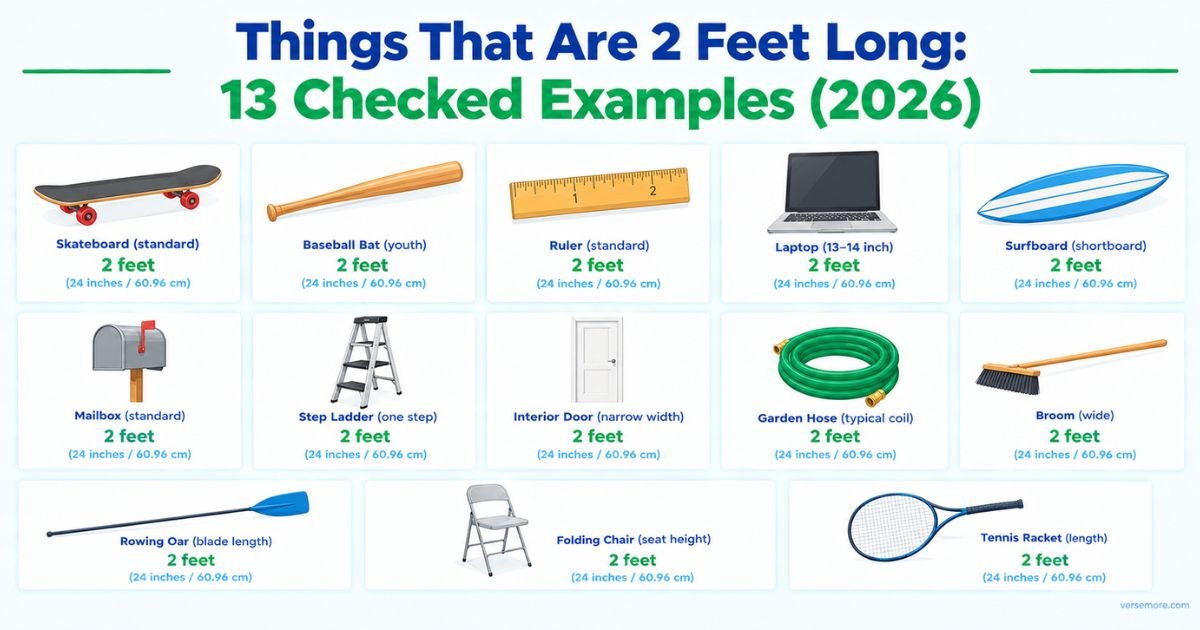
Two feet is easy to say and surprisingly hard to picture. Most lists of things that are 2 feet long hand you round numbers without checking them, and a few of the popular favorites are off by whole inches.
This guide checks each of the 13 examples against a standard, a specification or published data, then rates how close it really comes to 24 inches.
You will also find exact conversions, tape-free tricks with their real error, and a few common comparisons that don’t hold up.
2 feet is exactly 24 inches, which equals 60.96 centimeters or 0.6096 meters.
Key Takeaways
•        2 feet = 24 in = 60.96 cm = 609.6 mm. All exact, and about 61 cm is the usual rounded value.
•        Exact by design: two 12-inch rulers, eight NHL hockey pucks in a row, and the 24-inch mark on a yardstick.
•        Within an inch: four US $1 bills (24.56 in), seven bank cards (23.59 in) and a male Golden Retriever at the shoulder (23–24 in).
•        A 2-year-old is not 2 feet tall. The typical height at that age is closer to 34 inches.
How Long Is 2 Feet in Inches, Centimeters and Meters?
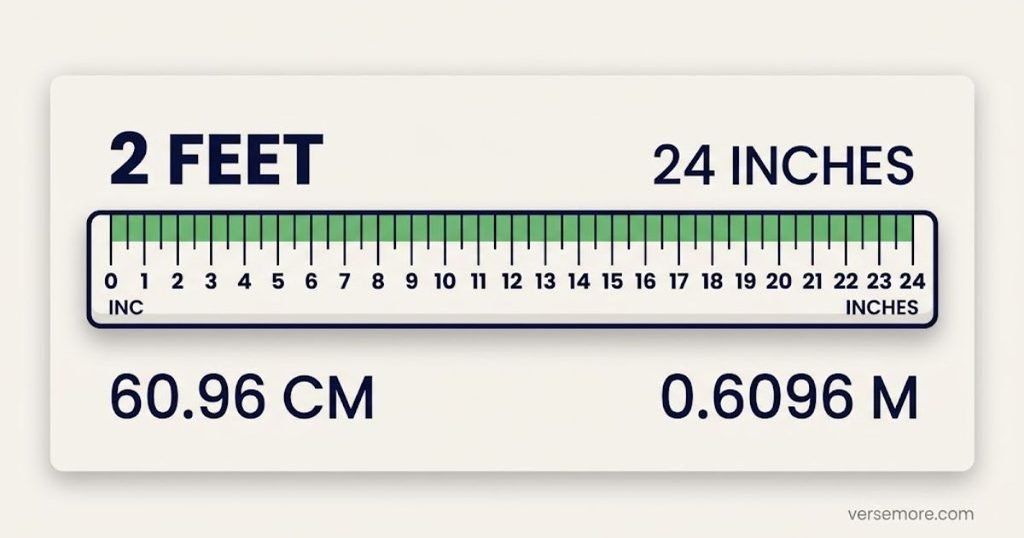
Two feet is 24 inches, 60.96 centimeters or 0.6096 meters. In yards it is two-thirds of one.
| Unit | 2 feet equals | Exact or rounded |
| Inches | 24 in | Exact |
| Millimeters | 609.6 mm | Exact |
| Centimeters | 60.96 cm | Exact |
| Meters | 0.6096 m | Exact |
| Kilometers | 0.0006096 km | Exact |
| Yards | 2/3 yd (0.6667 yd) | Fraction exact, decimal rounded |
Decimal places differ by row because each unit needs a different scale to be readable.
These figures are exact because the international foot is defined as 0.3048 meters, and one inch is exactly 2.54 centimeters. Multiply 24 by 2.54 and you get 60.96 with nothing left over. For shopping, “about 61 cm” is fine, since it overshoots by only 0.04 cm. For cutting or converting, use 60.96.
You will see 2 feet written as 2 ft, 2′ or 2′ 0″. They all mean the same length.
Three lots of 2 feet make 6 feet, which is the 72 inches covered in our longer guide.
One more detail for the curious: the US once had a second, slightly longer “survey foot” (1200/3937 meter) used for land surveying. NIST retired it at the end of 2022. Over 2 feet the difference was about a thousandth of a millimeter, so it never affected everyday objects. If you wonder whether the US and UK foot ever differed, we cover that in the 300 feet guide.
Quick Reference: 13 Things Compared With 24 Inches
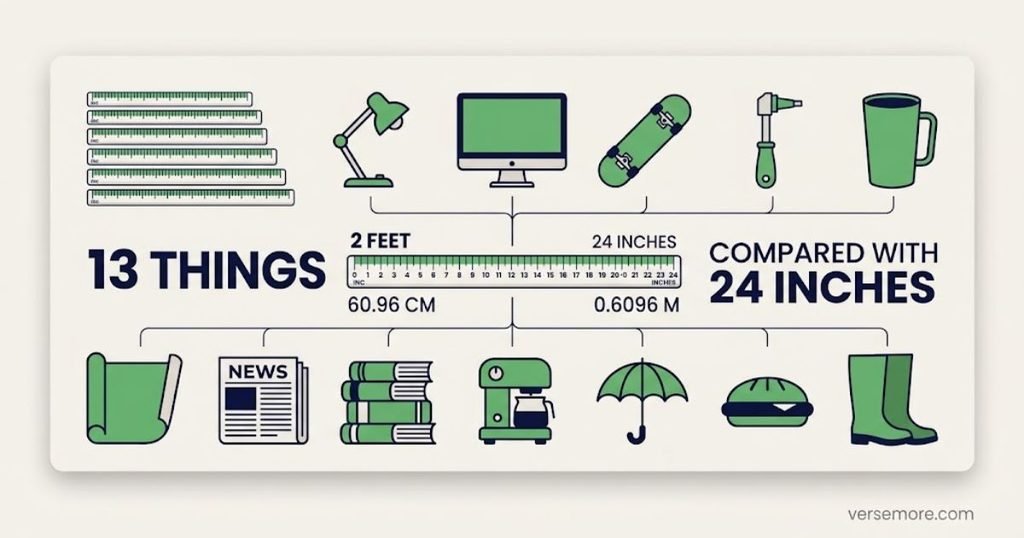
Every one of these things that are 2 feet long, or close to it, gets a rating on what we call the 2-Foot Accuracy Scale:
• Exact: 24.00 in by definition, standard or specification.
• Within 1 inch: lands between 23.00 and 25.00 in.
• Near-miss: off by more than 1 inch, so it needs a correction to be useful.
| # | Thing | Real length | Difference from 24 in | Rating |
| 1 | Two 12-inch rulers end to end | 24.00 in | 0.00 | Exact |
| 2 | Eight NHL hockey pucks side by side | 24.00 in | 0.00 | Exact |
| 3 | Two-thirds of a yardstick | 24.00 in | 0.00 | Exact |
| 4 | Smallest youth T-ball bat | 24.00 in | 0.00 | Exact |
| 5 | Standard yoga mat (width) | 24.00 in | 0.00 | Exact |
| 6 | Standard built-in dishwasher (opening) | 24.00 in | 0.00 | Exact |
| 7 | “24×24” porcelain floor tile | 23.63 in | −0.37 | Within 1 inch |
| 8 | Four US $1 bills | 24.56 in | +0.56 | Within 1 inch |
| 9 | Seven bank cards | 23.59 in | −0.41 | Within 1 inch |
| 10 | Two sheets of paper (US Letter / A4) | 22.00 / 23.39 in | −2.00 / −0.61 | Near-miss / Within 1 inch |
| 11 | Male Golden Retriever (shoulder) | 23.00–24.00 in | −1.00 to 0.00 | Within 1 inch |
| 12 | A 3-month-old baby (median length) | 23.54–24.18 in | −0.46 to +0.18 | Within 1 inch |
| 13 | UK/EU 600 mm kitchen base unit | 23.62 in | −0.38 | Within 1 inch |
Figures are rounded to two decimals at the final step only. Rows 1–6 are exact by definition, standard or spec. Rows 7–13 are rounded values taken from published sizes, so real items can vary slightly.
Things That Are Exactly 2 Feet Long by Design
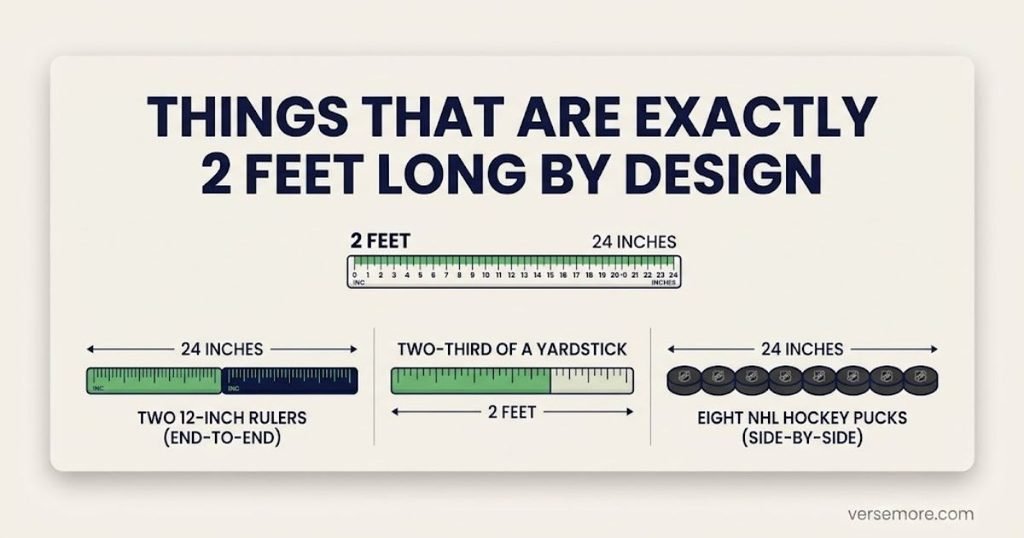
These three need no luck and no rounding. Their length comes from how they are defined.
Two 12-Inch Rulers Placed End to End
This is the textbook answer, and it works. Each foot ruler is 12 inches, so two of them give exactly 24.
One thing trips people up: on many rulers the zero mark sits slightly in from the physical edge. Line the 12-inch mark of the first ruler up with the zero of the second, not edge to edge, or you will lose a fraction of an inch.
If your rulers are metric, they are usually 30 cm long (11.81 in). Two of them make 23.62 in, which falls a little short.
Two-Thirds of a Yardstick
A yardstick is 36 inches, so the 24-inch line sits exactly two-thirds of the way along. Hold one up against a wall and you can see 2 feet and 3 feet side by side. That makes it a handy way to feel the jump from 24 to 36 inches before we get to height later in this guide.
Eight NHL Hockey Pucks Side by Side
An official NHL puck is 3 inches across and 1 inch thick. Line up eight on their flat sides and the row is exactly 24 inches. Stack 24 of them and the tower is also 24 inches high, because each puck is 1 inch thick.
Only regulation pucks follow this. Souvenir and training pucks can differ, so check before you trust the count.
Sports and Fitness Gear That Is 2 Feet Long
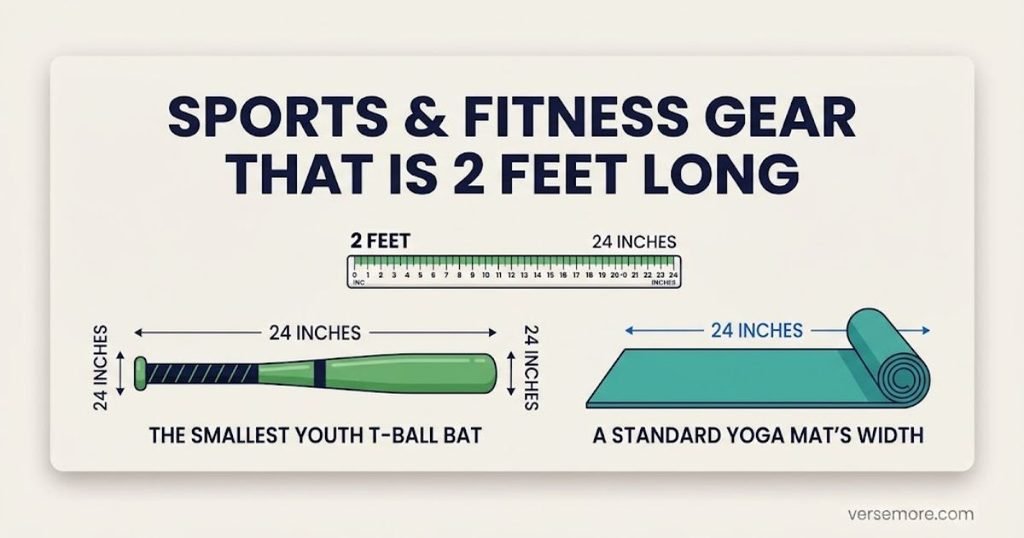
Sports equipment is sold in labeled sizes, which makes it a reliable source of things that are 2 feet long.
The Smallest Youth T-Ball Bat
Bat makers list lengths in whole inches. Rawlings’ sizing chart puts players aged 5 to 7 in the 24–26 inch range, and T-ball bats start at 24.
So a 24-inch bat is the shortest size in the chart, not the typical one. A 25-inch bat is just as likely for the same age group, so look for the length printed on the barrel or label before you use a bat as a ruler.
A Standard Yoga Mat’s Width
The industry-standard yoga mat is 24 inches wide and 68 inches long. Many brands now make mats 71–72 inches long for taller users, and wider mats run 26–30 inches, but the 24-inch width is the baseline.
Roll one out and look across it, not along it. That short edge is 2 feet, which is why it is also a quick way to judge whether an object is more or less than 24 inches.
Kitchen and Home Standards That Measure 24 Inches
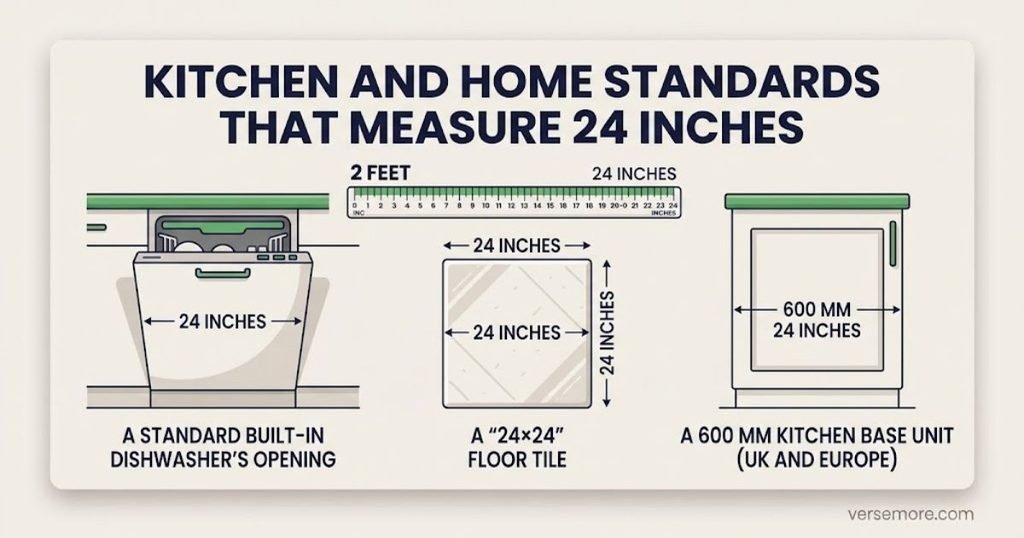
Home building runs on standard sizes, and 24 inches sits at the center of the kitchen. These three are things that are 2 feet long (or a hair under) because the rest of the room was designed around them.
A Standard Built-In Dishwasher’s Opening
A full-size built-in dishwasher is made to slide into a cabinet opening 24 inches wide, 24 inches deep and 35 inches high. Slimline models are narrower, around 18 inches, so check which type you are looking at.
The 24 inches belongs to the opening, not the machine. Home Depot’s measuring advice is to measure the opening at the top and bottom and use the smaller number. That small habit matters for every “about 2 feet” item in this guide.
Standard base cabinets are 24 inches deep too. The countertop usually overhangs by an inch or so, which is why finished kitchen counters often measure roughly 25 to 26 inches from the wall.
A “24×24” Floor Tile
The label says 24 inches. The tile is usually 23⅝ inches (23.63 in), because porcelain tiles are made in metric and labeled in rounded inches. Many rectified tiles are exactly 600 mm, or 23.62 inches.
The gap is small on one tile and adds up across a floor. Four tiles in a row cover 94.5 inches, not 96, before grout lines. If you plan a layout from the label alone, you will be short.
A 600 mm Kitchen Base Unit (UK and Europe)
In the UK and Europe, kitchens are sized in millimeters. A standard base unit is 600 mm wide and 600 mm deep, and 600 × 600 mm paving slabs are a staple of UK landscaping.
600 mm is 23.62 inches, or 1.97 feet. It falls 0.38 inches short of 2 feet, close enough to mistake for it and far enough to cause a fit problem if you swap a US 24-inch product into a metric space.
The same habit of attaching a friendly inch label to a metric size shows up at smaller scale in our guide to 2.75-inch objects that are really 70 mm.
Pocket-Sized Things You Can Line Up to Make 2 Feet
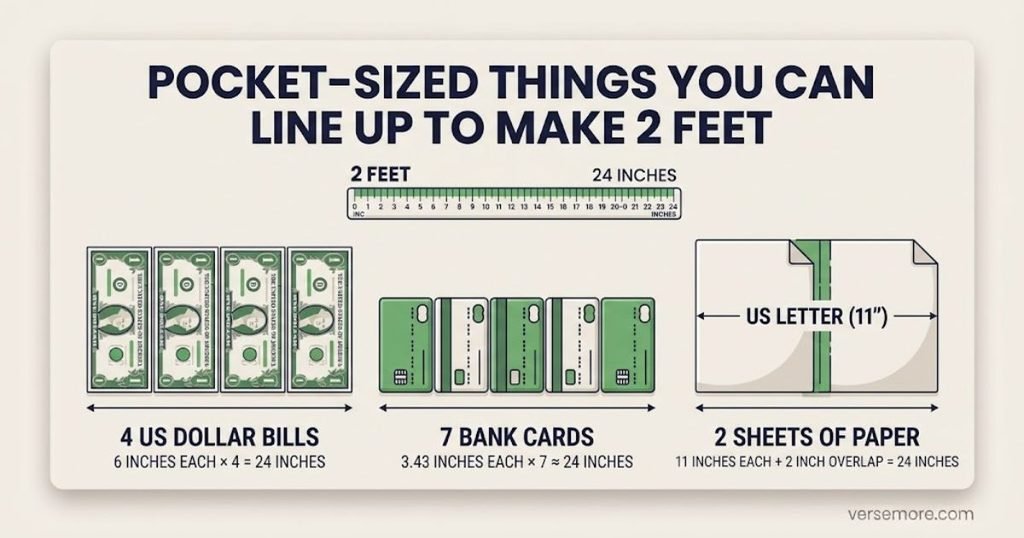
None of these is 2 feet long on its own. Lined up end to end, each becomes one of the quickest things that are 2 feet long (or nearly) when you have no ruler. The ratings below show how far off each one lands.
Four US Dollar Bills
A US bill is 6.14 inches long, and every current denomination is the same size. Four laid end to end make 24.56 inches, which overshoots by 0.56 inches, about 2.3 percent.
That is accurate enough to check a shelf or a box. It only works if you carry US cash, so if you don’t, the next trick is a better choice.
Seven Bank Cards
Credit cards, debit cards and most ID cards follow the same international standard (ISO/IEC 7810 ID-1), which is 85.60 mm, or 3.370 inches, long. Seven in a row measure 599.2 mm, or 23.59 inches.
That is 0.41 inches short of 24, and it works anywhere in the world because the standard is global. Add a thin strip of anything about half an inch wide and you are essentially at 2 feet.
Two Sheets of Paper
Here the answer depends on where you live, so we rate this one in two ways. Two US Letter sheets (11 inches on the long side) make 22 inches, a 2-inch near-miss. Two A4 sheets (297 mm, or 11.69 inches) make 23.39 inches, within an inch.
If you use Letter, treat two sheets as “a bit under 2 feet.” If you use A4, they are close enough for most estimates.
Living Things That Are About 2 Feet
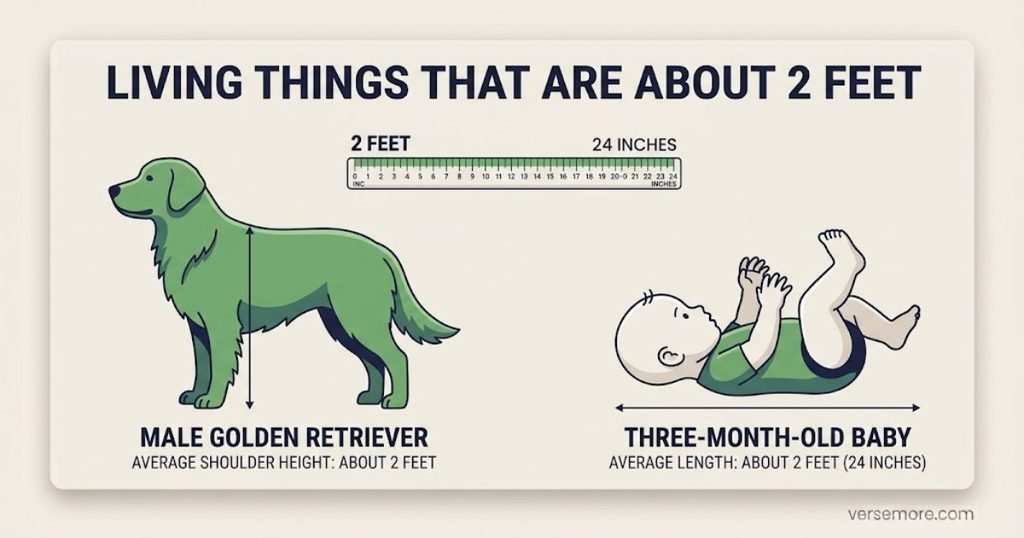
Animals and babies are the hardest examples to measure precisely, so these two use official data, not impressions.
A Male Golden Retriever
The AKC breed standard puts a male Golden Retriever at 23 to 24 inches at the withers (the top of the shoulder), and a female at 21½ to 22½ inches. A dog more than an inch above or below the standard is disqualified in the show ring.
That makes 2 feet the top of the male range, not its middle. The measurement is taken at the shoulder, not at the head, and most pet owners see a dog standing, so the visual is easy to picture.
A Three-Month-Old Baby
Babies under two are measured lying down, and the numbers are length. WHO median length at 3 months is 59.8 cm (23.54 inches) for girls and 61.4 cm (24.18 inches) for boys. Two feet falls between those two figures, so a typical 3-month-old is about 2 feet long.
These are medians for healthy babies, and individual babies vary widely. A pediatrician reads growth from charts over time. This list does not replace that.
2 Feet Comparisons That Don’t Hold Up
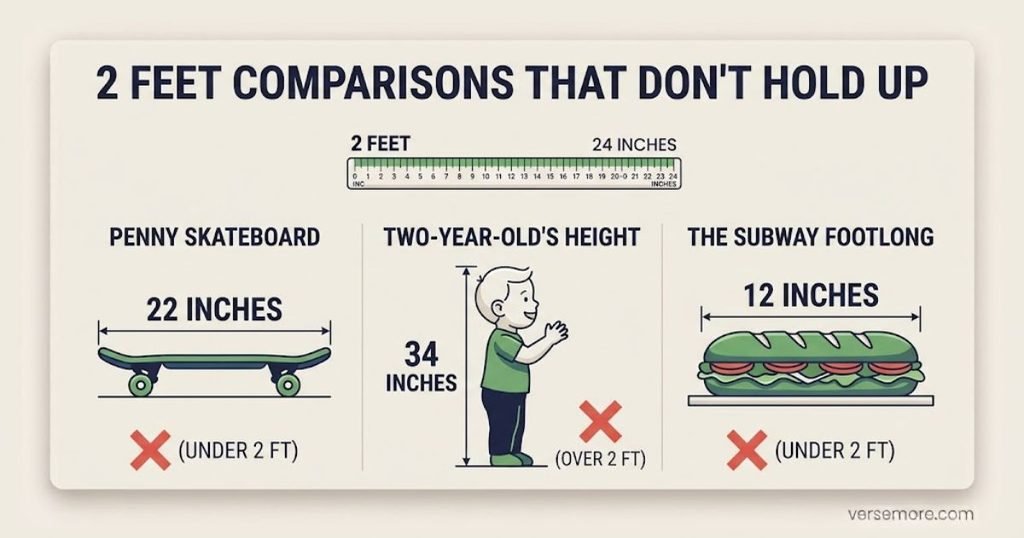
Some comparisons are repeated so often that they feel true. These three are worth correcting, because each one is off by enough to matter.
Penny Skateboards
The original Penny board is 22 inches long, and the larger Nickel is 27 inches. Neither is 24, and the Nickel sits a full 3 inches over. If you want a skateboard that is nearly 2 feet, the 22-inch Penny comes closest, at 2 inches short.
A Two-Year-Old’s Height
A toddler of 18 to 24 months is often called “2 feet tall.” The typical height at 24 months is about 34 inches. CDC ranges at age 2 run from roughly 31½ to 37 inches. Two feet is closer to the length of a 3-month-old baby, as covered above.
The Subway Footlong
A footlong is a name, not a guarantee of exactly 12 inches. In 2013 a customer in Australia posted a photo of an 11-inch sandwich, and Subway later agreed to practices ensuring at least 12 inches. A federal appeals court threw that settlement out in 2017, noting that no company can promise every roll measures exactly 12 inches.
Two footlongs are about 2 feet. They are not exactly 2 feet.
How Tall Is 2 Feet? And What About 3 Feet Tall?
Two feet tall means 24 inches, or 60.96 cm. For a person, that is the length of a baby around 3 months old. It is not the height of an older child.
Three feet tall is 36 inches, or exactly 91.44 cm (one yard). It is a normal height for a child between about 2 and 3 years old, depending on the child.
| Age | Typical length or height | Where 2 ft and 3 ft fall |
| Birth | about 19.5 in | 4.5 in under 2 ft |
| 3 months | 23.5–24.2 in | about 2 ft |
| 12 months | about 29.5 in | 5.5 in over 2 ft |
| 24 months | about 34 in | 2 in under 3 ft |
| 3 years | 34.5–40.5 in (typical range) | 3 ft falls inside the range |
Figures are typical values from WHO and CDC growth data, rounded to one decimal. Under age 2, children are measured lying down. From age 2 they are measured standing, and WHO notes that this changes the number by about 0.7 cm (roughly a quarter inch).
The jump from 2 feet to 3 feet is 12 inches, or 30.48 cm. The yardstick trick from earlier shows it well: the 24-inch line and the end of the stick are exactly one ruler apart.
How to Measure 2 Feet Without a Tape Measure
The tricks earlier in this guide work, but they don’t all work equally well. Here they are ranked by how far each one lands from 24 inches.
| Method | Result | Error from 24 in |
| Two 12-inch rulers (aligned at the 12 and 0 marks) | 24.00 in | 0.00 |
| Eight regulation NHL pucks in a row | 24.00 in | 0.00 |
| Seven bank cards in a row | 23.59 in | −0.41 |
| Four US $1 bills in a row | 24.56 in | +0.56 |
| Two A4 sheets | 23.39 in | −0.61 |
| Two US Letter sheets | 22.00 in | −2.00 |
Inches, rounded to two decimals at the final step.
If you have none of these, your own body is the next best ruler. The catch is that it only works once you have measured it, because hands, forearms and strides vary from person to person.
1. Measure your references once. Lay a ruler or tape against the span of your spread hand (thumb tip to little fingertip), your forearm from elbow to fingertip, and the length of one of your shoes.
2. Write the numbers down. Keep them in your phone notes so you never need to guess again.
3. Do the math for 24. For example, if your hand span measures 8 inches, three spans make 24. If your shoe is 10 inches, 2.4 shoe lengths make 24.
4. Repeat each check twice and use the smaller figure. A small error in a single placement adds up when you chain three or four of them.
For longer distances the same calibrate-first habit applies. Our guide to estimating 15 feet without a tape measure shows how to apply it to paces.
Why “About 2 Feet” Can Still Cost You: A Fit Check
Most of the trouble with things that are 2 feet long comes from the gap between the label and the real size. Run these four checks before you buy, cut or install anything that has to fit a 24-inch space. We call it the 24-Inch Fit Check.
1. Look for nominal vs. actual. A “24×24” tile is really 23⅝ inches. A “24-inch” label tells you the rounded size, not the real one. Look for “actual dimensions” in the product details.
2. Check the unit behind the label. A 600 mm product is 23.62 inches, which is 0.38 inches short of 2 feet. Swap one for the other in a tight space and it won’t match.
3. Measure the opening at several points. Home Depot’s advice for dishwashers is to measure at the top and the bottom and use the smaller number. Walls and cabinets are rarely perfectly square, so the narrowest point wins.
4. Leave room to open and handle it. Dishwasher makers typically recommend 21 to 27 inches between the open door and the cabinet opposite. Fitting the item is only half of the job.
If an item passes all four checks, “about 2 feet” is good enough. If it fails even one, get a tape measure.
FAQ’s
How many inches, centimeters and meters are in 2 feet?
Two feet is exactly 24 inches, 60.96 centimeters and 0.6096 meters. The conversions are exact because an inch is defined as 2.54 centimeters. For quick estimates, 61 cm is a safe rounded value.
What is a common household item that is 2 feet long?
A standard built-in dishwasher opening is 24 inches wide, and a standard kitchen base cabinet is 24 inches deep. Two 12-inch rulers placed end to end also make exactly 2 feet. The dishwasher opening and the cabinet depth are the ones you will find in almost every kitchen.
How can I measure 2 feet without a ruler?
Lay seven bank cards end to end for 23.59 inches, or four US $1 bills for 24.56 inches. Both land within an inch of 24. For the best accuracy, measure your hand span against a ruler once and count spans (three 8-inch spans make 24).
How tall is 2 feet for a baby or a child?
A typical 3-month-old baby is about 2 feet long: the WHO median is 23.54 inches for girls and 24.18 inches for boys. By age 2 the typical height is about 34 inches, so a 2-year-old is much taller than 2 feet. Children grow at different rates, and a pediatrician tracks this over time.
Is a Golden Retriever 2 feet tall?
An adult male Golden Retriever is 23 to 24 inches at the shoulder under the AKC breed standard, so 2 feet is the top of the range. Females are 21½ to 22½ inches. A dog more than an inch outside the standard is disqualified in the show ring.
How many yards is 2 feet?
Two feet is two-thirds of a yard (about 0.6667 yards). A yard is 3 feet, or 36 inches, so 24 inches is exactly two-thirds of it. The 24-inch mark on a yardstick shows this clearly.
What is the difference between 2 feet and 600 mm?
600 mm is 23.62 inches, so it is 0.38 inches (about 9.6 mm) shorter than 2 feet. Kitchen units, paving slabs and appliances in the UK and Europe use 600 mm. The gap is small but enough to cause a bad fit if you swap one size for the other.
How do you write 2 feet?
You can write it as 2 ft, 2′ or 2′ 0″. The single prime mark means feet and the double prime mark means inches. So 2 feet 6 inches is written 2′ 6″ or 2 ft 6 in.
Conclusion
Things that are 2 feet long turn up all over your home, from the dishwasher opening to a stack of bank cards, and the best ones are the ones you can check against a standard. Exact matches like two 12-inch rulers or eight regulation pucks give you a perfect 24 inches, while cards, dollar bills and a Golden Retriever’s shoulder get you within an inch. The popular comparisons that don’t hold up, such as the Penny Nickel board or a 2-year-old’s height, are worth dropping. When a fit matters, measure the real thing instead of trusting a label, and keep the 24-Inch Fit Check in mind.

I am the admin of VerseMore, sharing helpful, informative, and engaging content on various topics to inspire readers, provide value, and make everyday life easier.