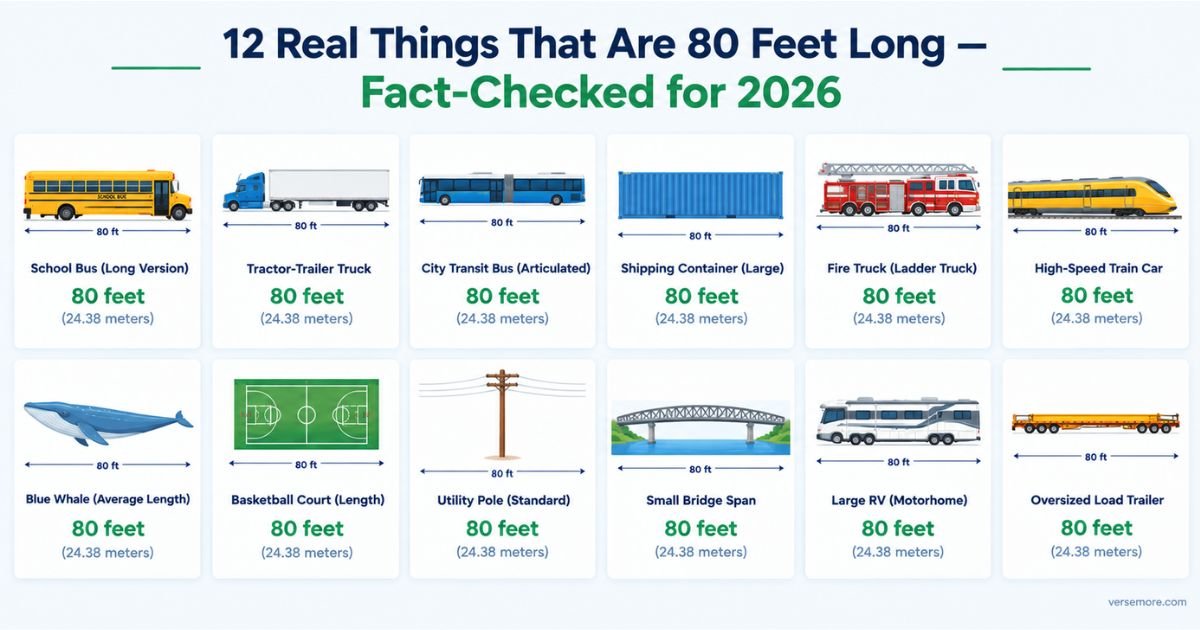
Eighty feet is a strange length to picture. It’s too long to eyeball across a room, too short to compare to a skyscraper, and most of the go-to comparisons people reach for — a school bus, a jet, a rocket booster — turn out to be measured wrong more often than not.
That’s the real problem with most “80 feet long” lists: they recycle the same handful of comparisons without checking whether the numbers hold up. A few don’t. A full-size school bus isn’t 80 feet. Neither is a regional jet.
This guide sticks to comparisons that check out against primary sources — NOAA, NASA, sports governing bodies, and manufacturer specs — and flags the popular ones that don’t.
80 feet equals 24.38 meters, 26.67 yards, or 960 inches.
How Long Is 80 Feet? Quick Conversion
| Unit | 80 Feet Equals |
| Inches | 960 in |
| Yards | 26.67 yd |
| Centimeters | 2,438.4 cm |
| Meters | 24.384 m |
| Kilometers | 0.024384 km |
| Millimeters | 24,384 mm |
Things That Are 80 Feet Long in Nature
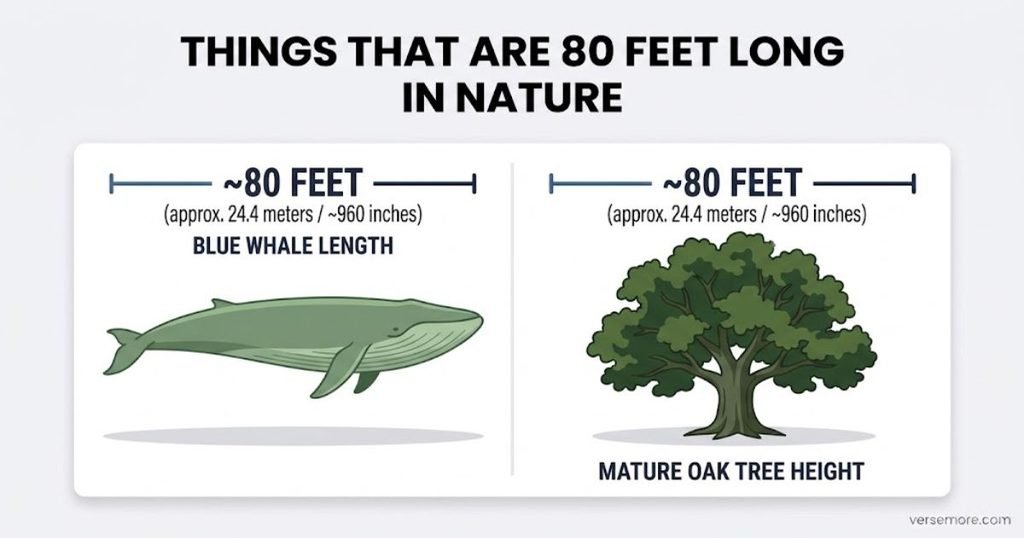
Blue Whale
The blue whale is one of the few 80-foot comparisons that actually holds up under scrutiny. NOAA Fisheries and the National Park Service both document blue whales reaching close to 100 feet at the extreme end, with most adults commonly falling in the 70- to 90-foot range depending on sex and population — females tend to run longer than males. An 80-foot individual sits squarely in the middle of that normal range, not at some exaggerated upper limit.
What’s easy to miss is how much variation exists by region: blue whales feeding in colder Southern Ocean waters tend to grow noticeably larger than those in warmer feeding grounds, so “80 feet” describes a mid-sized adult rather than the species maximum.
Mature Oak or Pine Tree
Height varies enormously by species, soil, sunlight, and age, but many mature oak and pine species commonly reach 70 to 90 feet under good growing conditions in open, nutrient-rich land. An 80-foot specimen isn’t unusual — it’s a fairly ordinary mature tree, not a record-setter. Forestry measurements this specific always depend on the individual tree and site conditions, which is worth keeping in mind before treating any single number as universal.
Things That Are 80 Feet Long in Sports & Recreation
Regulation Tennis Court
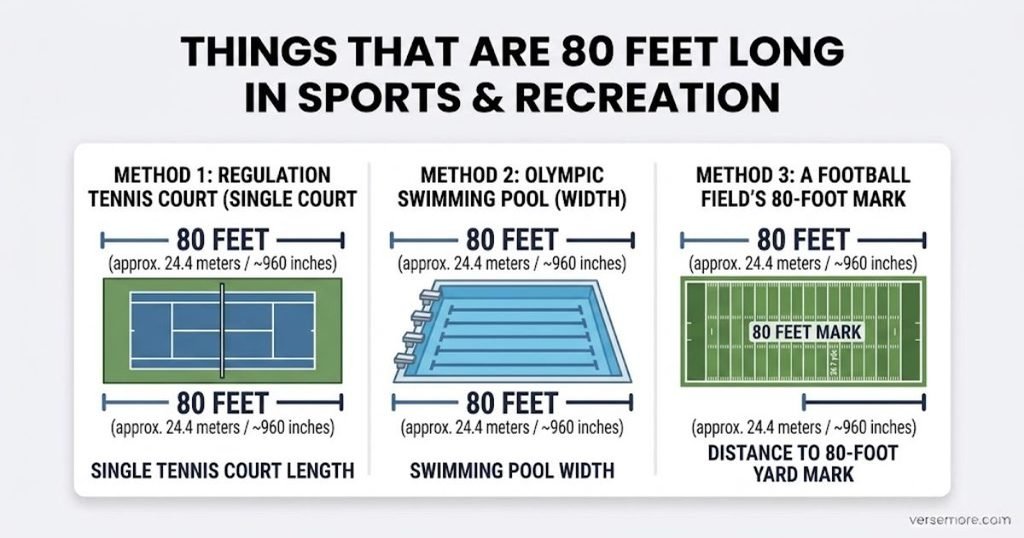
A regulation tennis court measures 78 feet from baseline to baseline under International Tennis Federation rules — just two feet short of 80. Because this dimension is fixed by regulation rather than estimated, it’s one of the more reliable comparisons available: every certified tennis court, from a public park to Wimbledon’s Centre Court, uses this exact length.
Olympic Swimming Pool — Width, Not Length
Most articles reach for the pool’s 50-meter length (164 feet), which isn’t close to 80 feet at all. The pool’s width is the better match: World Aquatics (formerly FINA) sets the standard competition width at 25 meters — 82 feet. It’s a small detail competitors consistently miss, but it’s a genuinely closer and more accurate comparison than the one everyone repeats.
A Football Field’s 80-Foot Mark
On a standard American football field, 80 feet works out to roughly 26 yards, 2 feet — putting it just past the 27-yard line if you’re measuring from the goal line. For anyone who’s watched football and has a mental picture of where the 25- or 30-yard line sits on the field, this gives a surprisingly intuitive way to visualize the distance without needing a tape measure at all.
Vehicles and Transport That Reach 80 Feet
Extendable Flatbed Trailer at Full Extension
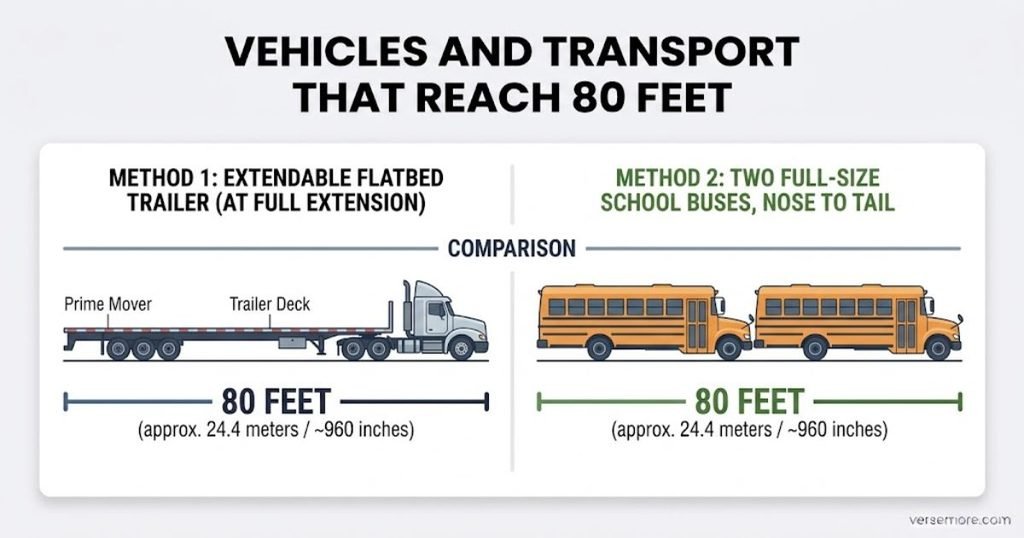
Standard tractor-trailer combinations don’t actually hit 80 feet — a typical rig pulling a 53-foot dry van runs closer to 70–75 feet total once you account for the tractor. The trailers that genuinely reach 80 feet are specialized ones: extendable double-drop and removable-gooseneck (RGN) trailers, built to haul oversized equipment, stretch to roughly 80 feet when fully extended. Drivers who move heavy machinery or construction equipment across state lines deal with this exact length regularly, even though it never shows up on an everyday highway commute.
Two Full-Size School Buses, Nose to Tail
Here’s a correction worth making explicitly: a single full-size school bus is not 80 feet long. Even the longest Type C and Type D models — the large, conventional buses used for standard student routes — typically max out around 40 to 45 feet. Line up two of them bumper to bumper, though, and you land almost exactly at 80 feet. It’s a more accurate way to use a bus as a length reference than the single-bus comparison that keeps circulating.
Structures That Reach 80 Feet
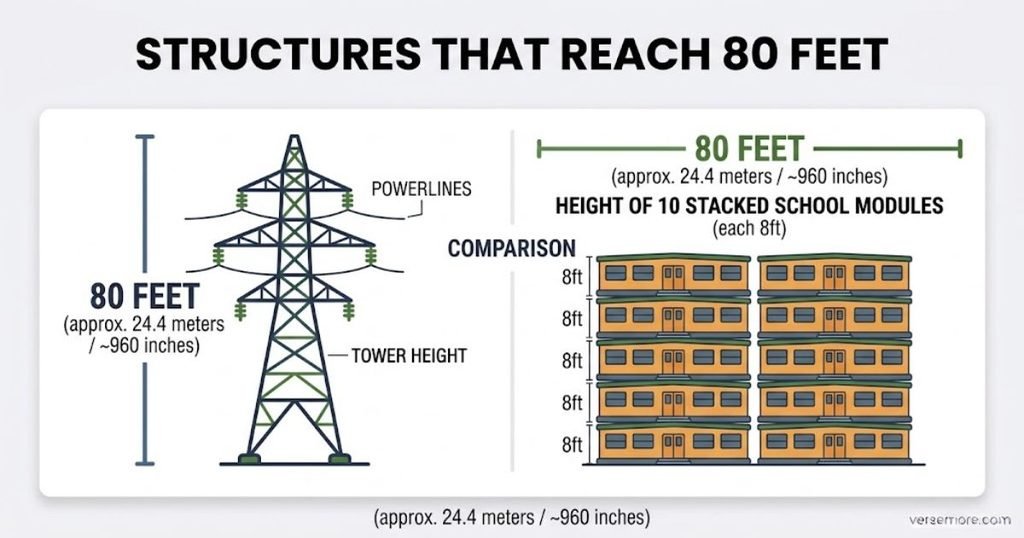
An eight-story building is a reasonable rough estimate for 80 feet, based on the common construction convention of roughly 10 feet per floor once you include floor slabs and ceiling structure. That figure shifts depending on building type — office floors tend to run taller than residential ones, and older buildings don’t always follow modern conventions — but as a general rule of thumb, eight stories gets you into 80-foot territory.
Residential lot width tells a different, more everyday story. Many U.S. single-family zoning codes set minimum lot widths somewhere in the 60- to 80-foot range, depending on the municipality and zoning district. If you’ve ever stood at the front of a suburban property and wondered how wide your own lot actually is, 80 feet sits at the generous end of a very common range — wide enough for a two-car driveway, a reasonable side yard, and a house that doesn’t feel wedged between its neighbors.
Boats and Industrial Equipment at 80 Feet
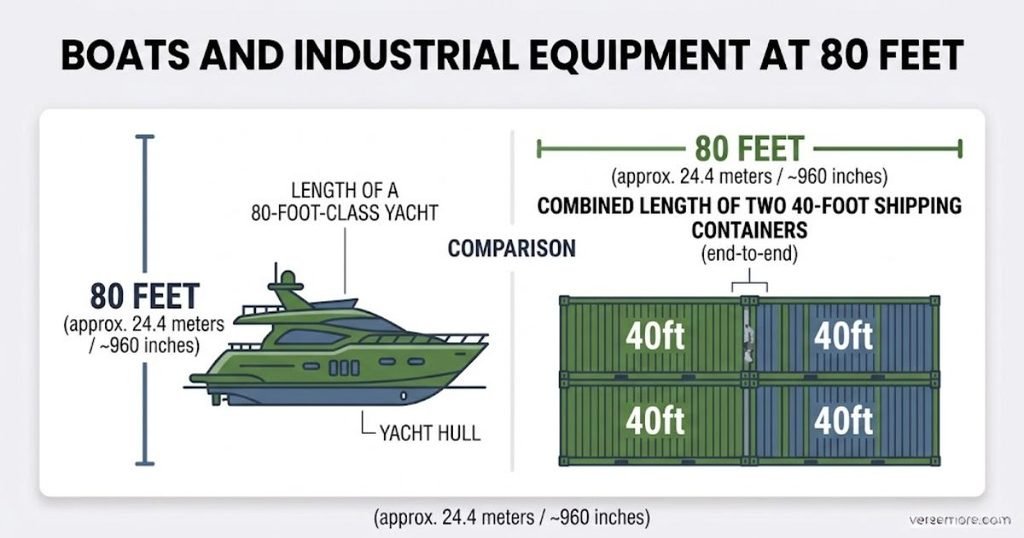
An 80-Foot-Class Luxury Yacht
In the yacht industry, boats are conventionally grouped into size classes — 60-foot, 80-foot, 100-foot, and so on — and the 80-foot class represents a genuine step up from a large recreational boat into serious ocean-going territory. Vessels at this size typically require a professional crew rather than an owner-operator, and they’re built for extended offshore cruising rather than day trips. It’s one of the few places where “80 feet” isn’t just a coincidental measurement — it’s an actual industry sizing category.
Two 40-Foot Shipping Containers End to End
This is the cleanest, most mathematically exact comparison on this list. Standard ISO shipping containers come in two common lengths — 20 feet and 40 feet — and two of the 40-foot units placed end to end equal exactly 80 feet, no rounding or estimation involved. Anyone who’s driven past a container yard or a rail freight terminal has likely seen this exact configuration without realizing it matched the measurement precisely.
Things Often (Wrongly) Called 80 Feet Long
A lot of “80 feet” content circulating online repeats a handful of claims that don’t hold up against primary sources. Here’s what the actual numbers say:
| Commonly Repeated Claim | Verified Actual Length | Source |
| Full-size school bus is 75–80 ft | Typically 35–45 ft | Bus manufacturer specifications |
| Semi-truck with 53-ft trailer totals 80 ft | Typically 70–75 ft | DOT length regulations |
| Embraer E175 regional jet is ~80 ft | Approximately 98–104 ft | Aircraft manufacturer specs |
| Modern wind turbine blade is 80–85 ft | Typically 160–260+ ft on modern onshore turbines | Industry/DOE data |
| Space Shuttle Solid Rocket Booster is exactly 80 ft | 149.16 ft | NASA specifications |
None of these are close calls — they’re each off by a wide enough margin that they shouldn’t be used as 80-foot references at all. Worth keeping in mind next time a “things that are X feet long” list cites one of them with confident precision.
How to Estimate 80 Feet Without a Tape Measure
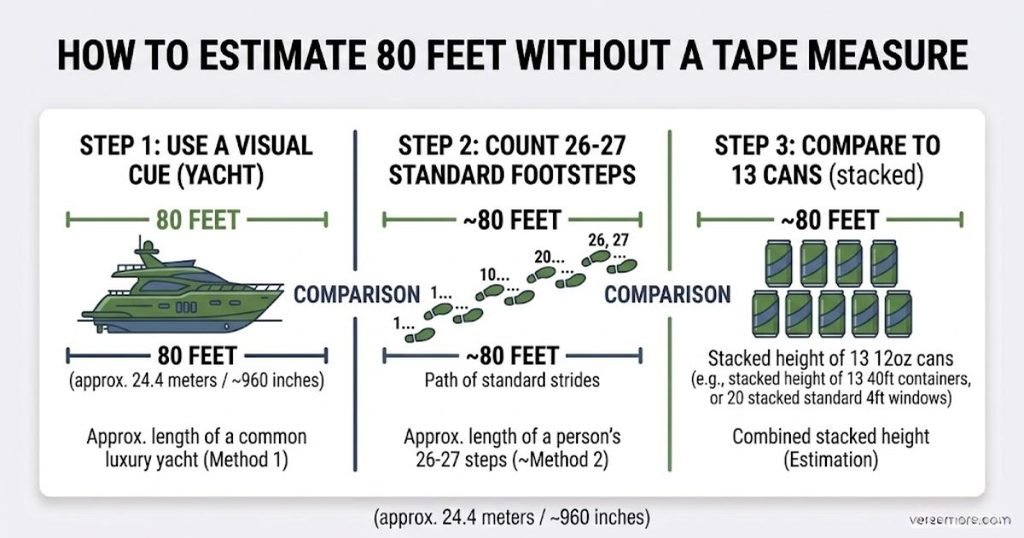
If you need a rough sense of 80 feet on the spot — sizing up a yard, a driveway, or a stretch of fence line — a few low-tech methods get you close:
● Walk it off. An average adult stride covers roughly 2.5 feet, so about 32 normal steps gets you to 80 feet.
● Use your own height as a unit. If you’re around 5’6″, laying that length down roughly 14–15 times covers the distance.
● Compare to a parked car. Most passenger cars run 14–17 feet long, so five to six of them nose to tail approximate 80 feet.
● Use a tennis court as a mental anchor. At 78 feet baseline to baseline, it’s close enough to treat as a stand-in for 80 feet in most everyday situations.
None of these replace an actual tape measure for anything that matters, but they’re useful for a fast gut check.
FAQ’s
How long is 80 feet in meters?
80 feet equals 24.384 meters. This is a standard, exact conversion used in construction, engineering, and international measurement contexts.
What is 80 feet in yards?
80 feet equals 26.67 yards. This works out to just over 26 yards and 2 feet.
Is 80 feet longer than a basketball court?
No. A regulation NBA basketball court measures 94 feet long, making it 14 feet longer than 80 feet.
How many steps does it take to walk 80 feet?
At an average adult stride of about 2.5 feet, walking 80 feet takes roughly 32 steps at a normal, comfortable pace. Stride length varies by height and pace, so this is an estimate rather than a fixed figure.
Is a school bus 80 feet long?
No — this is one of the most commonly repeated errors in “80 feet” comparisons. A full-size school bus typically measures 35 to 45 feet, even at its longest configuration. Two full-size buses parked nose to tail come much closer to 80 feet than a single bus does.
What is exactly 80 feet long?
Two standard 40-foot ISO shipping containers placed end to end measure exactly 80 feet, with no rounding involved. Extendable RGN and double-drop trailers, used for hauling oversized equipment, also reach 80 feet at full extension.
How many car lengths is 80 feet?
Roughly five to six standard passenger cars parked bumper to bumper equal about 80 feet, depending on the specific vehicle models involved.
Is the Space Shuttle rocket booster 80 feet long?
No. This claim circulates widely but doesn’t match NASA’s own specifications: each Solid Rocket Booster measured 149.16 feet long — nearly double 80 feet.
What everyday object is closest to 80 feet?
An Olympic swimming pool’s competition width — 25 meters, or 82 feet — is one of the closest and most precisely documented matches available, since it’s set by World Aquatics regulation rather than estimated.
Conclusion
Eighty feet turns out to be a length better measured against a short list of genuinely accurate references than a long list of recycled ones. A blue whale, a tennis court’s baseline-to-baseline span, two shipping containers end to end, an Olympic pool’s width — these hold up against the primary sources that define them. Several of the comparisons that show up most often in searches for this topic don’t hold up nearly as well, and it’s worth knowing which is which before repeating them yourself. Next time you need to picture 80 feet, a tennis court or two containers lined up end to end will get you there more reliably than a school bus or a rocket booster ever could.

I am the admin of VerseMore, sharing helpful, informative, and engaging content on various topics to inspire readers, provide value, and make everyday life easier.